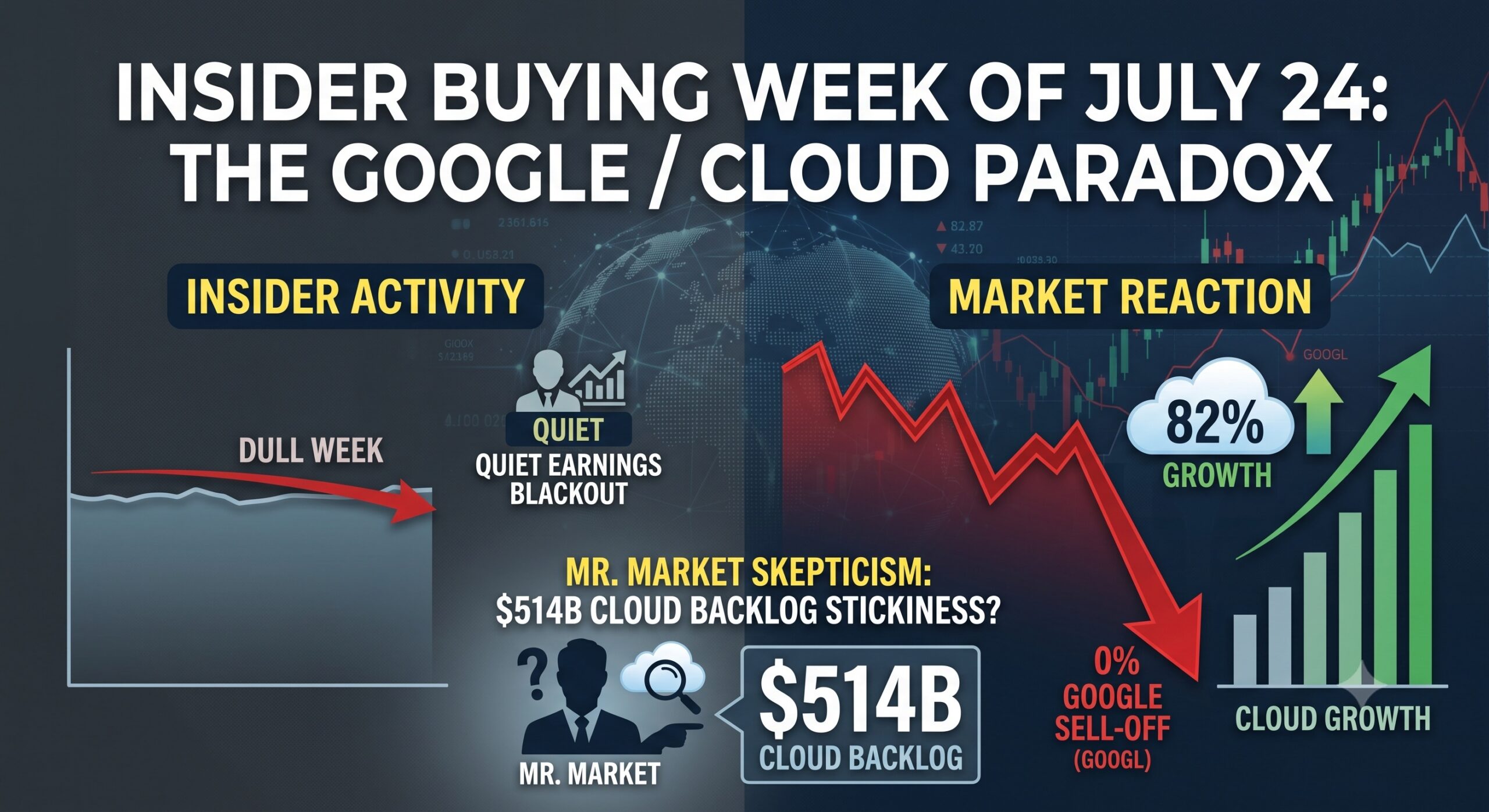
It was a dull week for insider buying as we are deep in the quarterly earnings blackout but it wasn’t a dull week by any other measure. Google had a steep sell off on 82% growth in their cloud business. If you had told me that Google would sell off on cloud numbers like that, no one would have believed you. Yet here we are, Mr. Market is skeptical that the $514 billion cloud backlog is as sticky as Alphabet believes.
Alphabet posted a negative quarterly free cash flow figure for the first time since its 2004 IPO, rattling investors looking for immediate return In Alphabet’s Q2 2026 earnings. Perhaps the team at Google doesn’t know how to read a contract, but that kind of backlog might just be worth calling a bottom in. All along, it would have been much better if Google sold its’ SpaceX shares and used those funds for the $~200 billion per year infrastructure products they embarked upon. Or just as good spun it off to shareholders, and let them make their own choice. But the market is taking this skepticism a bit too far. Google and the other hyperscalers indicated robust demand- until they don’t.
Intel got clobbered on great earnings. That came as no surprise to anyone as stocks that skyrocket the way Intel did need several months of basing in a range. My bet is in the long term that range goes higher but Intel is dead money until Q3 at least.
Keep an eye on development biotech ProQR. There is more buying in the upcoming weeks as well. https://insomniachedge.com/insider-buying-week-08-07-26/
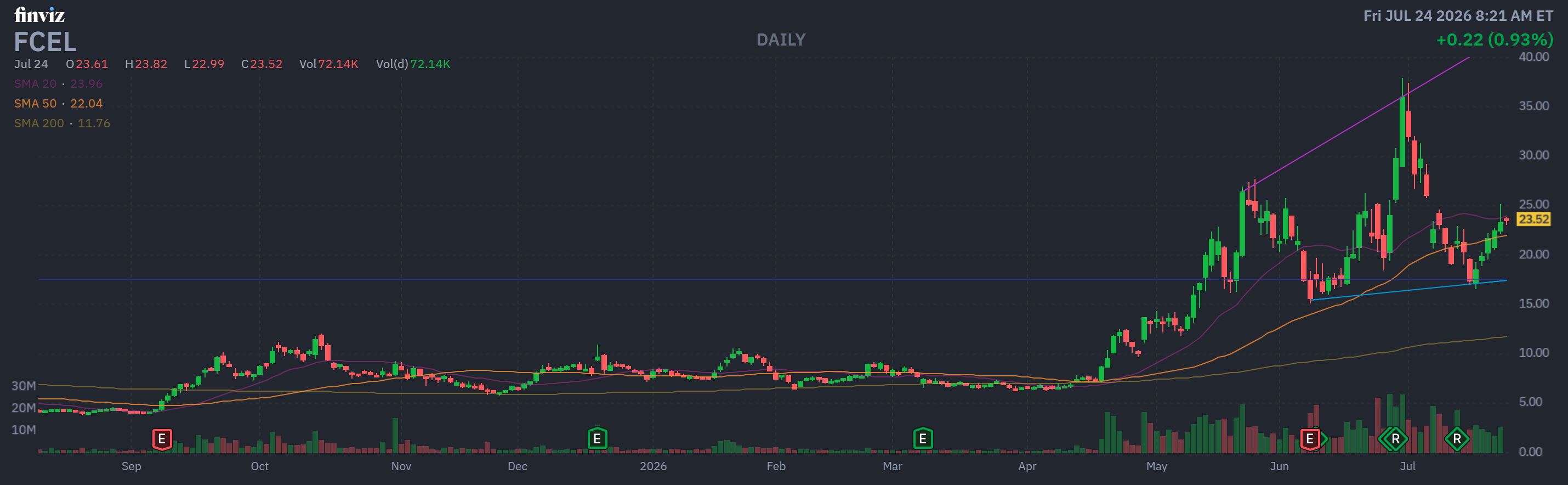
Name: John Livingston Homer III
Position: Director
Transaction Date: 07-16-2026 Shares Bought: 26,343 shares an average price paid of $18.79 for Cost: $494,967
Company: Fuelcell Energy Inc. (FCEL)
FuelCell Energy, Inc. and its subsidiaries design, develop, manufacture, build, operate, and service high temperature fuel cells for clean electricity generation. In addition, the corporation offers power, heat, steam, capacity, and renewable energy credits. In addition, the company offers turnkey solutions for fuel cell projects, such as development, engineering, procurement, construction, interconnection, and operation. It provides services to utilities and independent power producers, data centers, wastewater treatment, commercial and hospitality, and microgrids, as well as industrial, commercial, municipal, and government customers such as manufacturing facilities, pharmaceutical processing facilities, universities, and hospitals. The corporation primarily serves the United States, South Korea, Europe, and Canada. FuelCell Energy, Inc. was founded in 1969 and is based in Danbury, Connecticut.
John Livingston has served as an independent director of FuelCell Energy, Inc. since May 19, 2026, when he was elected to the company’s Board of Directors. He brings more than 25 years of experience in strategy, industrial technology, and cybersecurity, having founded and served as Chief Executive Officer of Verve Industrial Protection before its acquisition by Rockwell Automation. Prior to that, Livingston spent more than two decades at McKinsey & Company, advising industrial, technology, and infrastructure clients. He holds degrees from Princeton University and the Northwestern University Pritzker School of Law and Northwestern University Kellogg School of Management.
Insomniac Hedge Fund Guy Opinion: FCEL is a story stock trading on a dream (data-center power, Siemens partnership) while the fundamentals scream cash-burning science project. Negative operating cash flow, negative net income, gross losses, and now fresh dilution from a $225M raise plus a 12M-share warrant overhang — that’s a lot of supply hitting the market for a company that still hasn’t proven it can make money on what it sells. The one green shoot is a single insider buying half a million dollars’ worth of stock in the last 90 days, and a PEG ratio that looks statistically cheap if the growth materializes. But my back-of-envelope DCF pegs fair value well below the current tape. This is a speculative trade, not an investment — I’d stay on the sidelines or treat it strictly as a volatile momentum play around news catalysts, not a buy-and-hold position.
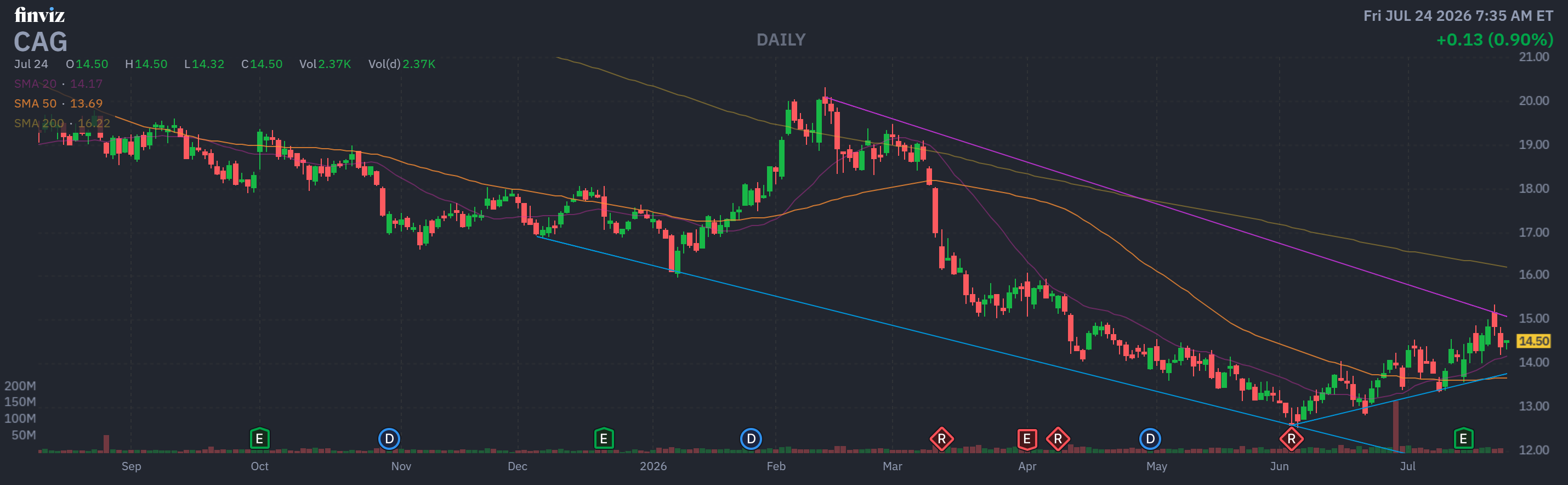
Name: John P. Brase
Position: President And CEO
Transaction Date: 07-17-2026 Shares Bought: 35,000 shares an average price paid of $14.59 for Cost: $510,633
Company: Conagra Brands Inc. (CAG)
Conagra Brands, Inc., and its subsidiaries are a branded consumer packaged products food company based mostly in the United States. The corporation is divided into four segments: grocery and snacks, refrigerated and frozen, international, and foodservice. The Grocery & Snacks segment largely sells shelf-stable food items through various retail channels. The International sector sells food goods in a variety of temperature states through retail and foodservice outlets outside of the United States. The Foodservice business provides branded and personalized food goods such as meals, entrees, sauces, and other custom-made culinary products packaged for restaurants and other foodservice facilities. Birds Eye, Duncan Hines, Healthy Choice, Marie Callender’s, and Angie’s BOOMCHICKAPOP are the names under which the company offers its products. Conagra Brands, Inc. was established in 1919 and is based in Chicago, Illinois.
John P. Brase has served as president and chief executive officer of Conagra Brands, Inc. since January 1, 2026. He joined Conagra in 1993 and has held numerous leadership positions across the company, including executive vice president and chief operating officer, where he played a key role in driving operational excellence, innovation, and portfolio growth. Prior to becoming President and CEO, Brase led several of Conagra’s major business segments and helped execute the company’s long-term strategic transformation. He holds a BSBA and Marketing degree from University of Missouri-Columbia and an MBA in marketing/marketing management and general degree from St. Louis University.
Insomniac Hedge Fund Guy Opinion: Conagra Brands is one of North America’s largest packaged food companies, owning a diverse portfolio of well-known brands across frozen meals, snacks, condiments, and grocery products. Its business benefits from consistent consumer demand, making it more defensive than many companies during economic downturns.
The company’s moat comes from its portfolio of established brands, extensive retail distribution network, and strong relationships with major grocery chains. These advantages provide pricing power, shelf space, and customer loyalty that are difficult for smaller competitors to replicate.
Over the past five years, revenue has been relatively stable, supported by everyday consumer purchases and strategic pricing actions. While Conagra generates recurring sales from repeat customers, it does not operate a subscription-based business, making recurring revenue and net revenue retention not directly applicable.
Management has focused on improving operating efficiency, strengthening its brand portfolio, reducing debt, and investing in product innovation while managing inflationary cost pressures. This disciplined approach has helped preserve margins despite volatile input costs.
Profitability remains solid, supported by strong cash flow and resilient consumer demand. Although growth is unlikely to be rapid, Conagra’s diversified brands, defensive business model, and consistent earnings make it a stable consumer staples company capable of delivering reliable long-term shareholder value.
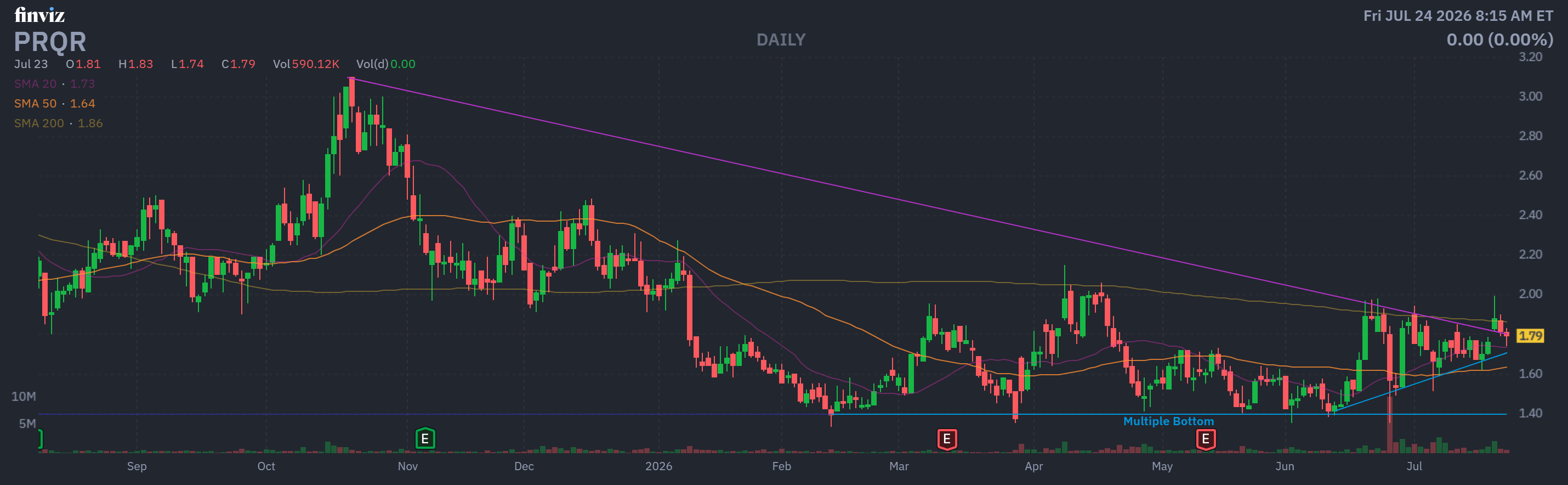
Name: Bart Filius
Position: Director
Transaction Date: 07-17-2026 Shares Bought: 150,000 shares an average price paid of $1.72 for Cost: $257,925
Company: ProQR Therapeutics N.V. (PRQR)
ProQR Therapeutics N.V., a clinical-stage biotechnology firm, specializes in the discovery and development of innovative therapeutic medications. The business uses its Axiomer RNA editing technology to provide an RNA editing platform for genetic illnesses that have unmet needs. AX-0810, the company’s primary pharmaceutical candidate, aims to treat cholestatic disorders by targeting na-taurocholate cotransporting polypeptide (NTCP). It has a research and partnership agreement with Eli Lilly & Company to find, develop, and commercialize potential novel treatments for genetic illnesses of the liver and nervous system. The company was established in 2012 and is headquartered in Leiden, Netherlands.
Bart Filius has served as a non-executive director of ProQR Therapeutics N.V. since May 2019, when he was elected to the company’s Board of Directors after being nominated in April 2019. He has never held an executive position at ProQR, serving solely as a board member and Chair of the Audit Committee. Filius is the former President and Chief Operating Officer of Galapagos NV, where he joined as Chief Financial Officer in 2014 and added the Chief Operating Officer role in 2017 before becoming President in 2021. He also previously held senior finance and M&A leadership positions at Sanofi. Filius holds an MBA from INSEAD and a bachelor’s degree in Business from Nyenrode Business University.
Insomniac Hedge Fund Guy Opinion: ProQR Therapeutics is a clinical-stage biotechnology company developing RNA-based therapies for rare genetic diseases. The company focuses on RNA editing technologies designed to treat conditions with limited or no effective treatment options, making its future largely dependent on successful clinical development rather than current commercial operations.
The company’s moat lies in its proprietary RNA editing platform, scientific expertise, and intellectual property surrounding genetic medicine. If its pipeline succeeds, ProQR could address significant unmet medical needs, although competition from larger biotechnology companies remains intense.h
Over the past five years, revenue has been inconsistent, consisting mainly of collaboration agreements, milestone payments, and research partnerships rather than product sales. Recurring revenue is effectively zero, and net revenue retention is not applicable because the company has no commercial subscription or recurring customer model.
Management has strategically shifted its focus toward higher-potential RNA editing programs while maintaining financial discipline and extending its cash runway through partnerships and prudent capital allocation.
Profitability remains negative, reflecting substantial research and development spending typical of clinical-stage biotechnology companies. Future value creation will depend almost entirely on positive clinical trial results, regulatory approvals, and the successful commercialization of its pipeline.
This blog is solely for educational purposes and the author’s own amusement. IT IS NOT INVESTMENT ADVICE. Think of the blog as part of my personal investment journal that I am willing to share with the DIY investor. We could be long, short, or have no position at all in any of the stocks mentioned and express no written or implied obligation to disclose any of that. Nothing contained here constitutes a recommendation to buy or sell any security. Investing involves risk, including the possible loss of principal, and past performance is not indicative of future results.
“The insomniac hedge fund guy” is a moniker Harvey Sax, the portfolio manager for The Insiders Fund” has used from time to time on email, blog ,and social media posts. While Mr. Sax is the portfolio manager of The Insiders Fund, these posts are not communications from, nor endorsed by, Alpha Wealth Funds, LLC or any of its managed funds. References to Alpha Wealth Funds or its affiliates are for identification only and do not imply sponsorship or approval.
All company names, logos, and trademarks belong to their respective owners. The use of company logos is solely for descriptive and illustrative purposes under fair use. Any information provided is based on publicly available data and should not be considered financial, investment, or legal advice. Readers should conduct their own research or consult with a professional before making any investment decisions. Insiders sell the stock for many reasons, but they generally buy for just one – to make money. You’ve always heard the best information is inside information. Everyone with any stock market experience pays close attention to what insiders are doing. After all, who knows a business better than the people running it? Officers, directors, and 10% owners are required to inform the public through a Form 4 Filing of any transaction, buy, sell, exercise, or any other within 48 hours of doing so.
This info is available for free from the SEC’s Web site, Edgar, although we subscribe to SECForm4 as they provide a way to manage and make sense of the vast realms of data. I’ve tried a lot of vendors. SECForm4 is one of the smaller ones, but I like supporting Frank. He is not arrogant. He’s helpful and has great prices. He also trades on his own data, so I like people that eat what they kill. The bar is different from selling because the natural state of management is to be a seller. This is because most companies provide significant amounts of management compensation packages as stock and options. Therefore, we analyze unusual patterns with selling, such as insiders selling 25 percent or more of their holdings or multiple insiders selling near 52-week lows. Another red flag is large planned sale programs that start without warning. Unfortunately, the public information disclosure requirements about these programs, referred to as Rule 10b5-1, are horrendously poor. Also, planned sales that pop up out of nowhere are basically sales and are seeking cover under this corporate welfare loophole.
I also generally ignore 10 percent shareholders as they tend to be OPM (other people’s money) and perhaps not the smart money on which we are trying to read the tea leaves. I say generally because some 10% shareholders are great investor, think Warren Buffett and others. Of course, insiders can also be wrong about their Company’s prospects. Don’t let anyone fool you into believing they never make mistakes. Do your own analysis. They can easily be wrong, and in many cases, maybe most cases, have no more idea what the future may hold than you or me. In short, you can lose money following them. We have, and we curse aloud; what were they thinking!
We like Fly on the Wall for keeping up with what events might be happening, analysts’ comments, and whatever else could be moving the stock. Dow Jones news service is an essential tool, but many services pick up their feed like they do Bloomberg. My assistant probes the 10k for a reasonable description of the business. I’ve found that to be the most accurate and succinct place to find out what a business actually does.