Check out our EVS strategy combining insider trading. This strategy predicts short term price movements based on earnings volatility. The day of quarterly earnings typically produces large price moves, often the most volatility a stock will have during the year. Try it out. Our AI does the heavy lifting, waiting for your final human touch.
Check out the list of notable buys. Granted that is a subjective variable. Some insiders count more than others. We like to believe that the CFO is particularly knowledgeable and money sensitive. Yet even a high confidence buy from the CFO invites scrutiny. First of all we read the Form 4 carefully to make sure its an open market purchase with the CFO’s own money, not part of some option plan or RSU grant.
Then is this purchase meaningful. Is this likely part of a mandatory stock ownership plan? That in and of itself is not bad, as all officers subject to these purchase requirements have choice of when they buy stock. As a rule then you can assume their timing is good if not perfect. The size of the purchase is very meaningful to us. We tend to ignore purchase under $200,000 unless it’s a pattern of accumulating stock over the last few weeks or months. A one off purchase of $50,000 looks more like taking one for the team, than an investment designed to enrich the owner.
A fact that many investors are not aware of is called the “short swing rule”. The short-swing rule Section 16(b) of the Securities Exchange Act of 1934 dictates that corporate insiders—officers, directors, and 10%+ shareholders—must return any profits earned from buying and selling company stock within a six-month period. It is a strict-liability regulation intended to prevent executives from exploiting material, non-public information. The net result of that is that insiders have a longer time horizon than we as public investors need to have. We can profit from short time price swings that are forbidden to these insiders.
Over the next 30 days, approximately 3,000 to 4,000 public companies will announce quarterly earnings worldwide, as the peak of the Q2 earnings season is currently underway. Hundreds of reports are released weekly, with major announcements happening almost every day. Insomniac Hedge Fund Guy picks his favorite buys each week and publishes the list. When you subscribe you get access to the “Guy’s list”. You also get access to the Guy’s handpicked portfolio which show all the buys and sells, the dates and prices, and you can piggyback on that portfolio or create your own from the curated “Guys List”.
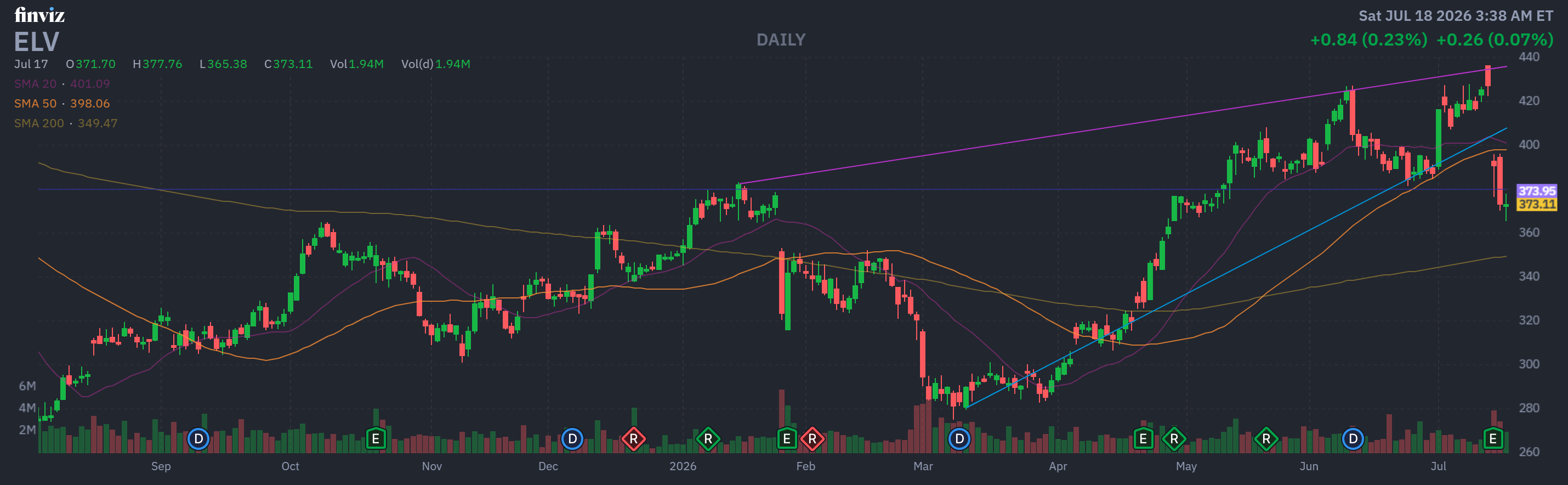
Name: Gail Boudreaux
Position: President And CEO
Transaction Date: 07-17-2026 Shares Bought: 2,725 shares an average price paid of $367.79 for Cost: $1,002,230
Name: Ramiro G. Peru
Position: Director
Transaction Date: 07-17-2026 Shares Bought: 1,000 shares an average price paid of $366.05 for Cost: $366,050
Company: Elevance Health Inc. (ELV)
Elevance Health, Inc. is a leading health benefits provider that offers medical, pharmacy, mental health, and care management services throughout the United States. The company’s Health Benefits, CarelonRx, and Carelon companies provide a wide range of insurance and healthcare solutions to individuals, employers, Medicare and Medicaid beneficiaries, and government programs. Elevance Health also provides specialty care, virtual health, pharmacy services, data analytics, and technological platforms to help enhance healthcare delivery and patient outcomes. The corporation works under well-known names like as Anthem Blue Cross and Blue Shield, Wellpoint, and Carelon. Elevance Health was created in 2001 and is based in Indianapolis, Indiana.
Gail K. Boudreaux has been President and Chief Executive Officer of Elevance Health, Inc. since November 2017, when she joined the firm. She was also elected to the company’s Board of Directors, where she has been Chair since March 2022. Elevance Health has developed its integrated healthcare services and cemented its position as one of the largest health-benefits companies in the United States. Prior to joining Elevance Health, Boudreaux was CEO of UnitedHealthcare and held senior leadership positions at BlueCross BlueShield of Illinois. She holds a Bachelor of Arts degree from Dartmouth College and an MBA from Columbia Business School.
Ramiro G. Peru has been an independent director at Elevance Health, Inc. since May 2025, when he joined the company’s Board of Directors. Peru is the former President of BP America Inc. and previously served as Executive Vice President of Production & Operations at BP plc, bringing decades of worldwide leadership experience in operations, strategy, and risk management to Elevance Health’s board. He has a bachelor’s degree in mechanical engineering from Texas A&M University and a master’s degree in petroleum engineering from the University of Tulsa.
Insomniac Hedge Fund Guy Opinion: Elevance Health is one of the largest health benefits companies in the United States, providing medical, pharmacy, behavioral health, and government-sponsored insurance plans to more than 45 million members. While many investors still think of the company as simply an insurance provider, Elevance has steadily transformed itself into a diversified healthcare platform with growing exposure to care management, pharmacy services, and value-based healthcare. This kind of insider buying — a CEO and a director purchasing together in the same week — is exactly the pattern we look for when reading conviction into a Form 4 filing.
The company’s moat is built on scale, data, and relationships. Its nationwide provider network, deep government partnerships through Medicare and Medicaid, and massive membership base create advantages that are difficult for smaller competitors to replicate. Every additional member improves the company’s ability to negotiate with providers, spread administrative costs, and leverage healthcare data to improve outcomes while managing expenses.
Over the past five years, revenue has grown consistently through a combination of membership expansion, premium increases, and acquisitions. Although healthcare insurance is not a subscription business in the traditional software sense, it generates highly recurring premium revenue, supported by annual policy renewals and long-term employer and government contracts. Member retention remains strong, providing predictable cash flow despite periodic fluctuations in medical costs.
Management has demonstrated disciplined execution by expanding into higher-margin healthcare services while maintaining prudent underwriting standards and returning capital through dividends and share repurchases. The company’s diversified earnings profile has made it less dependent on pure insurance margins than many of its peers.
Profitability remains strong, although medical cost trends, reimbursement changes, and government regulation will always influence earnings. Investors should also monitor utilization trends, as higher-than-expected healthcare spending can pressure margins even when revenue continues to grow. This insider buying at Commercial Metals reflects the kind of steady, size-driven conviction we screen for each week.
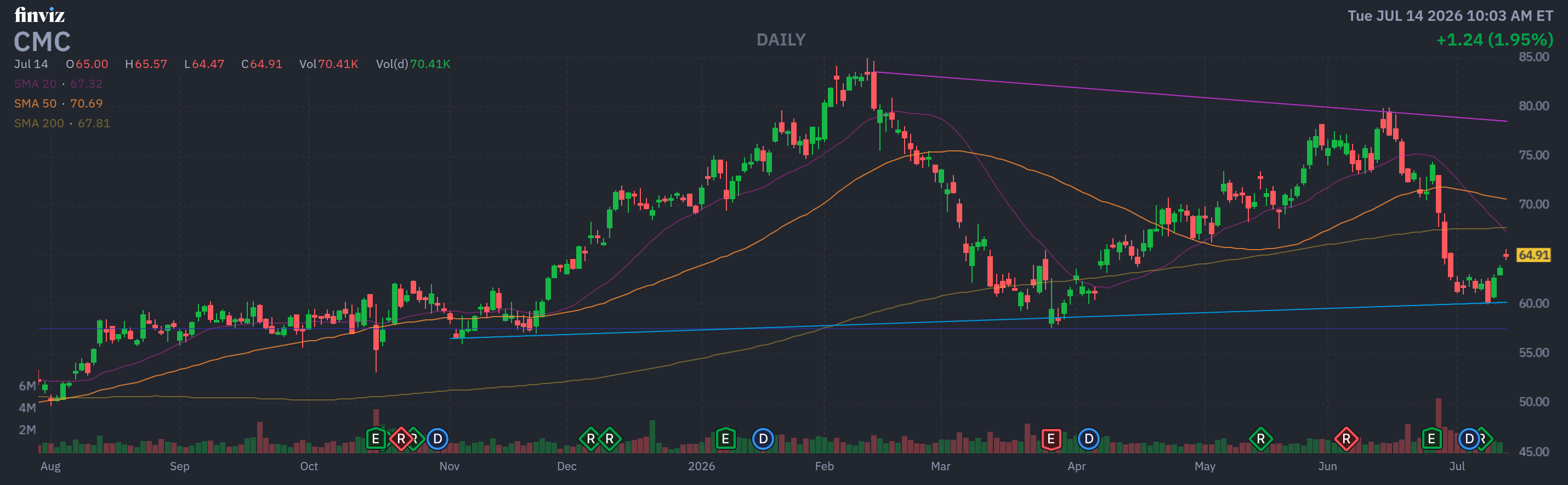
Name: Peter R. Matt
Position: President And CEO
Transaction: Date: 07-10-2026 Shares Bought: 8,230 shares an average price paid of $61.30 for Cost: $504,499
Company: Commercial Metals Co. (CMC)
Commercial Metals Company is a significant manufacturer, recycler, and fabricator of steel and metal products, servicing customers in the United States and internationally. The corporation has three business segments: North America Steel Group, Europe Steel Group, and Emerging Business Group. It processes and recycles ferrous and nonferrous scrap metals and manufactures long steel products such as rebar, wire rod, merchant bar, structural steel, and billets. CMC also manufactures reinforcing steel for major infrastructure and commercial construction projects, as well as specialist steel products for the transportation, energy, and defense sectors. The company was founded in 1915 and is based in Irving, Texas.
Peter R. Matt became President of Commercial Metals Company in April 2023 and was named President and CEO on September 1, 2023. He joined the company’s Board of Directors in June 2020, bringing considerable leadership expertise from his roles as Constellium SE’s Executive Vice President and Chief Financial Officer, as well as nearly three decades of investment banking at Credit Suisse. He continues to serve on the CMC Board of Directors. Peter received a Bachelor of Arts in English from Amherst College.
Insomniac Hedge Fund Guy Opinion: Commercial Metals Company is one of North America’s leading steel producers and metal recyclers, supplying rebar, structural steel, and fabricated products used in infrastructure and commercial construction. Unlike many commodity producers, CMC operates a vertically integrated business built around electric arc furnace technology and recycled scrap metal.
The company’s competitive advantage comes from its nationwide recycling network, fabrication operations, and relatively low-cost manufacturing platform. These assets help improve margins while positioning CMC to benefit from long-term infrastructure spending and public construction projects.
Revenue is inherently cyclical because demand depends on construction activity and steel pricing rather than recurring contracts. As a result, investors should expect earnings to fluctuate alongside economic conditions and changes in industrial demand.
Management has consistently demonstrated disciplined capital allocation by maintaining a strong balance sheet, investing in efficiency projects, and returning excess cash through dividends and share repurchases. That discipline has helped CMC outperform many steel producers during industry downturns.
Profitability remains above industry averages, supported by efficient operations and vertical integration. However, no steel company is immune to declining steel prices, weaker construction markets, or slowing manufacturing activity, all of which can pressure margins.
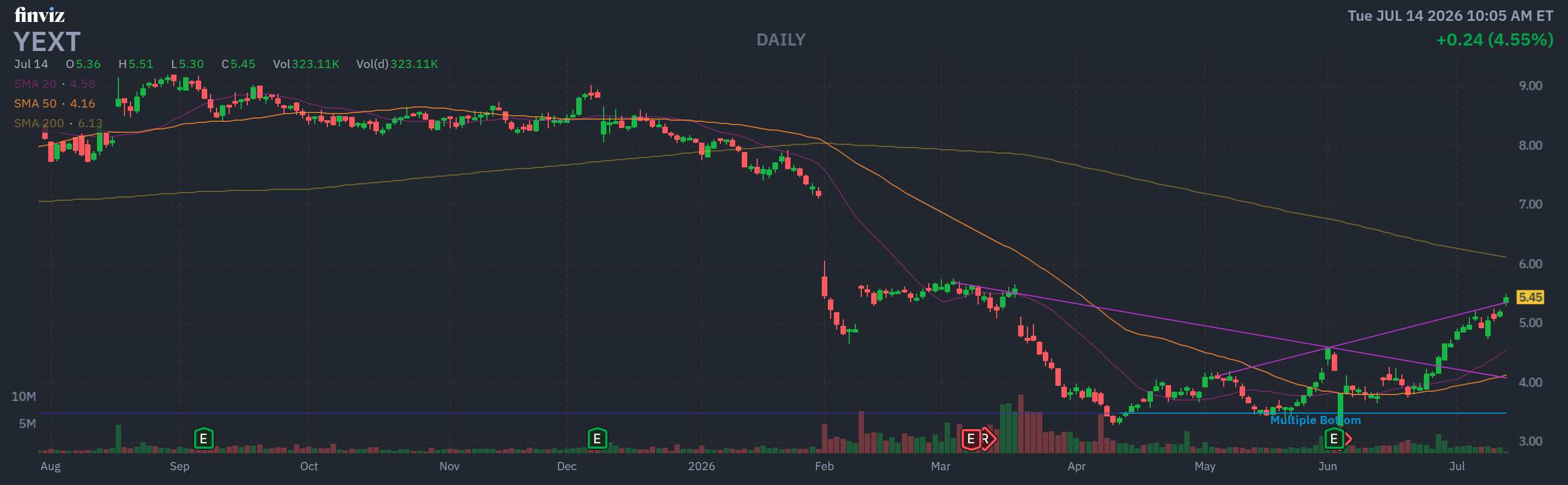
Name: Daniel J. Englander
Position: Director
Transaction Date: 07-13-2026 Shares Bought: 76,190 shares an average price paid of $5.22 for Cost: $397,910
Company: Yext Inc. (YEXT)
Yext, Inc. is a software firm that offers a cloud-based digital presence platform that allows businesses to manage and optimize how their content shows on search engines, maps, applications, social networks, and other digital channels throughout the world. Its platform enables businesses to retain correct company information, manage customer evaluations, develop landing pages, publish FAQs, and centralize critical business data. Yext also provides professional services such as custom integrations, landing page building, platform maintenance, and digital client interaction solutions for the financial industry. The organization provides services in healthcare, hotel, retail, food services, and finance. Yext, Inc. was founded in 2006 and is headquartered in New York, NY.
Daniel J. Englander has been a Director of Yext Inc. since November 2016. He joined the Board once Yext became a private company, bringing substantial experience in investment management and corporate governance. Englander is the founder and CEO of Millennial Management LLC, an investment management firm he founded in 1997. He continues to lead the firm’s investing strategy. Prior to starting Millennial Management, he worked at many investing firms, gaining experience in equity research and portfolio management. He graduated from the University of Pennsylvania’s Wharton School with a Bachelor of Science in economics.
Insomniac Hedge Fund Guy Opinion: Yext is a software-as-a-service (SaaS) company that helps businesses manage their digital presence across search engines, maps, websites, social media platforms, and AI-powered search experiences. Its platform ensures that customers receive accurate and consistent information wherever they search, while increasingly positioning itself as an enterprise solution for AI-driven search and customer engagement.
The company’s moat lies in its extensive network of digital publishing partners, enterprise customer relationships, and growing expertise in structured data and AI search. As consumers shift from traditional search engines toward conversational AI, Yext has an opportunity to become the infrastructure that helps businesses control how their information is discovered. The challenge is that this remains a highly competitive market, with larger software vendors and specialized competitors constantly vying for market share.
Over the past five years, revenue growth has been steady but far from spectacular as the company transitioned toward improving profitability rather than pursuing growth at any cost. Recurring revenue remains a major strength, with subscription-based contracts generating approximately 95% of total revenue, while net revenue retention has generally hovered around the 100% range, reflecting a stable but only modestly expanding customer base.
Management has shifted its focus toward operational efficiency, improving margins, and generating sustainable free cash flow while investing in AI-enabled products that could reignite growth. The balance sheet remains healthy, providing flexibility without requiring excessive leverage.
Profitability has improved considerably as expenses have come under control, although long-term shareholder returns will ultimately depend on accelerating revenue growth rather than simply reducing costs. Insider buying at Yext has been more sporadic, which makes this director’s purchase worth watching alongside the company’s ongoing margin improvement.
This blog is solely for educational purposes and the author’s own amusement. IT IS NOT INVESTMENT ADVICE. Think of the blog as part of my personal investment journal that I am willing to share with the DIY investor. We could be long, short, or have no position at all in any of the stocks mentioned and express no written or implied obligation to disclose any of that. Nothing contained here constitutes a recommendation to buy or sell any security. Investing involves risk, including the possible loss of principal, and past performance is not indicative of future results.
“The insomniac hedge fund guy” is a moniker Harvey Sax, the portfolio manager for The Insiders Fund” has used from time to time on email, blog ,and social media posts. While Mr. Sax is the portfolio manager of The Insiders Fund, these posts are not communications from, nor endorsed by, Alpha Wealth Funds, LLC or any of its managed funds. References to Alpha Wealth Funds or its affiliates are for identification only and do not imply sponsorship or approval.
All company names, logos, and trademarks belong to their respective owners. The use of company logos is solely for descriptive and illustrative purposes under fair use. Any information provided is based on publicly available data and should not be considered financial, investment, or legal advice. Readers should conduct their own research or consult with a professional before making any investment decisions. Insiders sell the stock for many reasons, but they generally buy for just one – to make money. You’ve always heard the best information is inside information. Everyone with any stock market experience pays close attention to what insiders are doing. After all, who knows a business better than the people running it? Officers, directors, and 10% owners are required to inform the public through a Form 4 Filing of any transaction, buy, sell, exercise, or any other within 48 hours of doing so.
This info is available for free from the SEC’s Web site, Edgar, although we subscribe to SECForm4 as they provide a way to manage and make sense of the vast realms of data. I’ve tried a lot of vendors. SECForm4 is one of the smaller ones, but I like supporting Frank. He is not arrogant. He’s helpful and has great prices. He also trades on his own data, so I like people that eat what they kill. The bar is different from selling because the natural state of management is to be a seller. This is because most companies provide significant amounts of management compensation packages as stock and options. Therefore, we analyze unusual patterns with selling, such as insiders selling 25 percent or more of their holdings or multiple insiders selling near 52-week lows. Another red flag is large planned sale programs that start without warning. Unfortunately, the public information disclosure requirements about these programs, referred to as Rule 10b5-1, are horrendously poor. Also, planned sales that pop up out of nowhere are basically sales and are seeking cover under this corporate welfare loophole.
I also generally ignore 10 percent shareholders as they tend to be OPM (other people’s money) and perhaps not the smart money on which we are trying to read the tea leaves. I say generally because some 10% shareholders are great investor, think Warren Buffett and others. Of course, insiders can also be wrong about their Company’s prospects. Don’t let anyone fool you into believing they never make mistakes. Do your own analysis. They can easily be wrong, and in many cases, maybe most cases, have no more idea what the future may hold than you or me. In short, you can lose money following them. We have, and we curse aloud; what were they thinking!
We like Fly on the Wall for keeping up with what events might be happening, analysts’ comments, and whatever else could be moving the stock. Dow Jones news service is an essential tool, but many services pick up their feed like they do Bloomberg. My assistant probes the 10k for a reasonable description of the business. I’ve found that to be the most accurate and succinct place to find out what a business actually does.