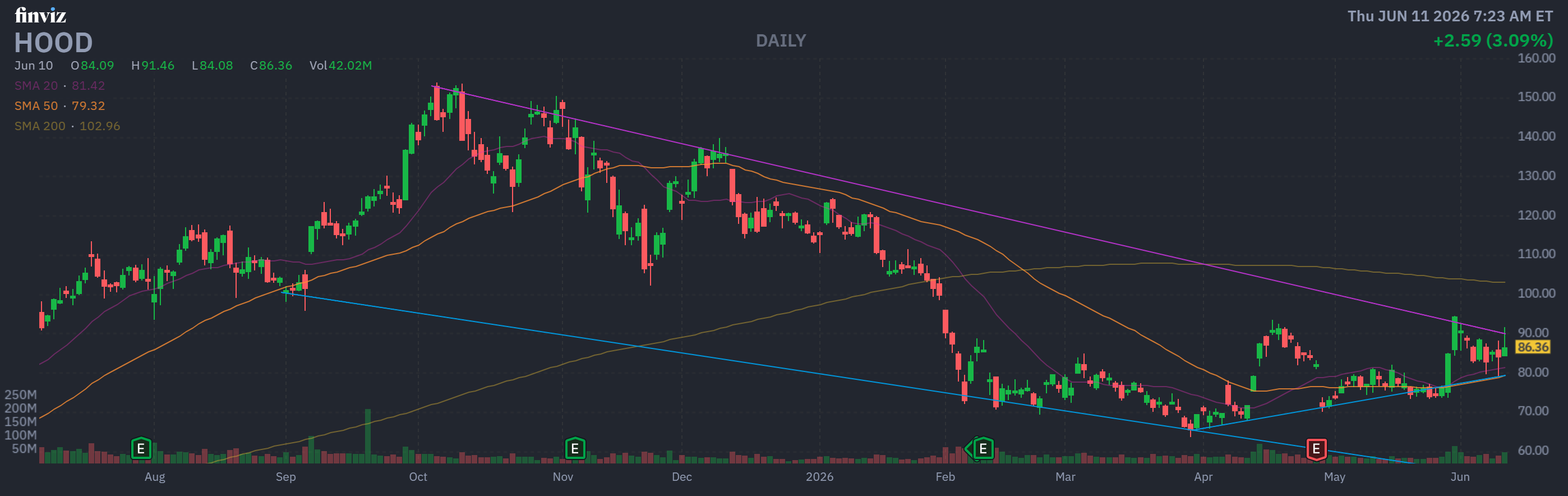
The market has not had much love for anything other than the downstream recipients of the largest capex investment boom in history, the semiconductor supply chain. We continue to track insider buys but it seems like a fools errand. I don’t know when the tide will go out and the picks and shovels will move to applications, consumer spending, or something other than postage stamping the earth with AI data centers. Inevitably overbuilding will happen. It’s a mathematical certainty but when that happens is beyond anyone’s ability to forecast just yet. Perhaps insiders have got some feel for this. Certainly there is some enthusiasm and animal spirits. You don’t need to look further than the mammoth $20 million Robin Hood purchase.
Name: Meyer Malka
Position: Director
Transaction Date: 06-05-2026 Shares Bought: 250,000 shares an average price paid of $80.74 for Cost: $20,184,200
Company: Robinhood Markets Inc. (HOOD)
Robinhood Markets, Inc. runs a financial services platform in the United States. The company’s platform enables customers to invest in equities, exchange-traded funds, and American depository receipts. It provides fractional trading, recurring investments, margin investing, fully-paid securities loans, cash sweep, instant withdrawals, retirement plans, 24-hour trading, joint investing accounts, event contracts, future contract services, and short selling. The company also offers a variety of learning and education solutions, including Snacks, an accessible digest of business news stories for a new generation of investors; Learn, an online collection of guides, feature tutorials, and a financial dictionary; and premium news from sites such as Barron’s, Reuters, and Dow Jones. Robinhood Markets, Inc. was incorporated in 2013 and is headquartered in Menlo Park, California.
Meyer Malka has been a Director at Robinhood Markets, Inc. since March 2022, when he was appointed to the Board of Directors. Malka is the founder and managing partner of Ribbit Capital, a venture capital firm specializing in financial technology investments. He has over 25 years of experience creating and investing in technology and financial services firms in the United States, Europe, and Latin America. He was also an early investor and advisor to Robinhood, contributing to the company’s growth before joining the board. Malka graduated from Caracas, Venezuela’s Universidad Católica Andrés Bello with an economics degree.
Insomniac Hedge Fund Guy Opinion: Robinhood is no longer just a meme-stock brokerage. The company has evolved into a broader financial platform offering stock trading, options, crypto, retirement accounts, cash management, and subscription services. Its mission remains simple: make investing accessible to retail investors.
The moat is stronger than many critics admit. Robinhood has built a highly recognizable brand among younger investors and benefits from a large, engaged user base. The platform’s ease of use, integrated ecosystem, and growing product suite create switching costs that increase as customers consolidate more of their financial lives on the platform.
Revenue growth over the past five years has been impressive despite market volatility. The business has diversified beyond transaction-based revenue into more recurring streams such as Robinhood Gold subscriptions, interest income, and retirement products. Recurring revenue is becoming a larger percentage of the business, reducing dependence on trading activity. Net retention metrics are not formally disclosed, but asset growth and increasing customer balances suggest improving customer engagement.
Management is led by co-founder and CEO Vlad Tenev, who has navigated the company through regulatory scrutiny, meme-stock controversies, and crypto cycles while continuing to expand the product offering.
Profitability has improved dramatically. After years of being viewed as a growth-at-all-costs story, Robinhood has demonstrated meaningful operating leverage and growing earnings power as customer assets and monetization have increased.
Name: Michael Stuart Rosenthal
Position: Chief Operating Officer
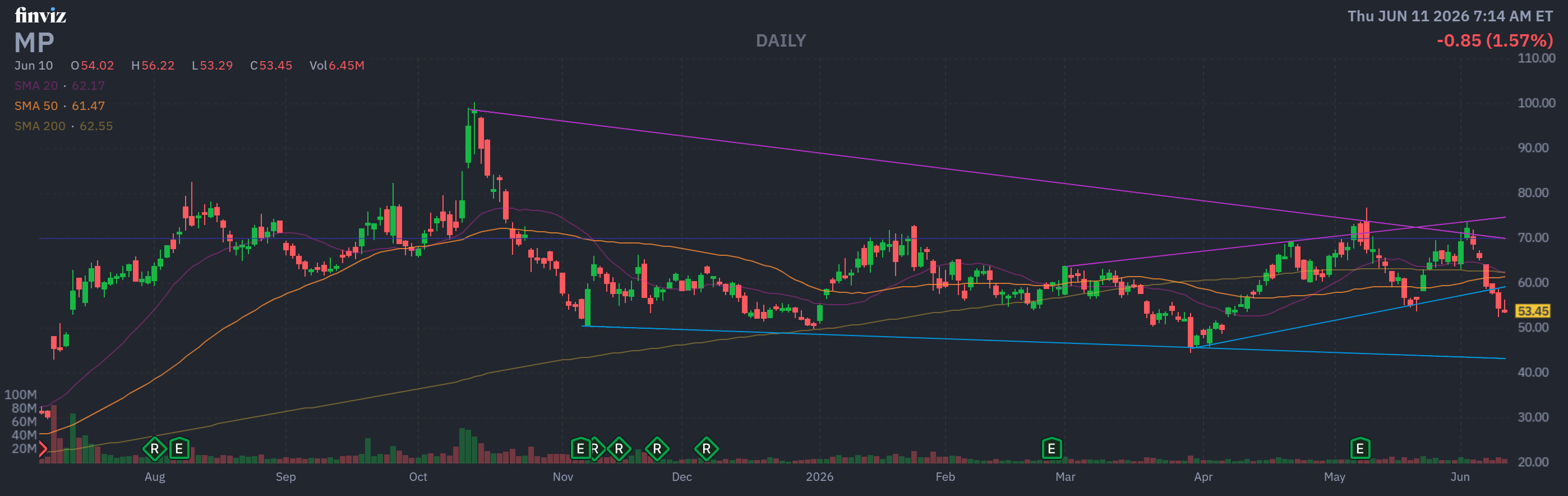
Transaction Date: 06-09-2026 Shares Bought: 10,000 shares an average price paid of $54.30 for Cost: $543,000
Company: MP Materials Corp. (MP)
MP Materials Corp. produces rare earth materials and magnetic products in the Western Hemisphere. The company operates through its Materials and Magnetics segments, focusing on the mining, processing, and manufacturing of critical materials used in advanced technologies. MP Materials owns and operates the Mountain Pass Rare Earth Mine and processing facility in California, one of the largest rare earth resources in North America. The company also produces magnetic precursor materials and manufactures NdFeB permanent magnets used in electric vehicles, renewable energy systems, electronics, and defense applications. Founded in 2017, MP Materials is headquartered in Las Vegas, Nevada.
Michael Stuart Rosenthal has been Chief Operating Officer of MP Materials Corp. since June 2024. He joined the firm in 2020 and previously worked as Executive Vice President of Operations, overseeing the refurbishment and expansion of the Mountain Pass rare earth mining and processing facilities in California. Prior to joining MP Materials, Rosenthal had operational and engineering leadership positions in the mining and industrial sectors, gaining substantial experience in large-scale processing and manufacturing operations. He holds a bachelor’s degree in metallurgical engineering from the Colorado School of Mines.
Insomniac Hedge Fund Guy Opinion: MP Materials is the only scaled rare earth mining company in the United States and owns the Mountain Pass Mine, one of the world’s largest rare earth deposits. The company produces materials critical for permanent magnets used in electric vehicles, wind turbines, robotics, and defense applications.
The investment case is straightforward: MP sits at the intersection of supply-chain security and growing demand for rare earth magnets. Its moat comes from the strategic importance of its resource base and the difficulty of developing competing rare earth projects. However, unlike software businesses, mining is capital-intensive and commodity-driven, meaning pricing power is limited.
Revenue growth over the past five years has been volatile rather than steadily upward because earnings are heavily influenced by rare earth prices. When neodymium-praseodymium (NdPr) prices rise, profits can surge; when prices fall, results can deteriorate quickly. Recurring revenue is minimal since the business primarily sells commodities rather than subscription-like products. Net retention metrics therefore are not relevant.
Management, led by James Litinsky, has focused on moving MP up the value chain from mining into magnet production. Success here would reduce dependence on China and potentially create a more valuable, higher-margin business.
Profitability has fluctuated significantly with rare earth pricing cycles. Recent results have been pressured by weak commodity prices and investment spending, making current earnings look less attractive than peak-cycle profits.
Name: Peter Graham
Position: Director
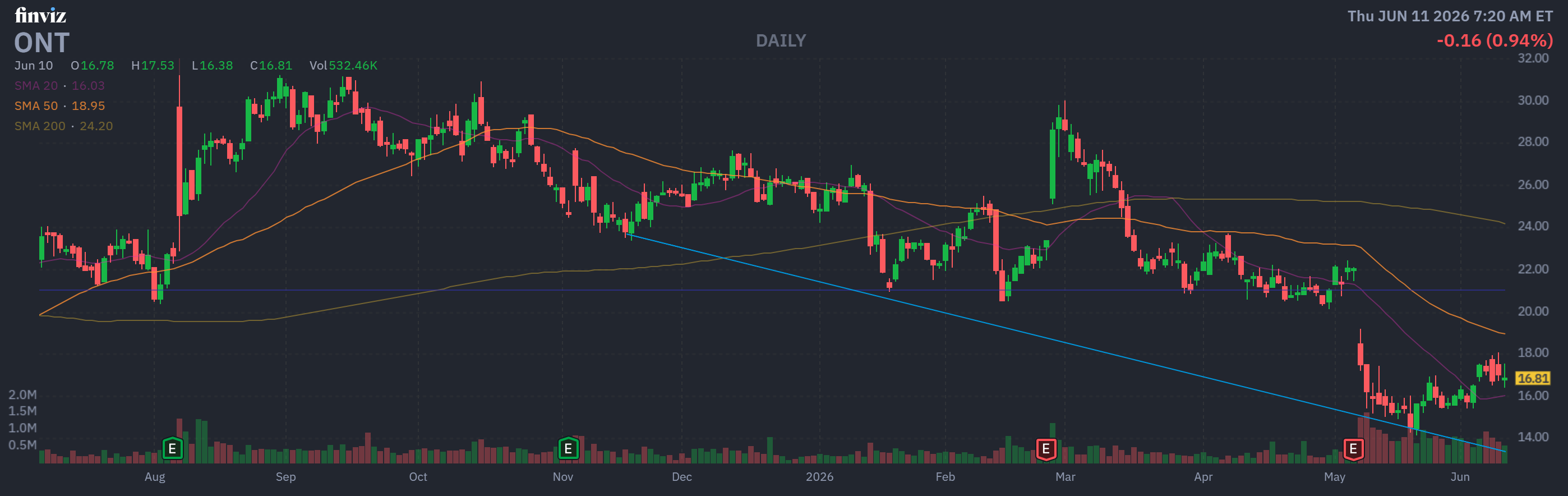
Transaction Date: 06-05-2026 Shares Bought: 25,140 shares an average price paid of $17.19 for Cost: $432,157
Transaction Date: 06-03-2026 Shares Bought: 4,860 shares an average price paid of $15.94 for Cost: $77,468
Company: Onterris Inc. (ONT)
Onterris, Inc. provides environmental services in the United States, Australia, Canada, and across the world. It is divided into two segments: consulting and treatment, and measurement and analysis. The Consulting and Treatment division offers environmental consulting, engineering, and implementation services to assist clients in assessing, managing, and mitigating environmental hazards throughout the lifetime of their operations and projects. It provides environmental assessments, regulatory permitting, toxicology consulting, disaster planning and response, and environmental audits and permits, as well as engineering, design, and implementation solutions for contaminated water and soil remediation. The corporation was previously known as Montrose Environmental Group, Inc., but changed its name to Onterris, Inc. in April 2026. Onterris, Inc. was created in 2012 and is based in North Little Rock, Arkansas.
Peter Graham has been an independent director of Onterris, Inc. since June 2017. He is a private investor and has been a partner with One Better Ventures LLC since June 2017. Graham has considerable governance and capital markets experience, having served as Chairman of Seventh Generation, Inc. for 17 years and previously held key leadership positions at Ladenburg Thalmann Group Inc., including Principal, President, and Vice Chairman. He has also served on various public and private firm boards, providing expertise in audit, remuneration, and corporate governance.
Insomniac Hedge Fund Guy Opinion: Onterris, formerly known as Montrose Environmental Group, is an environmental services company that helps businesses and governments comply with environmental regulations. Its services range from air and water testing to environmental consulting, remediation, and permitting. The business sits at the intersection of regulation, sustainability, and infrastructure spending.
The moat is not technology but scale, expertise, and regulatory know-how. Environmental compliance is becoming more complex, creating demand for specialized providers. Customers generally care more about accuracy and regulatory compliance than finding the cheapest vendor.
Revenue growth has been impressive. The company generated roughly $831 million of revenue in 2025, up about 19% from the prior year, continuing a strong multi-year growth trend fueled by acquisitions and expanding environmental regulation.
Management, led by Vijay Manthripragada, deserves credit for building a national platform in a fragmented industry. The challenge now is converting growth into consistently strong profits.
That is the key investment debate. While revenue has grown rapidly, profitability has lagged. Operating margins remain thin, debt is meaningful, and investors are still waiting for the business to demonstrate sustained earnings power. On the positive side, free cash flow has improved significantly and recent earnings trends have moved in the right direction.
Name: Richard Carucci
Position: Director
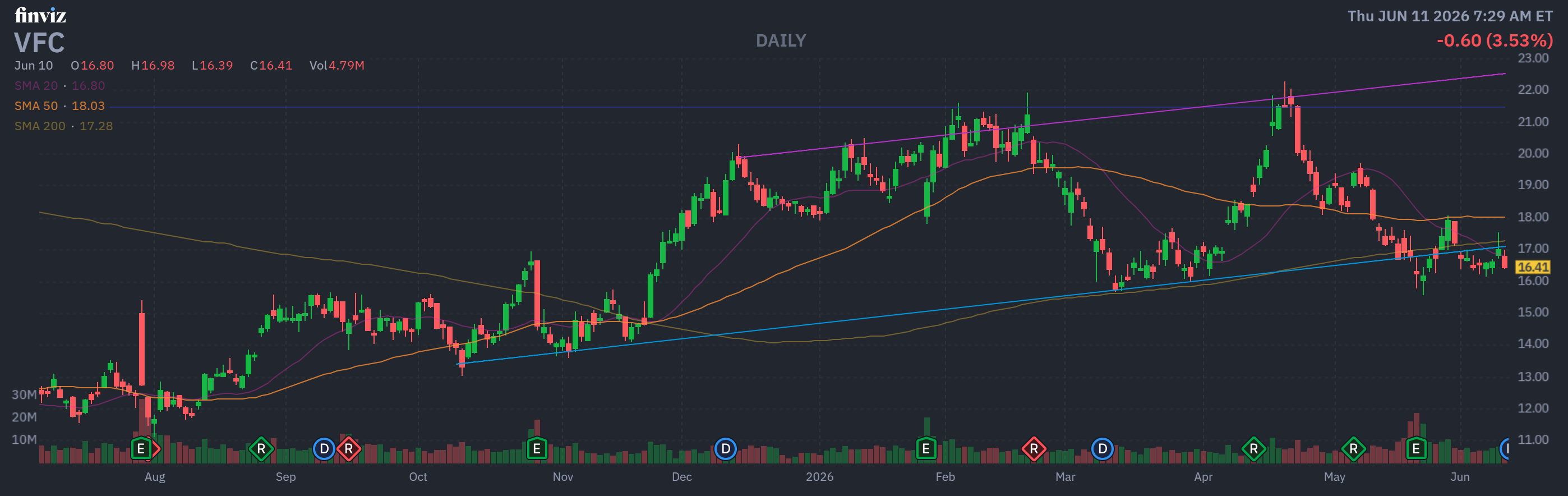
Transaction Date: 06-09-2026 Shares Bought: 30,000 shares an average price paid of $17.17 for Cost: $515,010
Company: V F CORP (VFC)
V.F. Corporation, along with its subsidiaries, sells branded garments, footwear, and accessories to men, women, and children throughout the Americas, Europe, and Asia Pacific. The company operates in two segments: outdoor and active. The company sells outdoor clothes, footwear, equipment, and accessories, as well as fashion-forward and weather-ready footwear, gear, and accessories under the Timberland, Timberland PRO, and The North Face brands. It also sells youth culture/action sports-inspired and streetwear apparel, footwear, and accessories; purses, luggage, backpacks, totes, and accessories; and backpacks and luggage under the Vans, Kipling, Eastpak, and JanSport labels. The company generally sells to specialized stores, department stores, national chains, individually owned partnership stores, and mass retailers. V.F. Corporation was founded in 1899 and is based in Denver, Colorado.
Richard T. Carucci has been a director of VF Corporation since July 2009, and he has served as Chairman of the Board since June 2023. He is the former President and Chief Financial Officer of Yum! Brands, where he served in a range of top finance, international, and operational leadership roles over a 17-year tenure. Carucci provides considerable experience in finance, corporate governance, worldwide operations, and consumer brands, making him an important part of VF’s board leadership. He earned a Bachelor of Science from Brown University and an MBA from the University of California, Berkeley.
Insomniac Hedge Fund Guy Opinion: VF Corp is a global apparel company that owns well-known brands including The North Face, Vans, and Timberland. For years, it was viewed as a reliable consumer-products compounder, but recent execution issues and weakness at Vans have significantly pressured growth and profitability.
The company’s moat comes from its portfolio of established brands and global distribution network. However, apparel is a competitive industry, and brand strength can fade quickly if consumer preferences shift. That is exactly what happened with Vans, which experienced a sharp sales decline and became the primary drag on company performance.
Over the past five years, revenue growth has been disappointing, with sales declining overall as Vans weakened and the company restructured operations. Unlike software businesses, VF has very little recurring revenue; customers choose to buy products repeatedly, but there are no contractual revenue streams or meaningful net retention metrics.
Management, led by CEO Bracken Darrell, has focused on stabilizing the business, reducing debt, improving inventory management, and revitalizing key brands. Early signs of progress are emerging, but a full turnaround will take time.
Profitability has deteriorated sharply from historical levels. Margins that were once among the best in branded apparel have compressed due to lower sales volumes, promotional activity, and restructuring costs.
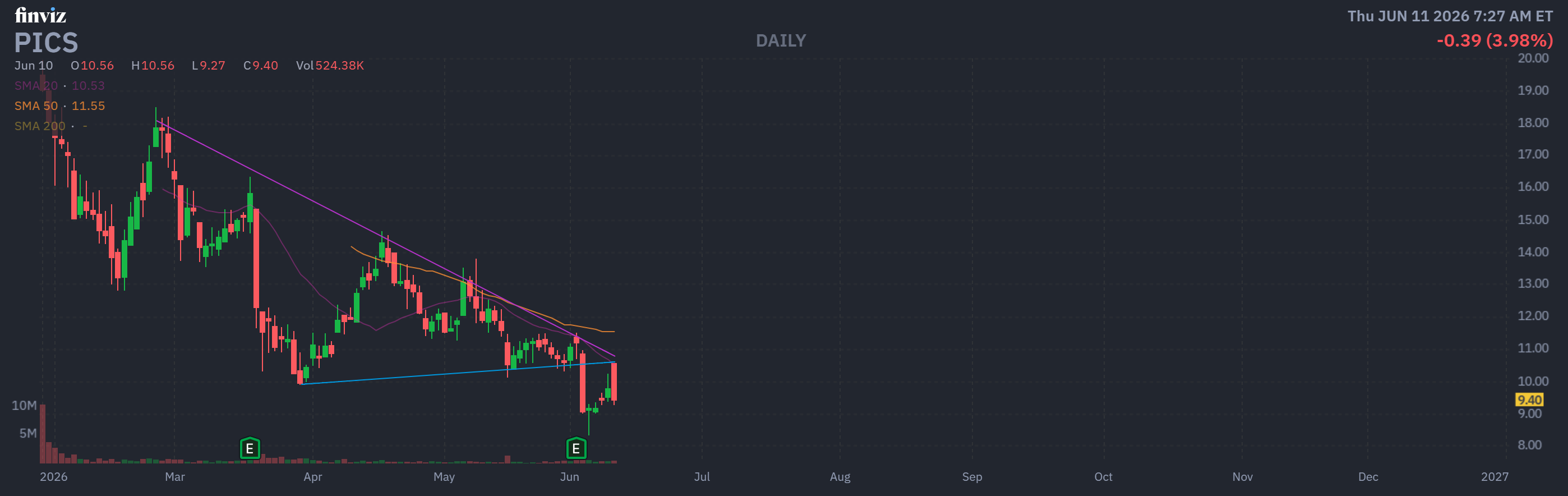
Name: Jose Antonio Batista Costa
Position: Director
Transaction Date: 06-09-2026 Shares Bought: 20,800 shares an average price paid of $9.73 for Cost: $202,384
Transaction Date: 06-08-2026 Shares Bought: 21,130 shares an average price paid of $9.42 for Cost: $199,045
Company: PicS N.V. (PICS)
Pics N.V. is a digital financial services company that provides digital wallets and applications to consumers and businesses in Brazil. It provides its customers with a variety of transactional products, such as Pix, an immediate payment system, a global account, and a payment assistant that helps them organize, centralize, and settle payments through an integrated hub. The organization also offers multifunctional cards, personal loans, installment payments, and payroll loans to public employees, retirees, and pensioners. In addition, it provides a digital insurance distribution platform with goods such as digital wallet insurance, PicPay Card bill protection, credit life insurance, smartphone protection, and life insurance. The company was created in 2012 and is headquartered in São Paulo, Brazil.
José Antonio Batista Costa has been a director of PicS N.V. since March 2024, and he has served as Chairman and non-executive member of the Board of Directors since September 2024. He is a seasoned executive with substantial leadership expertise in financial services, technology, and consumer industries. He served as CEO of PicPay Brazil from 2020 to 2023 and CEO of J&F Participações from 2022. Costa has also served on the boards of several important Brazilian firms and financial institutions, having extensive experience in corporate strategy and governance. He has a Business Administration degree from Universidade Paulista.
Insomniac Hedge Fund Guy Opinion: PicS N.V., better known as PicPay, is one of Brazil’s leading fintech platforms. The company operates a digital wallet, payments network, consumer lending platform, cards business, insurance marketplace, and merchant solutions ecosystem. Think of it as a Brazilian financial super-app attempting to capture a larger share of its customers’ financial lives.
The moat is still developing but looks promising. PicPay benefits from network effects, customer engagement, and cross-selling opportunities across payments, banking, lending, and commerce. The larger the user base becomes, the easier it is to monetize additional financial products. However, competition from established Brazilian fintech and banking players remains intense.
Growth has been exceptional. In 2025, revenue increased approximately 85% year-over-year, while net income grew more than 400%, demonstrating significant operating leverage as the platform scales. The company continues to report strong growth in users, lending, and transaction volumes.
Management is led by CEO Eduardo Chedid Simões, who has focused on balancing aggressive growth with improving profitability. Unlike many fintechs that prioritize growth at any cost, PicPay has recently shown an ability to generate meaningful earnings.
Profitability is the key reason investors are paying attention. The company generated over R$1 billion of net income in 2025 and produced strong returns on equity, a rarity among younger fintech businesses.
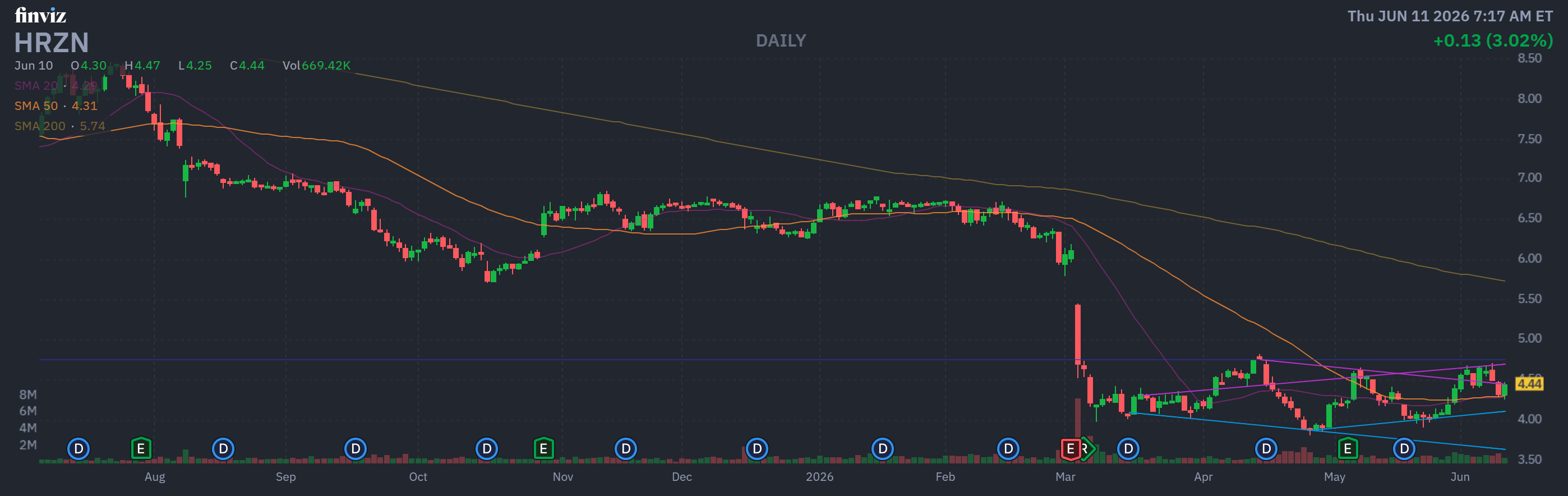
Name: Michael Balkin
Position: Chief Executive Officer
Transaction Date: 06-09-2026 Shares Bought: 100,000 shares an average price paid of $4.34 for Cost: $434,000
Company: Horizon Technology Finance Corp (HRZN)
Horizon Technology Finance Corporation is a specialized finance firm that offers secured loans and venture debt funding to development-stage and growth-oriented firms in the technology, life sciences, healthcare information and services, and sustainability sectors. Horizon, organized as a business development company, intends to produce current income and capital appreciation by assisting innovative enterprises with strong venture capital backing. The corporation typically invests in debt instruments but also acquires warrants and equity interests that may provide extra upside potential. Horizon Technology Finance Corporation was created in 2003 and is based in Farmington, Connecticut.
Michael P. Balkin has been the Chief Executive Officer of Horizon Technology Finance Corporation since June 2025, after being appointed as part of the company’s leadership succession plan. Prior to becoming CEO, he served as the company’s independent director beginning in June 2023, eventually becoming Chairman of the Board. Balkin has over 35 years of investment management expertise, including prominent positions at William Blair & Co. and Magnetar Investment Management, where he was a partner and chief investment officer. He specializes in small-cap growth investing and portfolio management. He holds a Bachelor of Arts degree from Northwestern University.
Insomniac Hedge Fund Guy Opinion: Horizon Technology Finance is a venture lending business development company (BDC) that provides secured loans to venture-backed technology, life sciences, healthcare information, and sustainability companies. Think of it as a specialized lender sitting between traditional banks and venture capital firms, earning attractive yields while taking less risk than equity investors.
The moat is niche expertise. Horizon has spent years building relationships within the venture capital ecosystem and understands how to underwrite companies that often have little profitability but strong institutional backing. While venture lending is competitive, reputation and deal sourcing matter.
Revenue and net investment income can be lumpy because results depend on loan originations, repayments, interest rates, and occasional warrant gains. Unlike software businesses, HRZN has virtually no recurring revenue metric or net revenue retention figure. Instead, investors focus on net investment income, portfolio quality, non-accruals, and dividend coverage.
Management has generally maintained a disciplined lending approach, emphasizing secured loans to venture-backed companies with support from reputable investors. The key risk is credit quality during periods when venture funding slows or capital markets become less supportive.
Profitability is attractive when credit losses remain low. HRZN typically generates a double-digit portfolio yield and distributes most of its earnings through a high dividend, which is the primary reason investors own the stock. However, the tradeoff for that yield is greater sensitivity to credit conditions than traditional investment-grade lenders.
This blog is solely for educational purposes and the author’s own amusement. IT IS NOT INVESTMENT ADVICE. Think of the blog as part of my personal investment journal that I am willing to share with the DIY investor. We could be long, short, or have no position at all in any of the stocks mentioned and express no written or implied obligation to disclose any of that. Nothing contained here constitutes a recommendation to buy or sell any security. Investing involves risk, including the possible loss of principal, and past performance is not indicative of future results.
“The insomniac hedge fund guy” is a moniker Harvey Sax, the portfolio manager for The Insiders Fund” has used from time to time on email, blog ,and social media posts. While Mr. Sax is the portfolio manager of The Insiders Fund, these posts are not communications from, nor endorsed by, Alpha Wealth Funds, LLC or any of its managed funds. References to Alpha Wealth Funds or its affiliates are for identification only and do not imply sponsorship or approval.
All company names, logos, and trademarks belong to their respective owners. The use of company logos is solely for descriptive and illustrative purposes under fair use. Any information provided is based on publicly available data and should not be considered financial, investment, or legal advice. Readers should conduct their own research or consult with a professional before making any investment decisions. Insiders sell the stock for many reasons, but they generally buy for just one – to make money. You’ve always heard the best information is inside information. Everyone with any stock market experience pays close attention to what insiders are doing. After all, who knows a business better than the people running it? Officers, directors, and 10% owners are required to inform the public through a Form 4 Filing of any transaction, buy, sell, exercise, or any other within 48 hours of doing so.
This info is available for free from the SEC’s Web site, Edgar, although we subscribe to SECForm4 as they provide a way to manage and make sense of the vast realms of data. I’ve tried a lot of vendors. SECForm4 is one of the smaller ones, but I like supporting Frank. He is not arrogant. He’s helpful and has great prices. He also trades on his own data, so I like people that eat what they kill. The bar is different from selling because the natural state of management is to be a seller. This is because most companies provide significant amounts of management compensation packages as stock and options. Therefore, we analyze unusual patterns with selling, such as insiders selling 25 percent or more of their holdings or multiple insiders selling near 52-week lows. Another red flag is large planned sale programs that start without warning. Unfortunately, the public information disclosure requirements about these programs, referred to as Rule 10b5-1, are horrendously poor. Also, planned sales that pop up out of nowhere are basically sales and are seeking cover under this corporate welfare loophole.
I also generally ignore 10 percent shareholders as they tend to be OPM (other people’s money) and perhaps not the smart money on which we are trying to read the tea leaves. I say generally because some 10% shareholders are great investor, think Warren Buffett and others. Of course, insiders can also be wrong about their Company’s prospects. Don’t let anyone fool you into believing they never make mistakes. Do your own analysis. They can easily be wrong, and in many cases, maybe most cases, have no more idea what the future may hold than you or me. In short, you can lose money following them. We have, and we curse aloud; what were they thinking!
We like Fly on the Wall for keeping up with what events might be happening, analysts’ comments, and whatever else could be moving the stock. Dow Jones news service is an essential tool, but many services pick up their feed like they do Bloomberg. My assistant probes the 10k for a reasonable description of the business. I’ve found that to be the most accurate and succinct place to find out what a business actually does.