
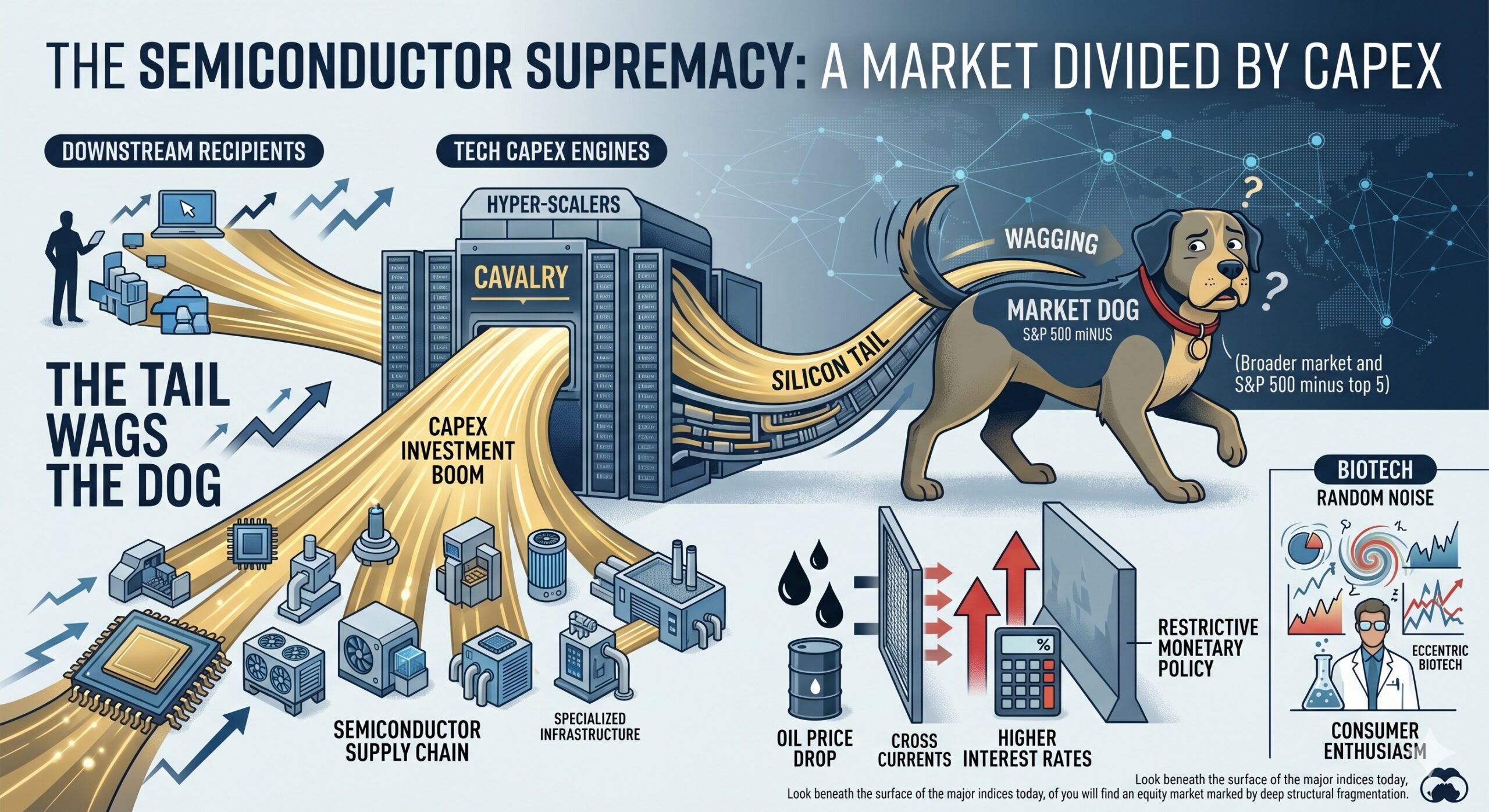
Look beneath the surface of the major indices today, and you will find an equity market marked by deep structural fragmentation. Despite a veneer of broad-based health, capital flows tell a completely different story—one dominated by an unprecedented concentration of infrastructure spending that is starving almost every other sector of momentum. This week’s insider buying reflects that same concentration, with notable purchases clustered in semiconductors, enterprise software, and fintech.
The Greatest Capex Boom in History
We are currently witnessing what can only be described as the largest capital expenditure boom in economic history. The world’s dominant hyper-scalers have effectively turned themselves into massive, single-minded capex engines. Billions of dollars are being funneled directly into infrastructure, with a singular destination: the semiconductor supply chain.
From chip designers and foundry operators to fabrication equipment manufacturers and specialized cooling systems, the downstream recipients of this cash waterfall are thriving. For investors positioned in this specific ecosystem, the market has been exceptionally rewarding. For anyone looking elsewhere, however, finding sustainable alpha has become an uphill battle.
The Hyper-Scaler Engine > When the largest technology platforms on earth redirect their massive balance sheets entirely toward building out AI infrastructure and data centers, they reshape the macro liquidity environment. This is the ultimate narrative driving equity valuations today.
Cross Currents and Canceled Catalyst Signals
In a standard market cycle, macroeconomic relief valves like dropping oil prices would act as a powerful catalyst for a broad-based economic recovery. Lower energy costs act as an immediate tax cut for consumers, freeing up discretionary income and injecting vitality into retail, travel, and consumer staples.
Yet, today’s macro environment is plagued by conflicting forces. The potential benefits of cheap oil are being aggressively neutralized by the persistent headwind of elevated interest rates. This financial friction dampens consumer enthusiasm and tightens credit conditions, leaving the broader economy unable to find its footing. The structural relief that cheaper energy should provide is trapped in the gridlock of restrictive monetary policy.
The Tail Wagging the Market Dog
This dynamic creates a highly concentrated market environment where technology capex is the absolute tail that wags the market dog. True structural traction has vanished from traditional sectors like industrials, financials, and small-caps. Instead, equity index performance is entirely dependent on whether the silicon supply chain can continue to absorb and justify trillions of dollars in physical investment.
Outside of this core technological axis, the market feels remarkably quiet. The few exceptions we see are isolated, unpredictable spikes—the random, volatile noise of an eccentric biotech company capturing retail attention on a clinical trial headline, or a singular momentum play disconnected from fundamental reality. These anomalies only serve to prove the rule: there is no systemic breadth to this rally.
Navigating the Concentration Risk
For asset allocators and retail investors alike, this environment demands extreme clarity. Fighting the hyper-scaler capex trend has proven futile, as it remains the only true engine of growth. However, relying entirely on a single supply chain leaves portfolios heavily exposed to capital spend fatigue. Until interest rates ease enough to allow consumer-driven sectors to capitalize on lower input costs, we remain locked in a two-speed market—where silicon reigns supreme, and everything else waits for the cross-currents to settle.
 Name: Marcelo Melamud
Position: SVP – Chief Accounting Officer
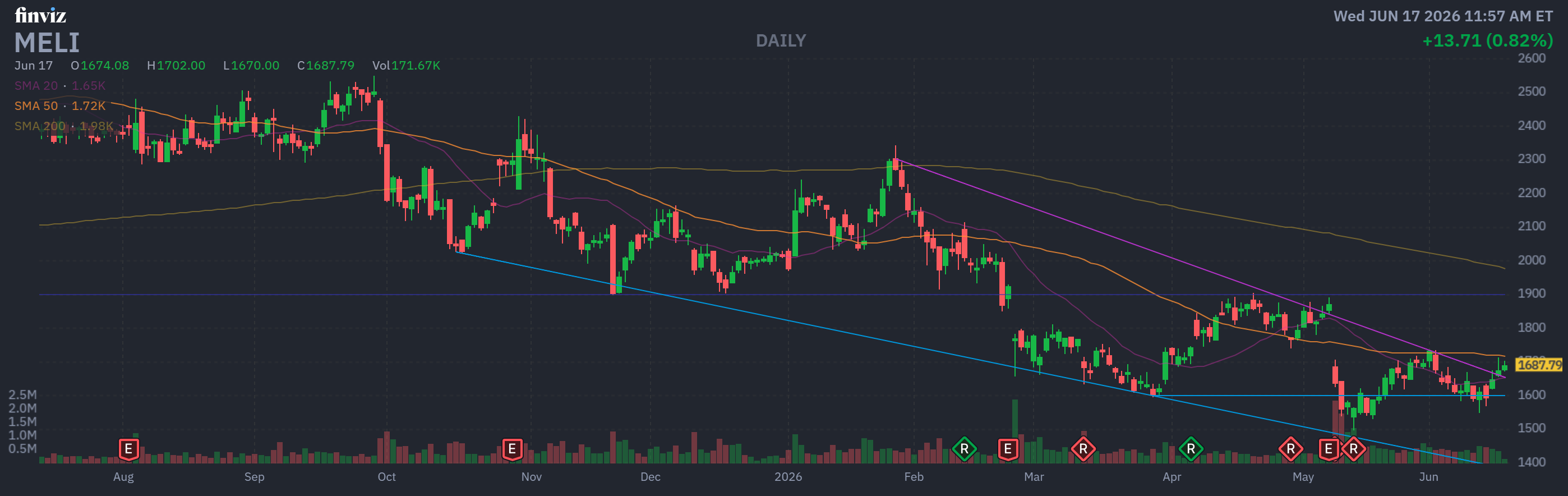
Transaction Date: 06-11-2026 Shares Bought: 125 shares an average price paid of $1,605.00 for Cost: $200,000
Company: Mercadolibre Inc. (MELI)
MercadoLibre, Inc. runs online commerce in Brazil, Mexico, Argentina, and others. The company operates Mercado Libre Marketplace, an online commerce platform accessible via mobile app or website, as well as Mercado Pago, a financial technology solution platform that provides a comprehensive set of financial technology services to its e-commerce platform users and others. It also offers Mercado Fondo, which allows users to invest cash put in their Mercado Pago accounts; Mercado Credito, which awards loans and finds better funding options; and Mercado Mercado Envios, which facilitates the transportation of items from the Company and sellers to buyers. MercadoLibre, Inc. was established in 1999 and is based in Montevideo, Uruguay.
Since January 2020, Marcelo Melamud served as MercadoLibre, Inc.’s Senior Vice President and Chief Accounting Officer, supervising the company’s global accounting, financial reporting, and compliance responsibilities. He joined MercadoLibre in 2017 as Vice President of Finance and has been instrumental in enhancing the company’s financial infrastructure as it has grown rapidly. Melamud is not a member of MercadoLibre’s Board of Directors, and hence has not acted as a director of the firm. Prior to joining MercadoLibre, he had senior finance positions at many international corporations. He is a Certified Public Accountant with a degree in Public Accounting from the University of Buenos Aires.
Insomniac Hedge Fund Guy Opinion: MercadoLibre is the dominant e-commerce and fintech platform in Latin America, often described as the region’s version of Amazon plus PayPal. The company operates online marketplaces, logistics networks, digital payments, credit products, and merchant services across key markets including Brazil, Mexico, and Argentina.
The moat is substantial. MercadoLibre benefits from powerful network effects between buyers, sellers, payments, logistics, and lending. As more merchants join the platform, more consumers shop there, which in turn strengthens its payments ecosystem and fulfillment network. Replicating this ecosystem would require massive investment and years of execution.
Over the past five years, revenue has compounded at roughly 35–40% annually, making it one of the fastest-growing large-scale internet businesses globally. A significant portion of revenue is recurring or transaction-driven through payments, merchant services, subscriptions, and financial products. User engagement and payment volumes continue to grow at healthy double-digit rates.
Management, led by Marcos Galperin, has consistently executed well, balancing aggressive growth with improving profitability. Few founder-led companies have maintained this level of discipline at scale.
Profitability has improved dramatically versus its earlier growth-at-all-costs years. Operating margins, free cash flow, and returns on capital are all trending higher while the company continues investing heavily. This insider buying at MercadoLibre — a $200,000 purchase from the company’s top accounting officer — is a smaller but still notable data point given his direct visibility into the numbers.
Name: Harry L. You
Position: Director
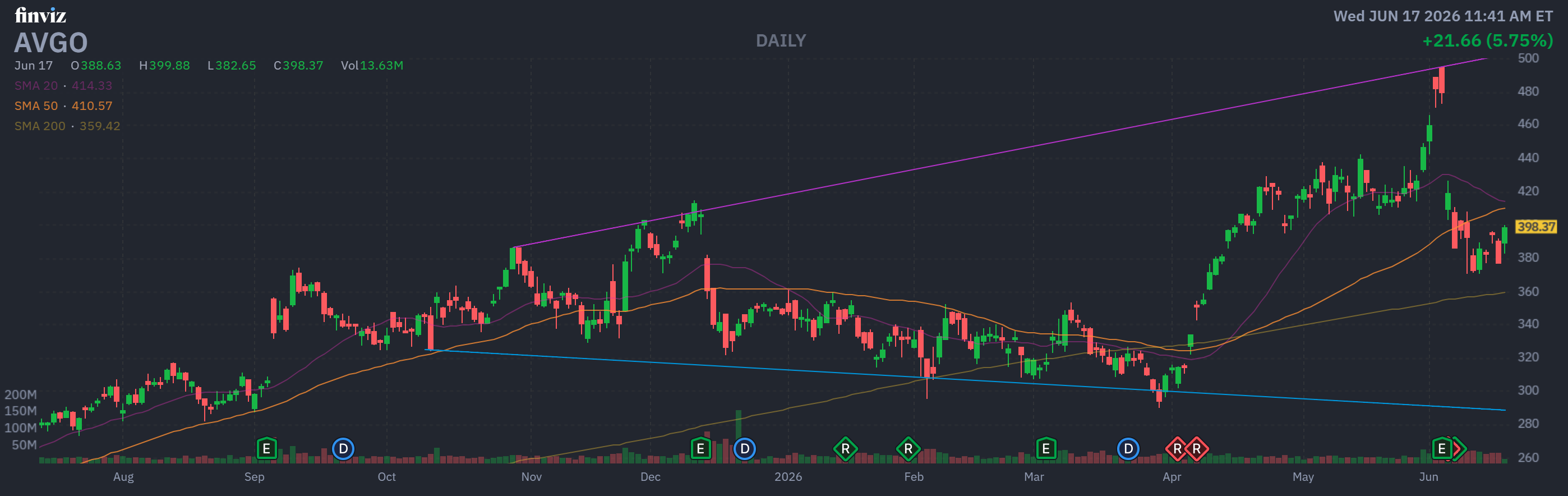
Transaction Date: 06-11-2026 Shares Bought: 1,000 shares an average price paid of $373.57 for Cost: $373,570
Company: Broadcom Inc. (AVGO)
Broadcom Inc. is a global designer, developer, and supplier of semiconductor devices and infrastructure software solutions. The company is divided into two business segments: semiconductor solutions and infrastructure software. The company provides networking connectivity, such as custom silicon solutions, ethernet switching & routing, ethernet NIC controllers, physical layer devices, and fiber optic components; wireless device connectivity, including RF semiconductor devices, connectivity solutions, custom touch controllers, and inductive charging ASICS; servers and storage system solutions, such as PCIE switches, SAS & raid products, fibre channel products, and HDD & SSD solutions; broadband so Broadcom Inc. was formed in 1961 and is based in Palo Alto, California.
Harry L. You has been an independent director of Broadcom Inc. since April 2018, when he joined the company’s Board of Directors following its redomiciliation in the United States. You, a seasoned technology and financial professional, previously served as Chairman and CEO of GTY Technology Holdings and in key leadership positions at EMC Corporation, Oracle Corporation, and Accenture. He also serves on the boards of many publicly traded firms and provides vast experience in finance, mergers and acquisitions, and corporate governance to Broadcom. You have a Bachelor of Science degree in Industrial Management from Massachusetts Institute of Technology and an MBA from the University of Chicago Booth School of Business.
Insomniac Hedge Fund Guy Opinion: Broadcom is a semiconductor and infrastructure software giant. The company designs networking chips, custom AI accelerators, broadband components, and enterprise software following its acquisition of VMware. Today, AI data centers are the biggest growth driver, with hyperscalers spending heavily on custom silicon and networking infrastructure.
The moat is exceptional. Broadcom dominates several niche but mission-critical semiconductor markets and has deep relationships with the world’s largest cloud providers. Designing custom chips is difficult, expensive, and creates long-term customer dependence. On the software side, VMware adds sticky enterprise customers and recurring subscription revenue.
Over the last five years, revenue has grown at roughly 15%+ annually, accelerated recently by AI demand and acquisitions. Recurring revenue is approximately 40–45% of total sales, primarily from infrastructure software subscriptions and support contracts. This recurring segment has been growing at a double-digit pace as VMware transitions customers toward subscriptions. Net revenue retention is not formally disclosed but appears strong given Broadcom’s pricing power and customer stickiness.
Management, led by Hock Tan, has one of the best capital-allocation records in technology. The playbook is simple: acquire strong assets, cut unnecessary costs, improve margins, and generate cash.
Profitability is outstanding. Broadcom routinely produces industry-leading operating margins and enormous free cash flow, allowing aggressive dividends and share repurchases while continuing to invest in growth. Director-level insider buying at Broadcom reinforces confidence in the company’s position at the center of the AI capex boom described above.
Name: Andrew Anagnost
Position: President and CEO
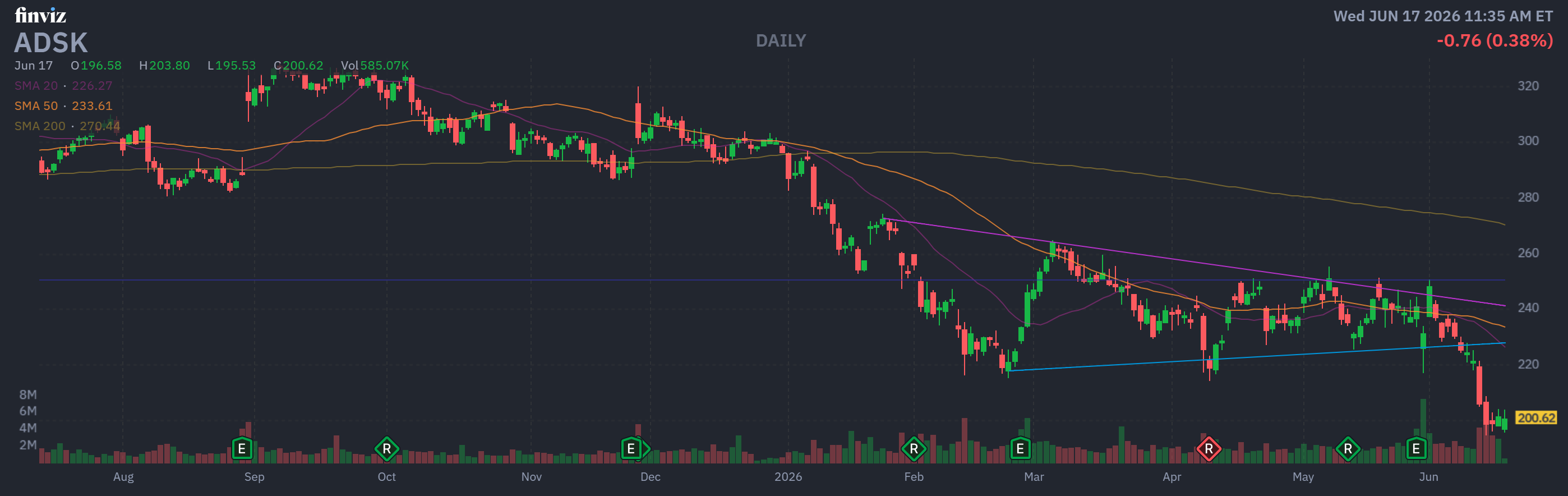
Transaction Date: 06-16-2026 Shares Bought: 2,460 shares an average price paid of $202.66 for Cost: $498,544
Name: Janesh Moorjani
Position: EVP, Chief Financial Officer
Transaction Date: 06-15-2026 Shares Bought: 2,500 shares an average price paid of $197.67 for Cost: $494,175
Company: Autodesk Inc. (ADSK)
Autodesk, Inc. provides 3D design, engineering, and entertainment technology solutions globally. The company provides AutoCAD Civil 3D, a surveying, design, analysis, and documentation solution; Autodesk Build, a toolset for managing, sharing, and accessing project documents for streamlined workflows between the office, trailer, and jobsite; and Revit, a software built for building information modeling to help professionals design, build, and maintain energy-efficient buildings. Autodesk BIM Collaborate Pro, a cloud-based design collaboration and management software; BuildingConnected, a SaaS preconstruction solution; and Tandem, a cloud-based platform that revolutionizes the built asset lifecycle. It sells its products and services via a network of resellers and distributors. Autodesk, Inc. was established in 1982 and is based in San Francisco, California.
Andrew Anagnost has been President and CEO of Autodesk, Inc. since June 2017 and a member of the company’s Board of Directors since the same year. He joined Autodesk in 1997 and has held a number of senior positions, including Chief Marketing Officer and Senior Vice President of Business Strategy and Marketing, which aided the company’s move to a cloud-based subscription business model. Prior to becoming CEO, he was Interim Co-CEO and Chief Marketing Officer. Anagnost earned a Bachelor of Science in Mechanical Engineering from California State University, Northridge, as well as a master’s and doctorate in Aeronautical Engineering from Stanford University.
Janesh Moorjani has been Executive Vice President and Chief Financial Officer at Autodesk, Inc. since December 16, 2024, when he joined the firm to manage its worldwide finance operation. He is not a member of Autodesk’s Board of Directors and hence has not served as a director of the firm. Moorjani was Chief Financial Officer and Chief Operating Officer of Elastic NV before joining Autodesk, and he has previously held top executive positions at Infoblox, VMware, Cisco, PTC, and Goldman Sachs. He has a Bachelor of Commerce degree from the University of Mumbai and an MBA from the Wharton School of the University of Pennsylvania.
Insomniac Hedge Fund Guy Opinion: Autodesk is the dominant software provider for architects, engineers, construction firms, and product designers. Its flagship products, including AutoCAD and Revit, are deeply embedded in professional design workflows across the world.
The moat is substantial. Design professionals spend years learning Autodesk products, and companies build entire workflows around them. Switching costs are high because changing software impacts productivity, training, file compatibility, and collaboration across teams.
Over the last five years, Autodesk has grown revenue at roughly 10–15% annually, driven by cloud adoption, price increases, and expansion within existing customers. The business is highly recurring, with approximately 95%+ of revenue coming from subscriptions and maintenance contracts. Revenue retention remains strong as customers typically expand usage over time.
Management, led by Andrew Anagnost, has successfully transitioned the company from perpetual licenses to a subscription model, improving revenue visibility and cash flow generation.
Profitability has improved significantly versus a decade ago. Autodesk now generates strong operating margins, robust free cash flow, and benefits from the attractive economics of software at scale. This week’s insider buying at Autodesk stands out for its breadth — both the CEO and CFO purchased shares within a day of each other.
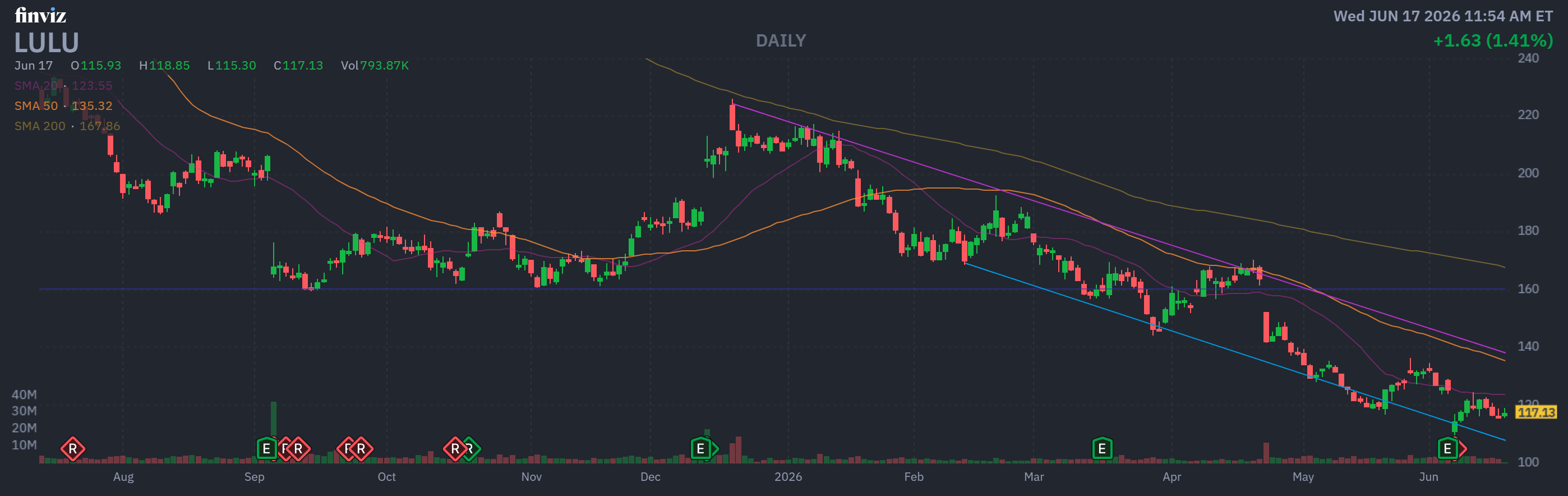
Name: Charles V. Bergh
Position: Director
Transaction Date: 06-15-2026 Shares Bought: 4,275 shares an average price paid of $117.05 for Cost: $500,384
Company: lululemon athletica Inc. (LULU)
Lululemon Athletica Inc., along with its subsidiaries, designs, distributes, and sells technical athletic apparel, footwear, and accessories for women and men under the lululemon brand in the United States, Canada, Mexico, China Mainland, Hong Kong, Taiwan, Macau, and other countries. It sells pants, shorts, tops, and jackets for athletic activities like yoga, jogging, training, and more. The brand also offers fitness-inspired accessories. It offers its products through company-owned stores, seasonal stores, pop-ups, university campus retailers, yoga and fitness studios, outlets, Like New, a re-commerce program, and its e-commerce website. The company was established in 1998 and is headquartered in Vancouver, Canada.
Charles V. Bergh has served as a Director of Lululemon Athletica Inc. since 2026, when he was appointed to the company’s Board of Directors as part of an ongoing board refresh to strengthen leadership and governance. He brings extensive global retail and brand leadership experience, having previously served as President and Chief Executive Officer of Levi Strauss & Co., where he led the company’s turnaround and return to public markets. Prior to that, Bergh spent nearly three decades at Procter & Gamble in senior leadership roles across global consumer brands. His expertise spans strategy, operations, and brand development. He holds a Bachelor of Arts degree from Lafayette College.
Insomniac Hedge Fund Guy Opinion: Lululemon is a premium athletic apparel company best known for yoga wear, but it has evolved into a global lifestyle brand spanning women’s apparel, men’s apparel, footwear, and accessories. Unlike many apparel companies, Lululemon sells primarily through its own stores and e-commerce channels, giving it greater control over pricing and customer relationships.
The moat is the brand. Lululemon has built a loyal customer base around quality, performance, and community-driven marketing. Its direct-to-consumer model supports strong margins and reduces dependence on wholesale partners. While competition from Nike, Adidas, Alo Yoga, and Vuori has intensified, Lululemon remains one of the strongest premium brands in activewear.
Over the last five years, revenue has grown at roughly 20% annually, an impressive rate for a company of its size. Unlike software businesses, Lululemon has little traditional recurring revenue, though repeat purchases from loyal customers create a form of behavioral recurrence. Net revenue retention is not reported.
Management, led by CEO Calvin McDonald, has successfully expanded internationally and significantly grown the men’s category. Execution has generally been strong, though recent concerns about slowing North American demand have weighed on investor sentiment.
Profitability remains a key strength. Lululemon consistently generates industry-leading gross margins and strong free cash flow, outperforming most apparel peers despite a tougher consumer environment. Insider buying from a newly appointed director at Lululemon is worth watching given his turnaround track record at Levi Strauss.
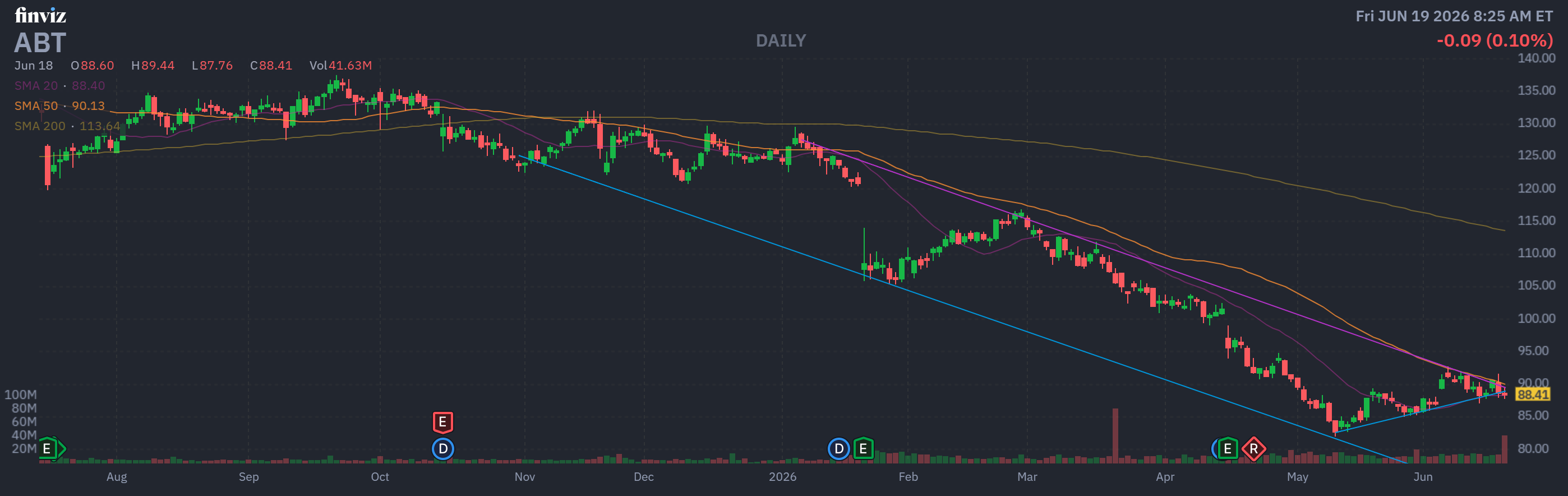
Name: John G. Stratton
Position: Director
Transaction Date: 05-07-2026 Shares Bought: 2,000 shares an average price paid of $86.82 for Cost: $173,640
Company: Abbott Laboratories (ABT)
Abbott Laboratories and its subsidiaries discover, develop, manufacture, and sell health-care products around the world. It operates in four business segments: established pharmaceutical products, diagnostic products, nutritional products, and medical devices. The company provides generic pharmaceuticals for the treatment of pancreatic exocrine insufficiency, irritable bowel syndrome or biliary spasm, intrahepatic cholestasis or depressive symptoms, gynecological disorder, hormone replacement therapy, dyslipidemia, hypertension, hypothyroidism, hypertriglyceridemia, Ménière’s disease and vestibular vertigo, pain, fever, inflammation, and migraine, as well as anti-infective clarithromycin, influenza vaccine, and products. In addition, the company offers nutritious items for children and adults, as well as infant formula. Abbott Laboratories was founded in 1888 and is headquartered in Abbott Park, Illinois.
John G. Stratton has served as an independent director of Abbott Laboratories since April 2021, when he joined the company’s Board of Directors. Stratton is a veteran telecommunications executive who spent more than 25 years at Verizon Communications Inc., including serving as Executive Vice President and President of Global Operations, where he oversaw wireless, wireline, enterprise, and network operations. He brings extensive expertise in technology, cybersecurity, operations, and strategic leadership to Abbott’s board. Stratton earned a Bachelor of Science degree in Business Administration from the Southern Illinois University Edwardsville and completed executive education programs at the Harvard Business School.
Insomniac Hedge Fund Guy Opinion: Abbott Laboratories is one of the most diversified healthcare companies in the world, operating across medical devices, diagnostics, nutrition, and established pharmaceuticals. Unlike many healthcare companies that rely heavily on a single product, Abbott benefits from multiple growth engines, including FreeStyle Libre glucose monitors, cardiovascular devices, diagnostics, and infant nutrition products.
The moat is built on trusted brands, regulatory expertise, global distribution, and strong positions in large healthcare markets. FreeStyle Libre has become a category leader in continuous glucose monitoring, creating a sizable recurring revenue stream through sensor replacements and helping strengthen customer loyalty.
Over the past five years, revenue growth has been modest but resilient, averaging in the mid-single digits after normalizing for the COVID testing boom and subsequent decline. Recurring revenue is substantial, particularly within medical devices and diabetes care, where consumables drive ongoing sales. Customer retention is strong due to physician adoption, patient familiarity, and reimbursement relationships.
Management has a long track record of disciplined capital allocation and operational execution. The company has consistently invested in innovation while maintaining a diversified portfolio that reduces dependence on any single business line.
Profitability remains solid, although margins have moderated since COVID-era diagnostic testing revenues faded. Even so, Abbott continues to generate significant free cash flow and maintains a strong balance sheet, allowing continued investment in growth initiatives and shareholder returns. This director’s insider buying at Abbott adds to a pattern of steady, if unspectacular, board-level confidence in the company’s diversified healthcare model.
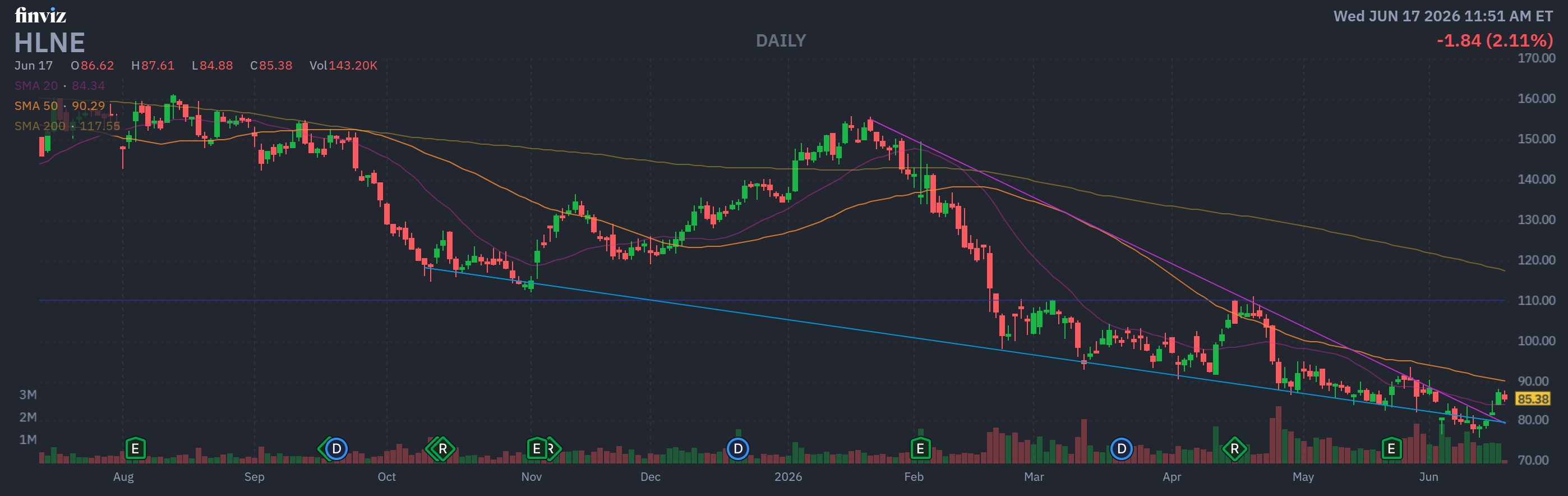
Name: Hartley R. Rogers
Position: Executive Co-Chairman and 10% Owner
Transaction Date: 06-11-2026 Shares Bought: 38,290 shares an average price paid of $78.49 for Cost: $3,005,339
Name: David J. Berkman
Position: Director
Transaction Date: 06-11-2026 Shares Bought: 15,000 shares an average price paid of $76.27 for Cost: $1,144,050
Company: Hamilton Lane Inc. (HLNE)
Hamilton Lane Incorporated is a private equity and venture capital business that invests in a variety of strategies, including buyouts, venture capital, growth equity, debt, and real estate. The business invests in North America, Europe, Asia Pacific, and emerging economies, with an emphasis on innovative and disruptive industries such as technology, healthcare, energy, and consumer services. Founded in 1991 and located in Philadelphia, Pennsylvania, it offers a wide range of alternative investment options for small and medium-sized businesses.
Hartley R. Rogers has been Executive Co-Chairman of Hamilton Lane Incorporated since January 2024, when Mario Giannini was appointed to join him. Rogers joined Hamilton Lane in 2003 after leading an investor group that acquired a major share in the company. He has been Chairman of the Board of Directors since 2005 and a director since joining the board. He is one of Hamilton Lane’s top shareholders, owning more than 10% of the company’s outstanding shares, and continues to be actively involved in investment, client relationships, and strategic development. Rogers received an A.B. magna cum laude from Harvard University and an MBA with High Distinction as a Baker Scholar from Harvard Business School.
David J. Berkman has been independent director of Hamilton Lane Incorporated since March 2017, when he joined the Board of Directors in conjunction with the company’s initial public offering. Berkman is a seasoned financial professional with substantial experience in investment banking and corporate finance, having previously served as Vice Chairman of Global Mergers and Acquisitions at Bank of America Merrill Lynch and as a senior executive at numerous other major financial organizations. His experience in mergers and acquisitions, financial markets, and strategic advising has made him an important member of Hamilton Lane’s board. Berkman earned a Bachelor of Arts degree from Duke University and a Juris Doctorate from the University of Michigan Law School.
Insomniac Hedge Fund Guy Opinion: Hamilton Lane is one of the leading private markets investment managers, specializing in private equity, private credit, infrastructure, and real assets. Unlike traditional asset managers tied to public markets, Hamilton Lane benefits from the long-term shift of institutional and wealthy investors toward private assets.
The moat comes from scale, relationships, and data. Private markets are relationship-driven, and Hamilton Lane has spent decades building access to top-tier fund managers. Its proprietary database and investment track record make it difficult for new entrants to replicate its position.
Over the past five years, revenue has grown at roughly a low-to-mid teens annual rate, supported by rising assets under management and increased demand for private market exposure. The majority of revenue is recurring, coming from management and advisory fees tied to long-duration client assets. This creates a predictable earnings profile with strong visibility.
Management has executed well, steadily expanding assets under management while maintaining profitability. The firm has also been a leader in making private markets more accessible to high-net-worth investors, a potentially large growth opportunity.
Profitability remains impressive. Hamilton Lane consistently generates high margins, strong free cash flow, and attractive returns on capital. Unlike many alternative managers that rely heavily on performance fees, Hamilton Lane’s business is more dependent on recurring fee streams, which reduces earnings volatility. Insider buying here included a $3 million purchase from the company’s Executive Co-Chairman, one of the largest of the week.
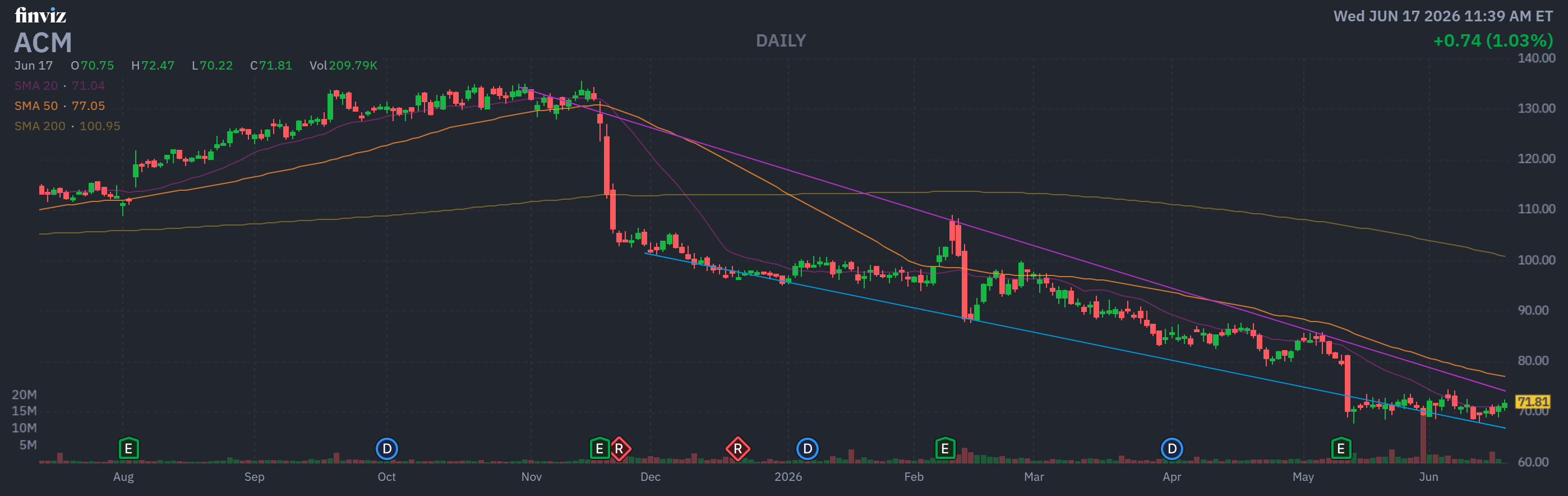
Name: Lara Poloni
Position: President
Transaction Date: 06-16-2026 Shares Bought: 4,224 shares an average price paid of $70.63 for Cost: $298,341
Company: Aecom (ACM)
AECOM, through its subsidiaries, provides professional infrastructure consulting services to governments, enterprises, and organizations worldwide. The corporation is divided into three segments: Americas, International, and AECOM Capital. The company provides advice, planning, consulting, architectural and engineering design, construction and program management, and investment and development services to public and private clients in major end markets such as transportation, facilities, water, environmental, and energy. It also invests and develops real estate developments. The corporation was previously known as AECOM Technology Corporation but changed its name to AECOM in January 2015. AECOM was established in 1980 and is based in Dallas, Texas.
Lara Poloni has been President of AECOM since October 2020, supervising the company’s global operations and strategic expansion projects. She has been with AECOM since 1994 and has held a number of leadership positions, including Chief Executive of AECOM’s Australia and New Zealand business and later Chief Executive of its Europe, Middle East, and Africa operations. Poloni is not a member of AECOM’s Board of Directors and hence has never served as a director of the corporation. She has a Bachelor of Arts degree in Urban Geography from Monash University and a Graduate Degree in Urban Planning Policy from the Royal Melbourne Institute of Technology.
Insomniac Hedge Fund Guy Opinion: AECOM is basically a global infrastructure consulting and engineering giant that quietly sits at the intersection of government spending, urbanization, and long-term capital cycles. They design, plan, and manage infrastructure projects—roads, rail, water systems, airports, and large public works—rather than building them outright. That asset-light model is the key to the story.
The moat here is less about technology and more about relationships, certifications, and embedded positioning in public-sector and large institutional projects. Once AECOM is the prime consultant on major infrastructure programs, it tends to stay in the loop for extensions and future phases. It’s sticky, but not monopolistic—more “trusted gatekeeper” than winner-takes-all.
Revenue is roughly in the mid-teens billions annually, with growth typically in the mid-single-digit range, driven by infrastructure stimulus, U.S. federal spending, and global urban development trends. The company has increasingly shifted toward higher-margin, advisory-heavy work after exiting more capital-intensive or lower-margin segments. This has improved earnings quality more than headline growth.
A large portion of revenue is effectively recurring in nature—long-duration government contracts, multi-year infrastructure programs, and backlog-driven visibility. The backlog itself is a key indicator, often covering more than a year of revenue, giving the business a quasi-annuity feel even if it isn’t formally “recurring SaaS-style.”
Margins are the real story. AECOM has steadily pushed operating margins into the high single-digit to low double-digit range, a meaningful improvement versus its earlier, more commoditized phase. Free cash flow conversion has also improved with the asset-light transition. This insider buying from AECOM’s President reflects continued confidence in the company’s infrastructure-driven backlog.
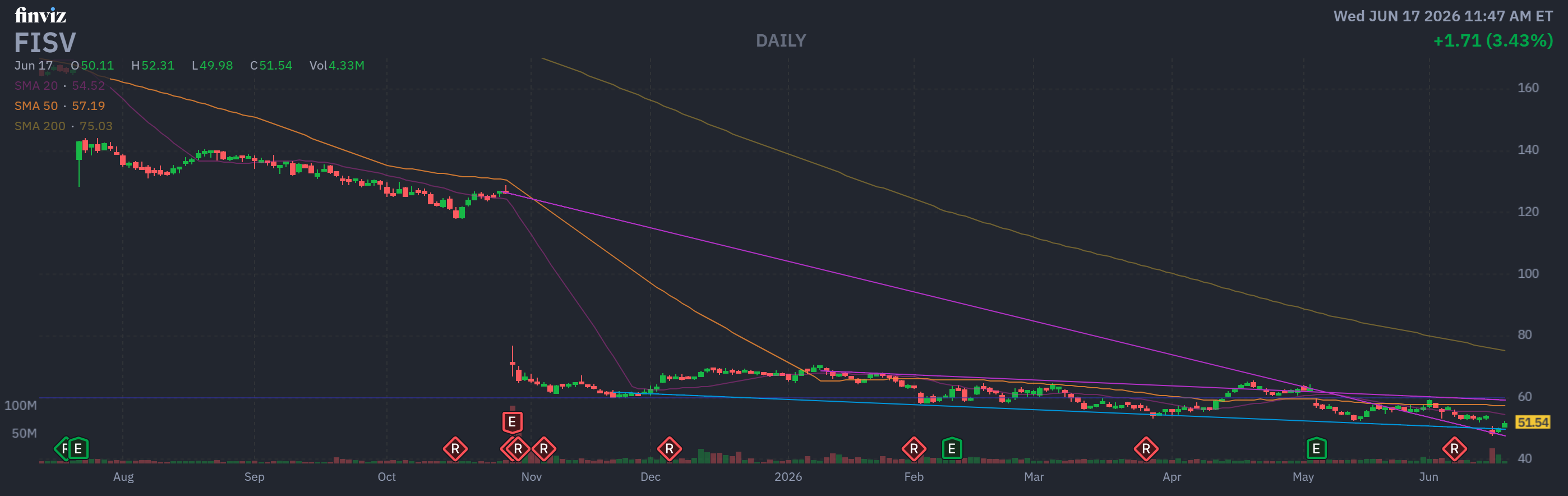
Name: Paul M. Todd
Position: Chief Financial Officer
Transaction Date: 06-17-2026 Shares Bought: 10,060 shares an average price paid of $49.70 for Cost: $499,982
Name: Gordon M. Nixon
Position: Director
Transaction Date: 06-16-2026 Shares Bought: 7,500 shares an average price paid of $49.57 for Cost: $371,775
Name: Yarkoni Charlotte
Position: Director
Transaction Date: 06-16-2026 Shares Bought: 2,023 shares an average price paid of $49.49 for Cost: $100,118
Name: Adam L. Rosman
Position: Chief Admin. and Legal Officer
Transaction Date: 06-16-2026 Shares Bought: 10,150 shares an average price paid of $49.33 for Cost: $500,700
Name: DiSimone Harry
Position: Director
Transaction Date: 06-16-2026 Shares Bought: 2,088 shares an average price paid of $48.41 for Cost: $101,080
Company: Fiserv Inc. (FISV)
Fiserv, Inc. is a global leader financial technology and payments, offering banking, merchant acquiring, digital payments, core account processing, and point-of-sale solutions to financial institutions, enterprises, and governments worldwide. Thousands of banks, credit unions, merchants, and organizations in over 100 countries rely on the company’s revolutionary payment and commerce technology to increase operational efficiency and customer experiences. Fiserv is also known for its Clover point-of-sale platform and broad payment processing capabilities, which make it one of the world’s largest fintech companies. The firm was started in 1984.
Paul M. Todd has been Fiserv, Inc.’s Chief Financial Officer since October 31, 2025, having previously joined the company as a special advisor to the executive leadership team several weeks before. He is not a member of Fiserv’s Board of Directors and hence has never served as a director of the company. Todd was a Partner at TTV Capital before joining Fiserv, and he previously worked as CFO of Global Payments and TSYS, where he established a solid name in the fintech and payments industries. He has a bachelor’s degree from the University of Memphis and an MBA from Vanderbilt University.
Gordon M. Nixon has been independent director of Fiserv, Inc. since July 2020, when he joined the company’s Board of Directors. Nixon is a seasoned financial services executive best known for his tenure as President and CEO of the Royal Bank of Canada from 2001 to 2014, as well as director of the bank from 2000 to 2014. He also sits on the boards of numerous big corporations and provides significant experience in banking, corporate governance, and risk management to Fiserv. Nixon has an Honors Business Administration degree from Western University’s Ivey Business School, as well as Chartered Accountant and Fellow Chartered Accountant qualifications.
Charlotte Yarkoni has been an independent director Fiserv, Inc. since August 2023, when she was named to the company’s Board of Directors. She has substantial experience in cloud computing, artificial intelligence, and digital commerce, having most recently served as President of Commerce, Ecosystems, Cloud & AI at Microsoft, where she held various top leadership positions since joining the firm in 2016. Yarkoni worked as an executive at Telstra, VMware, EMC, and other technology businesses before joining Microsoft. She holds a bachelor’s degree in management science from the Georgia Institute of Technology.
Since January 2024, Adam L. has served as Fiserv, Inc.’s Chief Administrative and Legal Officer, supervising the company’s global legal, compliance, government relations, and administrative operations. He joined Fiserv in January 2024 and is not on the Board of Directors, hence he has not served as a director of the company. Rosman formerly held high legal positions at The Walt Disney Company and Wilmer Cutler Pickering Hale and Dorr LLP before joining Fiserv. He was also Executive Vice President, General Counsel, and Secretary of Macy’s, Inc. He earned a bachelor’s degree from the University of Michigan and a Juris Doctorate from the University of Pennsylvania’s Carey Law School.
Harry A. DiSimone has been independent director of Fiserv, Inc. since July 2007, making him one of the company’s longest-tenured board members. From 1999 to 2005, he was the Chairman and CEO of Ceridian Corporation and held top management positions in a number of technology and business services organizations. DiSimone provides substantial experience in human resource management, technological services, and corporate governance to the Fiserv board. He holds a bachelor’s degree in economics from the University of Pennsylvania and a Master of Business Administration from Harvard Business School.
Insomniac Hedge Fund Guy Opinion: Fiserv is one of those boring financial infrastructure giants that quietly sits behind nearly every digital payment and banking transaction in the U.S. The company provides core banking software, payment processing, merchant acquiring, and digital banking solutions. Its ecosystem connects banks, credit unions, and merchants through platforms like core account processing and point-of-sale payments.
The moat is strong and structural. Switching core banking systems is expensive, risky, and operationally painful for financial institutions. Once Fiserv is embedded, it tends to stay embedded for years—often decades. That creates high switching costs and deep customer lock-in. On top of that, its merchant acquiring and payment rails benefit from scale and network effects, reinforcing its competitive position.
Revenue growth has been steady rather than explosive, typically mid-to-high single digits over time, supported by both merchant payment volume growth and recurring software and processing fees. A large portion of revenue is recurring or transaction-based, which gives the business a durable cash-flow profile tied to global consumer spending.
Management has focused heavily on margin expansion and platform integration following acquisitions like First Data. The company has been steadily improving operating efficiency while pushing cross-sell across banking and merchant clients.
Profitability is strong for a financial infrastructure player. Fiserv generates solid operating margins in the high-20% range with strong free cash flow conversion, supported by asset-light software economics and recurring transaction revenue. The breadth of insider buying at Fiserv this week — CFO, two directors, and the Chief Admin/Legal Officer all purchasing within days of each other — is exactly the kind of cluster we flag as high-conviction.
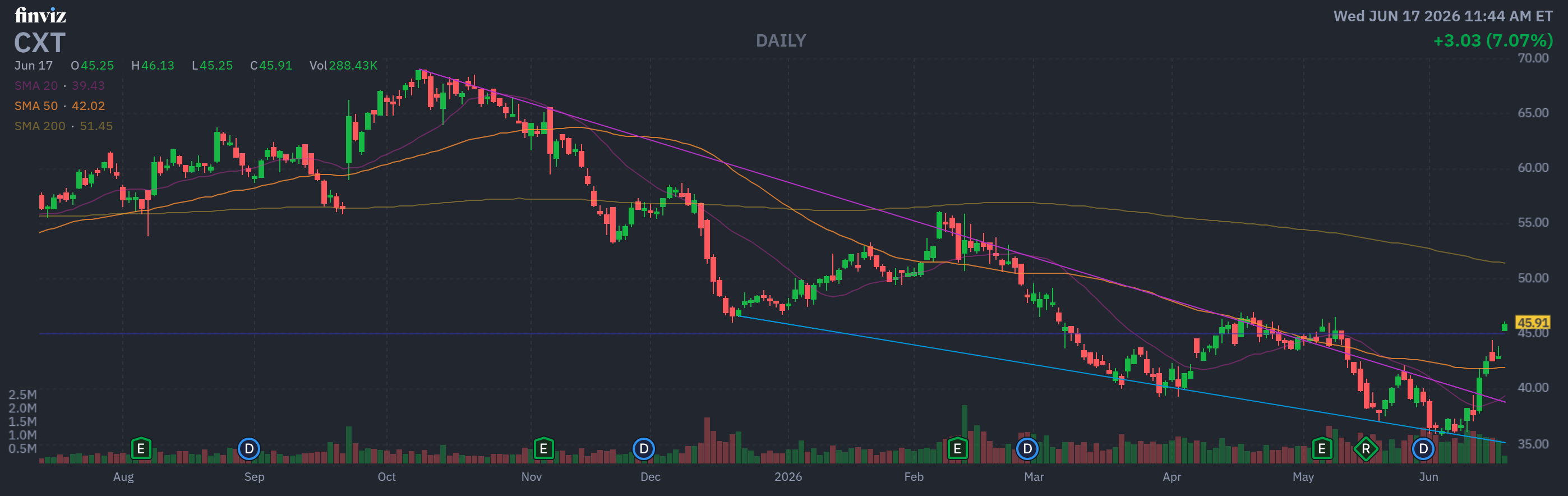
Name: Aaron W. Saak
Position: CEO
Transaction Date: 06-12-2026 Shares Bought: 24,000 shares an average price paid of $42.13 for Cost: $1,011,120
Name: Christina Cristiano
Position: SVP, Chief Financial Officer
Transaction Date: 06-12-2026 Shares Bought: 3,550 shares an average price paid of $41.96 for Cost: $148,958
Company: Crane NXT Co. (CXT)
Crane NXT, Co. is an industrial technology firm that offers technology solutions to protect, identify, and authenticate customers’ valuable assets. The company operates in two segments: Crane Payment Innovations and Security and Authentication Technologies. Crane Payment Innovations provides electronic equipment and software, as well as innovative automation, processing, field service, remote diagnostics, and productivity software solutions. The Security and Authentication Technologies section offers advanced security solutions based on patented technologies to protect physical objects such as banknotes, consumer goods, and industrial products. Crane NXT, Co. was established in 2021 and is headquartered in Waltham, Massachusetts.
Aaron W. Saak has been CEO of Crane NXT Co. since April 2023, following the division of Crane Holdings, Co. into two independent public businesses. He joined the company in April 2023 and has served on its Board of Directors since then. Before joining Crane NXT, Saak was President and CEO of Stanley Black & Decker’s industrial technologies sector, and he previously held key leadership positions at Honeywell International Inc. and Tyco. He has a bachelor’s degree in mechanical engineering from the University of Western Ontario and an MBA from York University.
Christina Cristiano has been Crane Co.’s Senior Vice President and Chief Financial Officer since April 2023, when the firm separated from Crane Holdings, Co. She has helped drive the company’s finance organization and strategic initiatives. She is not a member of the Board of Directors, and hence has not served as a director of the company. Cristiano previously served as Crane’s Vice President of Investor Relations and Treasurer, among other high financial positions. She earned a Bachelor of Science in Finance from the University of Connecticut and an MBA from Fordham University.
Insomniac Hedge Fund Guy Opinion: Crane NXT is a niche industrial and security technology company spun out of Crane Holdings, focused on authentication, payment security, and high-trust industrial sensing systems. Its core business sits in currency validation, casino gaming technology, and secure payment solutions—areas where failure is expensive and trust is non-negotiable.
The moat is based on entrenched infrastructure and compliance-driven switching costs. For example, its banknote authentication systems are deeply embedded in central bank and cash-handling ecosystems, while its gaming and casino tech is integrated into regulated environments where switching vendors is slow, costly, and heavily approved. This creates sticky, long-duration customer relationships rather than fast turnover SaaS-style retention.
Revenue growth is generally low-to-mid single digit, driven more by replacement cycles and incremental upgrades than explosive demand. The business is not a secular growth story; it’s more of a stable industrial compounder with occasional cyclical boosts tied to cash circulation, casino activity, and capital spending cycles in security infrastructure.
A meaningful portion of revenue is recurring or repeat-oriented, especially from service contracts, consumables, and long-life installed base refresh cycles, though it is not a pure subscription model. This makes cash flows relatively resilient, but not perfectly smooth.
Margins are solid for an industrial firm, supported by high-value engineering content and proprietary systems, with operating margins typically in the mid-to-high teens. Free cash flow conversion is strong due to modest capital intensity.
Management is focused on simplifying the portfolio and leaning into higher-margin security and authentication segments, while gradually shedding lower-value industrial exposure inherited from the legacy Crane structure. Insider buying from both the CEO and CFO at Crane NXT within the same week signals unified confidence at the top.
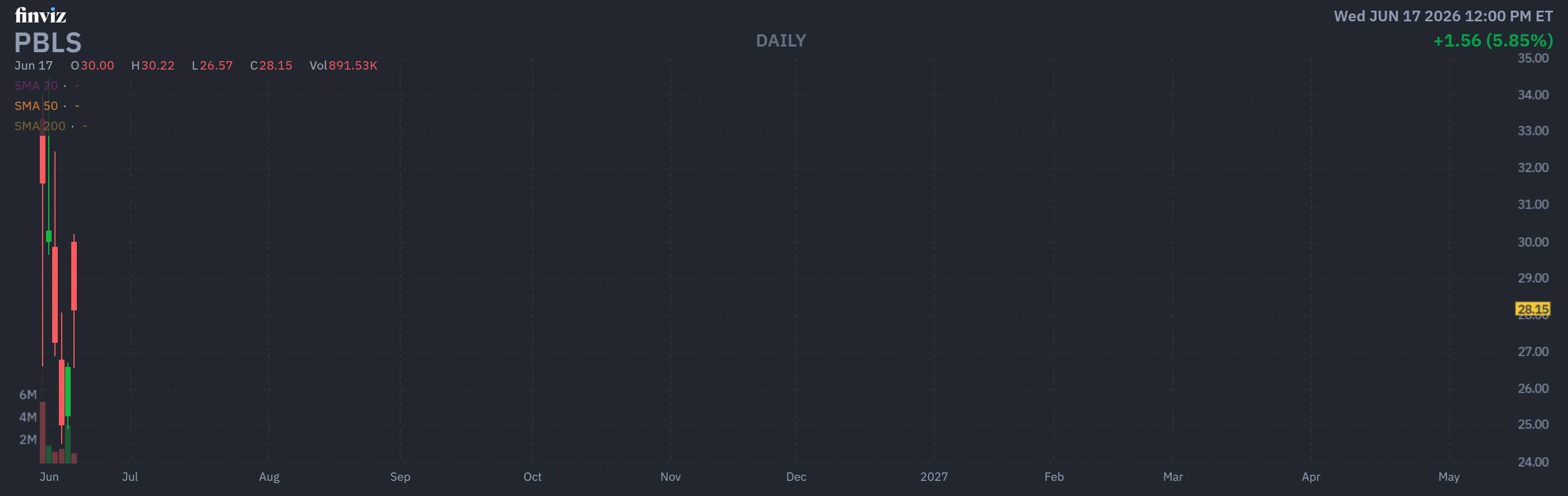
Name: Alan Sebulsky
Position: Director
Transaction Date: 06-12-2026 Shares Bought: 17,500 shares an average price paid of $27.06 for Cost: $473,529
Company: Parabilis Medicines Inc. (PBLS)
Parabilis Medicines, Inc. is a biopharmaceutical business focusing on developing helical peptide medicines for illness therapy. Through its Helicon discovery platform, the company creates stabilized helical peptide therapies that target proteins that have long been thought to be untreatable. Its pipeline includes functional inhibitors of intracellular protein-protein interactions, targeted protein degraders, and targeted radiopharmaceuticals, with FOG-001 serving as the lead clinical program, a TCF-blocking beta-catenin inhibitor for cancer treatment. The company applies artificial intelligence and data science to medication discovery, trial design, and clinical strategy optimization. Parabilis Medicines’ clients are in the healthcare and life sciences industries, including clinical research institutions and medical experts working in oncology and cancer treatment. The company was created in 2015 and is headquartered in Cambridge, Massachusetts.
Alan M. Sebulsky has been independent director at Parabilis Medicines, Inc. since May 2026, when he was named to the company’s Board of Directors. Sebulsky, a veteran healthcare investor and biopharmaceutical analyst, has over 40 years of expertise in public company investing, financial strategy, portfolio management, and board leadership. He most recently worked as a Partner and Portfolio Manager at Adage Capital Management, where he ran a diversified biopharmaceutical portfolio worth more than $2 billion, and he launched Apothecary Capital Management. He received his M.S. in Finance and B.B.A. in Finance and Economics from the University of Wisconsin–Madison.
Insomniac Hedge Fund Guy Opinion: Parabilis Medicines is a small-cap, early-stage biotech playing in the high-risk world of novel therapeutics. The company is focused on developing drug candidates for serious diseases using a platform-based approach rather than a single-asset story, which is typical for modern pre-commercial biotech firms trying to maximize optionality. At this stage, there is no meaningful commercial revenue—this is a pure R&D and pipeline valuation story.
The “moat,” if you can call it that, is not in revenue or market share but in intellectual property and scientific differentiation. In biotech, that usually means proprietary chemistry, target biology, or platform technology that could generate multiple drug candidates over time. The problem is that this moat is theoretical until clinical data proves otherwise. Most early platforms fail to translate into successful late-stage assets, and the attrition rate in this sector is brutal.
Financially, the company is likely pre-profitability with ongoing cash burn funded through equity raises or partnerships. That introduces dilution risk as a constant overhang for shareholders. Unlike established biotech names, there is no recurring revenue base or commercial infrastructure to stabilize results. Everything depends on clinical milestones, trial readouts, and regulatory progress.
Management credibility in this type of company is critical, but ultimately the market will only reward hard data. Phase 1 and Phase 2 results, safety profiles, and efficacy signals will determine whether the story transitions from speculation to asset value creation. Until then, valuation is driven more by sentiment and biotech risk appetite than fundamentals.
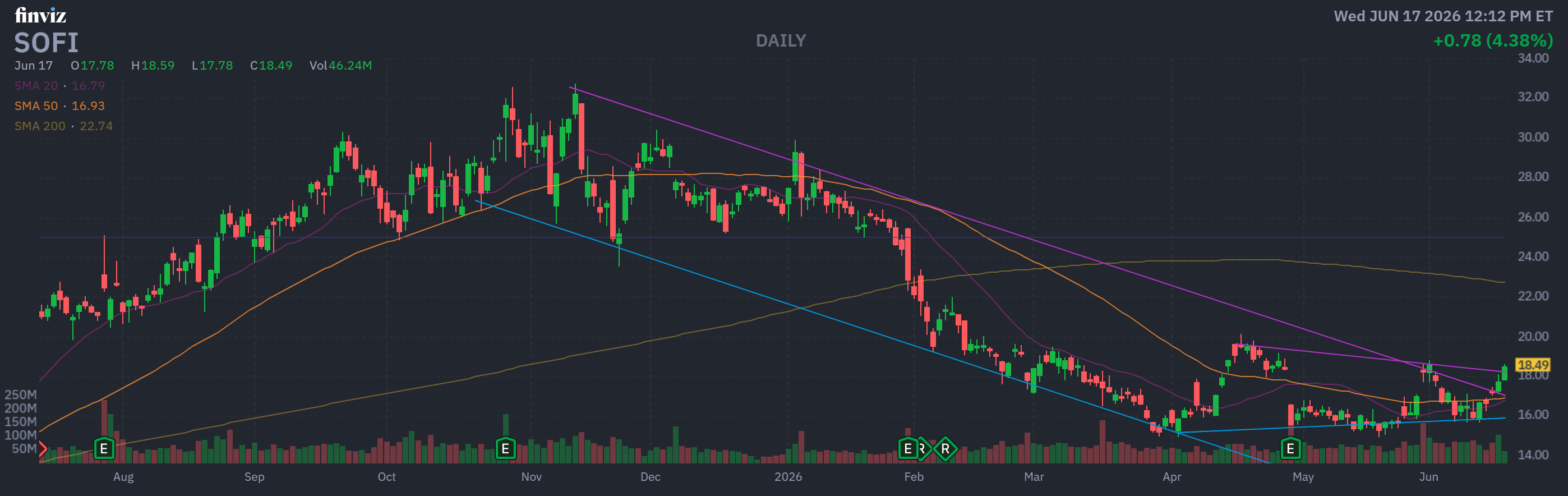
Name: Anthony Noto
Position: Chief Executive Officer
Transaction Date: 06-16-2026 Shares Bought: 13,888 shares an average price paid of $18.06 for Cost: $250,787
Company: SoFi Technologies Inc. (SOFI)
SoFi Technologies, Inc. provides a variety of financial services in the United States, Latin America, Canada, and Hong Kong. The corporation is divided into three business segments: lending, technology platforms, and financial services. It provides lending and financial services and products that let its members to borrow, save, spend, invest, and protect their money, as well as personal loans, student loans, house loans, and other related services. The company also manages Galileo, a technological platform that provides services to financial and non-financial institutions, as well as Technisys, a cloud-native digital and core banking platform that sells software licenses and related services such as implementation and maintenance.The company was created in 2011 and is headquartered in San Francisco, California.
Anthony Noto joined SoFi Technologies Inc. in February 2018 and was appointed Chief Executive Officer and member of the board on March 1, 2018. He was named CEO when he joined the company, following temporary leadership and taking on the duty of steering SoFi’s expansion as a major digital financial services platform. Prior to joining SoFi, Noto held prominent positions at Twitter, the National Football League, and Goldman Sachs, gaining vast experience in finance and technology. He graduated from the United States Military Academy at West Point with a Bachelor of Science in Mechanical Engineering and later earned an MBA from the University of Pennsylvania’s Wharton School.
Insomniac Hedge Fund Guy Opinion: SoFi is a transformed fintech that’s slowly evolving from a student-loan refinancing story into a full-stack digital financial institution. The business now spans lending (personal loans, student loans, home loans), financial services (checking, savings, credit cards), and its technology platform (Galileo and Technisys), which provides backend infrastructure to other fintechs and banks.
The core investment thesis is vertical integration. SoFi owns the customer relationship through its app, originates loans directly, and cross-sells multiple financial products. That creates a flywheel: more members → more deposits → cheaper funding → more lending capacity → higher profitability.
Growth has been strong but volatile. Over the last few years, revenue has compounded at high double-digit rates, driven by rapid member acquisition and expansion into new products. Membership growth is a key metric—SoFi has scaled to millions of users with consistent double-digit growth, reflecting strong brand traction among younger, higher-income borrowers.
The moat is still developing. It’s not a traditional “deep moat” company yet, but it benefits from switching costs once customers consolidate banking, investing, and borrowing inside one app. The technology platform adds a second revenue stream that is less cyclical than lending.
Profitability has been the major turning point. After years of losses, SoFi has recently reached consistent GAAP profitability, driven by strong net interest income, improving credit performance, and operating leverage as fixed costs scale.
Management under CEO Anthony Noto is aggressive, disciplined, and capital markets-savvy—basically running SoFi like a tech-enabled bank rather than a legacy lender.
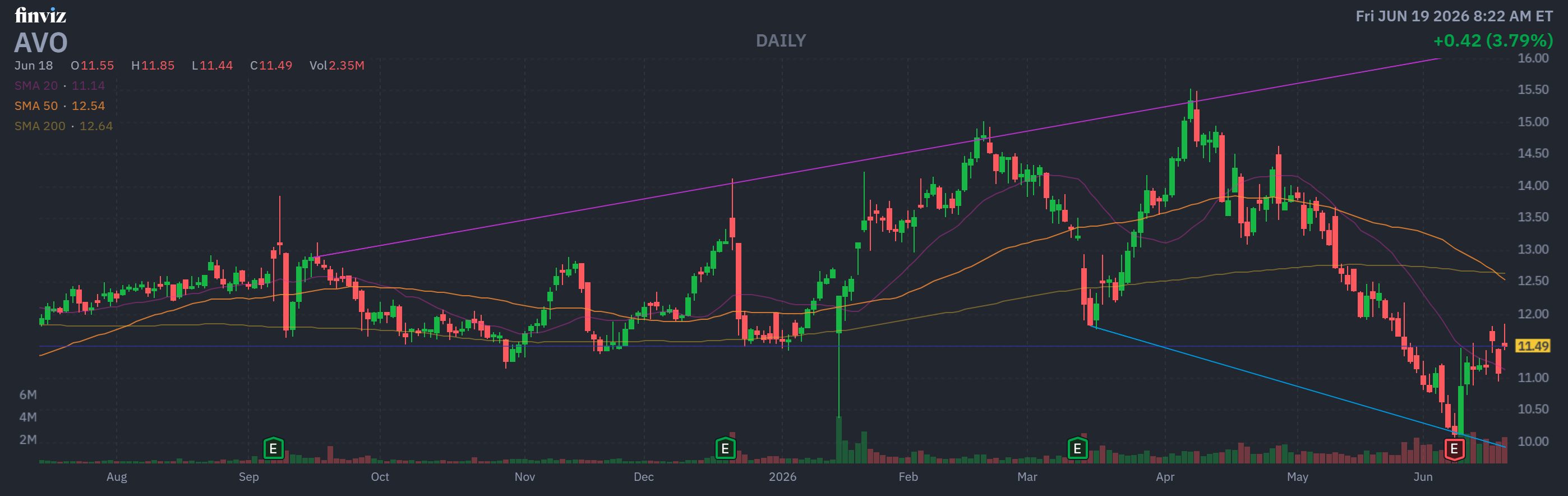
Name: Jay A. Pack
Position: Director
Transaction Date: 06-15-2026 Shares Bought: 188,550 shares an average price paid of $11.34 for Cost: $2,138,157
Name: Bruce C. Taylor
Position: Director
Transaction Date: 06-15-2026 Shares Bought: 313,590 shares an average price paid of $11.29 for Cost: $3,541,926
Company: Mission Produce Inc. (AVO)
Mission Produce, Inc. sources, farms, packages, markets, and distributes avocados, mangos, and blueberries to food stores, wholesalers, and foodservice consumers in the United States and around the world. The company is divided into three segments: marketing and distribution, international farming, and blueberries. It also offers ripening, bagging, bespoke packing, logistics management, and quality assurance services. In addition, the organization provides merchandising and promotional help, as well as market trend information and training. Mission Produce, Inc. was founded in 1983 and is based in Oxnard, California.
Jay A. Pack has been an independent director at Mission Produce, Inc. since October 2020, when he joined the company’s Board of Directors in connection with its initial public offering. Pack is a long-time food industry executive with extensive experience in finance, operations, and corporate governance. He previously served as Executive Vice President and Chief Financial Officer of Fresh Del Monte Produce Inc. and held senior leadership positions in the agricultural and consumer products sectors. His experience in financial management and worldwide operations has been beneficial to Mission Produce’s board. Pack earned a Bachelor of Science degree in Business Administration from the University of Southern California.
Bruce C. Taylor has been an independent director of Mission Produce, Inc. since October 2020, when he joined the company’s Board of Directors following its initial public offering. Taylor is an experienced executive in the food and consumer products industries, having previously served as President and CEO of Taylor Fresh Foods, Inc. and held top positions in the agricultural sector. He has decades of experience in fresh produce operations, supply chain management, and strategic expansion, which provides Mission Produce’s board with important industry perspective. Taylor received a Bachelor of Science degree in Agricultural Business from California Polytechnic State University, San Luis Obispo.
Insomniac Hedge Fund Guy Opinion: Mission Produce is the largest avocado distributor in the world, sourcing, packing, ripening, and marketing avocados across North America, Europe, and Asia. While that may not sound exciting, scale matters in a business where supply chains, logistics, and sourcing relationships determine who makes money and who gets squeezed.
The moat is operational rather than technological. Mission has built a global sourcing network across multiple growing regions, allowing it to supply customers year-round and manage crop volatility better than smaller competitors. The company has also expanded into mangoes and owns farming assets that provide additional supply security.
Revenue growth over the past five years has been modest, largely influenced by avocado pricing cycles rather than pure volume growth. The business has little true recurring revenue in the software sense, and there is no disclosed net revenue retention metric. Instead, repeat business from large grocery chains and food-service customers provides a degree of stability.
Management has generally executed well in a difficult industry, focusing on supply diversification and disciplined capital allocation. The key challenge is that profitability can swing significantly depending on avocado prices, harvest conditions, and transportation costs.
Recent results have improved as avocado supply conditions normalized and volumes increased. However, investors should remember that this remains an agricultural business where earnings can be much more volatile than revenue.
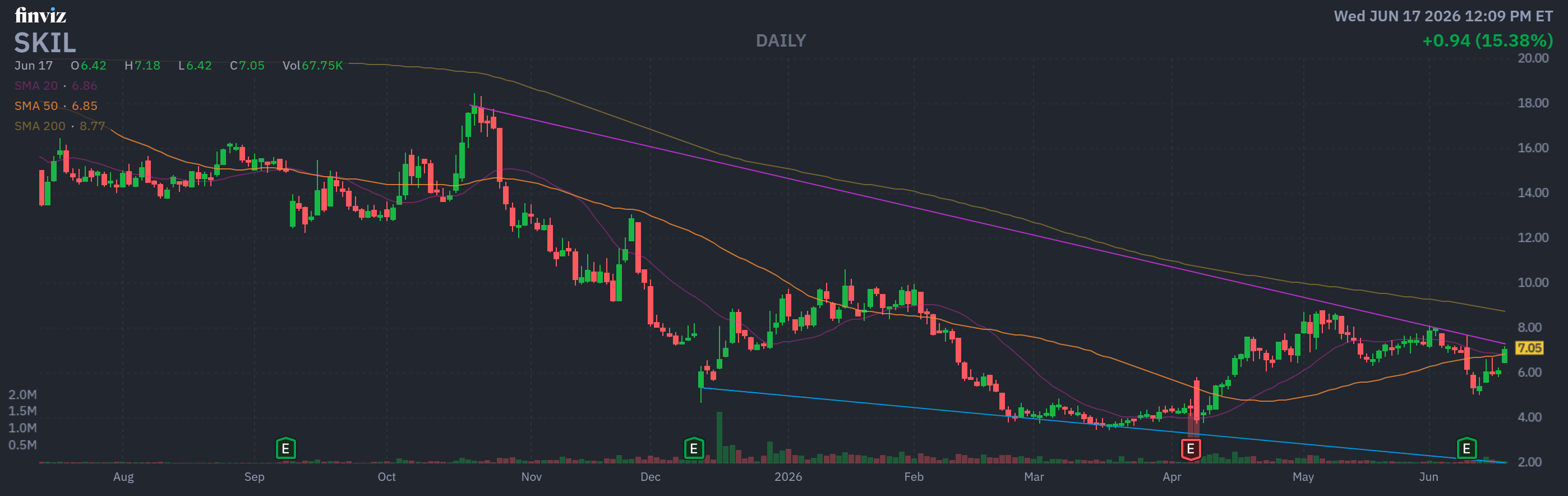
Name: Jim Frankola
Position: Director
Transaction Date: 06-12-2026 Shares Bought: 50,000 shares an average price paid of $6.05 for Cost: $302,730
Company: Skillsoft Corp. (SKIL)
Skillsoft Corp. offers a skills platform and related learning solutions in the United States, Other Americas, Europe, the Middle East, Africa, and Asia-Pacific. It operates in two segments: Talent Development Solutions and Global Knowledge. The company delivers two platforms: the Skills Management Platform, which gives organizations subscription-based access to learning and workforce capability development tools, and the Learner Platform, which provides interactive and practice-based technology skill development experiences for individual learners. It also offers instructor-led instruction, both in person and electronically. It markets and distributes its products through a direct sales force geared toward enterprise and public sector clientele. Skillsoft Corporation was founded in 2019 and is headquartered in Nashua, New Hampshire.
Jim Frankola has been an independent director Skillsoft Corp. since July 18, 2024, when he was named to the company’s Board of Directors. Frankola is a seasoned technology and finance expert who most recently served as Cloudera’s Chief Financial Officer and strategic advisor, having previously held CFO positions at Yodlee and Ariba. He also sits on the boards of several technological businesses and adds over 30 years of experience in enterprise software, cloud computing, and financial leadership to Skillsoft. Frankola has a Bachelor of Science degree in Accounting from Pennsylvania State University and a Master’s degree in International Business and Finance from New York University’s Stern School of Business.
Insomniac Hedge Fund Guy Opinion: Skillsoft is a digital learning and talent development company that sells enterprise subscriptions for employee training, compliance education, leadership development, and IT/certification prep. The business is split across Skillsoft content, Percipio learning platform, and Global Knowledge (IT training and certification services). In theory, it sits in a structurally attractive space—corporate upskilling and reskilling—but execution has been uneven for years.
The “moat” is weak compared to best-in-class SaaS peers. Skillsoft has some proprietary content libraries and enterprise contracts, but switching costs are not particularly high, and many customers view it as one vendor among several in a fragmented learning ecosystem. Competition comes from LinkedIn Learning, Coursera for Business, Udemy Business, and internal corporate learning systems, all of which are aggressively expanding.
Revenue has been mostly flat to declining over time, with low single-digit trends at best depending on restructuring cycles and acquisitions. Growth has not been consistent enough to classify this as a true SaaS compounding story. Recurring revenue exists via subscriptions, but retention and expansion dynamics are not strong enough to drive durable high growth.
Financially, the key issue is leverage. Skillsoft carries a heavy debt load from past acquisitions, which has constrained flexibility and kept investor focus on balance sheet repair rather than growth reinvestment. Margins have been volatile due to restructuring costs and integration inefficiencies.
Management has been attempting to simplify the business and improve profitability through cost cuts and portfolio focus, but the market still treats it as a turnaround rather than a growth platform.
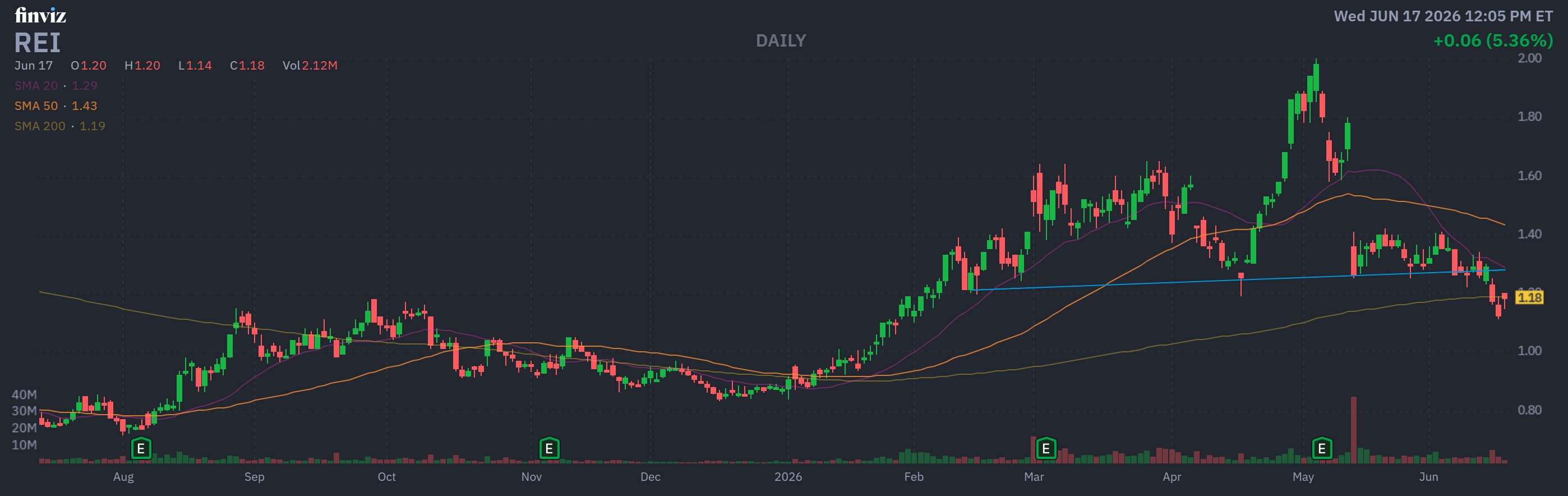
Name: Sundip Singh Johl
Position: EVP, Chief Financial Officer
Transaction Date: 06-15-2026 Shares Bought: 231,000 shares an average price paid of $1.21 for Cost: $278,840
Company: Ring Energy Inc. (REI)
Ring Energy, Inc. is an oil and natural gas business focused on the acquisition, exploration, development, and production of energy properties in the United States. The company’s operations are principally focused in the Permian Basin of Texas and New Mexico, where it has significant developed and undeveloped acreage positions. Ring Energy sells its oil and natural gas output to end users, marketers, and other buyers while focusing on increasing shareholder value through efficient operations and strategic acquisitions. The company was created in 2004 and was previously known as Transglobal Mining Corp. before changing its name in March 2008.
Sundip Singh Johl has been Executive Vice President and Chief Financial Officer of Ring Energy, Inc. since June 2022, when he joined the firm to oversee its financial strategy, capital markets activities, and accounting operations. He is not a member of the Board of Directors, and hence has not served as a director of the corporation. Prior to joining Ring Energy, Johl held senior finance and investment banking positions, including Managing Director and Head of Energy at numerous financial institutions, bringing considerable upstream energy knowledge. He earned a Bachelor of Business Administration in Finance from the University of Texas at Austin and a Master of Business Administration from Rice University.
Insomniac Hedge Fund Guy Opinion: Ring Energy is a small-cap, pure-play upstream oil and gas producer focused on conventional assets in the Permian Basin. This is not a story stock—it’s a commodity levered balance sheet wrapped in a Texas oilfield operating business. Revenue is almost entirely driven by crude oil and natural gas prices, which makes the earnings profile highly volatile and macro-dependent.
The “moat” is basically geology and operating efficiency rather than structural advantage. Ring’s assets are relatively low-cost, shallow conventional wells that can generate decent free cash flow when oil prices are supportive, but they lack the scale, hedging sophistication, and inventory depth of larger Permian peers.
Growth over the past several years has been uneven. Production has seen modest increases through acquisitions and selective drilling, but overall revenue growth is cyclical rather than structural. There is no meaningful recurring revenue component—this is a pure commodity exposure.
Management has historically focused on deleveraging and stabilizing the balance sheet after prior acquisition-driven expansion. That matters here because small E&Ps live and die by capital structure discipline.
Profitability swings heavily with oil prices. In strong commodity environments, margins expand sharply and free cash flow can look impressive. In weaker cycles, earnings compress quickly and leverage becomes the central risk factor.
This blog is solely for educational purposes and the author’s own amusement. IT IS NOT INVESTMENT ADVICE. Think of the blog as part of my personal investment journal that I am willing to share with the DIY investor. We could be long, short, or have no position at all in any of the stocks mentioned and express no written or implied obligation to disclose any of that. Nothing contained here constitutes a recommendation to buy or sell any security. Investing involves risk, including the possible loss of principal, and past performance is not indicative of future results.
“The insomniac hedge fund guy” is a moniker Harvey Sax, the portfolio manager for The Insiders Fund” has used from time to time on email, blog ,and social media posts. While Mr. Sax is the portfolio manager of The Insiders Fund, these posts are not communications from, nor endorsed by, Alpha Wealth Funds, LLC or any of its managed funds. References to Alpha Wealth Funds or its affiliates are for identification only and do not imply sponsorship or approval.
All company names, logos, and trademarks belong to their respective owners. The use of company logos is solely for descriptive and illustrative purposes under fair use. Any information provided is based on publicly available data and should not be considered financial, investment, or legal advice. Readers should conduct their own research or consult with a professional before making any investment decisions. Insiders sell the stock for many reasons, but they generally buy for just one – to make money. You’ve always heard the best information is inside information. Everyone with any stock market experience pays close attention to what insiders are doing. After all, who knows a business better than the people running it? Officers, directors, and 10% owners are required to inform the public through a Form 4 Filing of any transaction, buy, sell, exercise, or any other within 48 hours of doing so.
This info is available for free from the SEC’s Web site, Edgar, although we subscribe to SECForm4 as they provide a way to manage and make sense of the vast realms of data. I’ve tried a lot of vendors. SECForm4 is one of the smaller ones, but I like supporting Frank. He is not arrogant. He’s helpful and has great prices. He also trades on his own data, so I like people that eat what they kill. The bar is different from selling because the natural state of management is to be a seller. This is because most companies provide significant amounts of management compensation packages as stock and options. Therefore, we analyze unusual patterns with selling, such as insiders selling 25 percent or more of their holdings or multiple insiders selling near 52-week lows. Another red flag is large planned sale programs that start without warning. Unfortunately, the public information disclosure requirements about these programs, referred to as Rule 10b5-1, are horrendously poor. Also, planned sales that pop up out of nowhere are basically sales and are seeking cover under this corporate welfare loophole.
I also generally ignore 10 percent shareholders as they tend to be OPM (other people’s money) and perhaps not the smart money on which we are trying to read the tea leaves. I say generally because some 10% shareholders are great investor, think Warren Buffett and others. Of course, insiders can also be wrong about their Company’s prospects. Don’t let anyone fool you into believing they never make mistakes. Do your own analysis. They can easily be wrong, and in many cases, maybe most cases, have no more idea what the future may hold than you or me. In short, you can lose money following them. We have, and we curse aloud; what were they thinking!
We like Fly on the Wall for keeping up with what events might be happening, analysts’ comments, and whatever else could be moving the stock. Dow Jones news service is an essential tool, but many services pick up their feed like they do Bloomberg. My assistant probes the 10k for a reasonable description of the business. I’ve found that to be the most accurate and succinct place to find out what a business actually does.