
Management, led by CEO Terry Duffy, is pragmatic and capital allocation-focused—returning massive cash via dividends while steadily expanding into new areas like crypto derivatives and prediction markets.
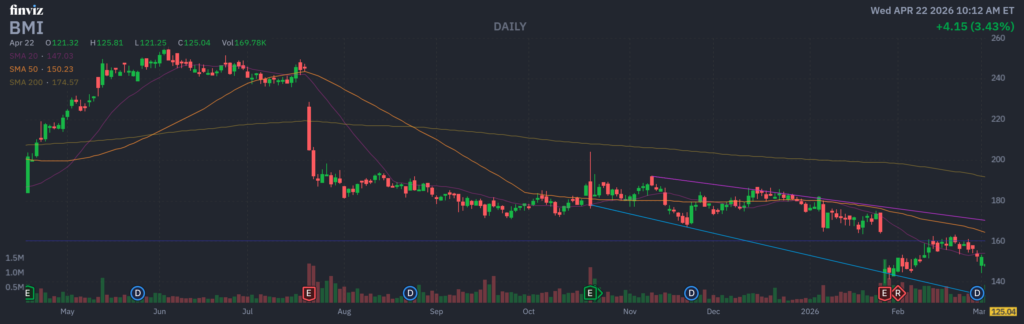
Name: Kenneth Bockhorst
Position: Chairman, President & CEO
Transaction Date: 04-21-2026 Shares Bought: 2,200 shares an average price paid of $117.53 for a cost of $258,573
Company: Badger Meter Inc. (BMI)
Badger Meter, Inc. manufactures and offers flow measurement, quality control, and communication solutions around the world. The company provides utility water smart metering solutions, software technology, and services to the municipal water utility industry. It also supplies flow instrumentation products, such as meters, valves, and other sensing instruments for measuring and controlling fluids such as water, air, steam, and other liquids and gases, to original equipment manufacturers as the primary flow measurement device within a product, as well as through manufacturers’ representatives.The company supports the water utilities, commercial, and industrial industries, as well as providing customers with training, technical support, and other collaborative services. It sells items and software to employees, dealers, and representatives. The corporation was established in 1905 and is headquartered in Milwaukee, Wisconsin.
Kenneth C. Bockhorst is the Chairman, President, and CEO of Badger Meter Inc. He joined the company as Chief Operating Officer in October 2017, was elevated to President in April 2018, CEO in 2019, and Chairman of the Board in 2020. He was also appointed to the Board of Directors in 2018. Before Badger Meter, he was a senior executive at Actuant Corporation and had worked in operations at IDEX and Eaton. He received a bachelor’s degree in operations management, marketing, and human resources from Marian University, as well as an executive MBA from the University of Wisconsin.
Insomniac Hedge Fund Guy Opinion: Badger Meter is a niche industrial quietly riding a powerful secular tailwind: global water infrastructure. The company makes smart water meters, flow measurement systems, and increasingly software that helps utilities monitor and manage water usage. It’s not glamorous, but every city needs to measure water, and most of that infrastructure is outdated.
The moat is stronger than it looks. Municipal water systems don’t switch vendors lightly, and once Badger installs meters, it often layers on communication hardware and analytics software. That creates a sticky ecosystem. The shift from mechanical meters to smart, connected systems (AMI) adds a recurring software and services layer on top of what used to be a one-time hardware sale.
Growth has been solid and accelerating. Revenue has gone from roughly $505M in 2021 to ~$917M in 2025, implying a low-teens CAGR, with ~11% growth in 2025 alone. The story is less about cyclicality and more about steady replacement cycles plus digital upgrades. Recurring revenue (software + connectivity) is still a minority but growing faster—often double digits, giving the model a SaaS-like tilt over time.
Management, led by CEO Kenneth Bockhorst, has been disciplined—no debt, consistent reinvestment, and a clear focus on expanding into adjacent water-quality and analytics markets.
Profitability is quietly improving. Gross margins are ~40%, and operating margins are trending toward high teens, with strong free cash flow and decades of dividend growth.
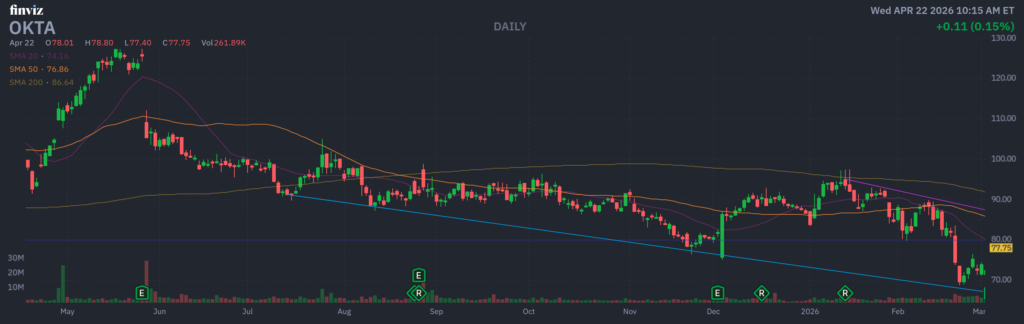
Name: David Schellhase
Position: Director
Transaction Date: 04-16-2026 Shares Bought: 3,712 shares an average price paid of $72.04for a cost of $267,408
Company: Okta Inc. (OKTA)
Okta Inc. is a multinational identity and access management firm. It uses Single Sign-On, Adaptive MFA, and API Access Management to protect applications, people, and systems. Its platform includes Universal Directory, Access Gateway, and Device Access, with support for cloud, hybrid, and on-premises environments. Okta also provides Identity Threat Protection and Identity Security Posture Management to help protect digital assets. Its governance tools are Lifecycle Management, Workflows, and Identity Governance. Additional solutions, such as Advanced Server Access and Privileged Access, improve infrastructure security. The platform includes Universal Login, Passwordless Authentication, and Attack Protection Suite. It also provides AI agents with dedicated identity solutions. Okta, Inc. was founded in 2009 and has its headquarters in San Francisco, California. It was previously known as Saasure, Inc.
David Schellhase was appointed as a Director on the Board of Okta, Inc. on August 13, 2025. He joined the company at the same time he assumed his role as an independent Class III director, contributing to board governance and strategic oversight. Schellhase brings extensive experience across technology, legal, and corporate strategy, having previously served as General Counsel at major SaaS companies, including Slack, Salesforce, and Groupon, and later as Entrepreneur-in-Residence at Ballistic Ventures starting in July 2025. Earlier in his career, he also served as Chief Operating Officer at Honest Work Corporation and has lectured at Stanford University. His career reflects a strong foundation in legal expertise and technology-driven leadership.
Insomniac Hedge Fund Guy Opinion: Okta is the pure-play identity layer of the internet. The company provides identity and access management (IAM) software—basically the system that verifies who you are and what you can access across apps, employees, customers, and now AI agents. It sits at the center of enterprise security architecture, which makes it mission-critical but not always top-of-budget.
The moat is solid but competitive. Identity is deeply embedded once deployed, creating switching friction, and Okta benefits from being a neutral platform across cloud vendors. That said, competition from Microsoft and others keeps pricing power in check. This isn’t a monopoly—it’s a contested control point.
Growth has clearly decelerated. Okta went from 30%+ growth a few years ago to roughly 9–11% expected revenue growth today, with FY2027 revenue guided around ~$3.17–$3.19B. Subscription revenue dominates (~95%+ of total), making the business highly recurring and predictable. Net revenue retention sits roughly around ~105–110%, down from prior peaks, reflecting seat-based headwinds and tighter enterprise spending.
Management, led by co-founder CEO Todd McKinnon, has shifted focus from growth-at-all-costs to profitability and execution after prior missteps (including security incidents and integration challenges with Auth0). That pivot is working.
Profitability has inflected meaningfully. Okta is now generating ~30% free cash flow margins and solid operating leverage, with GAAP profitability turning positive in FY2026.
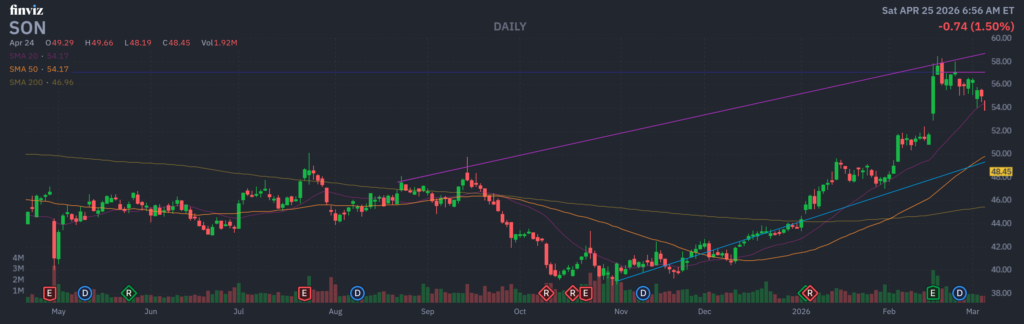
Name: Paul Joachimczyk
Position: CFO
Transaction Date: 04-24-2026 Shares Bought: 8,058 shares an average price paid of $49.64for a cost of $399,998
Company: Sonoco Products Co (SON)
Sonoco goods Company and its subsidiaries design, develop, manufacture, and sell a wide range of designed and sustainable packaging goods in the United States, Europe, Canada, the Asia Pacific region, and around the world. The company operates in two segments: consumer packaging and industrial paper packaging. Consumer Packaging manufactures round and shaped rigid paper, steel, and plastic containers, as well as metal and peelable membrane ends, closures, and components. The Industrial Paper Packaging category offers paperboard tubes, cones, and cores, as well as paper-based protective packaging and uncoated recycled paperboards. The company also sells packaging materials such as plastic, paper, foam, and other specialized materials. The company was founded in 1899 and is based in Hartsville, South Carolina.
Sonoco Products Company has hired Paul Joachimczyk as Chief Financial Officer, starting June 30, 2025. He joined the company on the same day and now manages its worldwide finance division, bringing nearly 25 years of financial leadership expertise from multinational public companies. Prior to joining Sonoco, he was Senior Vice President, Chief Financial Officer, and Corporate Secretary at American Woodmark Corporation. He also held senior finance positions at TopBuild Corporation, Stanley Black & Decker, and General Electric after starting his career at Ernst & Young. He has a Bachelor of Science in Accounting from the University of Wisconsin-Milwaukee and is a certified public accountant.
Insomniac Hedge Fund Guy Opinion: Sonoco is a 125+ year-old packaging company that quietly sits in the background of global consumer and industrial supply chains. It produces paper cans (think snack packaging), metal food containers, flexible packaging, and industrial paper products. The business is now streamlined into two core segments: Consumer Packaging (food, beverage, household goods) and Industrial Paper Packaging (corrugated, reels, tubes).
The “moat” isn’t good, but it’s real—scale, customer relationships, and integration into supply chains. Large CPG customers don’t switch packaging vendors lightly due to cost, reliability, and logistics complexity. That said, this is still a commodity-adjacent business, so pricing power is cyclical and tied to input costs (paper, resin, energy).
Revenue growth has been uneven. The company has posted low-to-mid single digit organic growth historically, but recent reported growth (~40%+ in 2025) is largely acquisition-driven, especially from Eviosys. The portfolio shift toward consumer packaging (now the majority of revenue) is meant to improve stability and recurring demand.
Recurring revenue isn’t disclosed cleanly, but a large portion of consumer packaging behaves like it—high repeat volumes from the same customers. Industrial packaging is more cyclical. Net retention is implicitly solid but not exceptional given the commodity exposure.
Management, led by CEO Howard Coker, has aggressively reshaped the portfolio—selling non-core assets, reducing debt, and focusing on higher-margin packaging segments.
Margins are decent, not elite. Operating margins sit in the low-to-mid teens, with net margins ~9%, far below premium industrial peers.
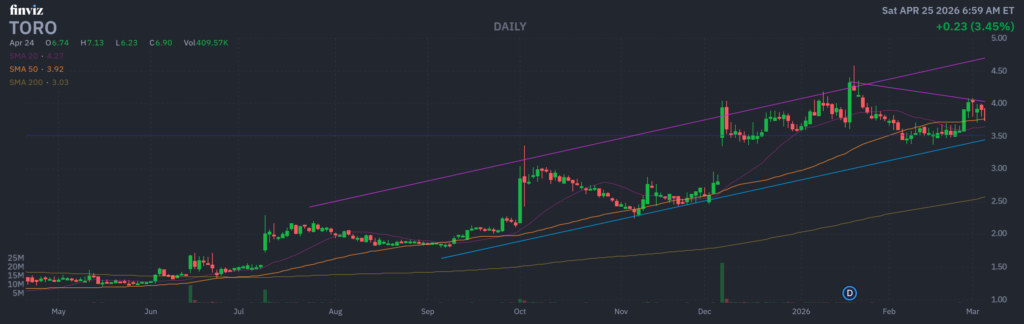
Name: Petros Panagiotis Panagiotidis
Position: Chief Executive Officer
Transaction Date: 04-22-2026 Shares Bought: 2,315,971 shares an average price paid of $6.15for a cost of $14,254,646
Company: Toro Corp. (TORO)
Toro Corp. is a shipping firm that acquires, owns, charters, and manages oceangoing LPG carrier vessels and MR tankers globally. It operates in three segments: eco tankers, non-eco tankers, and LPG carriers. The company offers energy seaborne transport services for LPG. It also operates and maintains a fleet of two LPG carrier vessels and two MR tankers, having a total cargo carrying capacity of 0.1 million deadweight tons. The company was previously known as Tankco Shipping Inc. before changing its name to Toro Corp. in September 2022. Toro Corporation was founded in 2022 and is headquartered in Limassol, Cyprus. Toro Corp. is a subsidiary of Castor Maritime Inc.
Petros Panagiotis Panagiotidis has been the CEO of Toro Corp. since March 2023, when the firm separated from Castor Maritime and became an independent publicly listed entity. He also serves as the company’s Founder and Chairman of the Board, where he is responsible for creating and scaling the company’s shipping operations and strategic direction. As CEO, he is in charge of fleet expansion, capital allocation, and overall corporate strategy, drawing on his marine and finance skills. He earned a Bachelor’s degree in International Studies and Mathematics from Fordham University and a Master’s degree in Management and Systems from New York University.
Insomniac Hedge Fund Guy Opinion: Toro Corp is not the lawnmower company—you’re looking at a tiny, Cyprus-based shipping play. The business owns and operates tanker vessels transporting crude oil, LPG, and refined products. In reality, this is less an “operating company” and more a capital allocation vehicle tied to shipping cycles and asset trades.
There is no real moat. Shipping is a commodity business—rates are volatile, assets are interchangeable, and returns depend heavily on timing vessel purchases and sales correctly. Toro has leaned into this, actively selling ships and generating gains, which has distorted financials and made revenue highly inconsistent.
The numbers reflect that instability. Revenue has collapsed from ~$100M in 2022 to ~$20–22M recently, with negative growth in the latest year (~-17%). This isn’t a steady grower—it’s a shrinking top line driven by fleet sales and repositioning. There is effectively no meaningful recurring revenue, and net retention as a concept doesn’t really apply here.
Management (led by shipping entrepreneur Petros Panagiotidis) appears focused on opportunistic asset trading—buy ships, sell ships, return capital via dividends. That can work in pockets, but it’s inherently lumpy and difficult to underwrite long-term.
Profitability is misleading. Toro has reported profits at times, but largely due to one-off gains from vessel sales rather than durable operating earnings. Core shipping income is volatile and tied to spot rates.
____________________________________________________________________________________________________________________
This blog is solely for educational purposes and the author’s own amusement. IT IS NOT INVESTMENT ADVICE. Think of the blog as part of my personal investment journal that I am willing to share with the DIY investor. We could be long, short, or have no position at all in any of the stocks mentioned and express no written or implied obligation to disclose any of that. Nothing contained here constitutes a recommendation to buy or sell any security. Investing involves risk, including the possible loss of principal, and past performance is not indicative of future results.
“The insomniac hedge fund guy” is a moniker Harvey Sax, the portfolio manager for The Insiders Fund” has used from time to time on email, blog ,and social media posts. While Mr. Sax is the portfolio manager of The Insiders Fund, these posts are not communications from, nor endorsed by, Alpha Wealth Funds, LLC or any of its managed funds. References to Alpha Wealth Funds or its affiliates are for identification only and do not imply sponsorship or approval.
All company names, logos, and trademarks belong to their respective owners. The use of company logos is solely for descriptive and illustrative purposes under fair use. Any information provided is based on publicly available data and should not be considered financial, investment, or legal advice. Readers should conduct their own research or consult with a professional before making any investment decisions. Insiders sell the stock for many reasons, but they generally buy for just one – to make money. You’ve always heard the best information is inside information. Everyone with any stock market experience pays close attention to what insiders are doing. After all, who knows a business better than the people running it? Officers, directors, and 10% owners are required to inform the public through a Form 4 Filing of any transaction, buy, sell, exercise, or any other within 48 hours of doing so.
This info is available for free from the SEC’s Web site, Edgar, although we subscribe to SECForm4 as they provide a way to manage and make sense of the vast realms of data. I’ve tried a lot of vendors. SECForm4 is one of the smaller ones, but I like supporting Frank. He is not arrogant. He’s helpful and has great prices. He also trades on his own data, so I like people that eat what they kill. The bar is different from selling because the natural state of management is to be a seller. This is because most companies provide significant amounts of management compensation packages as stock and options. Therefore, we analyze unusual patterns with selling, such as insiders selling 25 percent or more of their holdings or multiple insiders selling near 52-week lows. Another red flag is large planned sale programs that start without warning. Unfortunately, the public information disclosure requirements about these programs, referred to as Rule 10b5-1, are horrendously poor. Also, planned sales that pop up out of nowhere are basically sales and are seeking cover under this corporate welfare loophole.
I also generally ignore 10 percent shareholders as they tend to be OPM (other people’s money) and perhaps not the smart money on which we are trying to read the tea leaves. I say generally because some 10% shareholders are great investor, think Warren Buffett and others. Of course, insiders can also be wrong about their Company’s prospects. Don’t let anyone fool you into believing they never make mistakes. Do your own analysis. They can easily be wrong, and in many cases, maybe most cases, have no more idea what the future may hold than you or me. In short, you can lose money following them. We have, and we curse aloud; what were they thinking!
We like Fly on the Wall for keeping up with what events might be happening, analysts’ comments, and whatever else could be moving the stock. Dow Jones news service is an essential tool, but many services pick up their feed like they do Bloomberg. My assistant probes the 10k for a reasonable description of the business. I’ve found that to be the most accurate and succinct place to find out what a business actually does.