Management, led by CEO Terry Duffy, is pragmatic and capital allocation-focused—returning massive cash via dividends while steadily expanding into new areas like crypto derivatives and prediction markets.
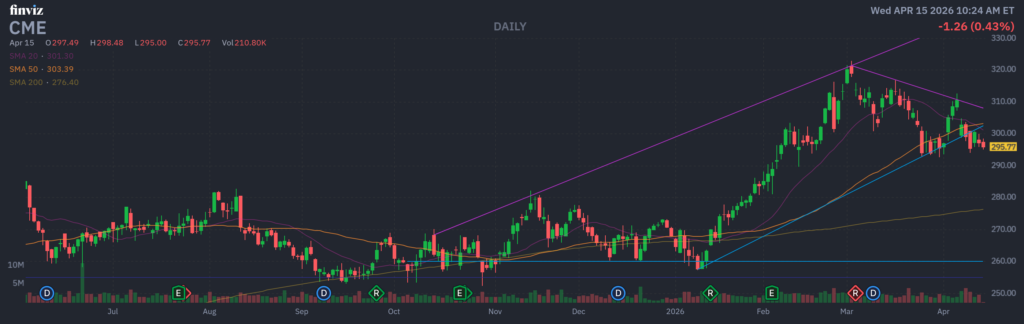
Name: William R. Shepard
Position: Director
Transaction Date: 03-26-2026 Shares Bought: 1,470 shares an average price paid of $297.38 for a cost of $437,101
Company: CME Group Inc. (CME)
CME Group Inc., through its subsidiaries, operates contract markets for the trading of futures and options on futures contracts worldwide. It provides futures and options products based on interest rates, equity indices, and foreign exchange, as well as agricultural, energy, and metals commodities, fixed income, and foreign currency trading services. The company offers clearing house services, which include clearing, settling, and guaranteeing futures and options contracts, as well as cleared swaps products traded on its exchanges. In addition, the company provides a variety of market data services. The corporation was previously known as Chicago Mercantile Exchange Holdings Inc. before changing its name to CME Group Inc. in July 2007. The company was founded in 1898 and is based in Chicago, Illinois.
William R. Shepard has been a Director of CME Group Inc. since 1997, making him one of the board’s longest-tenured members. He joined the company’s Board of Directors that same year and has been an active member of its governance, having previously served as Second Vice Chairman from 2002 to 2007 and contributed to important risk and clearing committees. Aside from CME, he is the founder and president of Shepard International, Inc., a futures commission merchant, and has been a CME member for decades.
Insomniac Hedge Fund Guy Opinion: CME Group is the tollbooth of global finance. It operates the world’s largest derivatives exchange—interest rates, equity indices, commodities, FX, even crypto futures. You don’t bet on markets here; you pay CME to facilitate the bet. Every trade generates clearing and transaction fees, making this a volume-driven, asset-light machine.
The moat is exceptional. CME owns deeply liquid benchmark contracts (Eurodollars/SOFR, S&P futures, WTI crude), and liquidity begets liquidity. If you’re a hedge fund or institution, you go where everyone else is. Add in clearing infrastructure and regulatory barriers, and this becomes one of the strongest network-effect businesses in finance.
Revenue growth has been steady rather than spectacular—roughly mid-to-high single digits (~6–8%) over the past five years, with 2025 revenue at ~$6.5B (+6%). The mix is highly recurring in practice: transaction fees (driven by trading volume) plus market data subscriptions (~$800M+ annually) provide a durable base. Not SaaS-style recurring, but structurally sticky.
Net retention isn’t disclosed, but customer behavior is obvious—trading activity clusters around CME’s contracts, and switching liquidity venues is costly and impractical.
Management, led by CEO Terry Duffy, has focused on product expansion (rates, energy, crypto) and global distribution. Growth often comes from volatility—when markets panic, volumes spike.
Profitability is elite. CME regularly posts 60–70%+ operating margins, with massive free cash flow and shareholder returns (dividends + specials).
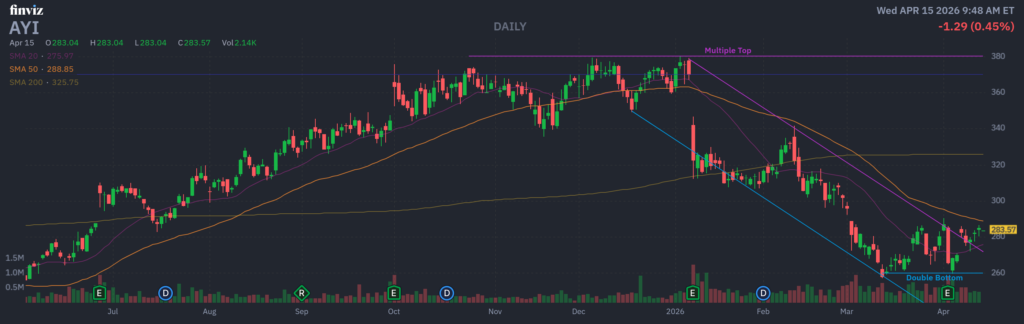
Name: Laura O’Shaughnessy
Position: Director
Transaction Date: 04-08-2026 Shares Bought: 1,000 shares an average price paid of $282.98 for a cost of $282,980
Company: Acuity Inc. (AYI)
Acuity Inc. provides lighting, lighting controls, building management system, and an audio, video, and control platform in the United States and internationally. It operates in two segments, Acuity Brands Lighting; and the Acuity Intelligent Spaces. The ABL segment provides lighting solutions and luminaires with advanced electronics under the Aculux, American Electric Lighting, Cyclone, Dark to Light,and original equipment manufacturer customers. The AIS segment offers Distech Controls intelligent Building Management Systems , such as products for controlling heating, ventilation, and building access that prioritize end-user outcomes; Q-SYS, a full-stack audio, themed entertainment, and hospitality sectors through system integrators. Acuity Inc. was formerly known as Acuity Brands, Inc. and changed its name to Acuity Inc. in March 2025. Acuity Inc. was incorporated in 2001 and is headquartered in Atlanta, Georgia.
Laura O’Shaughnessy has been a Director of Acuity Inc. since June 2020, when she was elected to the Board and has maintained the post since then. She is a co-founder and former CEO of SocialCode, having extensive experience in digital marketing, technology, and strategy, as well as business and product strategy at The Slate Group. She has previously worked as an independent consultant and had senior positions in digital commerce and technology companies. Laura O’Shaughnessy graduated from the University of Virginia, where she focused on economics.
Insomniac Hedge Fund Guy Opinion: Acuity Inc. is a classic “old economy quietly evolving” story. Historically a commercial lighting manufacturer, the company now straddles two worlds: traditional lighting (Acuity Brands Lighting) and higher-growth “Intelligent Spaces” (controls, building automation, AV systems). The latter—boosted by the QSC acquisition—is the part that matters.
The moat is decent but not bulletproof. In lighting, scale, distribution, and contractor relationships provide some advantage, but it’s still a competitive, somewhat cyclical market tied to construction. The real upside is in controls and building management systems, where software integration and ecosystem lock-in could create stickier, higher-margin revenue over time.
Revenue growth has been inconsistent but improving. Over the past five years, growth has been roughly low-to-mid single digit on average, with volatility tied to construction cycles. However, FY2025 showed a strong rebound with ~13% growth to ~$4.3B, and ~17% TTM growth more recently.
Recurring revenue is still limited compared to true SaaS-like models—likely <30% of total revenue—though growing via software, controls, and services. The Intelligent Spaces segment is expanding तेजी, but still not dominant. Net retention isn’t disclosed and likely not a key KPI yet.
Management, led by CEO Neil Ashe, is actively repositioning the business toward higher-value, tech-enabled solutions. The QSC deal signals a clear pivot toward integrated building tech and recurring-ish revenue streams.
Profitability is solid but not elite. Operating margins sit around ~13%, well below best-in-class industrial tech peers, and earnings have been somewhat pressured despite revenue growth.
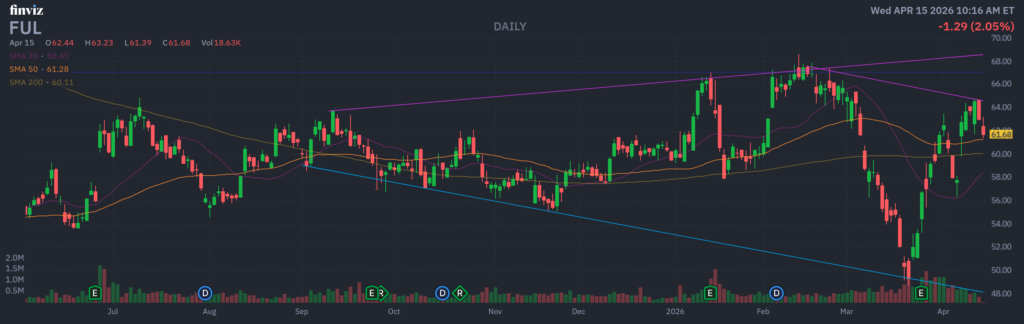
Name: Celeste Beeks Mastin
Position: President and CEO
Transaction Date: 04-07-2026 Shares Bought: 5,170 shares an average price paid of $57.08 for a cost of $295,104
Company: Fuller H. B. Co (FUL)
H.B. Fuller Company, through its subsidiaries, develops, manufactures, and markets adhesives, sealants, coatings, polymers, tapes, encapsulants, additives, and other specialized chemical products. It operates in three segments: hygiene, health, and consumable adhesives; engineering adhesives; and building adhesive solutions. Construction Adhesives manufactures solutions for commercial roofing, heating, ventilation, air conditioning, and insulation applications, as well as caulks and sealants for the consumer and professional markets. The company offers its products both directly to clients and through distributors and retailers in North America, Latin America, Europe, India, the Middle East, Africa, and the Asia Pacific. The H.B. Fuller Company was established in 1887 and is headquartered in Saint Paul, Minnesota.
Celeste Beeks Mastin joined H.B. Fuller Company on March 7, 2022, as Executive Vice President and Chief Operating Officer. She was promoted to President and Chief Executive Officer on December 4, 2022, and joined the company’s Board of Directors. She has almost three decades of leadership expertise in manufacturing and distribution, including previous CEO positions at PetroChoice and Distribution International.
Insomniac Hedge Fund Guy Opinion: H.B. Fuller is a specialty chemicals company that lives in the unsexy but essential world of adhesives. The firm manufactures industrial glues, sealants, and bonding materials used across packaging, hygiene (diapers, medical), electronics, construction, and automotive end markets. It’s not glamorous—but it touches everything.
The moat is modest but real. Adhesives are deeply embedded in customer manufacturing processes, and qualification cycles can be long. Once a product works, customers don’t switch easily. That said, this isn’t a “razor-and-blade” model like life sciences—pricing power exists, but it’s constrained by raw material volatility and competition. This is more of a formulation and customer-relationship business than a true technological lock-in.
Revenue growth over the past five years has been low-to-mid single digits, with volatility, including declines in recent years. FY2025 revenue came in at ~$3.47B, down ~2.7% YoY. The business lacks meaningful recurring revenue in the SaaS sense—sales are tied to industrial demand cycles, though repeat purchasing behavior provides some stability. Net retention isn’t disclosed and likely less durable than higher-quality industrial models.
Management, led by CEO Celeste Mastin, has focused on pricing discipline, portfolio reshaping, and margin expansion through cost control and acquisitions. The playbook is clear: fix margins first, then stabilize growth.
Profitability is improving. Adjusted EBITDA reached ~$621M in 2025 with margins ~18%, showing solid execution despite weak volumes.
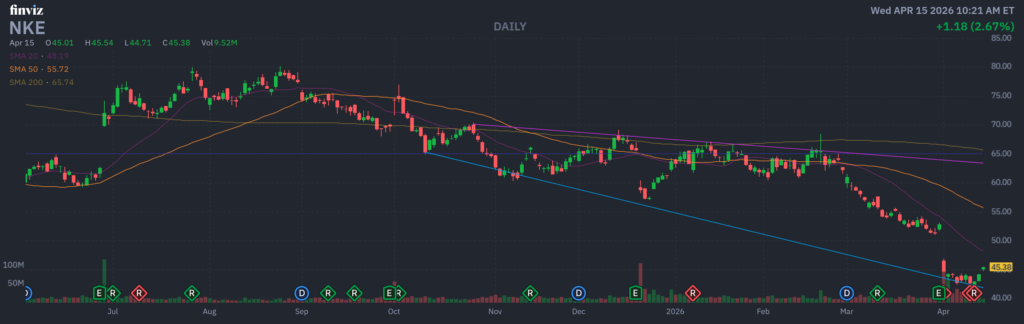
Name: Timothy D. Cook
Position: Director
Transaction Date: 04-10-2026 Shares Bought: 25,000 shares an average price paid of $42.43 for a cost of $1,060,750
Name: Elliott Hill
Position: President and CEO
Transaction Date: 04-13-2026 Shares Bought: 23,660 shares an average price paid of $42.27 for a cost of $1,000,000
Company: NIKE Inc. (NKE)
Nike, Inc. and its subsidiaries create, develop, market, and distribute athletic and casual footwear, clothes, equipment, accessories, and services to men, women, and children throughout North America, Europe, the Middle East, Africa, Greater China, Asia Pacific, and Latin America. The company sells its products under the brands NIKE, Jordan, Jumpman, Converse, Chuck Taylor, All Star, One Star, Star Chevron, and Jack Purcell. It also sells performance equipment and accessories, such as backpacks, socks, sports balls, sunglasses, digital gadgets, bats, gloves, protective equipment, and other sports gear. The corporation was previously known as Blue Ribbon Sports, Inc., but changed its name to Nike, Inc. in May 1971. Nike, Inc. was founded in 1964 and is based in Beaverton, Oregon.
Timothy D. Cook has been a director of NIKE Inc. since 2005, when he joined the company’s board while working as Chief Operating Officer for Apple. He has been an active member of the board for nearly two decades and was later named lead independent director in 2016, indicating his growing influence in Nike’s governance. Cook is well-known for his operational expertise and long-term strategic view, which contribute to Nike’s leadership oversight. He earned a Bachelor of Science in Industrial Engineering from Auburn University and an MBA from Duke University.
Elliott Hill is the President and CEO of Nike Inc., having returned to the firm in October 2024 to take up the top position after leaving in 2020. He began his career with Nike as an intern in 1988 and worked his way up through several leadership positions in North America and Europe, eventually becoming President of Consumer and Marketplace before leaving. Hill was appointed President and CEO on October 14, 2024, bringing extensive institutional knowledge and operational experience back to the organization. He earned a bachelor’s degree in kinesiology from Texas Christian University and a master’s degree in sports management from Ohio University.
Insomniac Hedge Fund Guy Opinion: Nike is the global leader in athletic footwear and apparel, built around brand, innovation, and distribution. The company designs and markets shoes, apparel, and equipment, outsourcing manufacturing while controlling branding and go-to-market. Its core strength remains performance footwear, but lifestyle and apparel have become increasingly important.
The moat is brand-driven and massive. Nike’s scale, athlete endorsements, and cultural relevance create a feedback loop that’s hard to replicate. Combined with global distribution and marketing muscle, it maintains pricing power and consumer mindshare. That said, the moat has shown cracks recently, particularly as competitors like On and Hoka gain traction in performance running and consumers rotate toward newer brands.
Revenue growth over the past five years has been modest—roughly mid-single digits (~5–6%), with recent periods showing volatility due to inventory resets and China weakness. Nike doesn’t have traditional “recurring revenue,” but its direct-to-consumer (DTC) business—now over 40% of revenue—creates a more predictable, higher-margin revenue stream. Digital sales and repeat purchases partially substitute for classic subscription-like visibility.
Management, led by CEO John Donahoe, has pushed aggressively into DTC and digital transformation. While strategically sound, execution has been mixed—pulling back from wholesale too quickly and mismanaging inventory cycles hurt near-term sales and brand heat.
Profitability has historically been strong, with mid-teens operating margins, but margins have compressed recently due to promotions, higher costs, and channel mix shifts.
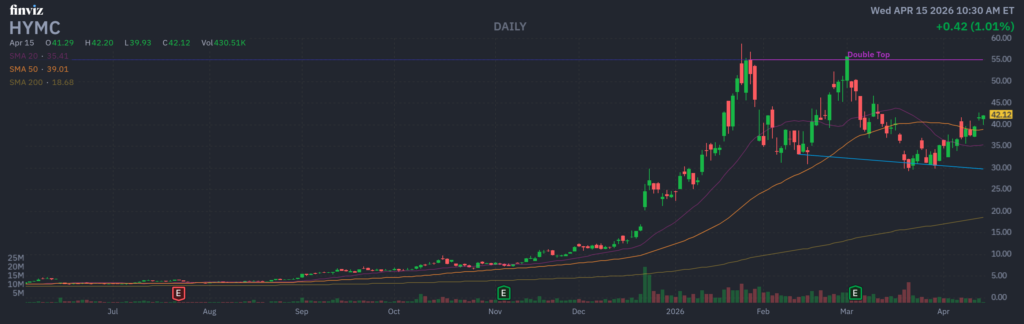
Name: Eric Sprott
Position: 10%Owner
Transaction Date: 04-09-2026 Shares Bought: 200,000 shares an average price paid of $38.67 for a cost of $7,734,000
Company: Hycroft Mining Holding Corp (HYMC)
Hycroft Mining Holding Corp. is a gold and silver exploration and development business established in the United States. Its primary focus is on expanding the Hycroft Mine, one of the world’s largest precious metals resources, located in northern Nevada’s Tier-1 mining jurisdiction. The company’s current strategy focuses on technical research, exploration drilling, and converting the asset to eventual commercial operations while maximizing high-grade gold and silver potential throughout its vast land holdings. Hycroft is publicly traded on the NASDAQ under the symbol HYMC and employs a team to drive research and development initiatives at the site. Hycroft Mining Holding Corp. was founded through its company combination and incorporation in 2017 and took on the name Hycroft Mining Holding Corporation on May 29, 2020.
Eric Sprott has been an 10% owner of Hycroft Mining Holding Corp. since March 2022, when he made a significant equity investment that established him as one of the company’s largest shareholders. He became associated with Hycroft at that time as a strategic investor, supporting the company during a critical phase of its development, and has since increased his ownership through additional share purchases disclosed in regulatory filings. Sprott is not involved in day-to-day operations but is recognized for his long-standing influence as a prominent resource-sector investor. He holds a Bachelor of Commerce degree from Carleton University.
Insomniac Hedge Fund Guy Opinion: Hycroft Mining is not really an operating business in the traditional sense—it’s a gold and silver development story centered around its massive Hycroft mine in Nevada. The asset is legitimately large, with tens of millions of ounces of gold and silver resources, but the key issue: it’s not consistently producing meaningful revenue today.
That shows up clearly in the numbers. Revenue effectively disappeared after 2022 as operations paused, making any 5-year growth metric almost meaningless. The company generated ~$111M in 2021, dropped to ~$33M in 2022, and has since had minimal to no revenue while focusing on exploration and feasibility work.
There is no recurring revenue here. No SaaS-like model, no consumables—just future optionality tied to commodity prices and successful mine redevelopment. Net retention? Not applicable. This is a pre-production asset play, not a customer-driven business.
Management, led by CEO Diane Garrett, has focused on repairing the balance sheet (now largely debt-free) and advancing technical studies to restart mining operations. The strategy is survival first, production later.
Profitability is predictably ugly. HYMC has posted consistent operating losses (~$40–50M annually) with negative free cash flow, reflecting ongoing exploration and zero meaningful production.
What has worked is narrative. The stock has behaved like a hybrid of a mining call option and a meme stock—boosted at times by retail interest, precious metals rallies, and high-profile investors like AMC and Eric Sprott.
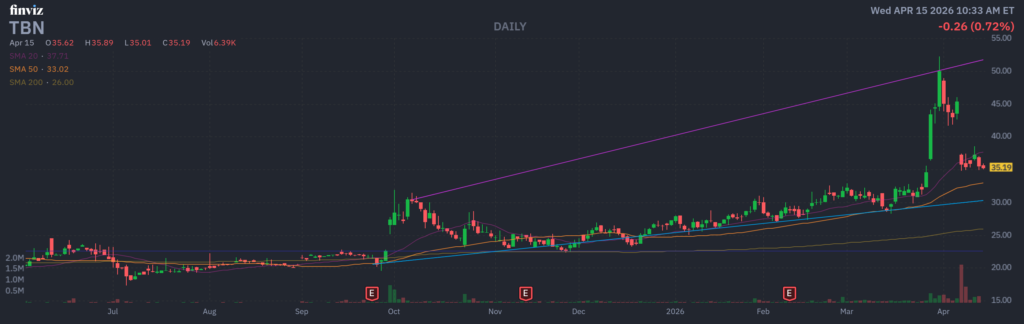
Name: Scott D. Sheffield
Position: Director
Transaction Date: 04-08-2026 Shares Bought: 6,990 shares an average price paid of $36.02 for a cost of $251,774
Company: Tamboran Resources Corp (TBN)
Tamboran Resources Corporation is a natural gas firm that focuses on the development of unconventional gas resources in Australia’s Northern Territory. The company seeks large-scale shale gas prospects in the Beetaloo Basin, with the goal of meeting domestic energy needs and potentially exporting. It owns a 25% non-operated working interest in EP 161 and a 38.75% working interest in EPs 76, 98, and 117. Tamboran also owns a 100% working interest in EPs 136 and 143, as well as EP A 197, which increases its operational control and exploration possibilities. Tamboran Resources Corporation was created in 2009 and is based in Sydney, Australia.
Scott D. Sheffield has been a Director of Tamboran Resources Corp since July 28, 2025, when he was appointed to the company’s Board as a Class II director. He has more than five decades of experience in the oil and gas sector, most notably as the founder and former CEO of Pioneer Natural Resources, and provides strategic and operational skills to Tamboran’s development activities. He has also served on a number of business and educational boards, including the National Petroleum Council, America’s Natural Gas Alliance, and the Southern Methodist University Cox School of Business’s Maguire Energy Institute. He earned a Bachelor of Science in Petroleum Engineering from the University of Texas.
Insomniac Hedge Fund Guy Opinion: Tamboran Resources is an early-stage natural gas E&P company focused on developing unconventional shale gas assets in Australia’s Beetaloo Basin. Think of it as a pre-cash-flow shale story trying to replicate the U.S. playbook in a new geography. The company holds a large acreage position—~2 million+ net acres—and is positioning itself as a future supplier to both Australia’s domestic gas shortage and Asian LNG markets.
There is no real “moat” yet. This is a resource development story, not a platform business. The upside comes from geology, execution, and access to capital—not switching costs or pricing power. If the Beetaloo Basin proves economically viable at scale, Tamboran wins. If not, equity holders get diluted into oblivion.
Revenue today is essentially non-existent, with meaningful production not expected until ~2026 or later. That means no real revenue growth rate, no recurring revenue, and no net retention metrics—this is still a concept moving toward commercialization.
Management, led by CEO Todd Abbott, brings U.S. shale experience, which is critical given the technical complexity of unconventional drilling. The company has also partnered with U.S. service providers to import expertise and equipment into Australia—smart, but capital intensive.
Profitability is deeply negative, as expected. The company is funding drilling and pilot projects through equity raises and external capital, with ongoing dilution a real risk. Recent capital raises and acquisitions (like Falcon Oil & Gas assets) reinforce the “build first, monetize later” strategy.
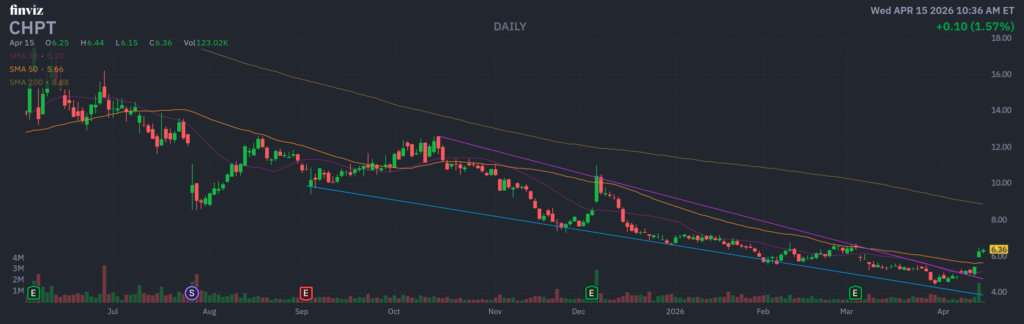
Name: Richard Wilmer
Position: President and CEO
Transaction Date: 04-13-2026 Shares Bought: 46,847 shares an average price paid of $5.34for a cost of $249,999
Company: ChargePoint Holdings Inc. (CHPT)
ChargePoint Holdings, Inc., through its subsidiaries, provides electric vehicle charging technology solutions in North America and Europe. The company serves commercial customers in retail, workplace, hospitality, healthcare, education, fueling and convenience, and parking lot operators; fleet customers in municipal buses, delivery and work vehicles, port/airport/warehouse and other industrial applications, as well as ride-sharing services; and residential customers in single family homes, multi-family apartments, and condominiums. It also comprises ChargePoint eMSP Service, ChargePoint Mobile App, ChargePoint Model, and the EV Ecosystem. ChargePoint Holdings, Inc. was created in 2007 and is based in Campbell, California.
Richard Wilmer has been the President and Chief Executive Officer of ChargePoint Holdings Inc. since November 2023, when he was also appointed to the board of directors. He joined the company in July 2022 as Chief Customer and Operations Officer, then became Chief Operating Officer in December 2022 before taking on the CEO job. Richard Wilmer has more than three decades of expertise in technology, operations, and global manufacturing leadership across a variety of businesses. He earned a Bachelor of Science in Chemistry from the University of California, Berkeley.
Insomniac Hedge Fund Guy Opinion: ChargePoint is a classic “picks-and-shovels” EV play—selling charging hardware, but more importantly operating a network with software, subscriptions, and fleet management tools. The vision is compelling: as EV adoption grows, someone has to own the infrastructure layer. ChargePoint wants to be that platform.
The problem is the business model is still in transition. A large portion of revenue historically comes from selling charging hardware—low margin and cyclical. The real value sits in subscriptions (software + services), which are higher margin and more predictable. Subscription revenue is growing faster (~13% in FY2026) but still only ~40% of total revenue, meaning the company hasn’t fully crossed into a true SaaS-like model yet.
Revenue growth over the past five years has been volatile—hyper-growth early, followed by stagnation and even declines (FY2025 down ~18%). Recent results show a modest return to growth (~6–7%), but this is hardly the straight-line EV adoption story investors once priced in.
Moat is questionable. There is some network effect and switching friction, but EV charging is still fragmented, capital-intensive, and competitive. This is not yet a Visa/Mastercard-type network—it’s closer to a hardware-heavy infrastructure rollout with software layered on top.
Management, led by CEO Rick Wilmer, is focused on cost control, margin improvement, and shifting mix toward subscriptions. Execution here is everything.
Profitability remains the core issue. Gross margins are improving (~30%+), but the company is still loss-making with ongoing cash burn.
____________________________________________________________________________________________________________________
This blog is solely for educational purposes and the author’s own amusement. IT IS NOT INVESTMENT ADVICE. Think of the blog as part of my personal investment journal that I am willing to share with the DIY investor. We could be long, short, or have no position at all in any of the stocks mentioned and express no written or implied obligation to disclose any of that. Nothing contained here constitutes a recommendation to buy or sell any security. Investing involves risk, including the possible loss of principal, and past performance is not indicative of future results.
“The insomniac hedge fund guy” is a moniker Harvey Sax, the portfolio manager for The Insiders Fund” has used from time to time on email, blog ,and social media posts. While Mr. Sax is the portfolio manager of The Insiders Fund, these posts are not communications from, nor endorsed by, Alpha Wealth Funds, LLC or any of its managed funds. References to Alpha Wealth Funds or its affiliates are for identification only and do not imply sponsorship or approval.
All company names, logos, and trademarks belong to their respective owners. The use of company logos is solely for descriptive and illustrative purposes under fair use. Any information provided is based on publicly available data and should not be considered financial, investment, or legal advice. Readers should conduct their own research or consult with a professional before making any investment decisions. Insiders sell the stock for many reasons, but they generally buy for just one – to make money. You’ve always heard the best information is inside information. Everyone with any stock market experience pays close attention to what insiders are doing. After all, who knows a business better than the people running it? Officers, directors, and 10% owners are required to inform the public through a Form 4 Filing of any transaction, buy, sell, exercise, or any other within 48 hours of doing so.
This info is available for free from the SEC’s Web site, Edgar, although we subscribe to SECForm4 as they provide a way to manage and make sense of the vast realms of data. I’ve tried a lot of vendors. SECForm4 is one of the smaller ones, but I like supporting Frank. He is not arrogant. He’s helpful and has great prices. He also trades on his own data, so I like people that eat what they kill. The bar is different from selling because the natural state of management is to be a seller. This is because most companies provide significant amounts of management compensation packages as stock and options. Therefore, we analyze unusual patterns with selling, such as insiders selling 25 percent or more of their holdings or multiple insiders selling near 52-week lows. Another red flag is large planned sale programs that start without warning. Unfortunately, the public information disclosure requirements about these programs, referred to as Rule 10b5-1, are horrendously poor. Also, planned sales that pop up out of nowhere are basically sales and are seeking cover under this corporate welfare loophole.
I also generally ignore 10 percent shareholders as they tend to be OPM (other people’s money) and perhaps not the smart money on which we are trying to read the tea leaves. I say generally because some 10% shareholders are great investor, think Warren Buffett and others. Of course, insiders can also be wrong about their Company’s prospects. Don’t let anyone fool you into believing they never make mistakes. Do your own analysis. They can easily be wrong, and in many cases, maybe most cases, have no more idea what the future may hold than you or me. In short, you can lose money following them. We have, and we curse aloud; what were they thinking!
We like Fly on the Wall for keeping up with what events might be happening, analysts’ comments, and whatever else could be moving the stock. Dow Jones news service is an essential tool, but many services pick up their feed like they do Bloomberg. My assistant probes the 10k for a reasonable description of the business. I’ve found that to be the most accurate and succinct place to find out what a business actually does.