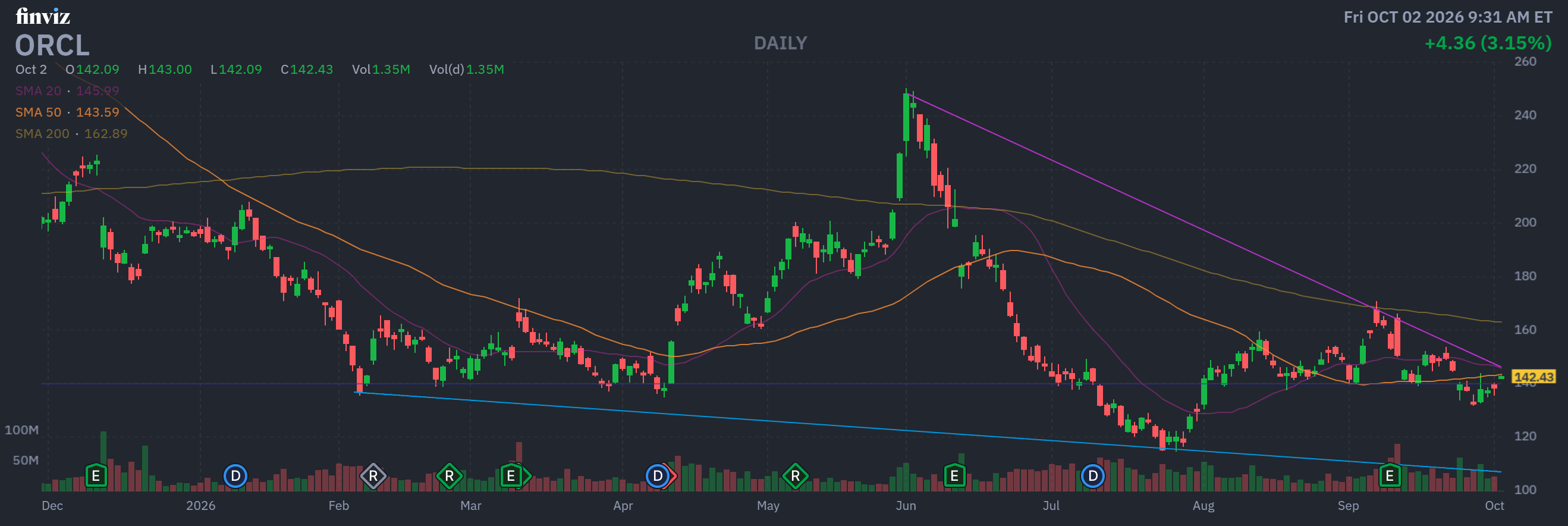
Name: Stephen H. Rusckowski
Position: Director
Transaction Date: 09-29-2026 Shares Bought: 25,000 shares an average price paid of $139.35 for Cost: $3,483,800
Company: Oracle Corp. (ORCL)
Oracle Corporation offers solutions and services for developing, running, and supporting enterprise information technology frameworks globally. The company provides cloud-based software tools for enterprise resource planning, enterprise performance management, supply chain and manufacturing management, human capital management, customer experience, NetSuite, and Oracle Health. It also offers cloud infrastructure, databases, Java, middleware, AI, ML, IoT, and blockchain technologies. Additionally, Oracle provides engineered systems, servers, storage solutions, operating systems, virtualization software, management software, hardware support, consultancy, and enhanced customer services. The corporation sells its products directly and indirectly to enterprises, governments, and educational institutions. Oracle Corporation was founded in 1977 and has its headquarters in Austin, Texas.
Stephen H. Rusckowski has been a Director at Oracle Corp. since November 2025, when he joined the company’s Board of Directors. He had not previously worked for Oracle. Rusckowski is the former President and CEO of Quest Diagnostics, where he managed the company for a decade, and was formerly CEO of Philips Healthcare. He presently serves on QIAGEN’s supervisory board and has vast experience in healthcare, technology, global operations, and corporate leadership. He holds a Bachelor of Science in Mechanical Engineering from Worcester Polytechnic Institute and a Master of Science in Management from the MIT Sloan School of Management.
Insomniac Hedge Fund Guy Opinion: Perfect 10 score: +4.9 (Constructive), driven by bullish readings on analyst sentiment, cash flow quality, PEG ratio, sector outlook, and catalysts, offset by neutral readings on valuation and insider activity. In spite of the recent buy, Oracle founder and still largest shareholder, CTO, and otherwise top dog runs the Company like he has is own personal printing press. Current insider buying is dwarfed by insider stock grants. Call me old fashioned but I think a company should respect its shareholders more.
Oracle is a real business with a real moat that got ahead of itself on AI hype, crashed back to earth, and now sits roughly fairly valued on a conservative DCF with a credible bull case still intact above that. The growth is genuine, the backlog is enormous, and the cash flow quality is strong, but the balance sheet is levered up like a company betting the house on AI infrastructure demand showing up on schedule. This isn’t a dog, and it isn’t a layup either, it’s a show-me story: if the capex converts to cash flow as the backlog suggests, today’s price looks cheap in hindsight; if it doesn’t, the debt load turns painful fast. On the numbers, the lean is cautiously bullish for investors with the stomach for the volatility, this is a stock position sizes should respect, not ignore.
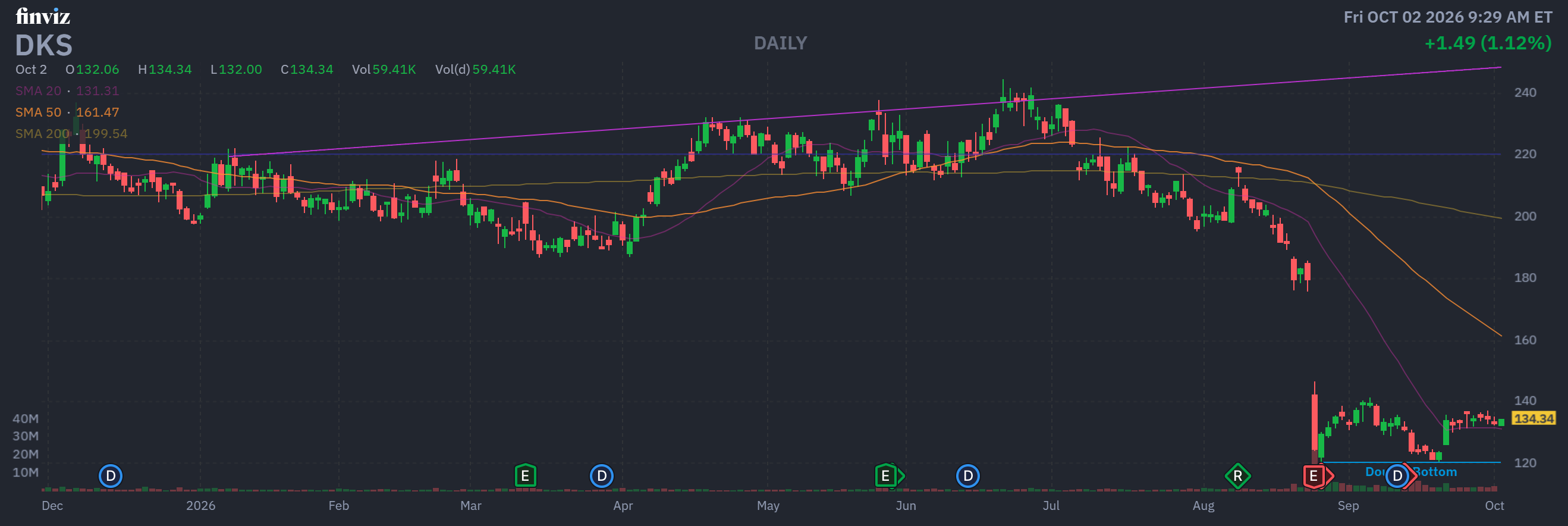
Name: Matthew Barnes
Position: President – Foot Locker Intl
Transaction Date: 09-30-2026 Shares Bought: 3,665 shares an average price paid of $136.39 for Cost: $499,869
Company: Dick’s Sporting Goods Inc. (DKS)
DICK’S Sporting Goods, Inc. is a leading omni-channel sports retailer in the United States, offering a diverse range of products for athletes and outdoor lovers. It sells sports equipment, fitness and golf gear, fishing supplies, athletic clothes, footwear, and accessories for running, basketball, tennis, hiking, and team sports. The company has several specialist retail concepts, including DICK’S Sporting Goods, Golf Galaxy, Public Lands, and DICK’S House of Sport. It also owns Foot Locker, which operates under many banners including Foot Locker, Kids Foot Locker, Champs Sports, WSS, and Atmos. Additionally, GameChanger offers digital youth sports services such as streaming, scheduling, communication, and scorekeeping. DICK’S Sporting Goods, Inc., founded in 1948, is headquartered in Coraopolis, Pennsylvania.
Matthew Barnes became president of Foot Locker International at DICK’S Sporting Goods, Inc. in December 2025, following the company’s acquisition of Foot Locker. He joined the firm in conjunction with this appointment and is in charge of Foot Locker’s shops, eCommerce, and digital businesses in Europe, Asia, and Australia, as well as its licensed activities in Europe, the Middle East, and Asia. Prior to joining DICK’S, Barnes was Tesco’s UK CEO and held many high leadership positions at Aldi Süd, including Group CEO and member of its International Executive Board. He has a Bachelor of Arts degree with honors in Law and Politics from the University of Liverpool.
Insomniac Hedge Fund Guy Opinion: The Perfect 10 composite score on DKS reads +1.1, officially a mixed/neutral read, and that’s the right word for a stock caught between a genuinely strong core business and a self-inflicted wound from the Foot Locker deal. The chart is bearish right now, rejecting resistance after a stochastic rollover. The sector backdrop is bearish. But cash flow quality is bullish, valuation is bullish against the $157.96 analyst target, and insider buying is bullish with zero offsetting sales.
This is a show-me stock, not a conviction buy or a conviction sell. The core DICK’S business still works, the price already reflects a lot of the Foot Locker bad news, and insiders are putting real money behind a turnaround. But a securities fraud lawsuit and a guidance cut inside the same quarter are not nothing, and until Foot Locker posts one clean quarter, the integration risk outweighs the cheap multiple. Watch the next earnings print in late November before committing either way: that single data point settles whether this was a buying opportunity or a value trap.
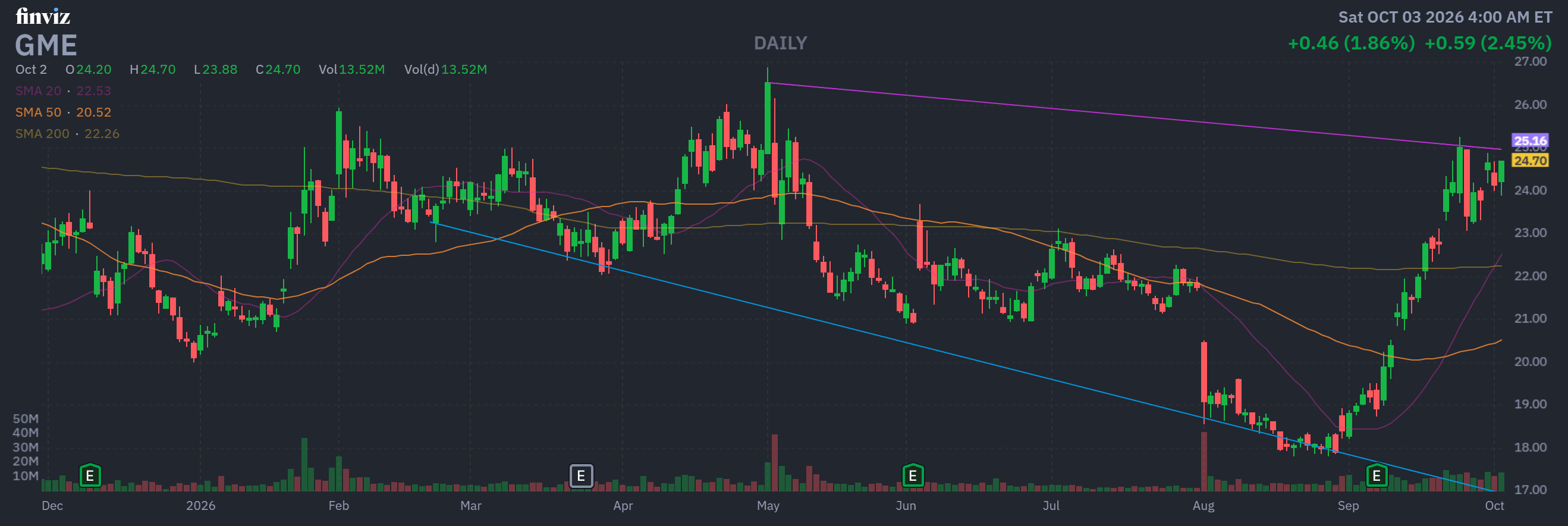
Name: Nat Turner
Position: Director
Transaction Date: 10-01-2026 Shares Bought: 10,462 shares an average price paid of $24.33 for Cost: $254,540
Company: GameStop Corp. (GME)
GameStop Corp. is a specialty retailer that sells games, collectibles, and entertainment products through physical stores and e-commerce platforms in the United States, Australia, and Europe. The company provides new and pre-owned gaming platforms; accessories such as controllers, gaming headsets, and other peripheral devices; new and pre-owned gaming software; and in-game digital currency, digital downloadable content, and full-game downloads. It also sells memorabilia such as clothing, toys, trading cards, gadgets, and other retail items for pop culture and technology fans. GameStop Corp., formerly GSC Holdings Corp., was formed in 1996 and is headquartered in Grapevine, Texas.
Nat Turner has been a Director of GameStop Corp. since November 2024, when he joined the company’s Board of Directors. He is the Chairman and CEO of Collectors Holdings, Inc., PSA’s parent company, and previously co-founded Flatiron Health, where he served as CEO and Invite Media. Turner has vast experience in entrepreneurship, technology, e-commerce, and the collectibles sector. He graduated from the University of Pennsylvania’s Wharton School with a Bachelor of Science in economics.
Insomniac Hedge Fund Guy Opinion: Perfect 10 composite score: +1.6 (mixed-to-neutral), with bullish reads on insider activity, cash flow quality, and PEG ratio, offset by a bearish chart setup and a bearish sector outlook. The fundamentals have genuinely improved, record operating profit, raised guidance, a fortress balance sheet, and the insider buying is about as loud a vote of confidence as you’ll see from a management team. But the stock has already run 34% in a month pricing a lot of that in, and the chart is flashing short-term exhaustion at resistance. This isn’t the beaten-down turnaround story anymore, it’s a fairly-valued cash-rich retailer with a legitimately improving margin profile riding insider momentum. I’d call this a hold for existing holders and a wait-for-a-pullback situation for anyone looking to start a position, chasing it here at resistance is how you end up catching the retracement instead of the rally.
This blog is solely for educational purposes and the author’s own amusement. IT IS NOT INVESTMENT ADVICE. Think of the blog as part of my personal investment journal that I am willing to share with the DIY investor. We could be long, short, or have no position at all in any of the stocks mentioned and express no written or implied obligation to disclose any of that. Nothing contained here constitutes a recommendation to buy or sell any security. Investing involves risk, including the possible loss of principal, and past performance is not indicative of future results.
“The insomniac hedge fund guy” is a moniker Harvey Sax, the portfolio manager for The Insiders Fund” has used from time to time on email, blog ,and social media posts. While Mr. Sax is the portfolio manager of The Insiders Fund, these posts are not communications from, nor endorsed by, Alpha Wealth Funds, LLC or any of its managed funds. References to Alpha Wealth Funds or its affiliates are for identification only and do not imply sponsorship or approval.
All company names, logos, and trademarks belong to their respective owners. The use of company logos is solely for descriptive and illustrative purposes under fair use. Any information provided is based on publicly available data and should not be considered financial, investment, or legal advice. Readers should conduct their own research or consult with a professional before making any investment decisions. Insiders sell the stock for many reasons, but they generally buy for just one – to make money. You’ve always heard the best information is inside information. Everyone with any stock market experience pays close attention to what insiders are doing. After all, who knows a business better than the people running it? Officers, directors, and 10% owners are required to inform the public through a Form 4 Filing of any transaction, buy, sell, exercise, or any other within 48 hours of doing so.
This info is available for free from the SEC’s Web site, Edgar, although we subscribe to SECForm4 as they provide a way to manage and make sense of the vast realms of data. I’ve tried a lot of vendors. SECForm4 is one of the smaller ones, but I like supporting Frank. He is not arrogant. He’s helpful and has great prices. He also trades on his own data, so I like people that eat what they kill. The bar is different from selling because the natural state of management is to be a seller. This is because most companies provide significant amounts of management compensation packages as stock and options. Therefore, we analyze unusual patterns with selling, such as insiders selling 25 percent or more of their holdings or multiple insiders selling near 52-week lows. Another red flag is large planned sale programs that start without warning. Unfortunately, the public information disclosure requirements about these programs, referred to as Rule 10b5-1, are horrendously poor. Also, planned sales that pop up out of nowhere are basically sales and are seeking cover under this corporate welfare loophole.
I also generally ignore 10 percent shareholders as they tend to be OPM (other people’s money) and perhaps not the smart money on which we are trying to read the tea leaves. I say generally because some 10% shareholders are great investor, think Warren Buffett and others. Of course, insiders can also be wrong about their Company’s prospects. Don’t let anyone fool you into believing they never make mistakes. Do your own analysis. They can easily be wrong, and in many cases, maybe most cases, have no more idea what the future may hold than you or me. In short, you can lose money following them. We have, and we curse aloud; what were they thinking!
We like Fly on the Wall for keeping up with what events might be happening, analysts’ comments, and whatever else could be moving the stock. Dow Jones news service is an essential tool, but many services pick up their feed like they do Bloomberg. My assistant probes the 10k for a reasonable description of the business. I’ve found that to be the most accurate and succinct place to find out what a business actually does.
For more, please visit out website at https://insomniachedge.com/