Insiders are buying. Is this like saying the fish are biting? Where they are biting though is very interesting. Make your own conclusions but the fishing is very good.
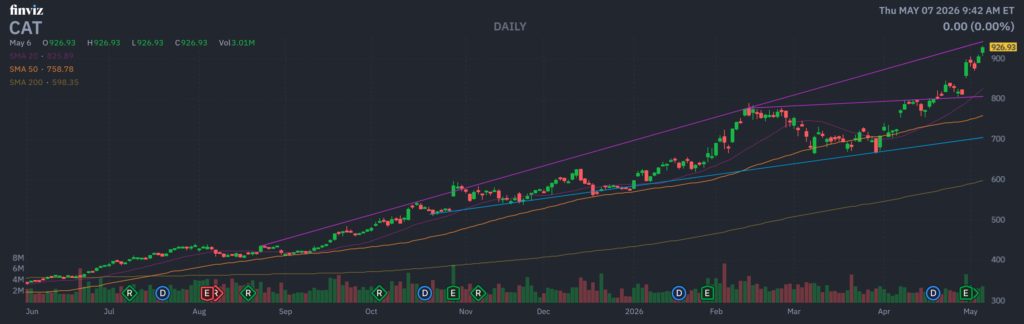
Name: David MacLennan
Position: Director
Transaction Date: 05-04-2026 Shares Bought: 250 shares an average price paid of $876.84 for Cost: $219,210
Company: Caterpillar Inc. (CAT)
Caterpillar Inc. is a global provider of construction and mining equipment, engines, turbines, and locomotives. It operates in five segments: construction industries, resource industries, energy and transportation, financial products, and all others. Its product line includes loaders, excavators, mining trucks, drills, generators, gas compressors, and rail goods, as well as parts, maintenance components, and advanced technological solutions, including fleet management, automation, and analytics. In addition to logistics, distribution, and digital solutions, the company provides financial services such as leasing, loans, and insurance. Formerly known as Caterpillar Tractor Co., it was founded in 1925 and is located in Irving, Texas, servicing customers in a variety of industrial industries worldwide.
David MacLennan has been a director of Caterpillar Inc. since 2022, bringing decades of worldwide leadership expertise to the company’s board. Although he did not join Caterpillar as an executive, his nomination as director demonstrates his experience managing complicated international operations. MacLennan is most recognized for his long stint at Cargill, where he started in 1991 and eventually became chairman and CEO from 2013 until 2023, leading one of the world’s largest privately held enterprises. His experience in strategy, risk management, and supply chains improves Caterpillar’s governance. He has a bachelor’s degree in economics from Amherst College and an MBA from the University of Chicago Booth School of Business.
Insomniac Hedge Fund Guy Opinion: Caterpillar is the global king of heavy equipment. The company sells construction machinery, mining trucks, engines, turbines, and industrial equipment used across infrastructure, energy, and resource industries. It is one of the purest ways to play global industrial activity and large-scale infrastructure spending.
The moat is scale, dealer networks, and brand reputation. Caterpillar’s global dealer ecosystem is nearly impossible to replicate and gives the company a massive advantage in service, financing, and parts distribution. Customers care deeply about uptime, reliability, and resale value, and CAT machines consistently rank near the top. Once customers standardize fleets around Caterpillar equipment, switching becomes expensive and operationally disruptive.
Over the past five years, revenue growth has been solid despite cyclical swings, averaging mid-single digits overall with stronger gains recently due to infrastructure spending and mining demand. Recurring revenue mainly comes from aftermarket parts, maintenance, and services, which now represent a meaningful portion of profits even if not the majority of total revenue. Services revenue has steadily expanded as Caterpillar pushes digital fleet management and predictive maintenance tools. Net retention metrics are not formally disclosed, but customer loyalty remains extremely high.
Management has become far more disciplined than in past cycles. The company now prioritizes free cash flow, margin stability, and shareholder returns over aggressive expansion. That operational discipline has significantly improved profitability compared with prior commodity cycles.
Margins and returns on capital are materially better today than a decade ago, helped by pricing power and stronger aftermarket economics.
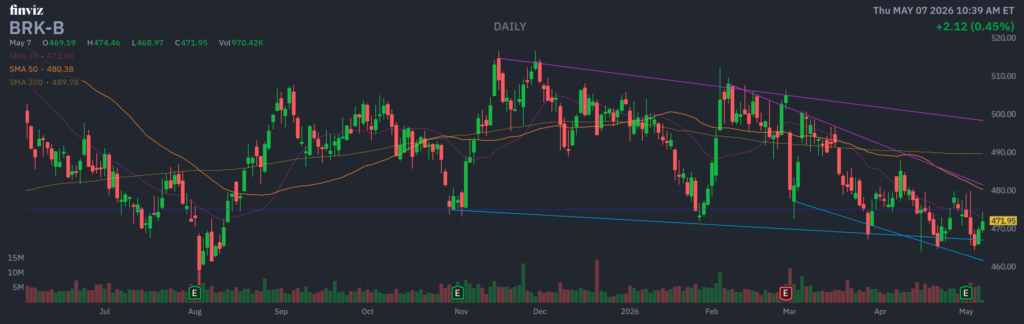
Name: Michael J. O’Sullivan
Position: See Remarks
Transaction Date: 05-06-2026 Shares Bought: 536 shares an average price paid of $467.44 for Cost: $250,545
Company: Berkshire Hathaway Inc. (BRK-B)
Berkshire Hathaway Inc., through its subsidiaries, operates in the insurance, freight rail transportation, and utility businesses. The company offers property, casualty, life, accident, and health insurance and reinsurance; operates railroad systems in North America; generates, transmits, stores, and distributes electricity from natural gas, coal, wind, solar, hydroelectric, nuclear, and geothermal sources; operates natural gas distribution and storage facilities, interstate pipelines, liquefied natural gas facilities, and compressor and meter stations; and owns coal mining assets. It creates packaged chocolates and other confectionery products, as well as specialty chemicals, metal-cutting tools, and aerospace and power-generating components. The company was established in 1998 and is based in Omaha, Nebraska.
Michael J. O’Sullivan is currently the Senior Vice President, General Counsel, and Secretary at Berkshire Hathaway Inc., having joined in January 2026. Prior to joining Berkshire Hathaway, he was Snap Inc.’s General Counsel since 2017, and he previously worked with Munger, Tolles & Olson for almost 20 years, specializing in corporate governance, mergers and acquisitions, and complex litigation problems. His appointment marked the start of Berkshire Hathaway’s first formal in-house General Counsel role. O’Sullivan is well-known for his legal and corporate advice expertise, which he gained from decades of experience working with major public firms. He received his law degree from Stanford Law School after finishing his undergraduate studies at Georgetown University.
Insomniac Hedge Fund Guy Opinion: Berkshire Hathaway is essentially a diversified holding company built around insurance, railroads, utilities, manufacturing, consumer brands, and one of the greatest investment portfolios ever assembled. The company owns businesses ranging from GEICO and BNSF Railway to energy assets and dozens of industrial subsidiaries, while also holding massive stakes in public companies like Apple Inc. and Coca-Cola.
The moat is capital allocation. Warren Buffett and Charlie Munger created a system where insurance float funds acquisitions and investments at extremely low cost. Berkshire’s decentralized structure allows subsidiaries to operate independently while headquarters allocates capital where returns are highest. Few companies have Berkshire’s balance sheet strength, liquidity, and ability to deploy billions during market stress.
Revenue growth over the past five years has generally been mid-single digits, though results fluctuate because of insurance underwriting, railroad demand, and investment income volatility. A large portion of earnings is effectively recurring, especially from insurance premiums, utilities, rail operations, and consumer subsidiaries. The business generates enormous free cash flow and consistently maintains one of the strongest balance sheets in corporate America.
Management succession is the key debate now. Buffett remains the face of the company, but Greg Abel is widely expected to lead Berkshire in the future. Investors are betting the culture and capital allocation discipline survive beyond Buffett.
Profitability remains exceptional for a conglomerate of this size. Berkshire continues compounding book value, cash flow, and operating earnings despite its enormous scale.
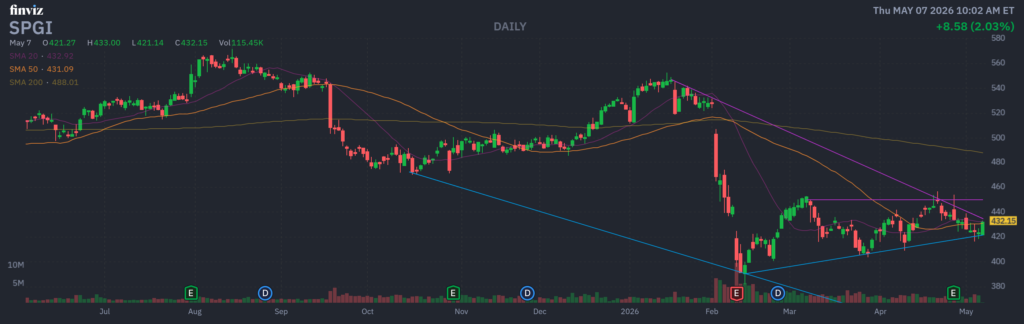
Name: Robert Edward Moritz Jr
Position: Director
Transaction Date: 04-30-2026 Shares Bought: 1,152 shares an average price paid of $434.03 for Cost: $500,001
Name: Catherine R. Clay
Position: CEO, S&P Dow Jones Indices
Transaction Date: 05-01-2026 Shares Bought: 2,500 shares an average price paid of $431.39 for Cost: $1,078,475
Company: S&P Global Inc. (SPGI)
S&P Global Inc. offers benchmarking, data, analytics, and workflow solutions for the worldwide financial, energy, commodity, and automotive industries. It operates in five segments: Market Intelligence, Ratings, Energy, Mobility, and S&P Dow Jones Indices. Market Intelligence provides financial professionals with multi-asset data, analytics, and workflow tools. Ratings provides impartial credit ratings, research, and market insights. Energy provides price benchmarks and statistics for commodity markets, whereas Mobility supports the automotive value chain. S&P Dow Jones Indices maintains popular market indices for investors. S&P Global Inc. was founded in 1860, has its headquarters in New York, and operates all over the world.
Robert Edward Moritz Jr. has been a Director of S&P Global Inc. since 2026, following his appointment by the board in November 2025, and his post became effective on March 1, 2026. He is a highly experienced global business leader best recognized for his nearly four-decade career at PricewaterhouseCoopers, where he served as Global Chairman from 2016 until 2024, overseeing strategy and global operations. In addition to S&P Global, he has served on the boards of large firms including Walmart and Northern Trust. Moritz joined S&P Global as a Director, rather than serving in previous operational roles. He graduated from the State University of New York at Oswego, which is also his alma mater.
Catherine R. Clay joined S&P Global Inc. in October 2025 as Chief Executive Officer of S&P Dow Jones Indices, and her position became effective on November 1, 2025. Since then, she has been the CEO of S&P Dow Jones Indices, where she oversees the company’s global index business as well as strategy, operations, and innovation across its benchmark offerings. She formerly served as CEO of LiveVol and held key leadership positions at Cboe Global Markets, including Executive Vice President and Global Head of Derivatives, before joining S&P Global. She has strong experience with derivatives, data analytics, and financial technology. Catherine Clay has a Bachelor of Science degree from the University of Colorado.
Insomniac Hedge Fund Guy Opinion: S&P Global is one of the best financial data businesses in the world. The company owns a collection of essential financial infrastructure assets: credit ratings, index licensing, commodity pricing data, and market intelligence platforms. Most investors know the S&P 500 index, but the real story is that SPGI sits directly inside global capital market workflows. Governments, banks, asset managers, and corporations rely on its data every day.
The moat is enormous. Credit ratings are effectively an oligopoly dominated by S&P and Moody’s. Meanwhile, the index business benefits from trillions of ETF assets benchmarked to S&P indices, creating highly recurring licensing revenue. Switching costs are significant because financial institutions build workflows around SPGI’s data products and analytics.
Revenue has compounded at a strong rate over the last five years, helped by the IHS Markit merger and continued demand for financial data and analytics. 2025 revenue reached roughly $15.3B, up nearly 8% year-over-year. Large portions of the company generate recurring subscription-like revenue, with some segments running above 80–95% recurring revenue.
Management recently transitioned to CEO Martina Cheung, a longtime company veteran focused on AI integration, private markets data, and simplifying the portfolio through the Mobility spin-off.
Profitability is elite. Operating margins regularly exceed 40%, and free cash flow generation remains exceptional.

Name: Lucy Clarke
Position: President of Risk & Broking
Transaction Date: 05-06-2026 Shares Bought: 1,896 shares an average price paid of $263.37 for Cost: $499,340
Name: Carl Aaron Hess
Position: Chief Executive Officer
Transaction Date: 05-04-2026 Shares Bought: 2,000 shares an average price paid of $255.08 for Cost: $510,160
Company: Willis Towers Watson Plc (WTW)
Willis Towers Watson Public Limited Company is a global advising, broking, and solutions provider. The company is divided into two segments: Health, Wealth, and Career, and Risk and Broking. It provides strategy and design advice, plan management services and support, and brokerage and administration services for health, wellness, and other group benefit plans such as medical, dental, disability, life, voluntary benefits, and other coverages. The company also provides advise, data, software, and products to handle clients’ total rewards and talent concerns, as well as risk advisory, insurance brokerage and consultancy services. In January 2016, the company changed its name from Willis Group Holdings Public Limited Company to Willis Towers Watson Public Limited Company. The Company was founded in 1828 and is headquartered in London, United Kingdom.
Lucy Clarke joined Willis Towers Watson Plc in July 2024 and became President of Risk & Broking. In her role, she is responsible for the financial and operational management of WTW’s global Risk & Broking business, which serves clients in more than 140 countries. Clarke has worked in high executive positions at Marsh and JLT Group, including President of Marsh Specialty and Global Placement and CEO of JLT Global Specialty. She has over 25 years of experience in the insurance and risk management industries and is known for her expertise in specialty insurance, analytics, and client-focused strategy. Clarke holds a Bachelor of Arts degree in English from Vanderbilt University.
Carl Aaron Hess has been the Chief Executive Officer of Willis Towers Watson Plc since January 1, 2022, having been named President and Future CEO in August 2021. He joined the company in 1989 through its predecessor firm, Watson Wyatt, and has held many senior positions in investment, risk, and reinsurance operations throughout the course of his more than three decades with the organization. Hess also serves as a Director of the company, a position he took when he was appointed CEO in 2022. According to public filings, he owns less than 10% of the corporation. He is a Fellow of the Society of Actuaries and holds a B.A. cum laude in logic and language from Yale.
Insomniac Hedge Fund Guy Opinion: Willis Towers Watson is basically a global insurance broker and consulting firm disguised as a boring corporate services company. The business spans risk brokerage, employee benefits, retirement consulting, and actuarial services. In practice, WTW sits in the middle of large corporations’ insurance and workforce decisions, which creates sticky client relationships and recurring fee revenue.
The moat comes from scale, relationships, and embedded advisory expertise. Large multinational clients do not casually switch risk consultants or benefits advisors because these relationships are tied into HR systems, insurance placements, and long-term planning. Retention across the industry is typically high, and WTW benefits from recurring commissions and consulting contracts.
Over the last five years, revenue growth has been modest, generally in the mid-single-digit range organically, though divestitures have distorted reported numbers recently. Organic growth in 2025 remained around 5–6%, while profitability improved materially through efficiency initiatives.
CEO Carl Hess has focused on operational discipline, margin expansion, and simplifying the portfolio after years of integration headaches following the Towers Watson merger. The company is also investing in AI-enabled brokerage and consulting tools while expanding further into middle-market insurance through acquisitions like Newfront.
Profitability has improved significantly. Adjusted operating margins moved above 20% in 2025, and free cash flow remains strong thanks to the asset-light model.

Name: David MacLennan
Position: Director
Transaction Date: 05-04-2026 Shares Bought: 800 shares an average price paid of $256.91 for Cost: $205,530
Company: Ecolab Inc. (ECL)
Ecolab Inc. offers water, hygiene, and infection prevention solutions and services in the United States and abroad. The company operates in four segments: Global Water, Global Institutional & Specialty, Global Pest Elimination, and Global Life Sciences. The Global Water business provides water treatment and processing applications, as well as cleaning and sanitation solutions. The Global Institutional & Specialty section offers cleaning and sanitizing solutions to the foodservice, healthcare, hospitality, lodging, government, education, and retail sectors. The Global Pest Elimination segment offers pest elimination services for detecting, preventing, and eliminating pests. The Global Life Sciences section offers cleaning and contamination control solutions for pharmaceuticals and personal care. Ecolab Inc. was formed in 1923 and is based in St. Paul, Minnesota.
David W. MacLennan has been a director of Ecolab Inc. since joining the board in December 2015, and he continues to play an important role as Lead Independent Director. With over three decades of leadership experience, he contributes extensive knowledge of global business operations, financial management, and corporate governance, which he gained notably during his long stint at Cargill as CEO (2013-2022) and later Executive Chair. His strategic insights contribute to Ecolab’s long-term growth and governance activities. He has a bachelor’s degree in English from Amherst College and an MBA in finance from the University of Chicago.
Insomniac Hedge Fund Guy Opinion: Ecolab is one of those classic “boring but powerful” businesses that quietly compounds for decades. The company provides water treatment, cleaning, sanitation, and infection-prevention solutions to restaurants, hotels, hospitals, food processors, and industrial facilities worldwide. Its products are essential to daily operations, which makes demand unusually resilient even during weaker economic periods.
The moat comes from customer integration and service relationships. Ecolab doesn’t just sell chemicals—it embeds employees, monitoring systems, and process expertise directly into customer operations. Once installed, switching providers becomes disruptive and risky, especially for food safety or industrial water systems. That creates sticky recurring revenue and long customer relationships.
Over the last five years, revenue growth has generally been in the mid-single-digit range, supported by pricing power, international expansion, and increasing demand for water-efficiency solutions. A large portion of the business is recurring because customers continuously reorder cleaning and treatment products while maintaining service contracts. The company does not formally disclose net revenue retention, but retention appears strong due to the mission-critical nature of its services.
Management has historically been disciplined, focusing on operational efficiency, margin expansion, and steady bolt-on acquisitions rather than aggressive empire building. The company also benefits from long-term secular trends around sustainability, water scarcity, hygiene standards, and energy efficiency.
Profitability has improved significantly after the inflationary pressure seen in 2022–2023. Gross margins and operating margins have been recovering as pricing actions caught up with higher raw material costs. Free cash flow generation remains solid.

Name: James D. Hope
Position: Director
Transaction Date: 05-07-2026 Shares Bought: 464 shares an average price paid of $194.41 for Cost: $90,209
Name: John E. Stokely
Position: Director
Transaction Date: 05-07-2026 Shares Bought: 1,000 shares an average price paid of $193.06 for Cost: $193,065
Name: Manuel J. Perez De La Mesa
Position: Director
Transaction Date: 05-07-2026 Shares Bought: 10,000 shares an average price paid of $190.00 for Cost: $1,900,000
Company: Pool Corp (POOL)
Pool Corporation provides swimming pool supplies, equipment, related recreational, irrigation, and landscape care items in the United States as well as around the world. The company provides maintenance products such as chemicals, supplies, and pool accessories; repair and replacement parts for pool equipment such as cleaners, filters, heaters, pumps, and lights; and building materials such as concrete, plumbing, and electrical components, functional and decorative pool surfaces, decking materials, tiles, hardscapes, and natural stones for pool installations and remodeling. It also offers pool equipment and components for new and renovated pools, as well as irrigation and related items. Pool Corporation was established in 1993 and is based in Covington, Louisiana.
James D. Hope has served as an Independent Director of Pool Corp. since October 10, 2022, when he was appointed by the Board of Directors to fill a newly created board seat and later stood for election by shareholders. He joined the company’s board after a long executive career in financial and operational leadership roles across major distribution companies, bringing deep expertise in finance, strategic planning and operations to Pool Corp’s governance. He holds a Bachelor of Business Administration from the University of Texas at Austin, reflecting his strong foundation in business and finance.
John E. Stokely joined Pool Corp.’s Board of Directors in 2000 and is currently the Executive Chair. He was named Lead Independent Director in 2003 and Chairman of the Board in 2017, before switching to Executive Chair in May 2026. Prior to joining Pool Corp, Stokely was President, CEO, and Chairman of Richfood Holdings, Inc., a Fortune 500 wholesale food distributor, where he gained valuable expertise in corporate leadership and operations management. His long service on Pool Corp’s board has helped to shape the company’s governance and strategic growth plans. Stokely holds a bachelor’s degree in business administration from the University of Richmond.
Manuel J. Perez de la Mesa joined Pool Corp’s Board of Directors in 2001 and presently serves as Vice Chairman and Director. He was appointed Director in 2001 while serving as President and Chief Executive Officer of the company, roles he held until his retirement at the end of 2018. Prior to becoming CEO, he joined Pool Corp in 1999 as President and Chief Operating Officer, where he helped convert the firm into the world’s largest wholesale distributor of swimming pool supplies and outdoor living items. Perez de la Mesa holds a bachelor’s degree in business administration from Florida International University and an MBA from St. John’s University.
Insomniac Hedge Fund Guy Opinion: Pool Corp is basically the hidden toll booth of the swimming pool industry. The company is the largest wholesale distributor of pool supplies, equipment, chemicals, irrigation products, and outdoor living materials in North America. It sells primarily to professional pool builders, maintenance companies, and contractors through a huge distribution network.
The moat is scale and logistics. Pool servicing is local, seasonal, and time-sensitive, which makes distribution density extremely valuable. Pool Corp’s nationwide network allows contractors to get products quickly, often same day, which smaller competitors struggle to match. The installed base of existing pools also matters more than new construction. Once a pool exists, it needs chemicals, pumps, filters, heaters, and repairs every year. That creates a surprisingly recurring business model.
Revenue growth over the last five years has been strong overall despite a post-COVID slowdown. Sales peaked during the housing and backyard boom, then normalized as higher interest rates crushed discretionary pool construction. 2025 revenue was roughly flat around $5.3 billion after several years of elevated demand. Maintenance and repair-related products represent roughly 60%+ of sales, giving the company a meaningful recurring revenue base tied to existing pool ownership rather than new builds.
CEO Peter D. Arvan has managed the downturn relatively well with disciplined inventory and cost control.Profitability has come down from pandemic highs, with operating margins falling from the mid-teens to around 11%, but the business still generates strong cash flow.

Name: Dino Robusto
Position: Director
Transaction Date: 05-05-2026 Shares Bought: 5,000 shares an average price paid of $105.44 for Cost: $527,200
Company: Loews Corp. (L)
Loews Corporation and its subsidiaries provide commercial property and liability insurance in the United States and abroad. The company offers specialty insurance products, such as management and professional liability and other coverage products; surety and fidelity bonds; professional liability coverages and risk management services to various professional firms, including architects, real estate agents, accounting and law firms; standard and excess property, marine and boiler, machinery coverages, workers’ compensation, general and product liability, as well as associated casualty coverage. Loews Corporation was founded in 1969 and is headquartered in New York, NY.
Dino Robusto is a director at Loews Corporation, having joined the board in 2022. He is most known for his work as President and Chief Executive Officer of CNA Financial Corporation, a Loews subsidiary, which he has held since 2016, following his prior position as CFO. Robusto brings extensive experience in insurance operations, underwriting, and financial management, providing unique industry knowledge to Loews’ board oversight and strategic direction. His leadership experience improves governance throughout Loews’ many companies. providing a solid foundation for his long career in finance and insurance. Dino Robusto has a bachelor’s degree in accountancy.
Insomniac Hedge Fund Guy Opinion: Loews is basically a mini-conglomerate hiding in plain sight. The business owns a controlling stake in insurer CNA Financial, along with Boardwalk Pipelines, Loews Hotels, and packaging assets. Insurance drives the majority of earnings and value, while the pipeline and hotel businesses provide diversification and steady cash flow.
The moat here is capital allocation. The Tisch family has run Loews for decades with a conservative, value-oriented mindset. They buy back stock aggressively when shares trade below intrinsic value and avoid the empire-building behavior common in conglomerates. The structure is boring, but boring can work.
Revenue growth over the past five years has been modest, generally in the mid-single digits, with 2025 revenue reaching roughly $18.5B. Insurance premiums and pipeline contracts create a fairly recurring revenue base, though this is not a SaaS-style recurring revenue story. CNA remains the economic engine, contributing over 80% of revenue.
Management recently transitioned from longtime CEO James Tisch to Ben Tisch, but the playbook remains unchanged: disciplined underwriting, conservative balance sheet management, and opportunistic buybacks. Reddit and investor discussions consistently highlight Loews’ large cash position and persistent repurchases as part of the bull case.
Profitability has improved meaningfully thanks to higher investment income and strong insurance underwriting, though results can fluctuate with catastrophe losses and reserve adjustments.

Name: Thomas A. Kennedy
Position: Director
Transaction Date: 05-01-2026 Shares Bought: 10,300 shares an average price paid of $95.98 for Cost: $988,594
Company: Textron Inc. (TXT)
Textron Inc. works in six business segments around the world, including aircraft, defense, industrial, and finance. Its aviation activities produce and repair business jets, military trainer aircraft, helicopters, and tiltrotor aircraft, while its defense section offers unmanned systems, marine craft, armored vehicles, weaponry, and military training solutions. The company’s industrial division manufactures fuel systems, golf cars, off-road and utility vehicles, turf-care equipment, and lightweight battery solutions for electric vehicles. Textron’s eAviation division, which develops electric and light aircraft technology, is also dedicated to sustainable aviation. Additionally, its finance business provides airplane and helicopter financing services. Founded in 1923, the corporation is based in Providence.
Thomas A. Kennedy has been a Director of Textron Inc. since January 1, 2023, after being elected to the Board of Directors in December 2022. He is the retiring Executive Chairman of Raytheon Technologies, having previously served as the Chairman and CEO of Raytheon Company from 2014 to 2020. Kennedy joined Raytheon in 1983 and held many top leadership positions in the company’s defense and aerospace industries throughout the course of his nearly four-decade career. Before joining the private sector, he was a captain in the United States Air Force. He received a bachelor’s degree in electrical engineering from Rutgers University, a master’s degree from the Air Force Institute of Technology, and a doctorate in engineering from the University of California, Los Angeles.
Insomniac Hedge Fund Guy Opinion: Textron is basically a collection of aerospace and defense businesses hiding under one ticker. The company owns Bell helicopters, Cessna jets, Beechcraft aircraft, defense systems, and various industrial operations. The crown jewels are clearly Bell and Textron Aviation, which benefit from rising defense budgets, business jet demand, and lucrative aftermarket service revenue.
The moat is decent but not exceptional. Aerospace certification, long production cycles, government relationships, and installed fleets create barriers to entry. Bell’s military programs—especially the U.S. Army’s FLRAA/MV-75 platform—could become a major long-term earnings driver if execution holds. Meanwhile, Cessna and Beechcraft generate sticky aftermarket parts and maintenance revenue that helps smooth cyclicality.
Recurring revenue is lower than pure aerospace service companies, but aftermarket services and defense support contracts still provide meaningful stability. Net retention metrics are not disclosed.
Management, led by CEO Scott Donnelly, has generally been disciplined on capital allocation, buybacks, and operational execution. Investors seem to trust the team, especially after navigating supply chain problems and labor disruptions better than many peers.
Profitability has improved recently. 2025 operating income climbed to about $1B with EPS growth accelerating into the high teens. Free cash flow generation has also remained strong.

Name: Pierre R. Breber
Position: Director
Transaction Date: 05-05-2026 Shares Bought: 5,000 shares an average price paid of $85.82 for Cost: $429,124
Company: Clorox Co. (CLX)
The Clorox Company manufactures and markets a diverse portfolio of consumer and professional products worldwide, operating through four segments: Health and Wellness, Household, Lifestyle, and International. Its products include cleaning and disinfecting solutions, bleach, laundry additives, cat litter, bags and wraps, grilling products, food items, water-filtration systems, and natural personal care goods. The company also offers vitamins, minerals, and dietary supplements under various brands. Key brands include Clorox, Pine-Sol, Glad, Kingsford, Hidden Valley, Brita, Burt’s Bees, and Fresh Step. It distributes products through mass retailers, grocery stores, e-commerce platforms, and direct sales channels. The company was founded in 1913 and is headquartered in Oakland, California.
Pierre R. Breber joined The Clorox Company’s Board of Directors in 2024 after being elected to the position at the company’s Annual Meeting of Shareholders. He has been an independent director since 2024 and now chairs the Audit Committee, having considerable financial leadership experience from his previous job as chief financial officer of Chevron Corporation. His expertise includes top executive positions in global operations, finance, and strategy, which help to shape Clorox’s governance and oversight. He has a bachelor’s degree in geophysics from the University of California, Berkeley, and an MBA from Cornell University.
Insomniac Hedge Fund Guy Opinion: Clorox is the definition of a classic consumer staples franchise. The company owns a portfolio of household brands including Clorox bleach, Pine-Sol, Glad bags, Hidden Valley Ranch, Burt’s Bees, and Fresh Step cat litter. It’s not exciting, but these are products consumers repeatedly buy regardless of the economic cycle.
The moat comes from brand recognition, shelf space, and retailer relationships. Consumers may trade down occasionally, but Clorox still controls strong market positions across multiple cleaning and household categories. Roughly the entire business is recurring by nature because demand is consumable and repeat-driven.
Over the last five years, revenue growth has been basically flat, hovering around low single digits annually, with fiscal 2025 revenue around $7.1B. The bigger story has been margin recovery after inflation, supply chain disruptions, and the cyberattack that hurt operations in 2023. Gross margins have rebounded meaningfully as pricing actions and lower input costs flowed through the P&L.
CEO Linda Rendle has focused on rebuilding market share, stabilizing operations, and defending profitability in a tougher consumer environment. The challenge is that private-label competition remains intense while consumers are increasingly price sensitive.
Profitability remains solid for a staples company, but growth is limited. This is no longer a premium-growth consumer business; it’s a mature cash-flow and dividend story.

Name: Richard F. Wallman
Position: Director
Transaction Date: 04-29-2026 Shares Bought: 15,000 shares an average price paid of $73.43 for Cost: $1,101,490
Company: Ceco Environmental Corp. (CECO)
CECO Environmental Corp. delivers vital solutions for industrial air quality, industrial water treatment, and energy transition in the United States, the United Kingdom, the Netherlands, China, and across the world. It operates in two segments: Engineered Systems and Industrial Process Solutions. The company provides emissions management, fluid bed cyclones, thermal acoustics, and separation and filtration solutions, as well as technical services and environmental systems. It also offers engineered and customized goods and solutions, such as dampers and diverters, expansion joints, water treatment packages, metallic and non-metallic pumps, industrial silencers, and fluid handling equipment. CECO Environmental Corporation was founded in 1869 and is based in Addison, Texas.
Richard F. Wallman has been an independent director of CECO Environmental Corp. since November 2021, when he joined the board of directors. He has more than three decades of executive leadership experience, including positions as Senior Vice President and Chief Financial Officer at Honeywell and AlliedSignal, as well as membership on several public company boards. He brings financial and strategic knowledge to CECO, serving on critical board committees such as audit supervision. Wallman has a Bachelor of Engineering from Vanderbilt University and an MBA from the University of Chicago’s Booth School of Business.
Insomniac Hedge Fund Guy Opinion: CECO Environmental is one of those classic small-cap industrial stories that suddenly starts showing up on hedge fund screens after years of being ignored. The company provides air, water, and energy transition solutions for industrial customers, with exposure to power generation, semiconductor manufacturing, industrial processing, and environmental compliance. In plain English: CECO sells mission-critical systems that help factories and power plants operate cleaner and more efficiently.
The moat is not massive, but it’s improving. CECO benefits from engineering expertise, long-cycle industrial projects, and growing exposure to regulatory and environmental spending trends. The company has also become more acquisition-driven, using M&A to expand into higher-growth niches tied to data centers, reshoring, and power infrastructure.
Growth recently accelerated in a major way. Revenue has compounded strongly over the last five years, with 2025 revenue jumping nearly 39% year-over-year to roughly $774 million as order activity surged. Backlog and bookings both hit record levels, supported by strong power-generation demand.
Recurring revenue is lower than a typical software or services business since CECO is project-oriented, but aftermarket service, replacement parts, and maintenance revenue provide some stability. Net revenue retention is not disclosed.
CEO Todd Gleason deserves credit for transforming CECO from a sleepy pollution-control company into a faster-growing industrial platform. Profitability is also improving, with adjusted EBITDA margins now around 11–12%, materially better than historical levels.

Name: H. Lawrence Culp Jr
Position: Director
Transaction Date: 05-06-2026 Shares Bought: 80,805 shares an average price paid of $61.88 for Cost: $5,000,076
Company: GE HealthCare Technologies Inc. (GEHC)
GE HealthCare Technologies Inc. creates technologies, medications, and solutions for providers worldwide. It works in four segments: Imaging, Advanced Visualization Solutions, Patient Care Solutions, and Pharmaceutical Diagnostics, providing CT, MRI, ultrasound, X-ray, patient monitoring, anesthetic, cardiology, and molecular imaging solutions. The company also provides contrast media medicines and radiopharmaceuticals for diagnostic scans and nuclear medicine treatments. The company has a strategic partnership with DeepHealth. GE HealthCare Technologies Inc. was previously known as GE Healthcare Holding LLC before changing its name to GE HealthCare Technologies Inc. in December 2022. The corporation was established in 2022 and is based in Chicago, Illinois.
In January 2023, H. Lawrence Culp Jr. was appointed Director and non-executive Chairman of the Board at GE HealthCare Technologies Inc., following the company’s spin-off from General Electric. He presently holds the offices of Chairman of the Board and Director, as well as Chairman and CEO of GE Aerospace. Before joining the GE HealthCare board, Culp joined the GE Board of Directors in April 2018 and was appointed CEO of GE in October 2018, driving a significant restructuring of the company’s operations and portfolio. Before joining GE, he worked at Danaher Corporation for 25 years, including as President and CEO from 2001 to 2014. Culp holds a bachelor’s degree from Washington College and an MBA from Harvard Business School.
Insomniac Hedge Fund Guy Opinion: GE HealthCare is essentially a global medical imaging and diagnostics franchise that got spun out of General Electric. The company sells MRI machines, CT scanners, ultrasound systems, patient monitoring equipment, and pharmaceutical diagnostics products to hospitals and healthcare systems worldwide. Imaging is the crown jewel. Hospitals don’t replace MRI platforms every year, but once installed, these systems create long-term service, software, and consumables revenue streams.
The moat is scale, installed base, and switching costs. Hospitals train technicians around GE systems, integrate the software into workflows, and sign multi-year service contracts. That creates sticky customer relationships and recurring revenue from maintenance, diagnostics agents, and software. Service and recurring-style revenue likely represents roughly half the business today, with management pushing harder into software and digital imaging solutions.
Over the past five years, revenue has grown at a modest mid-single-digit pace, reaching about $20.6B in 2025, up roughly 5% year over year. Growth is not explosive, but healthcare imaging is a durable market with aging-population tailwinds.
CEO Peter Arduini has focused on operational discipline, margin expansion, and building a more software-driven recurring revenue model. The company has also been acquisitive, including the Intelerad deal aimed at expanding imaging software capabilities.Profitability is solid but not elite. Adjusted EBIT margins run around 15–16%, lower than pure software or diagnostics peers but respectable for a capital equipment business.

Name: Joel S. Marcus
Position: Executive Chairman
Transaction Date: 05-05-2026 Shares Bought: 7,500 shares an average price paid of $42.72 for Cost: $320,416
Transaction Date: 05-04-2026 Shares Bought: 10,000 shares an average price paid of $41.02 for Cost: $410,200
Company: Alexandria Real Estate Equities Inc. (ARE)
Alexandria Real Estate Equities, Inc., an S&P 500 business, is a best-in-class, mission-driven life sciences REIT committed to having a positive and long-term global impact. Founded in 1994, the company pioneered the life science real estate specialty and has a proven track record of creating Class A/A+ properties in dynamic, collaborative mega campus environments. These campuses are intended to help tenants attract and keep top people while encouraging productivity, efficiency, creativity, and general success. Alexandria, in addition to its real estate operations, provides strategic funding to transformative life science enterprises via its venture capital platform. The company was founded on January 5, 1994, and is incorporated in Maryland, USA.
Joel S. Marcus joined Alexandria Real Estate Equities Inc. in 1994 as its co-founder and currently serves as Executive Chairman. He led the company for more than two decades as Chairman, Chief Executive Officer, and President before transitioning to Executive Chairman in April 2018, a role in which he continues to oversee long-term strategy and innovation in the life science real estate sector. Mr. Marcus accelerated Alexandria’s extraordinary growth through the tremendous execution of its visionary ecosystem-building and cluster development strategy in key locations, including Greater Boston, the San Francisco Bay Area, San Diego, Seattle, Maryland, the Research Triangle, and New York City. Mr. Marcus received his undergraduate and Juris Doctor degrees from the University of California, Los Angeles.
Insomniac Hedge Fund Guy Opinion: Alexandria Real Estate Equities is not your typical office REIT. The company focuses almost entirely on life-science campuses and laboratory space leased to biotech, pharma, and research tenants in markets like Boston, San Diego, and the Bay Area. In many ways, ARE is really a specialized infrastructure company for the biotech industry.
The moat comes from specialization. Lab buildings are expensive, technically complex, and difficult to replicate. A biotech tenant can’t just move from an Alexandria facility into a normal office tower. The company also clusters properties near elite universities and research hubs, creating network effects around talent and innovation. Lease durations are long, and tenant retention is strong.
Since this is a REIT, essentially all revenue is recurring rental income, making cash flows relatively predictable. Occupancy has softened recently as biotech funding slowed, but the tenant base remains high quality, with many investment-grade pharma companies.
Management, led for years by founder Joel Marcus, built ARE into the dominant life-science landlord in the U.S. The company historically operated with strong development discipline and premium assets.
Profitability has become more volatile recently because of asset write-downs and slower leasing activity, though adjusted FFO remains solid.

Name: Scott Tozier
Position: Director
Transaction Date: 05-01-2026 Shares Bought: 10,000 shares an average price paid of $31.30 for Cost: $313,009
Company: International Paper Co. (IP)
International Paper Company manufactures and sells renewable fiber-based packaging throughout North America, Latin America, Europe, South America, and North Africa. It is divided into two business segments: Packaging Solutions North America and Packaging Solutions EMEA. The company sells linerboard, medium, whitetop, and saturating kraft, and its conversion plants produce corrugated boxes, bulk bins, shipping containers, and specialized packaging. Its products benefit consumers from a variety of industries, including food and beverage, agricultural, industrial production, personal care medicines, and consumer goods. The company was founded in 1898 and is based in Memphis, Tennessee.
Scott Tozier is a director at International Paper Company, having joined the board in 2021. He has substantial financial leadership expertise, including as Chief Financial Officer of Albemarle Corporation, where he handled global financial operations and strategic planning. At International Paper, he helps with governance, financial monitoring, and long-term planning. Tozier is known for his knowledge of capital allocation, risk management, and corporate finance in major industrial enterprises. He has a degree in business administration with a focus on finance, which supports his strong analytical and leadership skills in the corporate sector.
Insomniac Hedge Fund Guy Opinion: NYSE:IP is one of the largest paper and packaging companies in the world, producing corrugated packaging, containerboard, pulp, and fiber-based products. The business is increasingly tied to e-commerce and industrial shipping demand, where corrugated boxes remain essential infrastructure for global trade.
The moat here is scale, mill infrastructure, and distribution reach. Paper and packaging is not a glamorous business, but replacing massive mill networks and logistics systems requires enormous capital. International Paper also benefits from long-term customer relationships with large industrial and consumer companies. That said, it is still a cyclical commodity-like industry with pricing pressure during weak economic periods.
Over the last five years, revenue growth has been relatively modest and volatile, generally fluctuating with box demand and pulp pricing. Unlike software or data businesses, recurring revenue is limited since most sales are volume-driven product contracts rather than subscriptions. Customer retention is solid because packaging supply chains are sticky, but net revenue retention metrics are not commonly disclosed in this industry.
Management has focused on restructuring operations, reducing costs, and shifting toward higher-margin packaging products instead of lower-growth paper categories. Recent years have been mixed as inflation, freight costs, and softer industrial demand pressured margins. Profitability today remains below peak-cycle levels seen during stronger packaging markets.
The real debate is whether International Paper is a value trap or a cyclical recovery play. The stock often looks statistically cheap because earnings swing heavily with containerboard pricing and economic conditions.
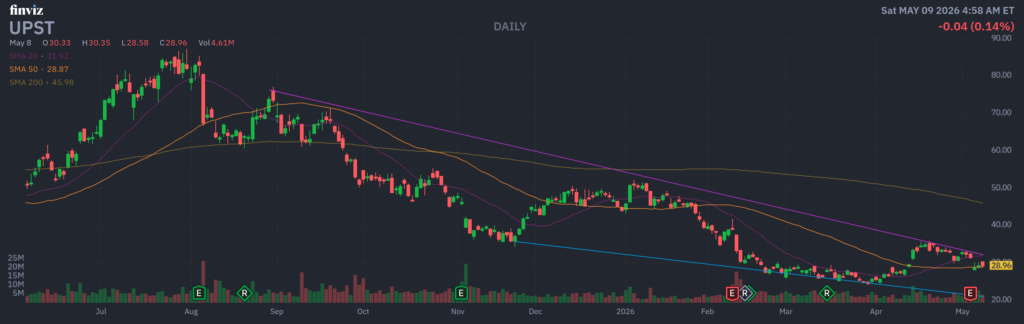
Name: Dave Girouard
Position: Director and 10% Owner
Transaction Date: 05-07-2026 Shares Bought: 170,240 shares an average price paid of $29.37 for a cost of $4,999,607
Company: Upstart Holdings Inc. (UPST)
Upstart Holdings, Inc. operates a cloud-based artificial intelligence lending platform in the United States through its subsidiaries. The company has three business segments: personal lending, auto lending, and other. Its AI-powered technology enables banks and credit unions to assess borrower risk and automate loan approvals. Upstart provides unsecured personal loans, small-dollar loans, auto refinance loans, auto retail loans, vehicle-secured personal loans, and home equity lines of credit. The company focuses on applying advanced data models and machine learning to improve credit availability and loan efficiency. Upstart Holdings, Inc., founded in 2012, is based in San Mateo, California.
Dave Girouard co-founded Upstart Holdings Inc. in 2012 and has served as its CEO and Director since December 2013. He also became a reported 10% owner due to his significant equity holdings in the company, with the latest filings indicating beneficial ownership of more than 11% of Upstart’s outstanding shares. Girouard previously worked in product marketing and engineering at Apple before launching Upstart. Under his leadership, Upstart evolved into a prominent AI-powered lending platform focused on expanding credit access through machine learning. Girouard holds a bachelor’s degree in engineering from Dartmouth College.
Insomniac Hedge Fund Guy Opinion: Upstart is basically an AI-driven lending marketplace trying to reinvent consumer credit underwriting. Instead of relying heavily on FICO scores, the company uses machine-learning models to evaluate borrowers and partners with banks to originate loans. Personal loans remain the core business, but management is aggressively pushing into auto and home lending.
The bull case is simple: if Upstart’s AI models consistently outperform traditional underwriting, this becomes a major fintech platform with enormous operating leverage. The moat is the proprietary loan-performance data collected across millions of repayment events. More data theoretically improves the model, which improves approvals and loss rates, which attracts more bank partners.
The problem is cyclicality. Upstart learned the hard way in 2022–2023 that AI doesn’t eliminate credit risk when capital markets freeze. Revenue collapsed as funding partners pulled back. That experience still hangs over the stock.
Now the recovery is real. 2025 revenue rebounded sharply to roughly $1.0B+, up ~64% year over year, while originations surged more than 80%. The company also returned to profitability after heavy losses during the downturn. Fee revenue remains the majority of the model, giving the business a relatively asset-light structure.
Management, led by founder Dave Girouard (ex-Google enterprise president), deserves credit for surviving the credit cycle without blowing up the balance sheet. Recent execution has been materially better than expected.
Profitability remains volatile, but operating leverage is finally showing up as volumes recover.

Name: Paul J. Sarvadi
Position: Chairman Of The Board & Ceo
Transaction Date: 05-05-2026 Shares Bought: 100,000 shares an average price paid of $28.73 for Cost: $2,873,236
Company: Insperity Inc. (NSP)
Insperity, Inc. provides human resources and business solutions to small and medium-sized organizations, especially in the United States. It provides the Insperity HR360 solution, a full-service PEO solution that delivers HR technology, compliance, and strategic support to small and medium organizations; Insperity HRCore is a streamlined HR platform for payroll, compliance, and workforce management, while Insperity HRScale is a scalable HR solution that combines Insperity knowledge with Workday technology for organizations. The company also offers performance solutions such as talent acquisition, retirement and insurance services, as well as Perks+ services. The company was previously known as Administaff, Inc., but changed its name to Insperity, Inc. in March 2011. Insperity, Inc. was founded in 1986 and is based in Kingwood, Texas.
Paul J. Sarvadi co-founded Insperity Inc. in 1986 and has been Chairman of the Board and CEO since 1989. He was instrumental in transforming the company into a top provider of human resources and business performance solutions to small and medium-sized enterprises in the United States. In addition to being CEO and Chairman, he was the company’s president from 1989 to 2003. Sarvadi has garnered numerous industry awards, including Ernst & Young’s National Entrepreneur of the Year for the Service Industry in 2001 and entry into the Texas Business Hall of Fame in 2007. He attended Rice University and the University of Houston before beginning his business career.
Insomniac Hedge Fund Guy Opinion: Insperity is basically a leveraged bet on small and mid-sized business employment. The company operates a Professional Employer Organization (PEO) model, handling HR, payroll, benefits administration, compliance, and workers’ compensation for clients that want outsourced HR infrastructure without building it internally. It’s a sticky business because once a company outsources payroll and benefits, switching providers becomes operationally painful.
The moat is scale and service integration. Insperity bundles HR software, healthcare benefits, payroll processing, and compliance into one platform, creating decent customer retention and recurring revenue visibility. Most revenue is recurring because clients pay ongoing fees tied to employees under management. Revenue has grown from roughly $4.3B in 2020 to about $6.8B in 2025, a solid mid-to-high single-digit annualized growth rate.
The issue right now is profitability. Rising healthcare and workers’ compensation costs crushed margins in 2025, with operating margins falling sharply from historical levels. Revenue still grew modestly, but earnings got hit hard because insurance costs outpaced pricing power.
Management, led by founder-like CEO Paul Sarvadi, has generally executed well over long periods, but this is one of those years where operational leverage worked in reverse. The company is now restructuring and cutting costs while renegotiating healthcare arrangements to stabilize margins.

Name: Matthew Charles Brown
Position: Chief Financial Officer
Transaction Date: 05-04-2026 Shares Bought: 12,000 shares an average price paid of $21.54 for Cost: $258,480
Company: Tenable Holdings Inc. (TENB)
Tenable Holdings, Inc. offers cyber exposure management solutions throughout the Americas, Europe, the Middle East, Africa, Asia Pacific, and Japan. Tenable’s services include Tenable AI Exposure, Tenable Vulnerability Management, Tenable Cloud Security, Tenable Identity Exposure, and Tenable Web App Scanning, which assist enterprises in identifying and mitigating cyber threats. Tenable also offers Tenable Attack Surface Management, Tenable Security Center, and Tenable OT Security to help safeguard IT, cloud, and industrial settings. Its flagship solutions, Nessus and Nessus Expert, facilitate vulnerability evaluation and secure development. The company was founded in 2002 and is headquartered in Columbia, Maryland. It services enterprises all around the world.
Matthew Charles Brown has been Tenable Holdings Inc.’s Chief Financial Officer since August 21, 2025, when he joined the firm and was designated CFO effective immediately. He leads Tenable’s global finance division, which includes financial strategy, planning, accounting, and reporting, and has over two decades of expertise in the technology business. Prior to joining Tenable, he was Chief Financial Officer at Altair Engineering and had top finance positions at NortonLifeLock, Symantec, and Netgear. Brown has a Bachelor of Science in Business Administration from the Haas School of Business at the University of California, Berkeley, and is a certified public accountant.
Insomniac Hedge Fund Guy Opinion: Tenable is a cybersecurity company focused on vulnerability management and “exposure management,” helping enterprises identify weaknesses across cloud infrastructure, endpoints, identities, and operational technology environments. Think of it as the system that tells companies where attackers are most likely to break in before the breach happens.
The moat comes from scale, data, and integration into enterprise security workflows. Tenable has built one of the largest vulnerability databases in cybersecurity and serves more than 40,000 customers, including a large percentage of the Fortune 500. Once integrated into a company’s security operations, the product becomes deeply embedded and difficult to rip out.
Financially, the story is solid but not elite. Revenue has compounded strongly over the last five years, growing from roughly $440M in 2020 to nearly $1B in 2025. Annual growth has slowed from 20%+ to around 11–12% today, which is typical for a maturing cybersecurity platform.
The business is highly recurring. Subscription and maintenance revenue account for roughly 95–96% of total revenue, giving Tenable strong visibility and durable cash flow characteristics. Net revenue retention appears healthy at around 107%, though lower than the best-in-class cybersecurity names.
Management has done a respectable job balancing growth and profitability. Margins are improving, free cash flow is rising, and the company is slowly transitioning from “growth at all costs” toward disciplined operating leverage.

Name: Harry M. Jansen Kraemer Jr
Position: Director
Transaction Date: 05-04-2026 Shares Bought: 36,610 shares an average price paid of $21.41 for Cost: $783,773
Name: John Charles Rademacher
Position: Chief Executive Officer
Transaction Date: 05-04-2026 Shares Bought: 12,500 shares an average price paid of $21.18 for Cost: $264,706
Name: Timothy P. Sullivan
Position: Director
Transaction Date: 05-07-2026 Shares Bought: 24,154 shares an average price paid of $20.69 for Cost: $499,671
Name: Meenal Sethna
Position: Chief Financial Officer
Transaction Date: 05-04-2026 Shares Bought: 16,225 shares an average price paid of $20.16 for Cost: $327,075
Company: Option Care Health Inc. (OPCH)
Option Care Health, Inc., offers home and alternate site infusion services in the United States. The company provides anti-infective therapy and services; home infusion services to treat heart failure; home parenteral nutrition and enteral nutrition support services for numerous acute and chronic conditions, such as stroke, cancer, and gastrointestinal diseases; immunoglobulin infusion therapies for the treatment of immune deficiencies; and treatments for chronic inflammatory disorders, including Crohn’s disease, plaque psoriasis, psoriatic arthritis, rheumatoid arthritis, ulcerative colitis, and other chronic inflammatory disorders. The company markets its services through patient referrals, including physicians, hospital discharge planners, hospital personnel, health maintenance organizations, and preferred provider organizations. The company is headquartered in Bannockburn, Illinois.
Harry M. Jansen Kraemer Jr. has been a director at Option Care Health Inc. since 2019. He joined the company’s board the following year and later became chairman, adding over three decades of healthcare leadership expertise. Kraemer was previously the chairman, president, and CEO of Baxter International. He is also a clinical professor of management and strategy at Northwestern University’s Kellogg School of Management. At Option Care Health, he helps with governance, strategy, and financial monitoring. He earned a BA from Lawrence University and an MBA from Northwestern University.
John Charles Rademacher has been the Chief Executive Officer of Option Care Health Inc. since January 2018. Under Rademacher’s leadership, Option Treatment Health has emerged as a creative leader in home and alternate site infusion services, with best-in-class treatment and improved clinical results, resulting in high patient satisfaction and cost savings for all stakeholders. Rademacher joined Option Care Health as Chief Operating Officer in 2015, before his current position. He has a Bachelor of Arts degree in accounting from Hillsdale College in Hillsdale, Michigan, and a Master of Business Administration from Wayne State University in Detroit, Michigan.
Timothy P. Sullivan is an independent director and member of the Compensation Committee of Option Care Health Inc., having joined the board in 2019. He has been with Madison Dearborn Partners, LLC since 1992, where he worked as Co-Founder, Managing Director, and Co-Head of the Health Care Team before becoming Co-Chief Executive Officer in 2022. Sullivan has decades of experience in private equity and serving on the boards of different healthcare companies, giving him deep knowledge of healthcare investments, corporate governance, and strategic growth. He has also been involved in various nonprofit organizations and trusteeships.
Meenal Sethna has been Chief Financial Officer of Option Care Health Inc. since October 1, 2025, when she joined the firm as Executive Vice President and CFO. She joined Option Care Health in 2025 with over 30 years of financial leadership experience, including her previous position as CFO of Littelfuse, Inc. She is in charge of finance, accounting, treasury, and investor relations at Option Care Health, where she helps to shape the company’s strategic and financial orientation. Meenal Sethna has a bachelor’s degree in finance from the University of Illinois and an MBA from Northwestern’s Kellogg School of Management.
Insomniac Hedge Fund Guy Opinion: Option Care Health is the largest independent provider of home and alternate-site infusion therapy in the U.S. The company administers complex drugs for chronic conditions like immune disorders, infections, and neurological diseases outside the traditional hospital setting. The investment case is simple: healthcare keeps moving toward lower-cost outpatient care, and OPCH sits directly in that trend.
The moat is mostly scale, payer relationships, and clinical infrastructure. Infusion therapy is operationally complex, reimbursement-heavy, and difficult to replicate nationally. Hospitals increasingly want to outsource this work, while insurers prefer cheaper home-based care over expensive inpatient treatment. That creates a favorable long-term demand backdrop.
Over the past five years, revenue has compounded at roughly a low-to-mid teens rate, with FY2025 revenue reaching about $5.65B, up 13% YoY. The business is highly recurring because patients often require ongoing infusion treatments over long periods, though the company does not formally report recurring revenue or net retention metrics.
CEO John Rademacher has done a solid job integrating acquisitions, expanding nationally, and using cash flow for buybacks. Operational execution has generally been strong.
The concern is profitability. Revenue growth remains healthy, but margins have compressed as drug costs and labor expenses rise. Operating margin in 2025 was about 6%, down from prior levels, while net margin was roughly 3.7%. Investors are starting to question whether scale alone can offset reimbursement and cost pressure.

Name: Ag Volkswagen
Position: 10% Owner
Transaction Date: 04-30-2026 Shares Bought: 62,889,522 shares an average price paid of $15.90 for Cost: $999,943,400
Company: Rivian Automotive Inc. (RIVN)
Rivian Automotive, Inc., and its subsidiaries create, manufacture, and distribute category-defining electric vehicles. It operates in two segments: Automotive and Software and Services. The company sells consumer cars such as a two-row, five-passenger pickup truck under the R1T brand and a three-row, seven-passenger sport utility vehicle under the R1S moniker. It also offers software and services such as vehicle electrical architecture and software development, Autonomy+, remarketing, car repair and maintenance, software subscriptions, vehicle accessories, finance, insurance, and others.Rivian Automotive, Inc. was created in 2009 and is headquartered in Irvine, California. It also provides the Rivian Commercial Van platform for Electric Delivery Vans in conjunction with Amazon.com, Inc.
Volkswagen AG became a 10% owner in Rivian Automotive Inc. in June 2025, when its ownership stake exceeded 10%. In June 2024, the corporation became a strategic stakeholder in Rivian by issuing a convertible note that was eventually converted into equity. Since then, Volkswagen has continuously increased its investment, cementing its position as a major stakeholder and strategic partner. The alliance aims to advance electric car technology and software development, which aligns with Volkswagen’s overall electrification goal.
Insomniac Hedge Fund Guy Opinion: Rivian is trying to become the premium outdoor EV brand before the mass market arrives. The company’s R1T pickup and R1S SUV are genuinely differentiated products with strong customer loyalty, but the real story is the upcoming R2 platform. If R2 works, Rivian becomes a real volume automaker. If it doesn’t, this becomes another capital-intensive EV science project.
The moat today is mostly brand, software, and engineering culture. Rivian has built a strong identity around adventure and lifestyle in a way most EV startups never achieved. Customer satisfaction appears high, and the company’s vertically integrated software stack gives it Tesla-like control over the driving experience. The Volkswagen partnership also validates Rivian’s technology platform.
Financially, the company is still in transition mode. Revenue has grown from essentially zero a few years ago to over $5.3B in 2025, though delivery growth has recently been uneven due to weaker EV demand and the expiration of certain tax incentives. Rivian’s software and services revenue is growing rapidly—up more than 200% in 2025—driven partly by the VW joint venture.
CEO RJ Scaringe is widely respected and still feels mission-driven rather than promotional, which matters in a sector full of hype.
Profitability remains the key debate. Rivian finally achieved positive gross profit in 2025 after years of massive losses, showing real manufacturing improvement. But the company is still burning billions in cash annually while betting heavily on R2 scaling.

Name: Anthony Noto
Position: Chief Executive Officer
Transaction Date: 05-08-2026 Shares Bought: 15,878 shares an average price paid of $15.73 for a cost of $249,769
Company: SoFi Technologies Inc. (SOFI)
SoFi Technologies, Inc. provides a variety of financial services in the United States, Latin America, Canada, and Hong Kong. The corporation is divided into three business segments: lending, technology platforms, and financial services. It provides lending and financial services and products that let its members to borrow, save, spend, invest, and protect their money, as well as personal loans, student loans, house loans, and other related services. The company also manages Galileo, a technological platform that provides services to financial and non-financial institutions, as well as Technisys, a cloud-native digital and core banking platform that sells software licenses and related services such as implementation and maintenance.The company was created in 2011 and is headquartered in San Francisco, California.
Anthony Noto joined SoFi Technologies Inc. in February 2018 and was appointed Chief Executive Officer and member of the board on March 1, 2018. He was named CEO when he joined the company, following temporary leadership and taking on the duty of steering SoFi’s expansion as a major digital financial services platform. Prior to joining SoFi, Noto held prominent positions at Twitter, the National Football League, and Goldman Sachs, gaining vast experience in finance and technology. He graduated from the United States Military Academy at West Point with a Bachelor of Science in mechanical engineering and later earned an MBA from the University of Pennsylvania’s Wharton School.
Insomniac Hedge Fund Guy Opinion: SoFi started as a student-loan refinance company but has evolved into a digital financial super-app offering banking, personal loans, mortgages, investing, credit cards, insurance, and fintech infrastructure through Galileo and Technisys. The pitch is simple: acquire customers cheaply through one product, then cross-sell everything else inside one ecosystem.
The moat is still developing, but there are signs it’s becoming real. SoFi’s bank charter gives it lower funding costs than many fintech competitors, while its technology stack allows faster product launches and tighter integration across services. The real advantage is engagement: once users direct deposit paychecks, invest, borrow, and bank in one app, switching becomes less likely.
Growth has been explosive. Revenue has compounded at roughly 25–35% annually over the last five years, with 2025 revenue surpassing $3.5 billion. Fee-based and non-lending revenue streams are becoming a much larger part of the story, reducing dependence on interest-rate cycles. Financial Services revenue grew nearly 80% year-over-year in Q4 2025, while fee-based revenue rose more than 50%.
CEO Anthony Noto is one of the stronger operators in fintech. Formerly at Twitter, Goldman Sachs, and the NFL, he has consistently emphasized profitability and cross-selling instead of “growth at all costs.”Profitability is the biggest change. SoFi has now posted multiple consecutive profitable quarters, with Q4 2025 net income reaching $174 million and EBITDA margins above 30%.

Name: Carsten Koerl
Position: Chief Executive Officer
Transaction Date: 05-04-2026 Shares Bought: 340,000 shares an average price paid of $13.39 for Cost: $4,552,360
Transaction Date: 04-30-2026 Shares Bought: 254,100 shares an average price paid of $13.16 for Cost: $3,342,856
Name: Marc Walder
Position: Director
Transaction Date: 04-30-2026 Shares Bought: 66,000 shares an average price paid of $12.77 for Cost: $842,820
Company: Sportradar Group AG (SRAD)
Sportradar Group AG, through its companies, provides sports data services to the betting and media industries in Switzerland, the United States, North America, Africa, Malta, Asia Pacific, the Middle East, Europe, Latin America, and the Caribbean. The company provides betting technology and solutions such as betting and gaming content; real-time sports data points; pre-match and live odds services; streaming and betting engagement services; iGaming (virtual soccer, horse and dog racing, basketball, tennis, baseball, and cricket); managed betting and trading services; and sports betting and gaming platforms. The company was created in 2001 and is based in Sankt Gallen, Switzerland.
Carsten Koerl is the founder and CEO of Sportradar Group AG. He joined the firm when it was founded in 2001 and has been CEO since then, overseeing its growth from a startup to a global leader in sports data and technology. Sportradar has grown globally under his leadership, servicing clients in over 100 countries and establishing itself as a vital partner to major sports leagues and betting companies. Koerl held management positions in the software and gaming industries before launching Sportradar and betandwin Interactive Entertainment. He has a Master’s degree in electronic and microprocessor engineering from the University of Applied Sciences Konstanz.
Marc Walder joined Sportradar Group AG’s board of directors in May 2015. He is currently an Independent Director and the Chair of the Compensation Committee. Aside from Sportradar, Walder has been the CEO and Managing Partner of Ringier AG since April 2012, and he was appointed Chairman of the Group Executive Board in 2012. Prior to it, he held various key editorial and executive leadership positions in the Ringier media company. Walder has received widespread recognition for his contributions to media, technology, and digital transformation activities in Switzerland, including the establishment of the digitalswitzerland initiative. He has a diploma in economics from AKAD Business School in Zurich and a diploma in journalism from the Ringier School of Journalism.
Insomniac Hedge Fund Guy Opinion: Sportradar is basically the plumbing behind modern sports betting. The company provides real-time sports data, odds, analytics, and integrity services to sportsbooks, leagues, and media companies worldwide. If you place a live in-game bet, there’s a decent chance Sportradar is somewhere in the background monetizing that transaction.
The moat is stronger than most investors realize. Sports data rights are difficult to replicate, and Sportradar has long-term partnerships with major leagues including the NBA, MLB, UEFA, and NASCAR. Scale matters here because sportsbooks want reliable low-latency data feeds and trading tools integrated directly into their systems. Once integrated, switching providers becomes operationally painful.
The company also reported a 109% customer net retention rate, showing existing customers continue expanding spend over time. Most revenue is recurring because sportsbooks subscribe to ongoing data, trading, and managed service contracts.
CEO Carsten Koerl founded the company and still runs it with a founder-led mentality. Management has consistently prioritized long-term contracts, exclusive rights, and global expansion rather than maximizing near-term margins.
Profitability is finally improving. Adjusted EBITDA margins reached roughly 23% in 2025, while free cash flow turned meaningfully positive.
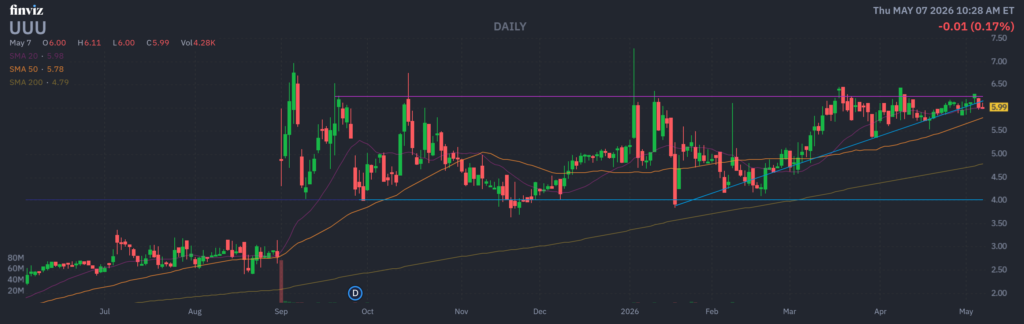
Name: Milton C. Ault Iii
Position: Director and 10% Owner
Transaction Date: 04-30-2026 Shares Bought: 155,000 shares an average price paid of $5.75 for Cost: $891,250
Company: Universal Safety Products Inc. (UUU)
Universal Safety Products, Inc., together with its subsidiary, markets and distributes safety and security products in the United States. Under the UNIVERSAL and USI Electric brand names, it sells a variety of safety alarm units, including replaceable batteries, sealed batteries, and battery backup alarms, as well as smoke alarms, carbon monoxide alarms, door chimes, ventilation products, ground fault circuit interrupters, and other electrical devices. The company’s products are also available via wholesale distributors, discount television retailers, home center stores, electrical and lighting distributors, and other distributors. The company was previously known as Universal Security Instruments, Inc., but changed its name to Universal Safety Products, Inc. in April 2025. It was established in 1969 and is based in Owings Mills, Maryland.
Milton C. Ault III has been a director of Universal Safety Products Inc. since May 2025. In 2025, he became a reported 10% owner through associated investment firms with Ault & Company and Ault Lending. He is a seasoned entrepreneur and investor with a strong background in financial markets, technology, and corporate leadership. Ault has also held executive and board positions at several publicly traded firms, including Hyperscale Data, Alzamend Neuro, and RiskOn International. According to SEC filings, he beneficially owned more than 10% of Universal Safety Products’ outstanding shares, both directly and indirectly.
Insomniac Hedge Fund Guy Opinion: Universal Safety Products is a tiny microcap safety-device company selling smoke alarms, carbon monoxide detectors, ventilation products, and electrical safety devices under the USI Electric brand. The business is tied heavily to the U.S. housing and home-improvement market, selling primarily through distributors and retail channels.
The moat is limited. This is not a technology leader or premium brand. The company competes mostly on distribution relationships and niche positioning in a market dominated by much larger players. That said, smoke alarms are regulatory-driven products with recurring replacement demand, which gives the business some baseline stability.
Revenue growth over the last five years has been inconsistent but positive overall, rising from roughly $17.5M in FY2021 to about $23.6M in FY2025. However, recent results became messy after the company sold its smoke alarm segment in 2025, causing revenue to collapse sharply afterward. There’s essentially no meaningful recurring revenue model here, and the company does not disclose net retention metrics.
Management, led by long-time CEO Harvey Grossblatt, runs the company extremely lean, with only around a dozen employees. Bulls argue the lean structure creates operating leverage when sales rise. Bears argue the company has spent years struggling to scale consistently.
Profitability has historically been weak and volatile. FY2025 returned to modest profitability after losses in FY2024, but margins remain thin and dependent on housing demand, supply chains, and tariffs.
____________________________________________________________________________________________________________________
This blog is solely for educational purposes and the author’s own amusement. IT IS NOT INVESTMENT ADVICE. Think of the blog as part of my personal investment journal that I am willing to share with the DIY investor. We could be long, short, or have no position at all in any of the stocks mentioned and express no written or implied obligation to disclose any of that. Nothing contained here constitutes a recommendation to buy or sell any security. Investing involves risk, including the possible loss of principal, and past performance is not indicative of future results.
“The insomniac hedge fund guy” is a moniker Harvey Sax, the portfolio manager for The Insiders Fund” has used from time to time on email, blog ,and social media posts. While Mr. Sax is the portfolio manager of The Insiders Fund, these posts are not communications from, nor endorsed by, Alpha Wealth Funds, LLC or any of its managed funds. References to Alpha Wealth Funds or its affiliates are for identification only and do not imply sponsorship or approval.
All company names, logos, and trademarks belong to their respective owners. The use of company logos is solely for descriptive and illustrative purposes under fair use. Any information provided is based on publicly available data and should not be considered financial, investment, or legal advice. Readers should conduct their own research or consult with a professional before making any investment decisions. Insiders sell the stock for many reasons, but they generally buy for just one – to make money. You’ve always heard the best information is inside information. Everyone with any stock market experience pays close attention to what insiders are doing. After all, who knows a business better than the people running it? Officers, directors, and 10% owners are required to inform the public through a Form 4 Filing of any transaction, buy, sell, exercise, or any other within 48 hours of doing so.
This info is available for free from the SEC’s Web site, Edgar, although we subscribe to SECForm4 as they provide a way to manage and make sense of the vast realms of data. I’ve tried a lot of vendors. SECForm4 is one of the smaller ones, but I like supporting Frank. He is not arrogant. He’s helpful and has great prices. He also trades on his own data, so I like people that eat what they kill. The bar is different from selling because the natural state of management is to be a seller. This is because most companies provide significant amounts of management compensation packages as stock and options. Therefore, we analyze unusual patterns with selling, such as insiders selling 25 percent or more of their holdings or multiple insiders selling near 52-week lows. Another red flag is large planned sale programs that start without warning. Unfortunately, the public information disclosure requirements about these programs, referred to as Rule 10b5-1, are horrendously poor. Also, planned sales that pop up out of nowhere are basically sales and are seeking cover under this corporate welfare loophole.
I also generally ignore 10 percent shareholders as they tend to be OPM (other people’s money) and perhaps not the smart money on which we are trying to read the tea leaves. I say generally because some 10% shareholders are great investor, think Warren Buffett and others. Of course, insiders can also be wrong about their Company’s prospects. Don’t let anyone fool you into believing they never make mistakes. Do your own analysis. They can easily be wrong, and in many cases, maybe most cases, have no more idea what the future may hold than you or me. In short, you can lose money following them. We have, and we curse aloud; what were they thinking!
We like Fly on the Wall for keeping up with what events might be happening, analysts’ comments, and whatever else could be moving the stock. Dow Jones news service is an essential tool, but many services pick up their feed like they do Bloomberg. My assistant probes the 10k for a reasonable description of the business. I’ve found that to be the most accurate and succinct place to find out what a business actually does.