
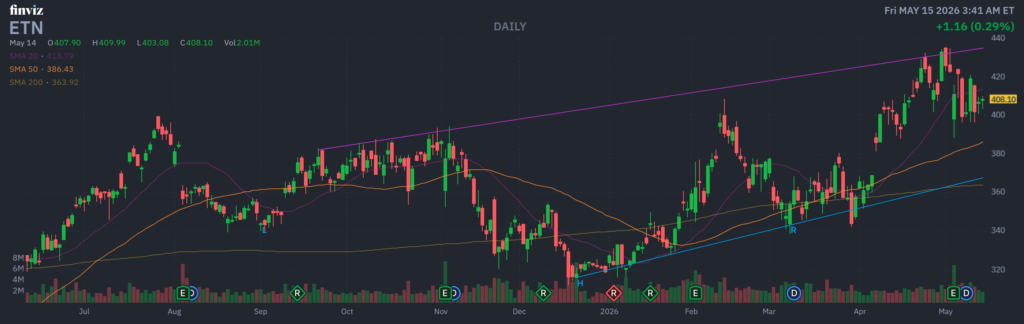
Some would say this is a blowoff top. I think we are just getting started. Ask your Uber drive what he is buying. If he gives you three stock picks, its a top. If he just gives you one, we have a lot more to go. If he tells you he lost a lot of money in crypto, get out of the car as soon as possible.
Name: Gerald Johnson
Position: Director
Transaction Date: 05-08-2026 Shares Bought: 961 shares an average price paid of $406.03 for Cost: $390,197
Company: Eaton Corp plc (ETN)
Eaton Corporation plc is a multinational power management firm with customers in the Americas, Europe, and Asia Pacific. The company’s offerings include electrical items, power distribution systems, circuit protection equipment, aeronautical components, hydraulic systems, automotive technologies, and eMobility solutions. Its products serve industries such as utilities, aerospace, industrial manufacturing, commercial transportation, and residential infrastructure. Eaton also creates sophisticated solutions for electric vehicles, energy efficiency, and sustainable power management applications. Through its many operations, the company strives to improve energy efficiency, safety, and dependability for clients globally. Eaton Corporation plc, founded in 1911, is based in Dublin, Ireland.
Gerald Johnson has been a Director of Eaton Corp. plc since July 23, 2025, when he was elected to the company’s Board of Directors. Johnson is the former executive vice president of global manufacturing and sustainability at General Motors, where he spent over 40 years directing global manufacturing, labor relations, quality, and operational excellence efforts after joining the company in 1980 through a co-op program. He now serves on the board of Caterpillar Inc. Johnson holds a bachelor’s degree in industrial management from Kettering University and a master’s degree in manufacturing operations from the Massachusetts Institute of Technology.
Insomniac Hedge Fund Guy Opinion: Eaton is one of the biggest beneficiaries of the electrification and AI infrastructure boom hiding in plain sight. The company sells electrical components, power management systems, circuit protection equipment, and aerospace products used across data centers, utilities, industrial facilities, and commercial buildings. In many ways, it’s a picks-and-shovels business for the global power upgrade cycle.
The moat comes from scale, distribution, engineering expertise, and deep customer relationships. Utilities, hyperscale data centers, and industrial customers do not casually switch electrical vendors because reliability matters more than price. Eaton also benefits from long product cycles and high aftermarket/service attachment in parts of the business.
Over the last five years, revenue has compounded at roughly 7–10% annually, accelerating recently thanks to AI-driven data center demand and grid modernization. Revenue reached approximately $27.4B in 2025, up over 10% year-over-year. Unlike software companies, Eaton doesn’t disclose recurring revenue or net retention metrics, but service, replacement demand, and long-cycle infrastructure exposure create a relatively durable revenue base.
Management under CEO Craig Arnold has done an excellent job reshaping Eaton into a higher-margin electrical business while reducing exposure to weaker cyclical segments. The portfolio looks materially better today than it did a decade ago.
Profitability has steadily improved. Operating margins have expanded from the mid-teens to around 19%, while gross margins are approaching 38%, reflecting pricing power and operating leverage.
Name: Jason R. Niswonger
Position: Chief Admin & Sustainability
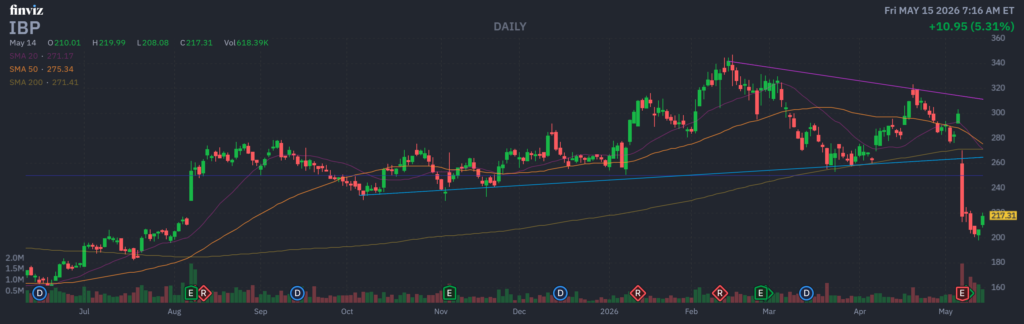
Transaction Date: 05-11-2026 Shares Bought: 455 shares an average price paid of $214.80 for Cost: $97,734
Name: Michael Thomas Miller
Position: Executive VP & CFO
Transaction Date: 05-11-2026 Shares Bought: 2,400 shares an average price paid of $207.82 for Cost: $498,771
Company: Installed Building Products Inc. (IBP)
Installed Building Products, Inc. offers insulation installation and other building product services for residential and commercial construction projects in the United States. The company provides fiberglass, cellulose, and spray foam insulation, as well as sealants, waterproofing systems, garage doors, rain gutters, blinds, mirrors, shower doors, and closet shelving systems. It also provides fireproofing and moisture protection solutions for new construction, maintenance, and remodeling projects. Furthermore, Installed Building Products supplies insulation materials, equipment, and associated products through its distribution network. The company services builders, contractors, and property owners around the country. It was founded in 1977 and has its headquarters in Columbus, Ohio.
Jason R. Niswonger has served as Chief Administrative and Sustainability Officer and President of Installed Building Products, Inc. since January 2024. He originally joined the company in 2004 and has held several leadership roles across operations, branch management, and corporate administration, including serving as Executive Vice President of Business Operations. In his current role, Niswonger oversees administrative functions, sustainability initiatives, and operational strategy as the company continues expanding its national insulation and building products platform. He earned a bachelor’s degree in business administration from Ohio University.
Michael Thomas Miller has been the executive vice president and chief financial officer of Installed Building Products, Inc., since January 2024. He joined the firm in 2015 and previously worked as Senior Vice President of Finance and chief accounting officer, where he oversaw financial operations, acquisitions, and growth strategy. Miller worked in finance and accounting for public accounting and corporate firms before joining IBP, where he gained substantial knowledge in financial reporting and operations. He holds a bachelor’s degree in accounting from The Ohio State University and is a Certified Public Accountant.
Insomniac Hedge Fund Guy Opinion: Installed Building Products is basically a leveraged bet on U.S. housing construction disguised as a “building products platform.” The company installs insulation, garage doors, gutters, shelving, shower doors, and other finishing products for residential and commercial builders across the U.S. Most investors think it’s just insulation, but the real story is a fragmented roll-up model with strong local market density.
The moat is operational rather than technological. IBP wins through scale, labor relationships, local branch networks, and acquisition integration. Thousands of smaller installers can compete locally, but very few can match IBP’s national footprint and purchasing power. Management has spent years consolidating mom-and-pop installers and cross-selling additional products into builder relationships.
Over the last five years, revenue roughly doubled from around $1.5B in 2019 to nearly $3B today, although growth has slowed materially with higher mortgage rates and softer housing activity. Unlike software companies, recurring revenue is limited. This is still fundamentally project-driven construction revenue, so there’s no meaningful net revenue retention metric to rely on.
CEO Jeff Edwards has run the company with discipline, balancing acquisitions, buybacks, and dividends while maintaining healthy margins. Profitability has actually held up surprisingly well despite housing weakness, with record EBITDA and earnings posted in 2025.
Name: Lorrie M. Norrington
Position: Director
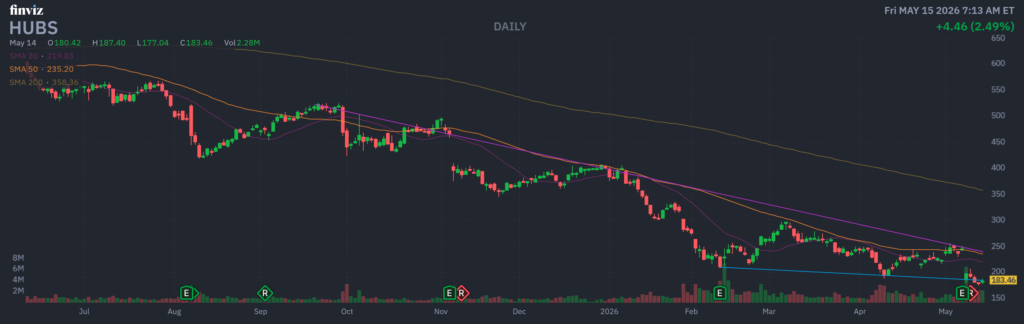
Transaction Date: 05-11-2026 Shares Bought: 1,313 shares an average price paid of $190.42 for Cost: $250,021
Name: Yamini Rangan
Position: Chief Executive Officer & President
Transaction Date: 05-12-2026 Shares Bought: 2,750 shares an average price paid of $189.84 for Cost: $522,060
Name: Shah Dharmesh
Position: Chief Technology Officer
Transaction Date: 05-12-2026 Shares Bought: 10,000 shares an average price paid of $181.37 for Cost: $1,813,700
Company: HubSpot Inc. (HUBS)
HubSpot, Inc. offers a cloud-based customer relationship management software to businesses around the Americas, Europe, and Asia Pacific. The company provides software solutions for marketing automation, sales management, customer support, content management, operations, and business-to-business commerce. Its platform provides capabilities for email marketing, social media management, analytics, live chat, pipeline management, invoicing, and workflow automation. HubSpot also uses artificial intelligence capabilities in its Breeze platform to improve efficiency, automation, and customer interaction. In addition, the organization offers training, customer support, and professional services to enterprises. HubSpot was founded in 2005 and has its headquarters in Cambridge, Massachusetts.
Lorrie M. Norrington has been a Director of HubSpot, Inc. since September 2013 and was appointed Chairperson of the Board in May 2025, after previously serving as Lead Independent Director. Norrington has over 30 years of leadership experience in technology and e-commerce, including top executive roles at eBay, where she was President of Global Marketplaces, as well as leadership positions at Shopping.com, Intuit, and General Electric. She is also an operating partner at Lead Edge Capital and has served on the boards of several significant publicly traded businesses, including Autodesk, Colgate-Palmolive, and Asana. Norrington holds a Bachelor of Science degree in Business Administration and Management from the University of Maryland and an MBA from Harvard Business School.
Yamini Rangan has been chief executive officer and president of HubSpot, Inc. since September 2021, having joined the firm in January 2020 as its first chief customer officer, where she supervised marketing, sales, and service operations. Rangan had senior leadership positions at Dropbox, Workday, and SAP before joining HubSpot, where he gained substantial knowledge in enterprise software, customer operations, and growth strategies. Since becoming CEO, she has overseen HubSpot’s continuous global expansion and product innovation in CRM and AI-powered customer platforms. Rangan has a bachelor’s degree in electrical engineering, a master’s degree in computer engineering, and an MBA from UC Berkeley’s Haas School of Business.
Dharmesh Shah has been the Chief Technology Officer of HubSpot, Inc. since co-founding the company in 2006. Shah and co-founder Brian Halligan helped build HubSpot into one of the leading CRM and marketing software platforms for inbound marketing, sales, and customer support solutions. As CTO, he has overseen the company’s product vision, engineering strategy, and innovation efforts, such as the integration of AI-powered capabilities across the HubSpot platform. Shah holds a bachelor’s degree in computer science from the University of Alabama at Birmingham and a master’s degree in management from the MIT Sloan School of Management.
Insomniac Hedge Fund Guy Opinion: HubSpot is one of the best-positioned software companies serving small and mid-sized businesses. What started as a marketing automation tool has evolved into a full CRM platform covering sales, marketing, customer service, operations, and now AI-powered workflow tools. The company increasingly competes against fragmented software stacks by offering an integrated “all-in-one” platform that is easier to deploy than enterprise-heavy alternatives like Salesforce.
The moat comes from ecosystem stickiness and product bundling. Once customers adopt multiple “hubs,” switching becomes painful because workflows, customer data, automation, and reporting are deeply integrated. Over 97% of revenue comes from subscriptions, giving the company an extremely recurring revenue model. Revenue has compounded around 20% annually over the last five years, while 2025 revenue reached roughly $3.1B.
Net revenue retention recently improved to about 103–104%, helped by seat expansion, AI tools, and upmarket customer adoption. The business is also quietly moving higher into mid-market and enterprise accounts, which matters because larger customers tend to buy more hubs and stay longer.
CEO Yamini Rangan has executed well, especially around AI integration and operational discipline. Profitability has improved materially, with non-GAAP operating margins approaching 20% versus much lower levels a few years ago.
The debate is valuation. HubSpot trades like a premium compounder because investors see a long runway for CRM consolidation and AI monetization.
Name: John A. Bryant
Position: Director
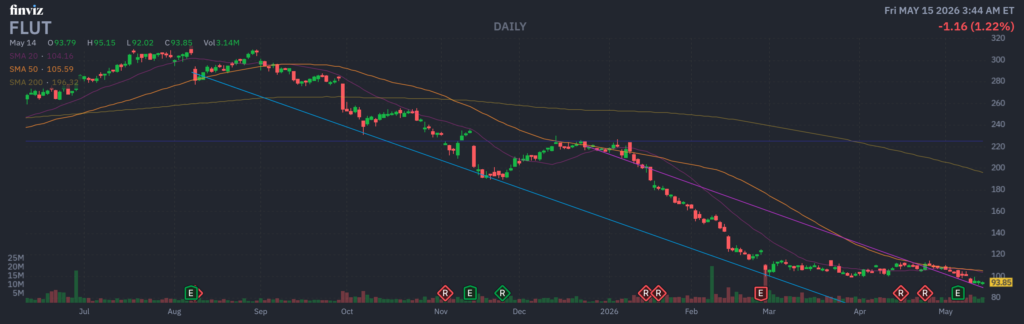
Transaction Date: 05-08-2026 Shares Bought: 1,950 shares an average price paid of $102.86 for Cost: $200,586
Name: Jeremy Peter Jackson
Position: Chief Executive Officer
Transaction Date: 05-08-2026 Shares Bought: 2,400 shares an average price paid of $101.94 for Cost: $244,656
Company: Flutter Entertainment plc (FLUT)
Flutter Entertainment plc is a sports betting and gaming company that operates in the United States, the United Kingdom, Ireland, Australia, Italy, and across the world. The company provides sports betting and gaming services through the websites fanduel.com, tvg.com, betfair.com, paddypower.com, paddypower.ie, sportsbet.com.au, pokerstars.com, sisal.it, maxbet.rs, and adjarabet.com under the FanDuel, Sky Betting & Gaming, Sportsbet, PokerStars, Paddy Power, Sisal, tombola, Betfair, TVG, Adjarabet, and MaxBet brands, as well as live poker tours and events. It also offers B2B pricing and risk management services. The company was previously known as Paddy Power Betfair plc until changing its name to Flutter Entertainment plc in 2019. Flutter Entertainment plc was founded in 1958 and is headquartered in New York, NY.
John A. Bryant has been a Director of Flutter Entertainment plc since April 2023, and he became Chair of the Board in September 2023. Bryant is the former Chairman and CEO of Kellogg Company, where he worked for nearly two decades after joining in 1998, holding various top leadership positions such as CFO, President International, and COO before becoming CEO in 2011. In addition to his leadership expertise in global consumer industries, he serves on the boards of many public companies, including Compass Group and Coca-Cola Europacific Partners. Bryant holds a bachelor’s degree in business and commerce from Australian National University, as well as an MBA from the University of Pennsylvania’s Wharton School.
Jeremy Peter Jackson has been Chief Executive Officer of Flutter Entertainment plc since January 2018, following the merger of Paddy Power and Betfair, where he previously served as a non-executive director starting in February 2016. Jackson had many top leadership positions before to becoming CEO, including CEO of Worldpay UK, CEO of Travelex Group, and Head of Global Innovation for Banco Santander. Under his leadership, Flutter has grown into one of the world’s leading online betting and gaming companies, thanks to major acquisitions and worldwide expansion plans. Jackson holds an MEng degree in manufacturing engineering from the University of Cambridge.
Insomniac Hedge Fund Guy Opinion: Flutter Entertainment is basically the global king of online sports betting and iGaming. The company owns a portfolio of dominant gambling brands including FanDuel, Betfair, Paddy Power, PokerStars, and Sky Betting & Gaming. The real crown jewel is FanDuel, which has become the market leader in U.S. online sports betting.
The moat here is scale, technology, and customer acquisition efficiency. Online gambling is a brutal marketing war, but Flutter’s size gives it advantages in pricing, promotions, data analytics, and cross-selling across markets. FanDuel’s leadership position in the U.S. matters because sports betting tends to become a winner-take-most market over time.
Revenue growth has been excellent. Flutter generated roughly $16.4B in 2025 revenue, up about 17% year over year, continuing a multi-year growth streak fueled by U.S. legalization trends and strong iGaming adoption. Unlike traditional casinos, most of Flutter’s revenue is inherently recurring because customers continuously deposit and wager on the platform. Average monthly players continue to rise globally, especially in the U.S. business.
CEO Peter Jackson has executed extremely well, particularly with FanDuel’s U.S. expansion. The company has shifted from “growth at any cost” toward stronger profitability and cash generation.
Margins still aren’t elite because the company spends heavily on promotions and market expansion, but profitability has improved materially as the U.S. business matures.
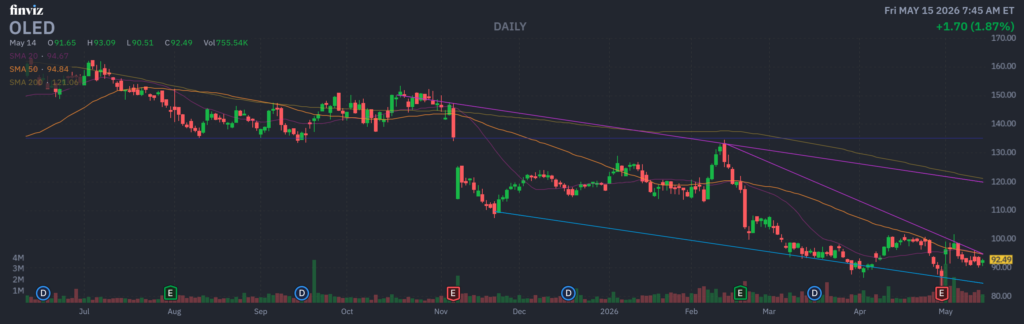
Name: Steven V. Abramson
Position: President and CEO
Transaction Date: 05-07-2026 Shares Bought: 11,000 shares an average price paid of $93.43 for Cost: $1,027,770
Name: Mauro Premutico
Position: SVP & CLO
Transaction Date: 05-07-2026 Shares Bought: 3,694 shares an average price paid of $93.40 for Cost: $345,035
Company: Universal Display Corp. (OLED)
Universal Display Corporation is involved in the research, development, and commercialization of organic light-emitting diode technologies and materials for use in display and solid-state lighting systems. The company also supplies FOLEDs, which are flexible OLEDs used to fabricate OLEDs on flexible substrates, as well as OVJP, an organic vapor jet printing technique. Furthermore, it offers technology development and support services, such as third-party collaboration and support for the commercialization of OLED products; contract research services in the areas of chemical synthesis research, development, and commercialization for non-OLED applications; and intellectual property and technology licensing activities. Universal Display Corporation was established in 1985 and is based in Ewing, New Jersey.
Steven V. Abramson has been President and CEO of Universal Display Corp. since January 2007. He began working for the company as a consultant in 1996 and was nominated to the Board of Directors in 1997. He then held many executive leadership positions before being named CEO. Under Abramson’s guidance, Universal Display has become a global leader in the development of OLED technology and materials for smartphones, televisions, wearable devices, and other display applications. Abramson holds a bachelor’s degree in political science from Franklin & Marshall College and a Juris Doctorate from Georgetown University Law Center.
Mauro Premutico has been the Senior Vice President, General Counsel, and Corporate Secretary of Universal Display Corp. since January 2022. He joined the firm in 2006 and has held progressively more responsible legal leadership positions, including Vice President and Deputy General Counsel, where he oversees intellectual property, licensing, corporate governance, and commercial operations. Prior to joining Universal Display, Premutico practiced corporate and securities law at prominent law firms specializing in technology and public companies. He holds a bachelor’s degree from Villanova University and a Juris Doctorate from Rutgers Law School.
Insomniac Hedge Fund Guy Opinion: OLED is one of those rare technology licensing businesses that quietly prints money. The company develops phosphorescent OLED materials and owns a deep patent portfolio used in OLED displays found in smartphones, TVs, tablets, wearables, and increasingly automotive screens. Its biggest customers include panel manufacturers like Samsung and LG Display.
The moat is intellectual property. Universal Display has spent decades building OLED patents and proprietary emitter materials that are extremely difficult to replicate. Display makers depend on these materials for better power efficiency and brightness, especially in premium devices. The result is a business model with high-margin royalty revenue layered on top of material sales.
Revenue growth over the past five years has been uneven but generally solid, driven by broader OLED adoption across consumer electronics. A large percentage of revenue is effectively recurring because customers continually purchase emitter materials and renew licensing agreements tied to ongoing panel production. While the company does not formally disclose net revenue retention, customer relationships tend to be long-term and sticky given the technical integration involved.
Management has historically been conservative, focusing heavily on R&D and patent protection rather than aggressive expansion. That conservatism has helped preserve industry leadership.
Profitability is exceptional. Gross margins are extremely high for a hardware-adjacent business because much of the economics come from licensing IP rather than manufacturing at scale. The balance sheet is also pristine, with significant cash and no major financial stress.
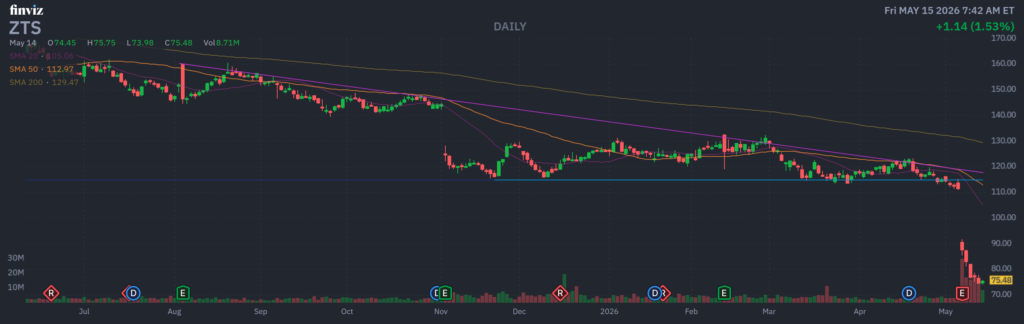
Name: Michael B. Mccallister
Position: Director
Transaction Date: 05-11-2026 Shares Bought: 3,000 shares an average price paid of $77.76 for Cost: $233,273
Company: Zoetis Inc. (ZTS)
Zoetis Inc. engages in the discovery, development, manufacture, and commercialization of medicines, vaccines, diagnostic products and services, biodevices, genetic tests, and precision animal health solutions for the animal health industry in the United States and internationally. The company primarily sells items for companion animals such as dogs, cats, and horses, as well as livestock species such as cattle, swine, poultry, fish, and sheep. It also offers parasiticides, vaccines, dermatology, anti-infectives, pain and sedation, other pharmaceuticals, and animal health diagnostics. It sells its products to veterinarians, livestock farmers, and pet owners. The company cooperated with Blacksmith Medicines, Inc. to find and develop new antibiotics for animal health. Zoetis Inc. was established in 2012 and is based in Parsippany, New Jersey.
Michael B. McCallister has been a Director of Zoetis Inc. since January 2013 and was appointed Chair of the Board in June 2013. McCallister is the former Chairman and CEO of Humana Inc., where he worked for nearly four decades, beginning in 1974 and serving as CEO from 2000 until his retirement in 2012. He provides considerable experience in healthcare, strategic growth, digital transformation, and corporate governance from his leadership positions and public company board service. McCallister has a Bachelor of Science degree in Accounting from Louisiana Tech University and an MBA from Pepperdine University.
Insomniac Hedge Fund Guy Opinion: Zoetis is basically the dominant animal health company globally. The business sells medicines, vaccines, diagnostics, and treatments for both livestock and companion animals. The real engine today is pets—especially dogs and cats—where spending trends continue to rise as owners increasingly treat pets like family members. Products for dermatology, pain management, and chronic disease management have become major growth drivers.
The moat is stronger than most people realize. Animal health has high regulatory barriers, deep veterinarian relationships, long product cycles, and strong brand loyalty. Once vets trust a treatment protocol, switching behavior tends to be slow. Zoetis also benefits from a massive distribution network and broad product portfolio that smaller competitors struggle to match.
Over the last five years, revenue growth has generally been high-single-digit to low-double-digit annually. A meaningful portion of revenue is recurring because many pet treatments require repeat purchases over long periods. Products like Apoquel and Cytopoint have created extremely sticky demand within companion animal care. Net revenue retention is not formally disclosed, but recurring usage trends are clearly strong.
Management has executed exceptionally well since the Pfizer spinout, consistently reinvesting into R&D, acquisitions, and new product launches while maintaining disciplined margins. The company has also shown pricing power without materially hurting demand, which is a sign of brand strength and market leadership.
Profitability is elite for healthcare. Zoetis consistently generates operating margins above 35%, strong free cash flow, and reliable EPS growth.
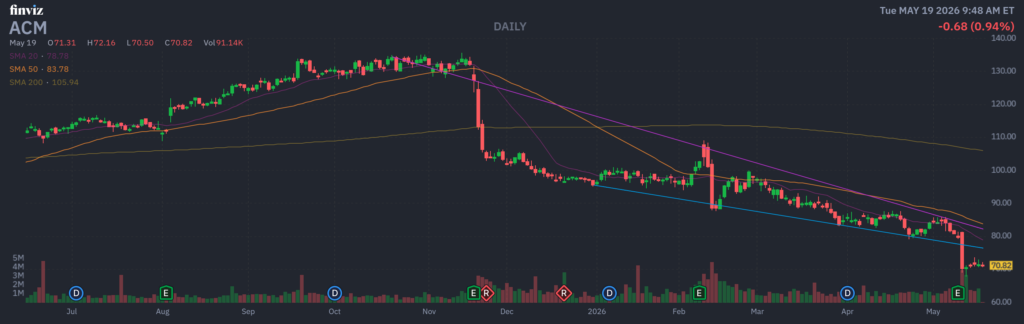
Name: Gaurav Kapoor
Position: Chief Financial Officer (Pao)
Transaction Date: 05-14-2026 Shares Bought: 1,420 shares an average price paid of $71.12 for Cost: $100,990.
Name: Troy Rudd
Position: Chief Executive Officer
Transaction Date: 05-14-2026 Shares Bought: 4,225 shares an average price paid of $71.02 for Cost: $300,060
Company: Aecom (ACM)
AECOM, through its subsidiaries, provides professional infrastructure consulting services to governments, enterprises, and organizations worldwide. The corporation is divided into three segments: Americas, International, and AECOM Capital. The company provides advice, planning, consulting, architectural and engineering design, construction and program management, and investment and development services to public and private clients in major end markets such as transportation, facilities, water, environmental, and energy. It also invests and develops real estate developments. The corporation was previously known as AECOM Technology Corporation but changed its name to AECOM in January 2015. AECOM was established in 1980 and is based in Dallas, Texas.
Gaurav Kapoor has been AECOM’s Chief Financial & Operations Officer since November 2023, having previously served as Chief Financial Officer commencing in August 2020. He joined the company in May 2015 and has held many senior finance positions, including Chief Accounting Officer, Global Controller, and Treasurer. Kapoor worked as an audit partner at Ernst & Young LLP for 15 years before joining AECOM. He holds a Bachelor of Business Administration degree from California State University, Fullerton.
Troy Rudd has been Chairman and Chief Executive Officer of AECOM since August 2020, when he was appointed CEO and a member of the company’s board of directors. He joined AECOM in 2009 and has held numerous senior leadership positions, including Chief Financial Officer, while contributing to the company’s operational transformation and strategic restructuring activities. Under Rudd’s leadership, AECOM has increased its emphasis on higher-margin professional services, infrastructure consulting, and long-term growth strategies in global markets. Rudd holds a Bachelor of Science degree from the University of British Columbia and a Master of Science in Taxation from Golden Gate University.
Insomniac Hedge Fund Guy Opinion: AECOM is essentially a global infrastructure consultancy disguised as an old-school engineering contractor. The company provides design, engineering, environmental, and program management services for transportation, water, energy, and government infrastructure projects. The market still tends to value it like a cyclical construction company, but management has spent years shifting the business toward higher-margin consulting and advisory work.
The moat is scale, relationships, and backlog. Large infrastructure projects require technical expertise, regulatory experience, and global execution capability that few firms can match. AECOM’s backlog is now at record levels, giving the company unusually strong long-term revenue visibility. Government infrastructure spending in the U.S. and internationally also creates a durable demand tailwind.
Revenue growth over the past five years has been modest, roughly low-to-mid single digits, but the important story is margin expansion. Net service revenue continues to grow faster than total revenue, while the company exits lower-quality, riskier construction exposure. AECOM doesn’t really have recurring revenue in the SaaS sense, but long-duration contracts, framework agreements, and repeat government relationships create fairly predictable cash flows.
CEO Troy Rudd has executed well. The strategy has been disciplined: simplify the portfolio, improve margins, buy back stock, and focus on professional services instead of volatile construction risk. Operating margins have steadily improved, with adjusted segment margins now above 16%, a record for the company.
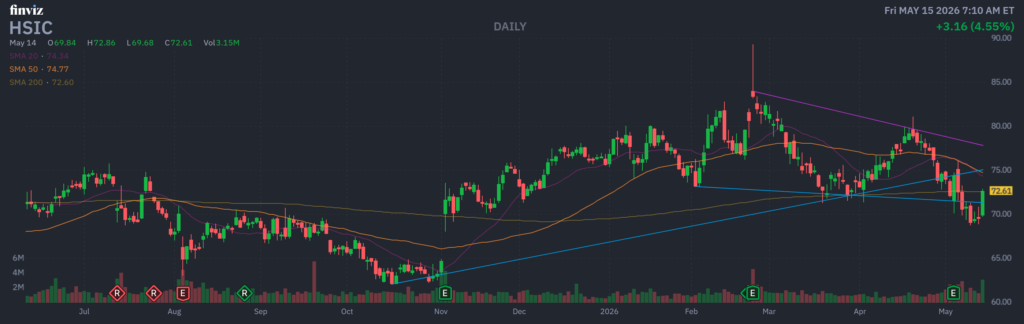
Name: William K. Daniel
Position: Director
Transaction Date: 05-11-2026 Shares Bought: 10,000 shares an average price paid of $69.19 for Cost: $691,900
Company: Henry Schein Inc. (HSIC)
Henry Schein, Inc. offers health care goods, technology solutions, and services to dental and medical professionals worldwide. The company sells dentistry supplies, medical products, medications, vaccinations, diagnostics, personal protection equipment, and digital imaging systems. It also produces and promotes specialized dental products such as implants, biomaterials, orthodontic, and endodontic treatments. In addition, Henry Schein creates practice management software, e-services, and digital platforms to help health care professionals manage operations and patient care. The company’s customers include dentistry offices, laboratories, physician practices, surgery centers, and government health clinics. It was founded in 1932 and has its headquarters in Melville, New York.
William K. “Dan” Daniel has been a Director of Henry Schein Inc. since May 2025, when he was officially appointed as an independent director following KKR’s strategic investment in the company. Daniel is an Executive Advisor at KKR, having previously served as Executive Vice President at Danaher Corporation for 14 years, where he led numerous healthcare and industrial business areas and was heavily involved in strategic growth projects and acquisitions. He also serves on Henry Schein’s Compensation and strategic advisory committees. Daniel received a B.A. in economics from DePauw University and an M.B.A. from the University of Virginia’s Darden School of Business.
Insomniac Hedge Fund Guy Opinion: Henry Schein is basically the logistics backbone of the dental and small-office healthcare world. The company distributes dental supplies, medical products, equipment, and practice-management software to dentists, physicians, and clinics globally. It is not a sexy business, but it sits deep inside everyday healthcare workflows.
The moat comes from distribution scale, customer relationships, and operational reach. Thousands of dental offices depend on Henry Schein for inventory, financing, software, and equipment servicing. Switching costs are not enormous individually, but collectively the ecosystem is sticky. The company also benefits from recurring demand because gloves, implants, consumables, and practice software are constantly replenished.
Revenue growth over the last five years has averaged roughly 4–5% annually, with 2025 revenue reaching about $13.2B. Recurring-style revenue from consumables, services, and software forms a large portion of the business, although exact recurring revenue percentages and net retention metrics are not formally disclosed.
Management has long been led by Stanley Bergman, who built the company into a dominant healthcare distributor through acquisitions and operational execution. Recently, activist involvement from KKR has increased pressure to improve margins and accelerate earnings growth.
Profitability is decent but not elite. Operating margins sit around 5%, far below premium medical technology businesses, though the company generates solid cash flow and benefits from steady demand. The 2023 cyberattack temporarily disrupted operations and exposed how operationally dependent customers are on the platform, but recovery has improved through 2025.
Name: Hakan Agnevall
Position: Director
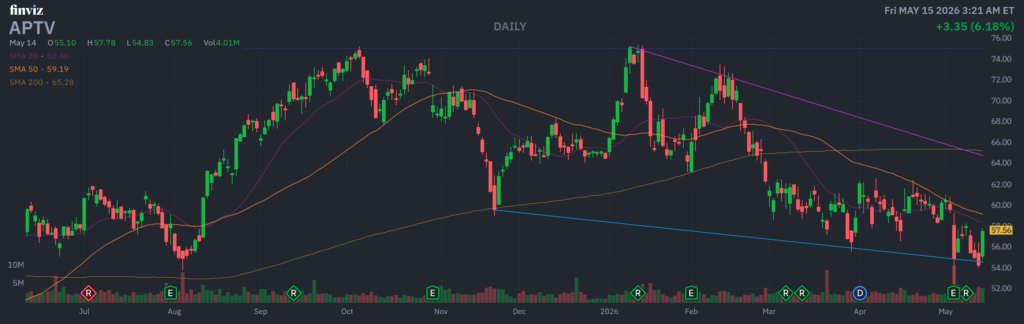
Transaction Date: 05-08-2026 Shares Bought: 6,100 shares an average price paid of $57.73 for Cost: $352,153
Company: Aptiv PLC (APTV)
Aptiv PLC is an industrial technology business that provides hardware and software solutions for the automotive and other sectors in North America, Europe, the Middle East, Africa, Asia Pacific, and South America. It operates in three segments: Advanced Safety and User Experience, Engineered Components, and Electrical Distribution Systems. The company provides active safety, user experience, smart car compute, and software products for automotive safety and security, including intelligent sensors, compute platforms, software tools, and services. It also offers connection systems, interconnects, and cable management and protection solutions for power, signal, and data transmission. Aptiv PLC was founded in 2011 and is headquartered in Schaffhausen, Switzerland.
Hakan Agnevall has been a Director of Aptiv PLC since December 2025, when he was appointed to the company’s Board of Directors on December 10, 2025. Agnevall is best known as the President and CEO of Wärtsilä Corporation, a position he has held since February 2021. He has spearheaded the company’s transition in marine and energy technologies. Prior to Wärtsilä, he served as President of Volvo Buses and held senior leadership responsibilities at Bombardier Transportation and ABB Ltd. He has a master’s degree in engineering physics, a bachelor’s degree in business administration from Lund University in Sweden, and an MBA from IMD in Switzerland.
Insomniac Hedge Fund Guy Opinion: Aptiv is basically a leveraged bet on the future electronic architecture of the automobile. The company supplies advanced wiring systems, connectors, ADAS software, sensors, and vehicle computing platforms to global automakers. As cars become more software-driven and electrified, Aptiv sits directly in the middle of that complexity.
The moat comes from engineering depth and customer integration. Once Aptiv wins a platform with an OEM, the relationship tends to last for years because redesigning vehicle electrical systems is expensive and risky. The company also benefits from scale in manufacturing and global supply-chain execution, which smaller competitors struggle to match.
Over the past five years, revenue growth has been uneven but generally positive, averaging low-to-mid single digits due to auto production volatility. 2025 revenue reached roughly $20.4 billion, up 3% year over year. Unlike software businesses, Aptiv does not have a large pure recurring revenue stream, although software, services, and long-term vehicle platform contracts create sticky customer relationships. Net revenue retention is not disclosed.
Management, led by CEO Kevin Clark, has focused aggressively on higher-margin software and advanced safety technologies while trying to reduce exposure to lower-value hardware businesses. The planned spin-off of the Electrical Distribution Systems segment is intended to make Aptiv a more focused software-and-automation story.
Profitability has improved operationally, though GAAP earnings have been noisy because of impairments and restructuring charges. Adjusted operating margins are still respectable at roughly 12%, solid for an automotive supplier.
Name: Jared Isaacman
Position: 10% Owner
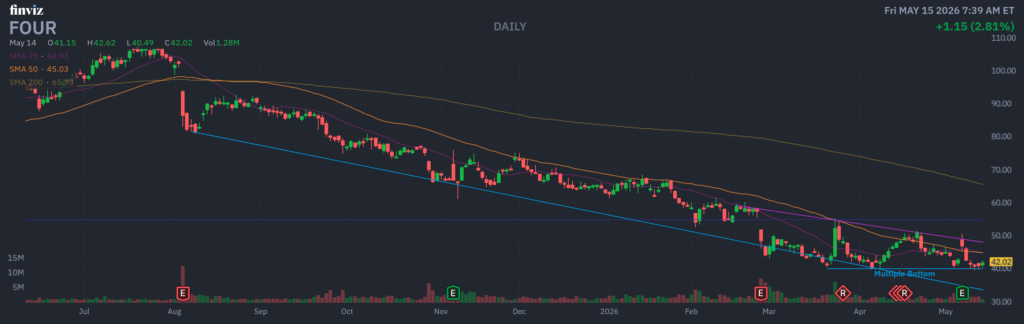
Transaction Date: 05-11-2026 Shares Bought: 388,500 shares an average price paid of $41.04 for Cost: $15,943,102
Company: Shift4 Payments Inc. (FOUR)
Shift4 Payments, Inc. offers integrated payment processing and commerce technology solutions in the United States and abroad. Its platform accepts omnichannel cards and a variety of payment methods, including credit, debit, contactless, mobile wallets, and alternative ways. The company also provides technology products such as SkyTab POS systems, e-commerce solutions, business intelligence tools, and bitcoin donation services, as well as merchant onboarding, risk management, and support. Shift4 was founded in 1999 and has its headquarters in Center Valley, Pennsylvania.
Jared Isaacman, the founder of Shift4 Payments, is a prominent shareholder and is reported to own 10% of the company. He started Shift4 in 1999 and has served as Chairman and CEO, guiding the company’s expansion into a significant integrated payments provider. Isaacman attended Embry-Riddle Aeronautical University and is recognized for founding Draken International and participating in private space missions.
Insomniac Hedge Fund Guy Opinion: Shift4 Payments is one of the more interesting second-tier fintech companies because it quietly built a strong niche in integrated payments for hotels, restaurants, casinos, stadiums, airlines, and entertainment venues. Instead of competing head-on with generic payment processors, Shift4 embeds itself deeply into vertical workflows where switching providers becomes operationally painful.
The moat is integration depth and vertical specialization. Once a casino, hotel chain, or sports venue runs payments, point-of-sale, and backend operations through Shift4, replacing the system is disruptive and expensive. The company also benefits from scale advantages as payment volume rises. End-to-end payment volume reached roughly $209 billion in 2025, continuing strong double-digit growth.
Revenue growth has been exceptional. Shift4 grew revenue from roughly $1.4B in 2021 to over $4.1B in 2025, driven by both organic volume growth and acquisitions. Subscription and software-related revenue remains a smaller portion of total sales but has been growing faster than payment processing revenue, up over 30% in 2025.
Founder-led management is a major part of the story. CEO and founder Jared Isaacman built the company aggressively and thinks more like a tech entrepreneur than a traditional payments executive. Investors either love the ambition or hate the volatility.
Profitability is improving, but not yet elite compared to larger fintech peers. EBITDA margins continue expanding while free cash flow generation has become meaningful.
Name: Caspar Felix Coppetti
Position: Executive Officer & Co-CEO
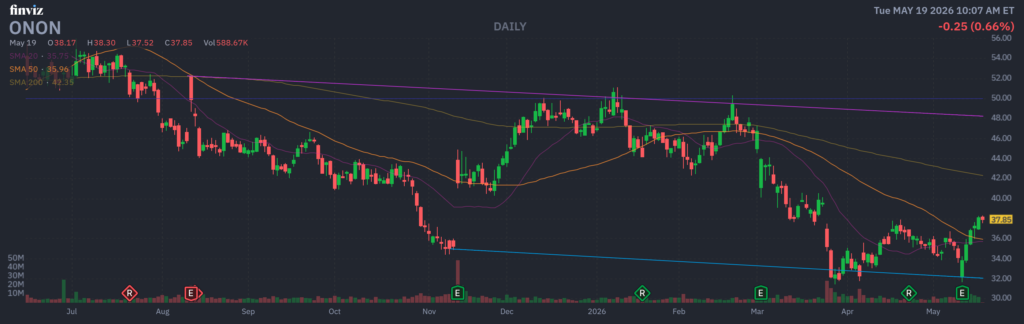
Transaction Date: 05-14-2026 Shares Bought: 60,000 shares an average price paid of $36.64 for Cost: $2,198,102
Name: Olivier Bernhard
Position: Executive Officer
Transaction Date: 05-14-2026 Shares Bought: 60,000 shares an average price paid of $36.63 for Cost: $2,198,099
Name: David Michael Allemann
Position: Executive Officer & Co-CEO
Transaction Date: 05-14-2026 Shares Bought: 60,000 shares an average price paid of $36.64 for Cost: $2,198,102
Company: On Holding AG (ONON)
On Holding AG, through its subsidiaries, creates and distributes performance sports products under the On brand in Switzerland, the rest of Europe, the Middle East, Africa, the United States, the rest of the Americas, and Asia Pacific. The company sells athletic footwear, clothes, and accessories for performance running, outdoor, all-day, training, tennis, and young movers. It offers its products to athletes and active clients through wholesale and direct-to-consumer channels; operates specialty, general sporting goods, outdoor, luxury, street fashion, and lifestyle retailers; and owns retail storefronts and e-commerce platforms. On Holding AG was created in 2010 and is based in Zurich, Switzerland.
Caspar Felix Coppetti has served as Executive Officer and Co-CEO of On Holding AG since May 2026, when he and co-founder David Allemann were appointed Co-Chief Executive Officers to lead the company’s next phase of global growth. Coppetti originally co-founded On in January 2010 and previously served as Executive Co-Chairman and Global Sales Director, helping build the Swiss performance footwear brand into a leading global sportswear company. Before founding On, he held leadership roles at Young & Rubicam and worked as a management consultant at McKinsey & Company. Coppetti holds a Dr. Oec. diploma from the University of St. Gallen in Switzerland.
Olivier Bernhard has served as an Executive Officer and Executive Board Member of On Holding AG since co-founding the company in January 2010. Bernhard is one of the key visionaries behind On’s performance footwear technology, including the development of the company’s signature CloudTec® cushioning system, and continues to lead product innovation and athlete engagement initiatives. Before co-founding On, he was a highly accomplished professional triathlete and duathlete, winning multiple world, European, and Swiss championship titles during his athletic career. Bernhard studied economics and law at the University of St. Gallen in Switzerland.
David Michael Allemann has served as Executive Officer and Co-CEO of On Holding AG since May 1, 2026, when he and co-founder Caspar Coppetti were appointed to jointly lead the company’s next phase of global growth. Allemann originally co-founded On in January 2010 and previously served as Executive Co-Chairman, helping build the brand into one of the world’s fastest-growing premium athletic footwear and apparel companies. Throughout his tenure, he has played a key role in product creation, branding, global marketing, and direct-to-consumer expansion. Allemann earned a Master of Law degree from the University of Zurich and completed an Advanced Management Program at INSEAD.
Insomniac Hedge Fund Guy Opinion: On Holding is basically the premium growth story in athletic footwear right now. The Swiss company started as a niche running shoe brand but has evolved into a global performance and lifestyle business competing with Nike, Adidas, and Lululemon for affluent consumers. The brand still skews heavily toward running, but apparel and lifestyle categories are expanding fast.
The moat is brand momentum plus premium positioning. On has managed to create a “cool performance” identity that resonates with higher-income consumers, especially in North America and Europe. The direct-to-consumer business is becoming increasingly important, giving the company stronger margins and tighter customer relationships. DTC revenue grew materially faster than wholesale in recent years.
The numbers are what make growth investors excited. Revenue has exploded from roughly CHF267M in 2019 to over CHF3B in 2025, a massive multi-year compound growth story. 2025 revenue alone grew about 30% year over year. Apparel and accessories are also scaling rapidly off a smaller base, showing the brand may have more depth than just running shoes.
Management, led by co-founders David Allemann and Caspar Coppetti alongside CEO Martin Hoffmann, has executed extremely well internationally while maintaining premium pricing power. Gross margins around 60% are elite for footwear.
Name: Richard Joseph Freeland
Position: Director
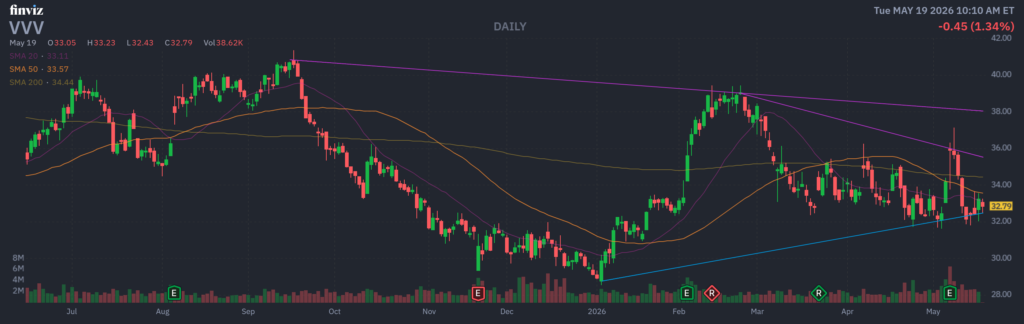
Transaction Date: 05-14-2026 Shares Bought: 3,100 shares an average price paid of $32.37 for Cost: $100,347
Name: J. Kevin Willis
Position: Chief Financial Officer
Transaction Date: 05-14-2026 Shares Bought: 10,000 shares an average price paid of $31.80 for Cost: $318,000
Company: Valvoline Inc (VVV)
Valvoline Inc. offers car preventative maintenance in its retail shops in the United States and Canada. The company provides oil changes, battery, bulb, and wiper replacement, tire rotations, and other maintenance services. It also runs and franchises service centers and retail stores. The company was formed in 1866 and is based in Lexington, Kentucky.
Richard Joseph Freeland has served as a Director of Valvoline Inc. since September 2016 and became Chairman of the Board in January 2022. Freeland is the retired President and Chief Operating Officer of Cummins Inc., where he spent four decades after originally joining the company in 1979 and held several senior leadership roles across engine, distribution, and components businesses. He brings extensive experience in manufacturing, automotive technology, global operations, and strategic leadership through both his executive career and public company board service. Freeland earned a Bachelor of Science degree in industrial management from Purdue University’s Krannert School of Management and an MBA from Indiana University’s Kelley School of Business.
J. Kevin Willis has served as Chief Financial Officer of Valvoline Inc. since May 19, 2025. He joined the company in 2025 after spending most of his career at Ashland Inc., where he served as CFO beginning in 2013 and played a key role in the 2016 separation and IPO of Valvoline. Willis brings extensive experience in capital markets, financial transformation, and operational efficiency, having held multiple senior finance leadership roles throughout his career. He earned a Bachelor of Business Administration in accounting from Eastern Kentucky University and an MBA from the Kellogg School of Management at Northwestern University.
Insomniac Hedge Fund Guy Opinion: Valvoline today is basically a pure-play quick-lube business. After selling its Global Products division, the company is focused almost entirely on preventive automotive maintenance through its Valvoline Instant Oil Change network. The thesis is simple: Americans keep cars longer, vehicle maintenance is non-discretionary, and quick service convenience matters.
The moat is mostly brand, scale, and real estate density. Oil changes are not a glamorous business, but Valvoline has built one of the largest quick-lube networks in North America with more than 2,000 locations. Customers value speed and convenience, while franchise expansion creates a relatively capital-efficient growth model.
Over the last five years, revenue growth has been solid, averaging high-single to low-double digits as store count and same-store sales expanded. Fiscal 2025 revenue grew about 6% to $1.71B, while total system-wide sales rose more than 11%. Same-store sales growth has now continued for nearly two decades, which is honestly impressive for such a boring category.
Recurring revenue is effectively very high because oil changes and maintenance are repeat purchases. Net revenue retention is not disclosed, but customer behavior appears sticky, especially in suburban commuter markets.
Management has aggressively expanded the footprint through acquisitions and franchising while maintaining EBITDA margins near 27–30%.
The risk is obvious: EV adoption eventually reduces oil-change demand. But that transition is probably slower than many expect, and management is already pushing broader maintenance services beyond oil changes.
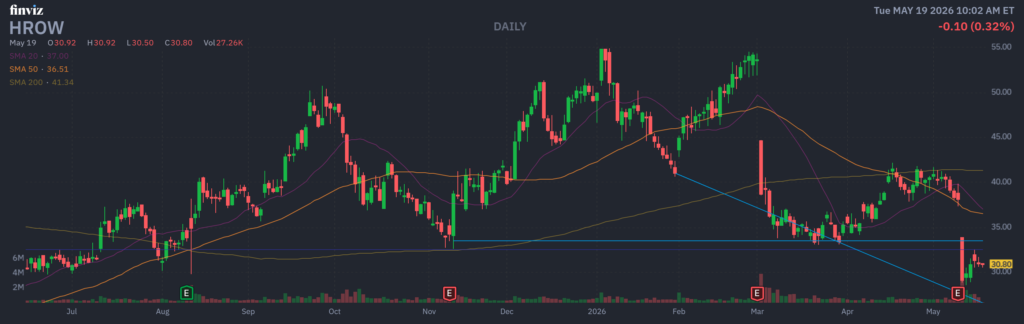
Name: Mark L. Baum
Position: Chief Executive Officer
Transaction Date: 05-14-2026 Shares Bought: 10,000 shares an average price paid of $30.20 for Cost: $302,000
Name: Andrew R. Boll
Position: President And CFO
Transaction Date: 05-14-2026 Shares Bought: 3,500shares an average price paid of $29.90 for Cost: $104,650
Company: Harrow Inc. (HROW)
Harrow, Inc., an eye care pharmaceutical business, is involved in the discovery, development, and commercialization of ophthalmic pharmaceutical products in the United States. It works through two segments: Branded and ImprimisRx. ImprimisRx is a compounded medicine designed specifically for ophthalmology. It also provides TOBRADEX ST, a tobramycin and dexamethasone ophthalmic suspension; VERKAZIA, a cyclosporine ophthalmic emulsion; NEVANAC, a nonsteroidal, anti-inflammatory eye drop; and FRESHKOTE preservative-free (PF), a lubricating eye drop. The corporation was previously known as Harrow Health, Inc., but changed its name to Harrow, Inc. in September 2023. Harrow, Inc. was founded in 1998 and is based in Nashville, Tennessee.
Mark L. Baum has served as Chief Executive Officer of Harrow Inc. since April 2012 after founding the company in 2011. He also serves as Chairman of the Board and has led Harrow’s growth into a leading ophthalmic pharmaceutical company focused on accessible and affordable eye-care treatments. Before Harrow, Baum founded TBLF, LLC, a private investment fund manager, and YesRx, an HIV-focused pharmacy business, while also serving as an investor and advisor to numerous healthcare and technology companies. Baum earned a bachelor’s degree, cum laude, from the University of Texas at Arlington and a Juris Doctor degree from California Western School of Law.
Andrew R. Boll has served as President and Chief Financial Officer of Harrow Inc. since August 2025, after previously serving as the company’s Chief Financial Officer since February 2015. Boll is a founding employee of Harrow and has helped lead the company since December 2011, overseeing financial strategy, market access, and administrative operations during the company’s growth into a leading ophthalmic pharmaceutical business. In addition to Harrow, he also helped co-found Eton Pharmaceuticals, Surface Ophthalmics, Melt Pharmaceuticals, and ImprimisRx. Boll graduated summa cum laude with a Bachelor of Science degree in Corporate and Public Finance and is also a CFA charterholder and certified management accountant.
Insomniac Hedge Fund Guy Opinion: Harrow is a specialty ophthalmology pharma company that has quietly turned into one of the faster-growing stories in small-cap healthcare. The company focuses on eye-care drugs, including branded products like VEVYE, IHEEZO, and TRIESENCE, while also operating a legacy compounding pharmacy business. The story here is simple: Harrow is transitioning from a low-margin compounding business into a branded pharmaceutical platform with much better economics.
The moat is still developing, but management has executed well in niche ophthalmology markets where large pharma competition is limited. The strategy revolves around acquiring overlooked assets, improving distribution, and aggressively expanding commercialization. Unlike many biotech stories, this is already a real revenue business.
Revenue growth has been explosive. Full-year 2025 revenue reached roughly $272M, up 36% year-over-year, continuing a multi-year streak of 30–50% growth. Branded products are now driving most of the growth, especially VEVYE and IHEEZO. Gross margins are strong at around 75–79%, reflecting the shift toward higher-value branded drugs.
CEO Mark L. Baum is founder-led, promotional, and extremely ambitious. Bulls love him because he thinks big and owns the story. Bears worry the company carries meaningful debt and depends heavily on continued execution. Both sides are probably right.
Profitability is improving rapidly. Harrow generated positive operating cash flow in 2025 and posted profitable quarters recently, although full-year GAAP earnings remain inconsistent.
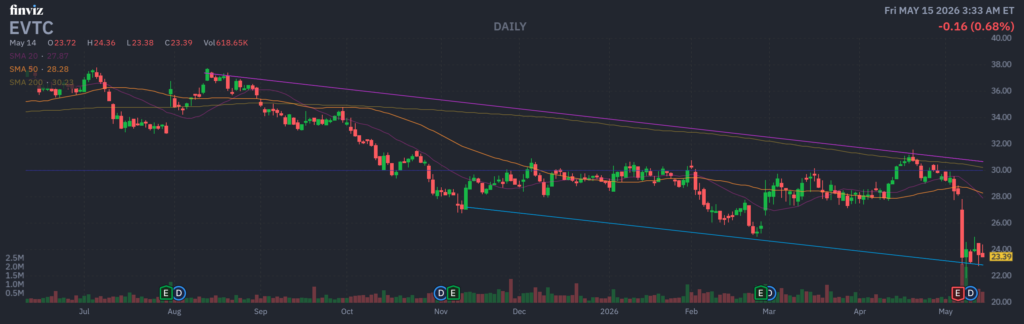
Name: Frank G. D’Angelo
Position: Director
Transaction Date: 05-08-2026 Shares Bought: 20,000 shares an average price paid of $23.40 for Cost: $468,000
Name: Miguel Vizcarrondo
Position: Executive Vice President
Transaction Date: 05-11-2026 Shares Bought: 21,000 shares an average price paid of $23.37 for Cost: $490,772
Company: Evertec Inc. (EVTC)
EVERTEC, Inc. offers transaction processing and financial technology services in Latin America, Puerto Rico, and the Caribbean. The company operates in four segments: payment services, merchant acquisition, Latin America solutions, and business solutions. It provides electronic payment processing, merchant acquisition, fraud monitoring, card authorization and settlement, and business process outsourcing services to financial institutions, merchants, enterprises, and government organizations. EVERTEC also owns and operates the ATH network, a PIN-based debit payment system popular in the region. Each year, the company’s electronic payment systems execute almost 10 billion transactions. EVERTEC was founded in 1988 and has its headquarters in San Juan, Puerto Rico.
Frank G. D’Angelo has been a Director of EVERTEC Inc. since September 2013 and was elected Chairman of the Board in February 2014. He has over 40 years of experience in the financial services, digital banking, and payments industries, including top leadership positions at NCR Corporation, Fidelity National Information Services (FIS), Metavante Technologies, and Diebold Corporation. In addition to his role on the EVERTEC board, he is an operational partner at Hill Path Capital and a former partner at Bridgeport Partners. D’Angelo received his B.B.A. and M.S. degrees from Walsh University.
Miguel “Mike” Vizcarrondo has been executive vice president of EVERTEC Inc. since 2012, and he was appointed Chief Product & innovation officer in August 2022. He joined EVERTEC in 2010 after 14 years with Banco Popular de Puerto Rico, where he held many leadership positions, including Senior Vice President of merchant acquiring solutions. Throughout his time with EVERTEC, Vizcarrondo has led important payment processing, merchant acquisition, and innovation programs throughout Puerto Rico, the Caribbean, and Latin America. He graduated from Tulane University with a Bachelor of Science in Management and a focus in finance.
Insomniac Hedge Fund Guy Opinion: Evertec is basically the digital plumbing behind payments and transaction processing across Puerto Rico, Latin America, and the Caribbean. The company handles payment processing, merchant acquiring, ATM networks, and core banking technology for financial institutions and governments. Think of it as a regional fintech infrastructure provider rather than a flashy consumer fintech story.
The moat comes from deep customer relationships, localized infrastructure, and regulatory integration. Banks generally do not rip out mission-critical payment systems unless absolutely necessary, which creates sticky recurring revenue. A large percentage of revenue comes from long-term contracts, transaction processing, and managed services, giving the business a fairly stable base despite operating in smaller regional markets.
Profitability has also improved steadily, with operating income reaching roughly $186M in 2025.
Management has focused aggressively on expanding beyond Puerto Rico through acquisitions and regional payment consolidation. That strategy makes sense, although it also increases integration and debt risk. Customer concentration remains the biggest issue since Popular Inc. still represents a meaningful relationship for the company.
The interesting part here is that Evertec behaves more like a toll-road business than a traditional IT company. As economies digitize payments, transaction volumes naturally rise.
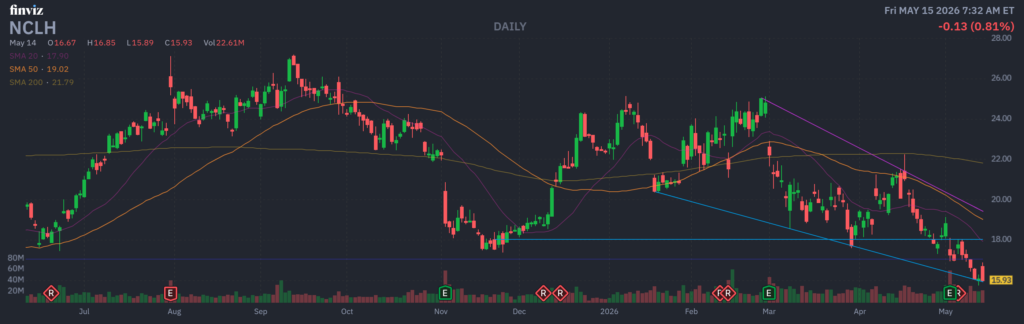
Name: Brian P. MacDonald
Position: Director
Transaction Date: 05-11-2026 Shares Bought: 15,000 shares an average price paid of $16.54 for Cost: $248,100
Company: Norwegian Cruise Line Holdings Ltd. (NCLH)
Norwegian Cruise Line Holdings Ltd. and its subsidiaries operate cruise ships in North America, Europe, Asia-Pacific, and across the world. It offers itineraries to Europe, Asia, Australia, New Zealand, South America, Africa, Canada, Bermuda, the Caribbean, and Alaska, as well as an inter-island tour in Hawaii. The company also offers features, amenities, and activities such as various accommodations, dining venues, bars and lounges, spas, casino and retail shopping areas, and entertainment options; shore excursions at each port of call; and air transportation and hotel packages for stays prior to or following a voyage. It offers its products and services under the Norwegian Cruise Line, Oceania Cruises, and Regent Seven Seas Cruises brands. The company was created in 1966 and is headquartered in Miami, Florida.
Brian P. MacDonald has served as a Director of Norwegian Cruise Line Holdings Ltd. since August 2024, when he was appointed to the company’s Board of Directors. MacDonald is the former Chief Executive Officer of CDK Global and previously held senior leadership roles at Dell Technologies, including President of the Infrastructure Solutions Group, where he helped drive growth across enterprise technology businesses. He brings extensive experience in digital transformation, operational strategy, and global business leadership across technology and services industries. MacDonald earned a bachelor’s degree in economics and political science from Allegheny College and an MBA from the University of Chicago Booth School of Business.
Insomniac Hedge Fund Guy Opinion: Norwegian Cruise Line is basically a leveraged bet on the global consumer still wanting experiences over stuff. The company operates three cruise brands—Norwegian, Oceania, and Regent Seven Seas—with exposure ranging from mass market to ultra-luxury cruising. The cruise industry has fully recovered from the pandemic, but NCLH still carries one major scar: debt.
Revenue has rebounded aggressively, climbing from pandemic lows to nearly $9.8B in 2025 revenue, versus about $6.5B pre-COVID in 2019. Over the last five years the numbers are distorted by COVID, but normalized growth has returned to mid-single digits. Unlike software companies, NCLH doesn’t really have “recurring revenue,” although advance bookings and onboard spending create decent visibility. Advance ticket sales remain strong and bookings have hit record levels in recent quarters.
The moat is weaker than investors pretend. Cruise lines compete heavily on pricing, destinations, and onboard experience. What helps Norwegian is its premium positioning and loyal repeat customer base, especially within Regent and Oceania. Still, this is ultimately a cyclical leisure business with high fixed costs.
Management recently transitioned leadership to CEO John Chidsey, formerly of Subway and Burger King. The focus now is deleveraging the balance sheet while improving margins through higher ticket pricing and onboard spending.
Profitability has improved dramatically. Adjusted EBITDA reached roughly $2.7B in 2025, and the company returned to meaningful profitability. But interest expense remains a major overhang due to pandemic-era borrowing.
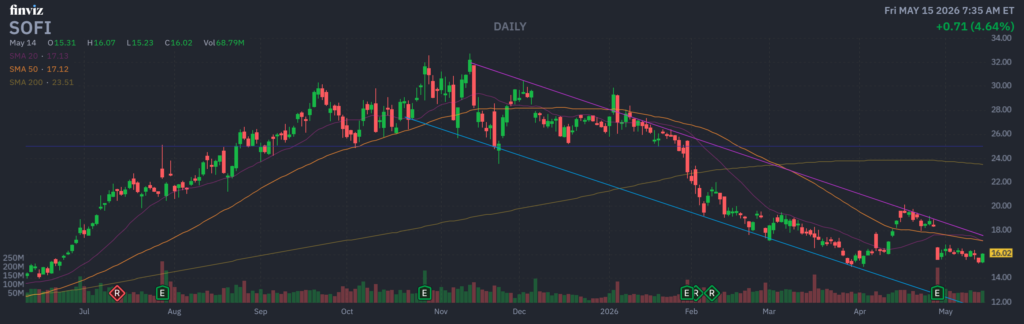
Name: Anthony Noto
Position: Chief Executive Officer
Transaction Date: 05-08-2026 Shares Bought: 15,878 shares an average price paid of $15.73 for Cost: $249,769
Company: SoFi Technologies Inc. (SOFI)
SoFi Technologies, Inc. provides a variety of financial services in the United States, Latin America, Canada, and Hong Kong. The corporation is divided into three business segments: lending, technology platforms, and financial services. It provides lending and financial services and products that let its members borrow, save, spend, invest, and protect their money, as well as personal loans, student loans, house loans, and other related services. The company also manages Galileo, a technological platform that provides services to financial and non-financial institutions, as well as Technisys, a cloud-native digital and core banking platform that sells software licenses and related services such as implementation and maintenance. The company was created in 2011 and is headquartered in San Francisco, California.
Anthony Noto joined SoFi Technologies Inc. in February 2018 and was appointed Chief Executive Officer and member of the board on March 1, 2018. He was named CEO when he joined the company, following temporary leadership and taking on the duty of steering SoFi’s expansion as a major digital financial services platform. Prior to joining SoFi, Noto held prominent positions at Twitter, the National Football League, and Goldman Sachs, gaining vast experience in finance and technology. He graduated from the United States Military Academy at West Point with a Bachelor of Science in Mechanical Engineering and later earned an MBA from the University of Pennsylvania’s Wharton School.
Insomniac Hedge Fund Guy Opinion: SoFi is trying to become the “AWS of consumer finance”—a one-stop digital platform for borrowing, saving, investing, and banking. What started as a student loan refinance company has evolved into a broader fintech ecosystem with banking products, brokerage accounts, credit cards, and infrastructure software through Galileo and Technisys.
The moat is still developing, but the ecosystem strategy is working. SoFi acquires customers cheaply through one product, then cross-sells multiple financial services over time. Member growth has been explosive, with 2025 revenue expected to grow roughly 30–36% year over year and members growing over 30% annually. Fee-based and recurring-style revenue streams are becoming a larger percentage of the business, reducing reliance on pure lending spreads. Fee-based revenue grew more than 50% in late 2025, which is important because investors want SoFi to look more like a scalable fintech platform than just another lender.
CEO Anthony Noto is one of the stronger operators in fintech. Formerly at Twitter, Goldman Sachs, and the NFL, he’s aggressive, media-savvy, and relentlessly focused on growth, cross-selling, and profitability. Importantly, SoFi has transitioned from “story stock” to actually generating GAAP profits.
Profitability is improving fast. Adjusted EBITDA margins are approaching 30%, revenue surpassed $1 billion in a quarter for the first time in 2025, and the company continues to post record member and product growth.
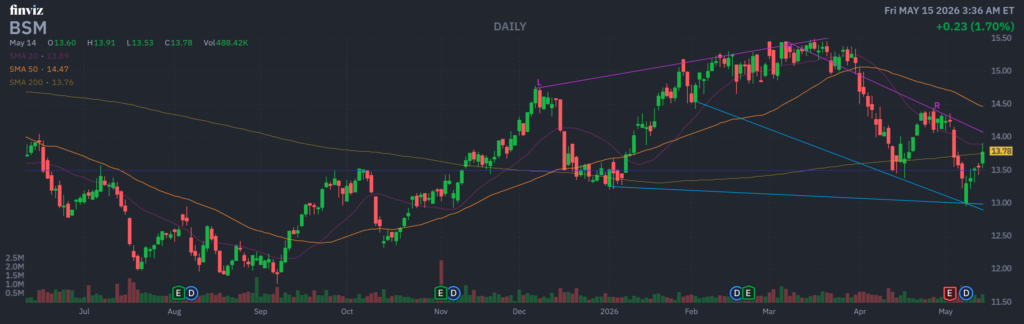
Name: Thomas L. Carter Jr
Position: Executive Chairman
Transaction Date: 05-08-2026 Shares Bought: 67,758 shares an average price paid of $13.42 for Cost: $909,335
Company: Black Stone Minerals L.P. (BSM)
Black Stone Minerals, L.P. owns and manages oil and natural gas mineral and royalty interests in the United States. The corporation holds mineral, nonparticipating, and overriding royalty interests in many energy-producing locations around the country. Its business consists on leasing mineral rights and collecting royalties from oil and gas production activities carried out by exploration and production companies. Black Stone Minerals has a wide portfolio of assets spread throughout several states in the United States, providing it with extensive exposure to the domestic energy sector. operates as a leading mineral and royalty holding firm in the area. Black Stone Minerals, L.P., was created in 1876, with its headquarters in Houston, Texas.
Thomas L. Carter Jr. has been executive chairman of Black Stone Minerals L.P. since January 2026, after more than a decade as Chairman and CEO of the company’s general partner from November 2014 to December 2025. Carter has been involved with the Black Stone organization for decades, founding Black Stone Energy Company in 1980 and Black Stone Minerals Company (BSMC), the partnership’s precursor, in 1998. Throughout his tenure, he has helped Black Stone become one of the largest owners of oil and gas mineral interests in the United States. He received both his BBA and MBA degrees from the University of Texas in Austin.
Insomniac Hedge Fund Guy Opinion: Black Stone Minerals is basically a royalty toll booth on U.S. oil and gas production. Instead of drilling wells itself, BSM owns mineral and royalty interests across millions of acres, especially in the Haynesville shale. Operators drill the wells, spend the capital, and take the operational risk. Black Stone collects royalties. That’s the appeal.
The moat is asset quality and acreage position. Mineral rights are hard to replicate, and BSM owns one of the largest mineral portfolios in the country. Unlike E&P companies constantly fighting decline curves and capex inflation, royalty businesses are structurally lighter and more cash generative. The model works especially well when commodity prices cooperate.
Revenue over the last five years has been volatile because oil and gas prices drive everything. 2025 revenue was about $470 million, up roughly 8% year over year, but the longer-term trend swings heavily with natural gas prices. There’s no true recurring revenue metric or net retention figure like software companies report, but royalty income behaves somewhat annuity-like as long as production continues.
Management has generally stayed disciplined on leverage and acquisitions. The balance sheet is relatively clean, and distribution coverage has remained solid despite commodity volatility.
Profitability is the real attraction. Royalty businesses have minimal operating costs, allowing BSM to throw off strong free cash flow and sizable distributions to unitholders.
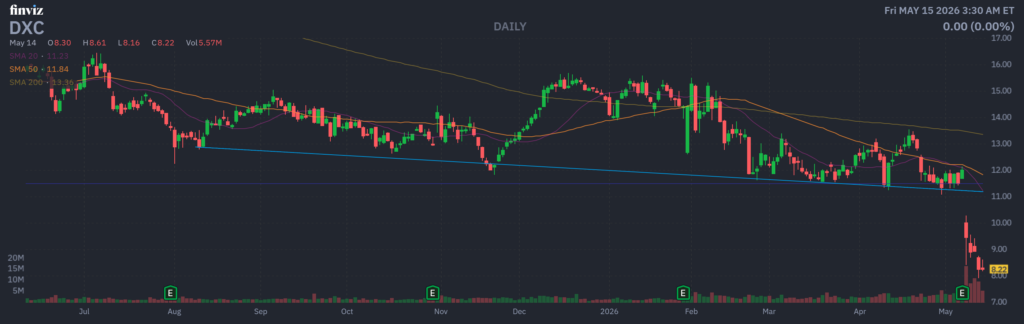
Name: Raul J. Fernandez
Position: President and CEO
Transaction Date: 05-11-2026 Shares Bought: 28,051 shares an average price paid of $8.90 for Cost: $249,512
Company: DXC Technology Co (DXC)
DXC Technology Company offers IT services and digital transformation solutions to businesses and the public sector throughout the world through its Global Business Services and Global Infrastructure Services segments. The company provides consulting, software engineering, analytics, application services, cloud infrastructure, cybersecurity, and IT outsourcing solutions to assist businesses in modernizing operations and managing mission-critical systems. DXC Technology, founded in 1959, is headquartered in Ashburn, Virginia.
Raul J. Fernandez has been a President and CEO at DXC Technology Co. since February 2024. He joined the company’s board in 2020 and later became President and CEO, bringing more than three decades of leadership expertise in the technology and digital services business. Before joining DXC as an executive, he started and ran several technology firms, including Proxicom and ObjectVideo, and has served on other public company boards, including Broadcom. He is also the Vice Chairman and co-owner of Monumental Sports and Entertainment. He earned his Bachelor of Arts in Economics degree from the University of Maryland.
Insomniac Hedge Fund Guy Opinion: DXC Technology is basically a legacy IT services and outsourcing company trying to reinvent itself before the market fully gives up on it. The business was formed from the merger of CSC and HPE’s enterprise services division, and today it provides cloud migration, IT outsourcing, consulting, engineering, and infrastructure management for large enterprises and governments.
The problem is simple: revenue has been shrinking for years. Sales have fallen from over $20B several years ago to roughly $13B today as legacy infrastructure contracts roll off faster than new business arrives. Recent revenue trends are still negative, with fiscal 2025 revenue declining around 5%.
The bull case is that DXC still has sticky enterprise relationships, large-scale outsourcing expertise, and meaningful free cash flow generation. Much of the revenue is recurring through long-duration contracts, although growth in that recurring base has been weak. The company’s book-to-bill ratio has recently improved above 1.0x, suggesting bookings stabilization may finally be happening.
CEO Raul Fernandez is pitching DXC as an AI-enabled modernization partner rather than a legacy outsourcing vendor. Management has focused heavily on cost cuts, operational discipline, and rebuilding sales execution. Margins have improved modestly, with adjusted EBIT margins moving toward the high-single digits.
But this is still a turnaround, not a clean compounder. Reddit and value-investing discussions basically frame the debate correctly: strong cash flow and cheap valuation versus years of declining revenue and questionable long-term competitiveness.
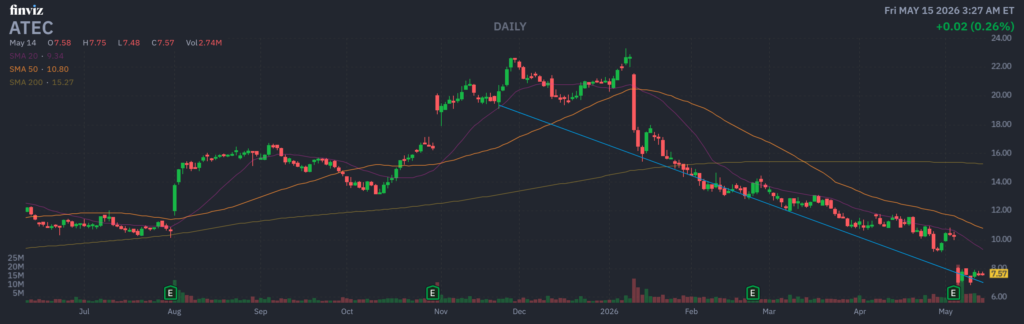
Name: Keith Valentine
Position: Director
Transaction Date: 05-07-2026 Shares Bought: 135,000 shares an average price paid of $7.38 for Cost: $996,192
Company: Alphatec Holdings Inc. (ATEC)
Alphatec Holdings, Inc. develops medical technologies for the surgical treatment of spinal problems in the United States and internationally. The company creates and sells spinal implants, fixation systems, biologics, imaging platforms, navigation tools, and robotic-assisted surgical solutions. Its product offerings include the EOS imaging system, the SafeOp Neural InformatiX monitoring platform, the Valence navigation and robotics system, and the NanoTec and Invictus spinal implant systems. Alphatec also provides biologic graft solutions for spinal operations, including AlphaGRAFT and BioCORE.Today, the corporation sells its products worldwide through direct reps and independent sales agents. The company was founded in 1990 and has its headquarters in Carlsbad, California.
Keith Valentine has been a Director of Alphatec Holdings Inc. since July 2024, having previously served as Special Advisor to the Board starting in October 2023. Valentine has over 30 years of expertise in the spine and orthopedic industries, including leadership roles as President and CEO of Orthofix and previously SeaSpine, where he managed the company since 2015. His significant experience includes top leadership roles at NuVasive and Medtronic Spine & Biologics. He graduated from Western Michigan University with a Bachelor of Business Administration in Management and Biomedical Sciences.
Insomniac Hedge Fund Guy Opinion: Alphatec is one of the more interesting small-cap med-tech stories because it’s not trying to be everything to everyone. The company is focused almost entirely on spine surgery, selling implants, biologics, imaging, navigation, and procedural systems designed to help surgeons perform complex spinal operations. The pitch is straightforward: make spine surgery more reproducible and easier for surgeons to adopt.
The moat is still developing, but there’s something real here. ATEC’s strategy is less about selling individual hardware products and more about owning the surgical workflow. Once surgeons are trained on ATEC’s procedural systems and imaging platforms, usage tends to deepen over time. That creates decent switching costs and helps drive recurring procedure volume.
Growth has been exceptional. Revenue has compounded aggressively over the last five years, with 2025 revenue reaching roughly $764M, up 25% year over year. Surgical revenue growth remains the core engine, fueled by surgeon adoption and increased procedural volume. Unlike software companies, recurring revenue metrics and net retention aren’t formally disclosed, but repeat procedural usage acts similarly to a recurring revenue stream.
Management, led by CEO Pat Miles, deserves credit for turning ATEC from a struggling spine business into a serious growth company. Execution has been strong, particularly around product launches and surgeon recruitment.
Profitability is improving but still the key debate. Gross margins are already around 70%, which is impressive for med-tech, but the company remains GAAP unprofitable due to heavy investment in sales expansion and innovation
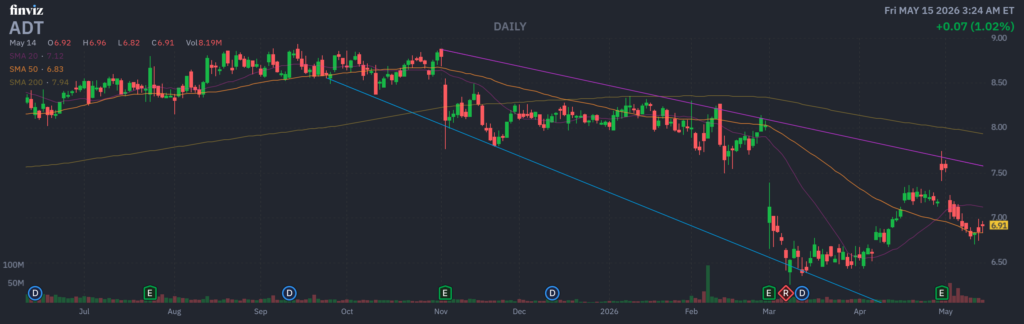
Name: Daniel Joseph Houston
Position: Director
Transaction Date: 05-08-2026 Shares Bought: 36,450 shares an average price paid of $6.87 for Cost: $250,412
Company: ADT Inc. (ADT)
ADT Inc. is a leading provider of security and smart home solutions in the United States. It provides burglar alarms, video surveillance, smart security cameras, home automation systems, and life safety solutions to residential and small business customers. ADT also offers expert monitoring, maintenance, and response systems for medical and environmental emergencies. Customers can remotely manage and monitor their houses via platforms such as ADT+ and Trusted Neighbor, which use mobile apps and smart devices. The company sells its products and services through retail, e-commerce, dealers, and direct sales. The corporation was previously known as Prime Security Services Parent, Inc., but changed its name to ADT Inc. in September 2017. ADT Inc. was founded in 1874 and is based in Boca Raton, Florida.
Daniel Joseph Houston has been a Director of ADT Inc. since June 2024, when he was named as an extra independent director to the company’s Board of Directors. Houston has decades of leadership experience with Principal Financial Group, where he started in 1984 and rose to the position of Chairman, President, and CEO in 2015. He also serves on ADT’s Compensation and Nominating and Corporate Governance Committees. Houston received a bachelor’s degree in business administration from the University of Northern Iowa.
Insomniac Hedge Fund Guy Opinion: ADT is basically a leveraged recurring-revenue business disguised as an old-school home security company. The company provides monitored security systems, smart-home automation, video surveillance, and emergency response services to residential and small business customers across the U.S. The market still thinks “legacy alarm company,” but management wants investors to think “sticky subscription platform.”
The moat is the installed customer base and monitoring network. Once a customer signs up, ADT collects monthly monitoring fees for years, creating an annuity-like revenue stream. Recurring monitoring and service revenue accounts for roughly 85% of total revenue, which is the real reason the stock still matters. Customer attrition remains relatively stable around 13%, and payback periods on customer acquisition are about 2.3 years, which are decent economics for a subscription business.
Over the last five years, revenue growth has been modest, generally low-to-mid single digits. 2025 revenue grew about 5% to $5.1B, while recurring monthly revenue continued hitting record levels. The issue is growth perception. DIY competitors like Ring and SimpliSafe have changed the industry narrative from “monitoring” to “cheap self-install hardware.”
CEO Jim DeVries has focused heavily on cash flow, buybacks, and improving customer economics rather than chasing aggressive subscriber growth. Profitability and free cash flow have improved materially, but the company still carries meaningful debt.
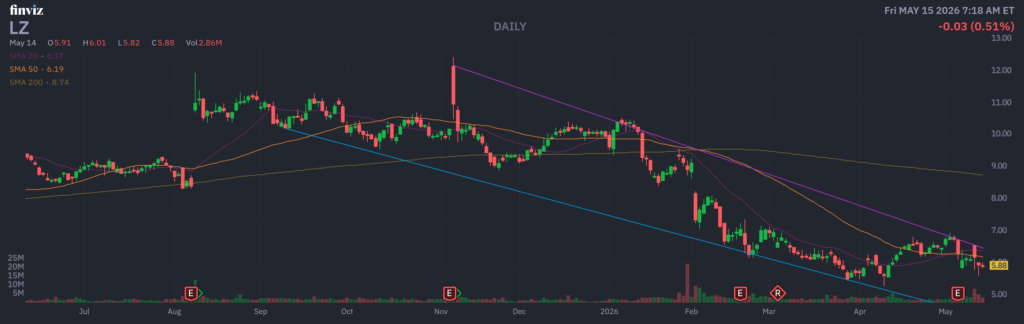
Name: Jeffrey M. Stibel
Position: Chief Executive Officer
Transaction Date: 05-11-2026 Shares Bought: 125,000 shares an average price paid of $6.15 for Cost: $768,988
Company: Legalzoom.Com Inc. (LZ)
LegalZoom.com, Inc. maintains an online platform that offers legal, compliance, and business management services to small businesses and individuals in the United States. The company provides business formation services, such as LLC and corporation registration, nonprofit registrations, business licenses, and compliance filings. It also offers intellectual property services, such as trademark, patent, and copyright applications, as well as estate planning items like wills, trusts, and power of attorney paperwork. Additionally, LegalZoom provides subscription-based legal plans, compliance support, bookkeeping, e-signature, and virtual mail services. The company was founded in 1999 and has its headquarters in Mountain View, California.
Jeffrey M. Stibel has served as Chief Executive Officer of LegalZoom.com Inc. since July 2024, when he was appointed to lead the company following a leadership transition. Stibel originally joined LegalZoom in October 2014 as a member of the Board of Directors and later became Chairman of the Board in October 2018. Prior to becoming CEO, he held senior leadership positions at Web.com and Dun & Bradstreet Credibility Corp., as well as co-founding Bryant Stibel, an investment and advisory firm. Stibel earned a bachelor’s degree in psychology, philosophy, and cognitive science from Tufts University and a master’s degree in cognitive science from Brown University.
Insomniac Hedge Fund Guy Opinion: LegalZoom is basically trying to become the digital operating system for small business legal needs. The company started with online business formation documents but is increasingly shifting toward subscriptions, compliance tools, bookkeeping, tax support, and recurring legal services for small businesses. That transition matters because one-time LLC formations are cyclical, while subscriptions are far more predictable.
The moat is decent but not bulletproof. LegalZoom has strong brand recognition among small businesses and a massive customer acquisition funnel from LLC formations. Once customers form a business through the platform, LegalZoom attempts to upsell recurring services like compliance filings, registered agent services, and bookkeeping. The challenge is competition: TurboTax, Rocket Lawyer, Clerky, Stripe Atlas, and AI-driven legal tools are all attacking parts of the workflow.
Revenue growth over the last five years has been modest but improving recently. 2025 revenue reached roughly $756 million, growing about 11% year over year. Subscription revenue now represents roughly 65% of total revenue and has been growing faster than transaction revenue, generally in the low double digits.
Management under CEO Jeff Stibel is clearly focused on profitability and recurring revenue expansion after a rough 2024 reset. The business now generates meaningful free cash flow and adjusted EBITDA margins above 20%, though GAAP profitability remains inconsistent.
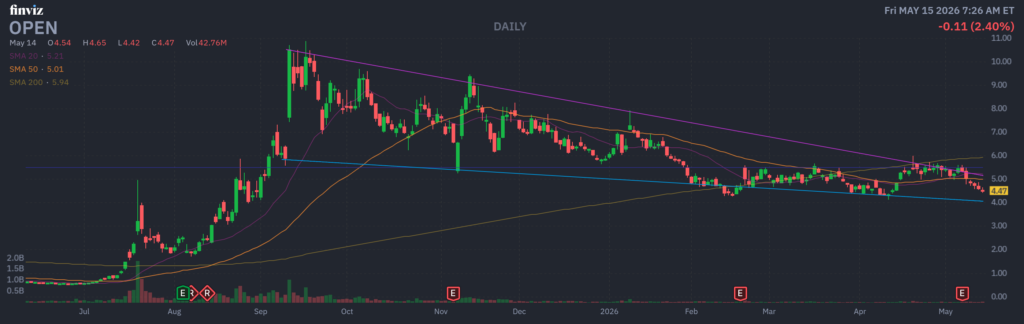
Name: Kasra Nejatian
Position: Chief Executive Officer
Transaction Date: 05-11-2026 Shares Bought: 100,000 shares an average price paid of $4.88 for Cost: $487,800
Company: Opendoor Technologies Inc. (OPEN)
OpenDoor Technologies Inc. provides a digital platform for residential real estate transactions in the United States. It buys and sells homes using an online e-commerce platform. The company also sells the house to a home buyer. In addition, it provides real estate brokerage, title insurance and settlement, escrow, property and liability insurance, real estate licensing, and construction services. The company was previously known as Social Capital Hedosophia Holdings Corp. II before changing its name to Opendoor Technologies Inc. OpenDoor Technologies Inc. was established in 2013 and is headquartered in Tempe, Arizona.
Kasra Nejatian has been Chief Executive Officer of Opendoor Technologies Inc. since September 2025, when he was appointed CEO and member of the Board of Directors. Nejatian came to Opendoor from Shopify, where he has been Chief Operating Officer and Vice President of Product since 2019, working to scale the company’s commerce and AI-driven product projects. Prior to joining Shopify, he launched Kash, a payments technology firm, and established himself as a technology entrepreneur and product leader. Nejatian earned a law degree from the University of Saskatchewan and studied commerce at the University of Calgary.
Insomniac Hedge Fund Guy Opinion: Opendoor is basically a giant experiment: can software and data turn home flipping into a scalable technology platform? The company buys homes directly from sellers, renovates them lightly, and resells them through its online marketplace. In theory, it removes friction from residential real estate. In practice, it’s a brutally cyclical, capital-intensive business with razor-thin margins.
The bull case is that Opendoor has built one of the strongest consumer brands in iBuying and owns a massive pricing dataset across U.S. housing markets. Management now wants to evolve from a balance-sheet-heavy home flipper into a more asset-light real estate platform with agents, services, and AI-driven transaction tools.
The problem is that the business still has not proven durable profitability. Unlike software companies, Opendoor has very little true recurring revenue and no disclosed net retention metric. This is transactional housing exposure disguised as a tech platform.
Management deserves some credit for improving operations. Losses narrowed significantly in 2025, inventory risk came down, and the company posted its first positive adjusted EBITDA quarter since 2022.
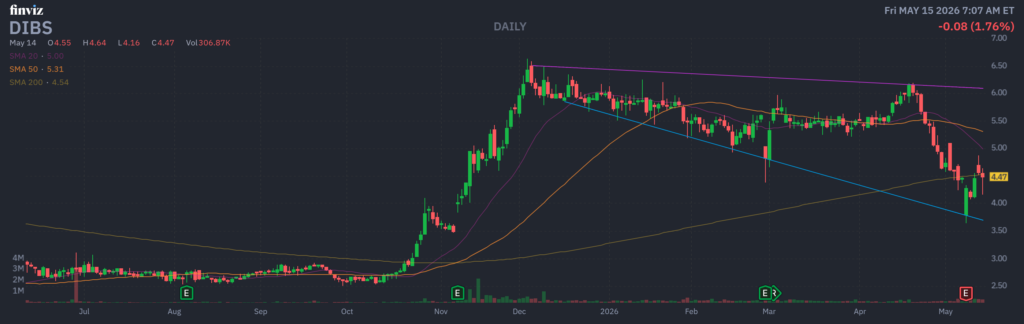
Name: David S. Rosenblatt
Position: Chief Executive Officer
Transaction Date: 05-12-2026 Shares Bought: 47,500 shares an average price paid of $4.51 for Cost: $214,132
Company: 1stdibs.com Inc. (DIBS)
1stdibs.com, Inc. is an online marketplace that specializes in luxury design products for buyers worldwide. The portal connects buyers with professional sellers and artisans who sell vintage, antique, and contemporary furniture, home decor, fine jewelry, watches, art, and fashion products. The company specializes in curated high-end products, catering to collectors, interior designers, and luxury consumers looking for one-of-a-kind and premium items. In addition to its marketplace operations, 1stdibs offers advertising and promotional services to sellers and brands that use its platform. It offers a global audience via its digital marketplace platform. The company was founded in 2000, and its headquarters are in New York, New York.
David S. Rosenblatt has been the Chief Executive Officer of 1stdibs.com Inc. since November 2011, when he was appointed CEO and joined the firm’s board of directors after Benchmark Capital invested in the company. Before joining 1stDibs, Rosenblatt was CEO of DoubleClick from 2005 to 2008, and after Google acquired DoubleClick, he became President of global display advertising. Under his guidance, 1stDibs grew into the world’s top online marketplace for premium design, art, jewelry, and collectibles. Rosenblatt received a bachelor’s degree in Asian studies from Yale University and an MBA from Stanford University’s Graduate School of Business.
Insomniac Hedge Fund Guy Opinion: 1stdibs is essentially a luxury marketplace for high-end furniture, art, jewelry, and collectibles. Think of it as a curated online platform where wealthy buyers shop for vintage designer pieces instead of mass-market goods. The brand has credibility in luxury design circles, which matters because trust and authenticity are everything when someone is buying a $40,000 chandelier online.
The moat is mostly brand and curation. 1stdibs carefully vets dealers and inventory, creating a marketplace that feels more like Sotheby’s than Etsy. That helps attract affluent buyers and keeps counterfeit risk lower than broader marketplaces. Still, this is not an unbeatable moat. Luxury demand is cyclical, and the company competes indirectly with auction houses, galleries, and offline dealers.
Financially, growth has been disappointing since the post-COVID luxury boom faded. Revenue peaked above $100 million in 2021 and sits around $90 million today, implying basically flat-to-down growth over the last five years. The good news is profitability is improving meaningfully. Gross margins are strong at roughly 73–74%, and management has aggressively cut costs, helping adjusted EBITDA finally turn positive in recent quarters.
CEO David Rosenblatt has focused on expense discipline, product improvements, and stabilizing the marketplace. The company also has a strong balance sheet with substantial cash and no debt pressure.
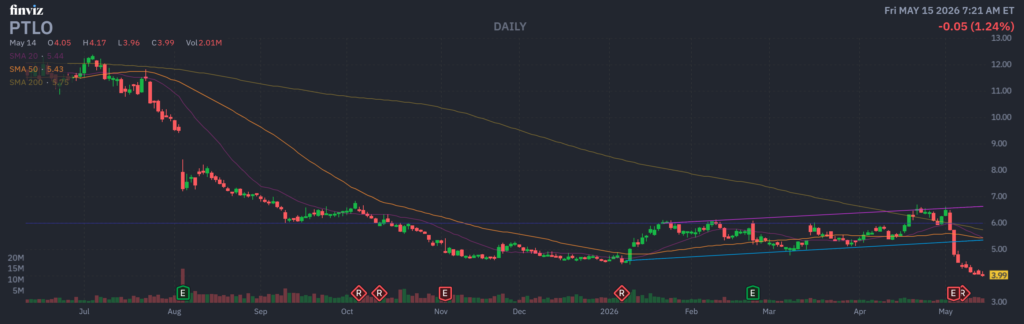
Name: Eugene I. Lee Jr
Position: Director
Transaction Date: 05-11-2026 Shares Bought: 70,165 shares an average price paid of $4.28 for Cost: $300,306
Company: Portillo’s Inc. (PTLO)
Portillo’s Inc. owns and operates fast-casual restaurants around the United States. The company serves Chicago-style hot dogs and sausages, Italian beef sandwiches, char-grilled burgers, chopped salads, crinkle-cut and cheese fries, handcrafted chocolate cakes, and chocolate cake shakes. It also maintains a food van called The Beef Bus, as well as a ghost kitchen. In addition, the company offers delivery services via its app and website, as well as third-party delivery systems. Additionally, it sells gift cards. Portillo’s Inc. was formed in 1963 and is headquartered in Oak Brook, Illinois.
Eugene I. Lee Jr. has served as Director at Portillo’s Inc. since June 2025. He brings extensive leadership experience in the restaurant industry and corporate governance. Lee previously served as Chief Executive Officer of Darden Restaurants from 2015 to 2022 and later as Chairman of its board from 2021 to 2023, where he helped drive significant revenue growth and operational improvements. Earlier in his career, he held several senior leadership roles at RARE Hospitality International, including President and Chief Operating Officer, before joining Darden through its acquisition of the company. In addition to his role at Portillo’s, he also serves as Independent Board Chair of Advance Auto Parts. He holds an MBA from Suffolk University in Boston.
Insomniac Hedge Fund Guy Opinion: Portillo’s is essentially a regional fast-casual restaurant concept trying to become a national growth story. The company is famous for Chicago-style hot dogs, Italian beef sandwiches, burgers, and shakes, with a cult-like following in the Midwest. The bull case is straightforward: take a highly productive restaurant model with strong brand loyalty and expand it across the Sunbelt.
The moat is mostly brand affinity and unusually high average unit volumes. Mature Portillo’s stores generate meaningfully higher sales than many fast-casual peers, which gives the concept economic appeal when execution is working. But unlike Chipotle or Domino’s, this is not an asset-light franchise machine. New store builds are expensive and operationally complex.
Revenue growth over the last five years has been solid, climbing from roughly $480M in 2019 to over $730M in 2025. However, recent trends have weakened. Same-store sales have turned slightly negative, while restaurant margins have compressed because of labor and food inflation. Unlike software or subscription businesses, Portillo’s has virtually no recurring revenue, so traffic trends matter enormously.
Management is currently in transition after leadership changes in 2025, with the company refocusing on operational execution and more disciplined expansion. That reset probably needed to happen.
Profitability is the concern. Operating margins have fallen from roughly 8%+ to around 6%, while net income declined sharply in 2025.
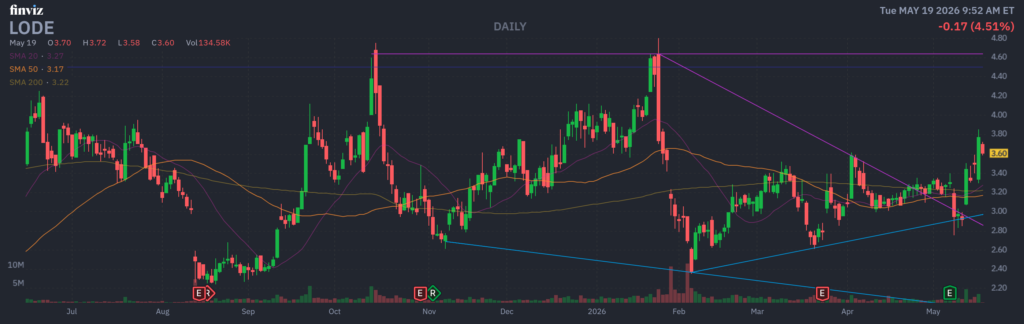
Name: Steven Yu-Tsung Pei
Position: Director
Transaction Date: 05-13-2026 Shares Bought: 424,559 shares an average price paid of $3.38 for Cost: $1,436,865
Name: Corrado De Gasperis
Position: CEO
Transaction Date: 05-12-2026 Shares Bought: 35,000 shares an average price paid of $2.89 for Cost: $101,150
Company: Comstock Inc. (LODE)
In the United States, Comstock Inc. commercializes technologies, methods, and supply chains for extracting, processing, and converting underutilized waste and natural resources into clean energy and clean energy-related products. It operates in four segments: fuels, metals, mining, and strategic investments. The firm creates and commercializes technology for extracting and converting waste and underused lignocellulosic biomass into intermediates that can be refined into advanced renewable fuels. It also owns 100 percent of the Lucerne Project in Storey County, Nevada, and the Spring Valley Project in Lyon County, Nevada. Comstock Inc. was established in 1999 and is headquartered in Virginia City, Nevada.
Steven Yu-Tsung Pei has been an Independent Director at Comstock Inc. since March 2026, when he was named to the company’s Board of Directors as part of a governance expansion to support Comstock’s solar recycling and essential metals recovery growth strategy. Pei is the Founder and Chief Investment Officer of Gratia Capital, a Los Angeles-based investment business he founded in 2012. He has over 25 years of experience in capital allocation, restructuring, and strategic investing in both public and private markets. Pei holds a BS from the University of Pennsylvania’s Wharton School, as well as an MA and BA from the university’s College of Arts and Sciences.
Corrado De Gasperis has served as Chief Executive Officer of Comstock Inc. since April 2010 and was additionally appointed Executive Chairman in September 2015. He joined the company during a transformational period and has led Comstock’s evolution from a traditional mining company into a clean energy and renewable resource technology business focused on metals recycling, fuels, and decarbonization solutions. Prior to Comstock, De Gasperis served as CEO of Barzel Industries and previously held senior finance and operational leadership roles at GrafTech International and KPMG LLP. He earned a Bachelor of Business Administration degree with honors from the Ancell School of Business at Western Connecticut State University.
Insomniac Hedge Fund Guy Opinion: Comstock is no longer really a mining company. Today, it’s a speculative clean-tech platform focused on renewable fuels, solar panel recycling, and metals recovery. The bull case is that management is trying to build valuable energy-transition businesses before revenues fully arrive. The bear case is that the company is still extremely early, heavily promotional, and dependent on capital markets.
Revenue remains tiny and volatile. Comstock generated only about $1–3 million of annual revenue over the last few years, with growth swinging wildly because the business is still in commercialization mode rather than steady operations. There is effectively no meaningful recurring revenue base yet, and net retention metrics are not really relevant at this stage because the company does not operate a mature SaaS-style or contracted recurring model.
CEO Corrado De Gasperis has been aggressive in repositioning the company from legacy mining assets into renewable fuels and recycling technologies. Recent financing deals tied to the Bioleum fuels business and partnerships with larger industrial players give the company some credibility. Still, execution risk is enormous.
Profitability is the major issue. Comstock continues to post large operating losses and negative cash flow while funding R&D, demonstration facilities, and expansion efforts. The company’s future depends on successfully scaling its fuels and recycling operations into something commercially viable before dilution becomes overwhelming.
This blog is solely for educational purposes and the author’s own amusement. IT IS NOT INVESTMENT ADVICE. Think of the blog as part of my personal investment journal that I am willing to share with the DIY investor. We could be long, short, or have no position at all in any of the stocks mentioned and express no written or implied obligation to disclose any of that. Nothing contained here constitutes a recommendation to buy or sell any security. Investing involves risk, including the possible loss of principal, and past performance is not indicative of future results.
“The insomniac hedge fund guy” is a moniker Harvey Sax, the portfolio manager for The Insiders Fund” has used from time to time on email, blog ,and social media posts. While Mr. Sax is the portfolio manager of The Insiders Fund, these posts are not communications from, nor endorsed by, Alpha Wealth Funds, LLC or any of its managed funds. References to Alpha Wealth Funds or its affiliates are for identification only and do not imply sponsorship or approval.
All company names, logos, and trademarks belong to their respective owners. The use of company logos is solely for descriptive and illustrative purposes under fair use. Any information provided is based on publicly available data and should not be considered financial, investment, or legal advice. Readers should conduct their own research or consult with a professional before making any investment decisions. Insiders sell the stock for many reasons, but they generally buy for just one – to make money. You’ve always heard the best information is inside information. Everyone with any stock market experience pays close attention to what insiders are doing. After all, who knows a business better than the people running it? Officers, directors, and 10% owners are required to inform the public through a Form 4 Filing of any transaction, buy, sell, exercise, or any other within 48 hours of doing so.
This info is available for free from the SEC’s Web site, Edgar, although we subscribe to SECForm4 as they provide a way to manage and make sense of the vast realms of data. I’ve tried a lot of vendors. SECForm4 is one of the smaller ones, but I like supporting Frank. He is not arrogant. He’s helpful and has great prices. He also trades on his own data, so I like people that eat what they kill. The bar is different from selling because the natural state of management is to be a seller. This is because most companies provide significant amounts of management compensation packages as stock and options. Therefore, we analyze unusual patterns with selling, such as insiders selling 25 percent or more of their holdings or multiple insiders selling near 52-week lows. Another red flag is large planned sale programs that start without warning. Unfortunately, the public information disclosure requirements about these programs, referred to as Rule 10b5-1, are horrendously poor. Also, planned sales that pop up out of nowhere are basically sales and are seeking cover under this corporate welfare loophole.
I also generally ignore 10 percent shareholders as they tend to be OPM (other people’s money) and perhaps not the smart money on which we are trying to read the tea leaves. I say generally because some 10% shareholders are great investor, think Warren Buffett and others. Of course, insiders can also be wrong about their Company’s prospects. Don’t let anyone fool you into believing they never make mistakes. Do your own analysis. They can easily be wrong, and in many cases, maybe most cases, have no more idea what the future may hold than you or me. In short, you can lose money following them. We have, and we curse aloud; what were they thinking!
We like Fly on the Wall for keeping up with what events might be happening, analysts’ comments, and whatever else could be moving the stock. Dow Jones news service is an essential tool, but many services pick up their feed like they do Bloomberg. My assistant probes the 10k for a reasonable description of the business. I’ve found that to be the most accurate and succinct place to find out what a business actually does.