When Macro trumps everything, does insider buying have relevance. The answer to this will only be apparent in time. My hunch is that insiders know as much about macro as anyone else.
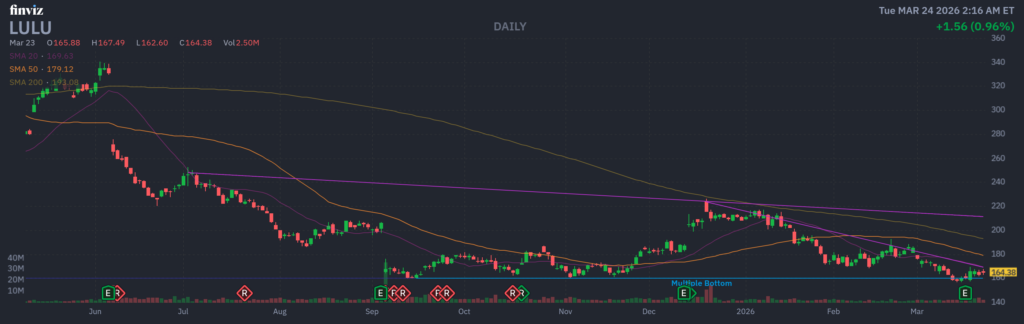
Name: Charles V. Bergh
Position: Director
Transaction Date: 03-20-2026 Shares Bought: 6,090 shares an average price paid of $164.20 for a cost of $999,978
Company: Lululemon Athletica Inc. (LULU)
Lululemon Athletica Inc., along with its subsidiaries, designs, distributes, and sells technical athletic apparel, footwear, and accessories for women and men under the lululemon brand in the United States, Canada, Mexico, China Mainland, Hong Kong, Taiwan, Macau, and other countries. It sells pants, shorts, tops, and jackets for athletic activities like yoga, jogging, training, and more. The brand also offers fitness-inspired accessories. It offers its products through company-owned stores, seasonal stores, pop-ups, university campus retailers, yoga and fitness studios, outlets, Like New, a re-commerce program, and its e-commerce website. The company was established in 1998 and is headquartered in Vancouver, Canada.
Charles V. Bergh has served as a Director of Lululemon Athletica Inc. since 2026, when he was appointed to the company’s Board of Directors as part of an ongoing board refresh to strengthen leadership and governance. He brings extensive global retail and brand leadership experience, having previously served as President and Chief Executive Officer of Levi Strauss & Co., where he led the company’s turnaround and return to public markets. Prior to that, Bergh spent nearly three decades at Procter & Gamble in senior leadership roles across global consumer brands. His expertise spans strategy, operations, and brand development. He holds a Bachelor of Arts degree from Lafayette College.
Insomniac Hedge Fund Guy Opinion: Lululemon Athletica is a premium athletic apparel brand built around yoga, training, and lifestyle wear. The company operates a vertically integrated, direct-to-consumer model (own stores + e-commerce), which gives it tight control over pricing, brand, and customer experience. It’s less “retail” and more of a lifestyle brand with a cult following.
The moat is primarily brand + pricing power. Lululemon sits at the premium end of athleisure, with loyal customers willing to pay up for fit, fabric, and status. The DTC model also avoids wholesale dilution and supports higher margins. There are no hard switching costs—but habit, community, and product feel create “soft” stickiness.
Growth has been strong but is clearly slowing. Revenue reached about $10.6B in 2024 (+10%), with current growth running in the 5–7% range. Over a 5-year view, the company delivered high-teens CAGR, but the business is now maturing, especially in North America. International—particularly China—is the key growth driver.
Recurring revenue is limited (this is apparel), but repeat purchasing behavior acts like a pseudo-recurring model. Net retention isn’t disclosed, but brand loyalty is historically strong.
Management has been solid operationally, though recent leadership uncertainty and execution issues in the U.S. have raised concerns.
Profitability remains elite for retail. Gross margins are ~55–58%, and operating margins sit in the high-teens to low-20s—well above peers. However, margins are now under pressure from tariffs, competition, and discounting.
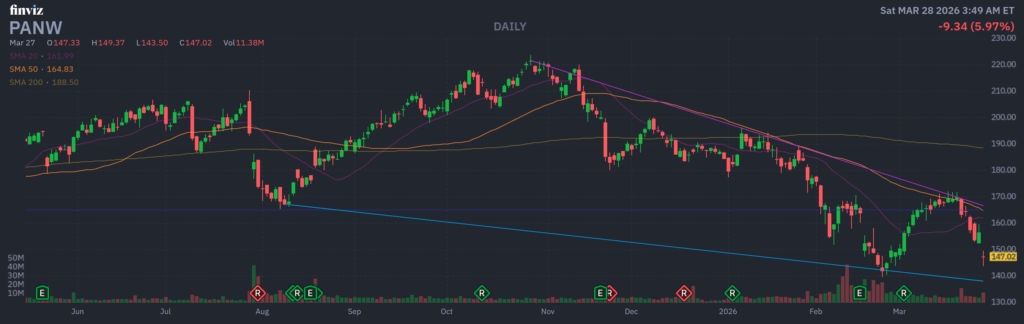
Name: Nikesh Arora
Position: Chief Executive Officer
Transaction Date: 03-27-2026 Shares Bought: 68,085 shares an average price paid of $146.87 for a cost of $9,999,977
Company: Palo Alto Networks Inc. (PANW)
Palo Alto Networks, Inc. offers cybersecurity solutions in the Americas, Europe, the Middle East, Africa, Asia Pacific, and Japan. It provides Prisma Access, a secure access service edge solution; Strata Cloud Manager, a network security management product; and Prisma AIRS, which protects companies’ whole AI ecosystems. It provides professional services such as architecture design and planning, implementation, configuration, and firewall migration; educational services such as certifications and online and in-person training; and support services. It provides its goods and services through channel partners and directly to corporations, service providers, and government bodies in a variety of industries, including financial services, Internet and media, manufacturing, public sector, and telecommunications. The company was established in 2005 and is based in Santa Clara, California.
Nikesh Arora has served as Chief Executive Officer of Palo Alto Networks Inc. since June 6, 2018, when he was appointed by the Board and also became Chairman, marking a major leadership transition for the cybersecurity firm. He joined the company in 2018, bringing extensive global technology and operating experience, including his prior role as President and Chief Operating Officer of SoftBank and a decade at Google where he held senior executive positions leading global sales and business operations. Under his leadership, Palo Alto Networks has expanded its platform and strengthened its position in cybersecurity and AI-driven solutions. He holds a B.Tech from IIT, an M.S. in Finance from Boston College, and an MBA from Northeastern University.
Insomniac Hedge Fund Guy Opinion: Palo Alto Networks is the closest thing cybersecurity has to a platform consolidator. The company started with firewalls but has evolved into a full-stack security vendor spanning network security, cloud (Prisma), and security operations (Cortex). The strategy now is “platformization”—bundle everything, reduce vendor sprawl, and become the default security layer across the enterprise.
The moat is shifting from product to platform. Cybersecurity used to be best-of-breed; PANW is forcing customers into integrated suites. Once a large enterprise standardizes on Palo Alto across firewall, cloud, and SOC workflows, switching becomes operationally painful. That’s showing up in the numbers: Next-Gen Security ARR is growing ~30%+, and large platform deals are accelerating.
Revenue growth has been strong and consistent—~14–16% annually, with FY2025 revenue at ~$9.2B. More importantly, the mix has shifted heavily toward subscriptions and support, now roughly 80%+ of revenue, making the business far more recurring than it used to be. Recurring ARR is growing faster than total revenue, which is exactly what you want to see.
Net revenue retention sits around ~120% for platform customers, implying meaningful upsell as customers adopt more modules.
Management, led by CEO Nikesh Arora, is aggressive and acquisitive, leaning into scale and bundling to win enterprise share. This isn’t subtle execution—it’s land, expand, and consolidate the industry.
Profitability has quietly become elite for a growth name: ~28–30% operating margins and ~38% free cash flow margins.
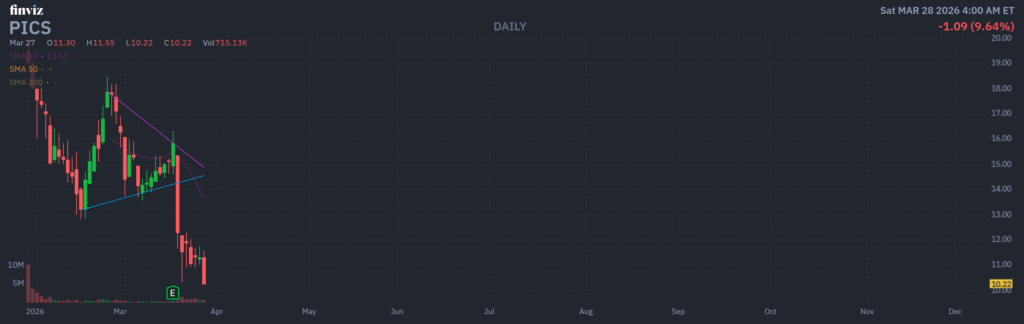
Name: Eduardo Chedid Simoes
Position: Chief Executive Officer
Transaction Date: 03-26-2026 Shares Bought: 87,505 shares an average price paid of $11.52 for a cost of $1,008,058
Company: PicS N.V. (PICS)
Pics N.V. is a digital financial services company that provides digital wallets and applications to consumers and businesses in Brazil. It provides its customers with a variety of transactional products, such as Pix, an immediate payment system, a global account, and a payment assistant that helps them organize, centralize, and settle payments through an integrated hub. The organization also offers multifunctional cards, personal loans, installment payments, and payroll loans to public employees, retirees, and pensioners. In addition, it provides a digital insurance distribution platform with goods such as digital wallet insurance, PicPay Card bill protection, credit life insurance, smartphone protection, and life insurance. The company was created in 2012 and is headquartered in São Paulo, Brazil.
Eduardo Chedid Simões has been the Chief Executive Officer of PicS N.V. since February 2024. He also serves as executive director of the corporation, having joined the board in October 2024. With nearly two years of leadership experience, he has helped guide the company through its public listing and growth phase in the digital financial services sector. Prior to this, he held top leadership positions in the PicPay ecosystem and the wider financial services industry. Details on his formal appointment as Chairman of the Board are not provided, as that post is now held by another person. He has a background in business and finance, which reflects his considerable experience in payment and financial services management.
Insomniac Hedge Fund Guy Opinion: PicS N.V. is essentially PicPay, a Brazilian digital wallet and fintech platform trying to become a one-stop financial super app. The product suite is broad: payments (Pix, P2P), digital wallet, lending (personal and payroll loans), insurance distribution, and even a marketplace and advertising layer. It’s a classic emerging market fintech play—high engagement, expanding monetization layers, and a push toward financial inclusion.
The “moat” is still forming. Network effects from users and merchants—especially around Brazil’s Pix ecosystem—are real, but not exclusive. Competition is intense (Nubank, Mercado Pago, banks). Switching costs are low at the wallet level, so retention depends on ecosystem depth and credit product stickiness.
Growth has likely been strong (typical fintech ramp), but disclosure is still limited given the recent 2026 IPO. The business mix is shifting from pure payments toward higher-yield lending and financial services, which should accelerate revenue but also introduces credit risk. Recurring revenue is meaningful (fees, financial services), but not in the same predictable sense as SaaS—this is transaction and credit-driven.
Management, led by CEO Eduardo Simões, is focused on scaling the platform and monetizing its user base more aggressively post-IPO. The strategy is clear: drive engagement → cross-sell credit → layer on higher-margin services.
Profitability is the key question. Like most fintechs at this stage, margins are still developing, and the balance between growth and credit quality will determine outcomes.
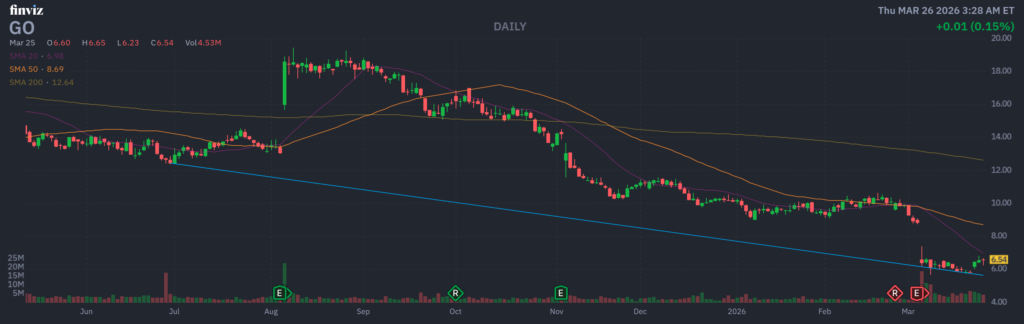
Name: Jason J. N. Potter
Position: President and CEO
Transaction Date: 03-23-2026 Shares Bought: 112,808 shares an average price paid of $6.36 for a cost of $717,174
Company: Grocery Outlet Holding Corp. (GO)
Grocery Outlet Holding Corp. sells consumables and fresh products through independently operated stores in the United States. It sells perishable category products such as dairy and deli, produce and floral, and meat and seafood. The company also sells non-perishable category items such as groceries, general merchandise, health and beauty care, frozen foods, and beer and wine. The company has stores in California, Washington, Oregon, Pennsylvania, Tennessee, Idaho, Maryland, Nevada, North Carolina, New Jersey, Georgia, Ohio, Alabama, Delaware, Kentucky, and Virginia. The company was formed in 1946 and is based in Emeryville, California.
Jason J. N. Potter has served as President and Chief Executive Officer of Grocery Outlet Holding Corp. since February 3, 2025, when he was appointed to lead the company and also joined its Board of Directors. He joined Grocery Outlet in 2025, bringing more than 30 years of grocery retail experience and a strong track record in operational leadership and business transformation. Prior to this role, Potter served as Chief Executive Officer of The Fresh Market from 2020 to 2025, where he led a successful turnaround, and earlier spent over two decades at Sobeys Inc., holding multiple senior leadership roles across large-scale retail operations. He holds a Bachelor of Business Administration and Management, General, from Harvard Business School and an MBA from Athabasca University.
Insomniac Hedge Fund Guy Opinion: Grocery Outlet is a discount grocery chain built on a “treasure hunt” model—selling excess inventory, closeouts, and overstock branded goods at steep discounts. Stores are small-box and run by independent operators, which keeps costs low and gives the business a quasi-franchise feel. The value proposition is simple: inconsistent assortment, but consistently cheap prices.
The moat is unconventional and fragile. On one hand, Grocery Outlet benefits from a differentiated sourcing model—buying opportunistic inventory that traditional grocers can’t easily replicate. On the other hand, that same model doesn’t scale cleanly. As the company grows, sourcing enough excess inventory becomes harder, and the “treasure hunt” experience risks turning into a more generic discount grocer.
Revenue growth has been solid, with sales rising from about $2.3B in 2018 to ~$4.7B in 2025—roughly 10% CAGR historically, though growth has recently slowed to ~7%. There is effectively no true recurring revenue, and customer loyalty is driven more by price than stickiness.
Management has leaned into expansion and private label to stabilize supply, but execution has been mixed. Recent results show declining comps and margin pressure, alongside restructuring efforts and store closures to fix profitability.
Profitability is the key issue. Grocery Outlet operates on thin margins typical of discount retail, and recently slipped to near breakeven or negative net margins, highlighting cost pressures and execution missteps.

Name: Jeffrey Currie
Position: Director
Transaction Date: 03-24-2026 Shares Bought: 250,000 shares an average price paid of $5.31 for a cost of $1,327,500
Name: Tor Olav Troim
Position: Director
Transaction Date: 03-24-2026 Shares Bought: 500,000 shares an average price paid of $5.20 for a cost of $2,597,900
Company: Borr Drilling Ltd (BORR)
Borr Drilling Limited provides offshore shallow-water drilling services to the oil and gas industries in the Americas, Southeast Asia, West Africa, the Middle East, North Africa, and Europe. It owns, contracts, and operates jack-up rigs for shallow-water operations, as well as providing related equipment and work crews for oil and gas drilling and workover activities in exploration and production. It caters to oil and gas exploration and production companies, including integrated oil companies, state-owned national oil enterprises, and independent oil and gas producers. The company was previously known as Magni Drilling Limited before changing its name to Borr Drilling Limited in December 2016. Borr Drilling Limited was established in 2016 and is headquartered in Hamilton, Bermuda.
Mr. Jeffrey Currie has been a director since October 16, 2023, and is a member of the Nominating and Governance Committee. He joined The Carlyle Group as Chief Strategy Officer of Energy Pathways in February 2024, following his retirement from Goldman Sachs, where he had worked for 27 years, including 15 years as a Partner and Global Head of Commodities Research. He also chairs the Advisory Board of the Energy Policy Institute at the University of Chicago and is on the board of Abaxx Technologies. He has an MA from Pepperdine University and a PhD from the University of Chicago.
Mr. Tor Olav Trøim has been a Director since the Company’s formation. He also served as Chairman from August 2017 to September 2019 and from February 2022 to September 2025. He is Magni Partners’ founder and sole shareholder, as well as a senior partner in the company’s UK subsidiary. With over 30 years of experience in the energy industry, he has previously held leadership positions at Seatankers Management Co. Ltd. and as CEO of DNO AS. He has held executive positions with other linked companies. He earned an MSc in naval architecture from the University of Trondheim.
Insomniac Hedge Fund Guy Opinion: Borr Drilling is a pure-play offshore jack-up rig operator—essentially a leveraged bet on shallow-water oil drilling activity. The company owns and operates a fleet of modern jack-up rigs used by oil majors and national oil companies for offshore exploration and production, particularly in regions like the Middle East, Southeast Asia, and Latin America.
There’s no real “moat” here in the traditional sense. This is a commodity service business where pricing power is dictated by global oil supply/demand and rig availability. What Borr does have is a relatively young, high-spec fleet, which makes it more competitive when dayrates tighten. But fundamentally, this is a cyclical asset utilization story, not a structural competitive advantage.
Revenue has rebounded sharply post-COVID as offshore activity recovered, with 2025 revenue around ~$1B+, up significantly from trough levels. However, growth is volatile and tied directly to rig utilization and dayrates. There is no recurring revenue model—contracts are finite, and visibility depends on backlog and new awards.
Profitability has inflected meaningfully. After losses in 2022, Borr now generates strong margins, with operating margins moving into the 30%+ range in 2024–2025 as utilization improved. Still, earnings remain volatile—Q4 2025 showed sequential declines in revenue and EBITDA.

Name: Richard Campbell-Breeden
Position: Director
Transaction Date: 03-23-2026 Shares Bought: 150,000 shares an average price paid of $2.21 for a cost of $331,665
Company: Arq Inc. (ARQ)
Arq, Inc., an environmental technology firm, sells consumable air, water, and soil treatment systems based on activated carbon in the US and Canada. It manufactures granular activated carbon, powdered activated carbon, and colloidal carbon products, as well as air emission control chemicals. The company’s products are utilized in a variety of applications, including water treatment, groundwater remediation, soil sediments, air emissions, and asphalt additives. The company was previously known as Advanced Emissions Solutions, Inc., but changed its name to Arq, Inc. in February 2024. Arq, Inc. was founded in 1997 and is based in Greenwood Village, Colorado.
Richard Campbell-Breeden has served as a Director of Arq Inc. since February 1, 2023, when he joined the company’s Board of Directors as part of a board refresh and later became Chairman of the Board, contributing to governance and strategic oversight. He brings over three decades of global investment banking and mergers & acquisitions experience, including a long tenure at Goldman Sachs where he held senior leadership roles such as Vice Chairman of Investment Banking in Asia Pacific and Head of M&A for Asia ex-Japan. He is also the founder of Omeshorn Capital Advisors and serves on multiple international boards. He holds a B.S. in Mechanical Engineering from the University of Bristol and an MBA from INSEAD.
Insomniac Hedge Fund Guy Opinion: Arq is a small-cap, somewhat messy industrial story trying to reinvent itself around environmental solutions. The company produces activated carbon—used in water purification, air filtration, and emissions control—selling primarily into utilities and industrial customers. The legacy business (powdered activated carbon, or PAC) is tied to coal plants and environmental compliance, while the “growth story” is granular activated carbon (GAC), targeting water treatment and higher-value applications.
The moat is… limited. Activated carbon is not a highly differentiated product, and pricing power is inconsistent. There are some advantages in sourcing, process know-how, and long-term customer contracts, but this is not a high-switching-cost business like Waters. It’s more cyclical, more commodity-like, and more execution-dependent.
Revenue has been volatile but recently improving, reaching about $120M in 2025 with ~10% growth. Growth has largely come from pricing and stabilization in the core PAC business, with GAC still in ramp mode. Recurring revenue is not really a thing here—this is primarily volume-driven product sales, not a consumables annuity model. Net retention is not disclosed and likely not meaningful.
Management is in turnaround mode, pushing expansion into GAC and trying to reposition the company as a broader environmental solutions provider. Execution has been uneven—facility ramp-ups, impairments, and strategy pivots have created noise.
Profitability is the biggest issue. Despite positive adjusted EBITDA in some quarters, highlighting operational and capital intensity challenges.
This blog is solely for educational purposes and the author’s own amusement. IT IS NOT INVESTMENT ADVICE. Think of the blog as part of my personal investment journal that I am willing to share with the DIY investor. We could be long, short, or have no position at all in any of the stocks mentioned and express no written or implied obligation to disclose any of that. Nothing contained here constitutes a recommendation to buy or sell any security. Investing involves risk, including the possible loss of principal, and past performance is not indicative of future results.
“The insomniac hedge fund guy” is a moniker Harvey Sax, the portfolio manager for The Insiders Fund” has used from time to time on email, blog ,and social media posts. While Mr. Sax is the portfolio manager of The Insiders Fund, these posts are not communications from, nor endorsed by, Alpha Wealth Funds, LLC or any of its managed funds. References to Alpha Wealth Funds or its affiliates are for identification only and do not imply sponsorship or approval.
All company names, logos, and trademarks belong to their respective owners. The use of company logos is solely for descriptive and illustrative purposes under fair use. Any information provided is based on publicly available data and should not be considered financial, investment, or legal advice. Readers should conduct their own research or consult with a professional before making any investment decisions. Insiders sell the stock for many reasons, but they generally buy for just one – to make money. You’ve always heard the best information is inside information. Everyone with any stock market experience pays close attention to what insiders are doing. After all, who knows a business better than the people running it? Officers, directors, and 10% owners are required to inform the public through a Form 4 Filing of any transaction, buy, sell, exercise, or any other within 48 hours of doing so.
This info is available for free from the SEC’s Web site, Edgar, although we subscribe to SECForm4 as they provide a way to manage and make sense of the vast realms of data. I’ve tried a lot of vendors. SECForm4 is one of the smaller ones, but I like supporting Frank. He is not arrogant. He’s helpful and has great prices. He also trades on his own data, so I like people that eat what they kill. The bar is different from selling because the natural state of management is to be a seller. This is because most companies provide significant amounts of management compensation packages as stock and options. Therefore, we analyze unusual patterns with selling, such as insiders selling 25 percent or more of their holdings or multiple insiders selling near 52-week lows. Another red flag is large planned sale programs that start without warning. Unfortunately, the public information disclosure requirements about these programs, referred to as Rule 10b5-1, are horrendously poor. Also, planned sales that pop up out of nowhere are basically sales and are seeking cover under this corporate welfare loophole.
I also generally ignore 10 percent shareholders as they tend to be OPM (other people’s money) and perhaps not the smart money on which we are trying to read the tea leaves. I say generally because some 10% shareholders are great investor, think Warren Buffett and others. Of course, insiders can also be wrong about their Company’s prospects. Don’t let anyone fool you into believing they never make mistakes. Do your own analysis. They can easily be wrong, and in many cases, maybe most cases, have no more idea what the future may hold than you or me. In short, you can lose money following them. We have, and we curse aloud; what were they thinking!
We like Fly on the Wall for keeping up with what events might be happening, analysts’ comments, and whatever else could be moving the stock. Dow Jones news service is an essential tool, but many services pick up their feed like they do Bloomberg. My assistant probes the 10k for a reasonable description of the business. I’ve found that to be the most accurate and succinct place to find out what a business actually does.