When Macro trumps everything, does insider buying have relevance. The answer to this will only be apparent in time. My hunch is that insiders know as much about macro as anyone else.

Name: Manuel J. Perez De La Mesa
Position: Director
Transaction Date: 03-13-2026 Shares Bought: 5,000 shares an average price paid of $205.00 for a cost of $1,025,000
Company: Pool Corp. (POOL)
Pool Corporation provides swimming pool supplies, equipment, related recreational, irrigation, and landscape care items in the United States as well as around the world. The company provides maintenance products such as chemicals, supplies, and pool accessories; repair and replacement parts for pool equipment such as cleaners, filters, heaters, pumps, and lights; and building materials such as concrete, plumbing, and electrical components, functional and decorative pool surfaces, decking materials, tiles, hardscapes, and natural stones for pool installations and remodeling. It also offers pool equipment and components for new and renovated pools, as well as irrigation and related items. Pool Corporation was established in 1993 and is based in Covington, Louisiana.
Manuel J. Perez de la Mesa has served as a Director of Pool Corp. (NASDAQ: POOL) since March 2023, when he rejoined the company’s Board of Directors after previously serving as its long-time President and Chief Executive Officer. He originally joined Pool Corp. in 1998 and led the company as CEO from 2002 to 2023, playing a central role in its growth and expansion into the world’s largest wholesale distributor of swimming pool supplies, equipment, and related products. In his current board role, he provides strategic guidance and deep industry expertise to support ongoing operations and governance. Perez de la Mesa earned a Bachelor of Science in Industrial Engineering from the Georgia Institute of Technology.
Insomniac Hedge Fund Guy Opinion: Pool Corp is a deceptively simple business: it’s the largest wholesale distributor of swimming pool supplies—chemicals, equipment, and maintenance products—primarily serving contractors and service professionals. It’s not sexy, but it sits in the middle of a surprisingly resilient ecosystem: once a pool is built, it needs to be maintained forever.
That’s the moat. Roughly 60–65% of revenue comes from recurring maintenance products like chemicals and replacement parts, which are non-discretionary. Pool owners can delay a renovation, but they can’t skip chlorine. Layer on top a dense distribution network (~450 locations), local inventory, and contractor relationships, and you get a logistics moat that’s hard to replicate.
Growth has been uneven. The business saw a pandemic pull-forward (2020–2022), followed by normalization. Revenue is now roughly flat around ~$5.3B in 2024–2025, implying low or slightly negative growth over the past couple years. Longer term, it’s more of a mid-single-digit grower tied to housing and installed pool base expansion.
Management, led by CEO Peter Arvan, has been disciplined—focused on margins, buybacks, and steady expansion rather than chasing growth.
Profitability is solid but not elite: ~30% gross margins and ~11–12% operating margins, with strong cash generation. The business throws off cash even in softer demand environments thanks to maintenance sales.
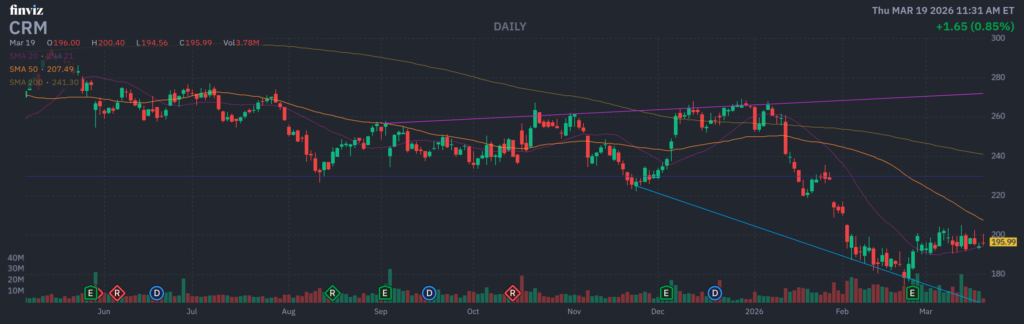
Name: David Blair Kirk
Position: Director
Transaction Date: 03-18-2026 Shares Bought: 2,570 shares an average price paid of $194.62 for a cost of $500,178
Name: Laura Alber
Position: Director
Transaction Date: 03-19-2026 Shares Bought: 2,571 shares an average price paid of $194.58 for a cost of $500,266
Company: Salesforce Inc. (CRM)
Salesforce, Inc. offers customer relationship management technology services that connect businesses and customers across the United States, Europe, and Asia Pacific. The company provides Agentforce, which enables customers to build, deploy, and manage enterprise-grade, autonomous AI agents at scale, allowing humans and agents to collaborate; Agentforce Sales, an integrated platform that combines the power of humans with AI agents to assist sales teams in selling, managing, and automating entire sales processes; and Agentforce Service, which enables companies in every industry to bring all of their customer, employee.It supports the financial services, healthcare and life sciences, manufacturing, automotive, and government industries. Salesforce, Inc. was established in 1999 and is based in San Francisco, California.
David Blair Kirk has served as a Director of Salesforce Inc. (NYSE: CRM) since November 2018, when he was appointed to the company’s Board of Directors to provide strategic guidance on technology, operations, and corporate governance. He brings extensive executive experience from his leadership roles in the technology and software industries, including his tenure as Chief Executive Officer and Director of NeXT Computer and as a senior executive at Apple, where he contributed to software development and enterprise technology strategy. Kirk has also served on the boards of several technology and financial services companies, offering expertise in corporate management, innovation, and growth strategy. He holds a Bachelor of Science degree in Electrical Engineering from Stanford University.
Laura Alber has served as a Director since November 2021 at Salesforce Inc., when she was appointed to the company’s Board of Directors and began contributing to its leadership in digital commerce and consumer strategy. She brings extensive executive experience as President and Chief Executive Officer of Williams-Sonoma, Inc., a role she has held since 2010, where she has led the company’s transformation into a leading e-commerce and omnichannel retailer. Prior to becoming CEO, she held multiple senior leadership roles within Williams-Sonoma across merchandising and marketing. Alber also serves on various corporate boards, providing governance and strategic insight. She earned a Bachelor of Arts in Psychology from the University of Pennsylvania.
Insomniac Hedge Fund Guy Opinion: Salesforce, Inc. is the original SaaS pioneer that turned customer relationship management into a cloud subscription machine. What started as core sales automation has expanded into a broad enterprise platform spanning Sales Cloud, Service Cloud, Marketing Cloud, Slack, and Data Cloud—effectively positioning Salesforce as a system of record for customer data across large enterprises.
The moat is scale, switching costs, and ecosystem. Once embedded, Salesforce becomes deeply integrated into workflows, data pipelines, and third-party apps. Migrating off is expensive and disruptive. Add in a massive partner ecosystem and AppExchange marketplace, and you get a sticky platform with strong cross-sell dynamics.
Growth has slowed from its earlier hyper-growth phase. Over the past five years, revenue has compounded at roughly 15–20%, but recent growth is closer to low double digits (~10–11%) as the company matures. The upside is predictability—~95%+ of revenue is recurring subscription-based, with solid renewal rates driven by enterprise contracts. Net retention has moderated but remains healthy, generally in the ~110% range.
Management, led by Marc Benioff, has shifted tone over the last two years. After years of aggressive M&A, the focus is now on margins, discipline, and shareholder returns—partly under pressure from activist investors.
Profitability has inflected meaningfully. Operating margins have expanded into the mid-20%+ range, a sharp improvement from prior years when growth was prioritized over efficiency.
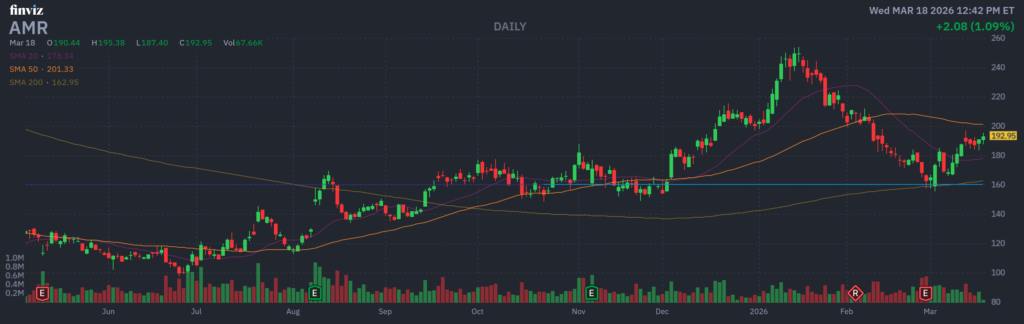
Name: Kenneth S. Courtis
Position: Director
Transaction Date: 03-11-2026 Shares Bought: 10,000 shares an average price paid of $186.87 for a cost of $1,868,707
Company: Alpha Metallurgical Resources Inc.(AMR)
Alpha Metallurgical Resources, Inc. is a mining firm that produces, processes, and sells met and thermal coal in Virginia and West Virginia. The company offers metallurgical coal products. It runs nineteen operating mines and eight active coal processing and loading facilities. The company was formerly known as Contura Energy, Inc. before changing its name to Alpha Metallurgical Resources, Inc. in April 2017. Alpha Metallurgical Resources, Inc. was established in 2016 and is based in Bristol, Tennessee.
Kenneth S. Courtis has been serving as director of Alpha Metallurgical Resources Inc. since February 2021. He has also been chairman of Starfort Investment Holdings since 2009. Mr. Courtis has more than 30 years of experience in corporate finance, investments, and nearly every facet of the commodity sector. Throughout his career, he has served on the boards or advisory councils of several significant worldwide corporations. Mr. Courtis holds an undergraduate degree from Glendon College in Toronto and a master’s degree in international relations from Sussex University in the UK. He holds a master’s degree in business administration from the European Institute of Business Administration as well as a doctorate with highest distinction from Sciences Po in Paris.
Insomniac Hedge Fund Guy Opinion: Alpha Metallurgical Resources is a pure-play metallurgical coal producer—selling coal primarily used in steelmaking, not power generation. The business is simple: mine coal, ship it globally, and hope pricing cooperates. Unlike software or life sciences, this is a price-taker commodity business, heavily tied to global steel demand and seaborne coal prices.
There is no real moat in the traditional sense. The closest thing is asset quality (high-grade met coal reserves) and logistics integration, plus some long-term contracts with steel producers. But ultimately, pricing power is dictated by global supply/demand, not by Alpha itself.
Financials tell the real story: volatility. Over the past five years, revenue has grown at roughly ~10% CAGR, but that number is misleading—it includes a massive coal price spike in 2022 followed by sharp declines. Recent revenue has been falling hard (down ~30% YoY) as coal prices normalize.
Recurring revenue? Essentially none. This is transactional, cyclical revenue with minimal visibility. Net retention isn’t a concept that applies here.
Management, led by CEO Andy Eidson, has been relatively disciplined—returning large amounts of capital via buybacks during peak cycles and keeping the balance sheet in decent shape. That’s important because survival in commodities is about capital allocation, not growth narratives.
Profitability swings wildly. In strong pricing environments, margins explode; in downturns, they compress sharply—gross margins fell to ~11% recently from much higher levels the prior year.
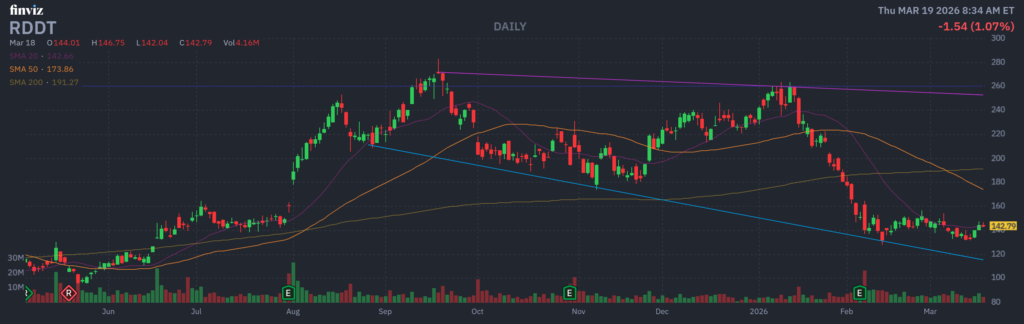
Name: Sarah E. Farrell
Position: Director
Transaction Date: 03-13-2026 Shares Bought: 10,500 shares an average price paid of $132.26 for a cost of $1,388,730
Company: Reddit Inc.(RDDT)
Reddit, Inc. manages a digital community in the United States and around the world. Users can utilize the company’s platform to engage in conversations, explore passions, investigate new hobbies, exchange goods and services, build new communities and experiences, laugh together, and find a place to belong. It also creates communities based on specific interests, allowing users to interact by sharing their experiences, sending links, uploading photographs and videos, and responding to one another. Reddit, Inc. was started in 2005 and is based in San Francisco, CA.
Sarah E. Farrell has been a Director on the Board of Reddit Inc. since May 2024, after initially joining the firm as a board observer in 2021. She officially became a Director in May 2024, when she was named to the Board’s Audit Committee. Farrell is a financial and investment specialist who presently serves as Co-Founder and Managing Partner of Waygrove Partnership. He has previously worked for ValueAct Capital, The Blackstone Group, and J.P. Morgan. She has a Bachelor of Arts in Chemistry from Harvard University, demonstrating a solid academic basis alongside her investment career.
Insomniac Hedge Fund Guy Opinion: Reddit is essentially a monetization story wrapped around one of the internet’s most unique assets: authentic, user-generated conversation. The platform operates thousands of niche communities where users discuss everything from finance to gaming to healthcare. Unlike traditional social media, Reddit is interest-based, not identity-based—which turns out to be extremely valuable for advertisers.
The moat is unconventional but real. Reddit’s content is hard to replicate because it’s built over decades of community engagement and moderation. This creates a massive archive of human discussion that is increasingly valuable—not just for ads, but also for AI training and data licensing. That said, switching costs for users are low, so the moat is more about content depth than platform lock-in.
Growth has been explosive post-IPO. Revenue reached ~$2.2B in 2025, up ~69% YoY, driven primarily by advertising. Ad revenue accounts for roughly 90%+ of the business, meaning recurring revenue is high but heavily dependent on ad budgets rather than subscriptions. There is emerging diversification via data licensing (AI deals), but it’s still small.
Management, led by co-founder Steve Huffman, deserves credit for finally cracking monetization after years of under-earning relative to engagement. Product improvements, AI-driven ad tools, and international expansion are clearly working.
Profitability has inflected hard. Reddit went from losses to ~24% net margins in 2025, with strong EBITDA and cash flow.

Name: Robert A. Katz
Position: Ceo & Chairperson Of The Board
Transaction Date: 03-16-2026 Shares Bought: 37,500 shares an average price paid of $131.81 for a cost of $4,942,875
Company: Vail Resorts Inc. (MTN)
Vail Resorts, Inc., along with its subsidiaries, manages mountain resorts and regional ski areas in the United States and abroad. It operates in three segments: mountain, lodging, and real estate. The Mountain Division manages destination mountain resorts and regional ski regions. This segment also engages in auxiliary businesses, such as ski school, restaurants, retail/rental operations, and real estate brokerage. The lodging division owns and manages several luxury hotels and condominiums under the RockResorts brand, as well as operating additional lodging facilities and condominiums and providing resort ground transportation services. The Real Estate segment owns, develops, and sells real estate assets. Vail Resorts, Inc. was formed in 1962 and is headquartered in Broomfield, Colorado.
Robert A. Katz was appointed CEO of Vail Resorts Inc. in May 2025 and continues to serve as the company’s Board Chairperson. He previously served as CEO since February 2006 and was appointed Chairperson in March 2009, holding both positions until November 2021 before shifting to Executive Chairperson and then returning as CEO. Katz has worked with the company since 1991 and has been a member of its board since 1996, making important contributions to its long-term growth and strategy. He graduated from the University of Pennsylvania’s Wharton School with a Bachelor of Science degree in Economics.
Insomniac Hedge Fund Guy Opinion: Vail Resorts is the dominant consolidator in the ski industry, owning a global portfolio of destination resorts and monetizing them through lift tickets, lodging, and on-mountain spend. But the real engine is the Epic Pass—a prepaid season pass that fundamentally reshaped the economics of skiing.
The moat is scale + network effects. Vail’s portfolio lets it sell one pass across dozens of resorts, locking customers into its ecosystem. More importantly, the Epic Pass pulls revenue forward—customers pay months before the season starts—creating a quasi-subscription model in an otherwise weather-dependent business. Pass sales now drive a majority of lift revenue (roughly 65%+) and stabilize cash flow.
Growth, however, is slowing. Revenue has grown low-single digits (~3–5%) recently, with FY2025 revenue up about 3%. The bigger issue: volumes are flat to declining. Skier visits fell ~3% in 2025, while pass units also declined, masked by price increases. This is increasingly a price-over-volume story.
Recurring revenue is strong in structure but not in optics. The pass model behaves like recurring revenue, but it’s still discretionary and cyclical. Retention is decent but under pressure as newer customers churn and pricing rises.
Management, led again by CEO Rob Katz, is trying to pivot—leaning into pricing strategy, marketing, and cost discipline.
Name: Richard H. Fearon
Position: Director
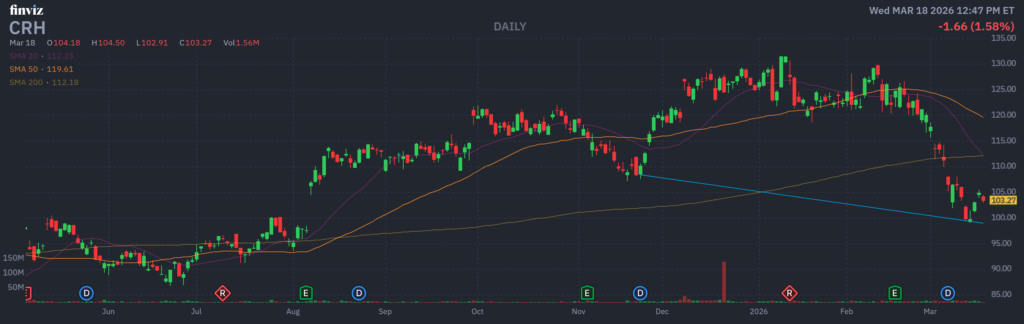
Transaction Date: 03-11-2026 Shares Bought: 3,800 shares an average price paid of $104.49 for a cost of $397,062
Name: Siobhan Talbot
Position: Director
Transaction Date: 03-12-2026 Shares Bought: 2,000 shares an average price paid of $102.11 for a cost of $204,223
Company: CRh Public Ltd Co (CRH)
CRH plc is a global provider of construction materials and infrastructure solutions, with operations in Ireland, the United States, the United Kingdom, Europe, and other foreign markets. The company operates in three segments: Americas Materials Solutions, Americas Building Solutions, and International Solutions. It provides aggregates, cement, concrete, asphalt, and construction services to infrastructure and building projects. CRH also makes precast concrete products, drainage systems, and outdoor living solutions. Its services cover transportation, utilities, and residential construction.CRH caters to both governmental and private sector construction demands worldwide. CRH plc was founded in 1936 and is headquartered in Dublin, Ireland.
Richard H. Fearon has been an independent non-executive director of CRH plc since December 2020, when he was appointed to the Board effective December 3, 2020. He has considerable financial and strategic experience from his long work at Eaton Corporation plc, where he was Vice Chairman and Chief Financial and Planning Officer until March 2021, supervising critical areas such as accounting, corporate development, and strategic planning. Fearon formally joined CRH in December 2020, when he was appointed to the board, and has been a director ever since. He earned a Bachelor of Arts in Economics from Stanford University, an MBA from Harvard Business School, and a Juris Doctorate from Harvard Law School.
Siobhan Talbot has been a director of CRH plc since December 1, 2018, when she was appointed to the board. She joined the firm concurrently with her director appointment and offers substantial leadership expertise from her stint as Group Managing Director at Glanbia plc, where she worked since 2013. Talbot is a Fellow of Chartered Accountants Ireland and has a Bachelor of Commerce and a Diploma in Professional Accounting from University College Dublin.
Insomniac Hedge Fund Guy Opinion: CRH is a global building materials giant—aggregates, cement, asphalt, and construction solutions—with a heavy tilt toward North America. Think roads, bridges, data centers, and infrastructure. This is not a “story stock”; it’s a scale-driven operator levered to physical economic activity.
The moat is local scale and logistics. Aggregates and cement are bulky, low value-to-weight products, which means transportation costs matter. CRH wins by owning dense regional networks of quarries and distribution assets. In many markets, it’s effectively an oligopoly. Add disciplined M&A and pricing power, and you get a structurally resilient business.
Revenue growth over the last five years has been mid-single digits (~5–7%), reaching about $35–37B recently. Growth is a mix of pricing, infrastructure demand, and steady bolt-on acquisitions. There’s no true recurring revenue model here—this is transactional, project-driven revenue—but infrastructure spending and maintenance cycles create a quasi-recurring demand base.
Management, led by CEO Jim Mintern, has leaned heavily into capital allocation—divesting non-core assets and reinvesting in higher-return U.S. markets. The playbook is clear: consolidate, optimize pricing, expand margins.
Profitability has quietly improved. Adjusted EBITDA margins have expanded toward ~19–20%, with consistent year-over-year improvement and strong cash flow generation. Pricing discipline and operational efficiency have offset input cost volatility.
Name: Paul S. Levy
Position: Director
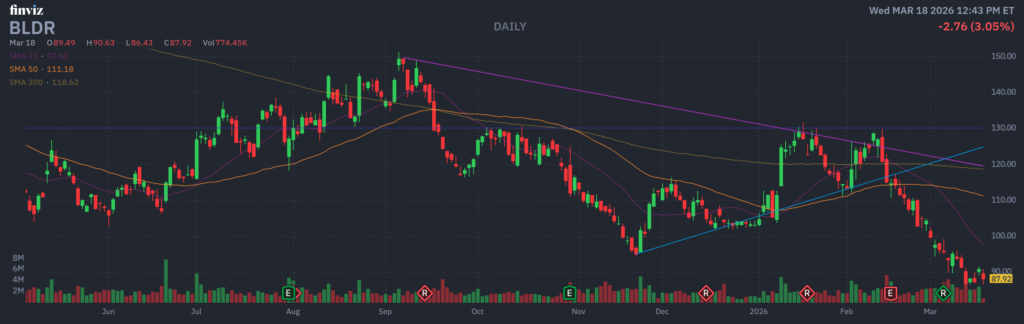
Transaction Date: 03-13-2026 Shares Bought: 50,000 shares an average price paid of $87.73 for a cost of $4,386,500
Company: Builders FirstSource Inc. (BLDR)
Builders FirstSource, Inc. provides building materials, manufactured components, and construction services to professional builders throughout the United States, assisting with new home construction, repair, and renovation projects. It offers roof and floor trusses, wall panels, engineered wood, and the Ready-Frame system. The company also offers modular homes under the Pine Grove Homes and Pleasant Valley Homes brands, as well as windows, doors, millwork, siding, roofing, insulation, cabinets, and hardware. Additionally, it provides design, installation, and virtual house planning services. Formerly known as BSL Holdings, Inc., it was renamed in 1999 and is headquartered in Irving, Texas.
Paul S. Levy has been a director of Builders FirstSource Inc. since 1998, when he joined the board, and he has also served as Chairman of the Board for a number of years. He is the founder and Managing Director of JLL Partners, with considerable expertise in private equity, corporate leadership, and legal consulting roles, including previous positions at Drexel Burnham Lambert and CEO of Yves Saint Laurent, Inc. His lengthy service on the board demonstrates a strong interest in strategic monitoring and governance. He has a bachelor’s degree from Lehigh University and a Juris Doctorate from the University of Pennsylvania Law School.
Insomniac Hedge Fund Guy Opinion: Builders FirstSource is essentially a levered bet on U.S. residential construction. The company is the largest supplier of structural building products—lumber, trusses, wall panels, windows, and prefabricated components—sold primarily to homebuilders. It’s less “tools company” and more “housing cycle with logistics and scale.”
The moat is scale and integration. BLDR has built a national footprint with manufacturing + distribution + value-added prefabrication. Large homebuilders increasingly outsource components like trusses and panels, which improves efficiency and reduces labor needs. That said, this is not a classic sticky SaaS model—customers will switch if pricing or demand shifts.
The numbers tell the real story. Over the last five years, revenue grew at roughly ~19% CAGR, driven heavily by acquisitions and a housing boom . But that growth has clearly peaked—2025 revenue declined ~7% as housing slowed and lumber prices normalized . This is a cyclical business, not a secular compounder.
Recurring revenue is limited. While value-added products and services provide some stability, the majority of revenue is tied directly to housing starts and commodity pricing. Net retention isn’t really a relevant concept here—this is volume-driven demand.
Management has been aggressive and generally effective, using M&A (notably the BMC merger) to consolidate the industry and drive scale efficiencies. Capital allocation via buybacks has also been meaningful.
Profitability has come down sharply. EBITDA margins compressed into the ~10% range in 2025, down significantly year-over-year as volumes and pricing weakened
Name: J. Erik Fyrwald
Position: Chief Executive Officer
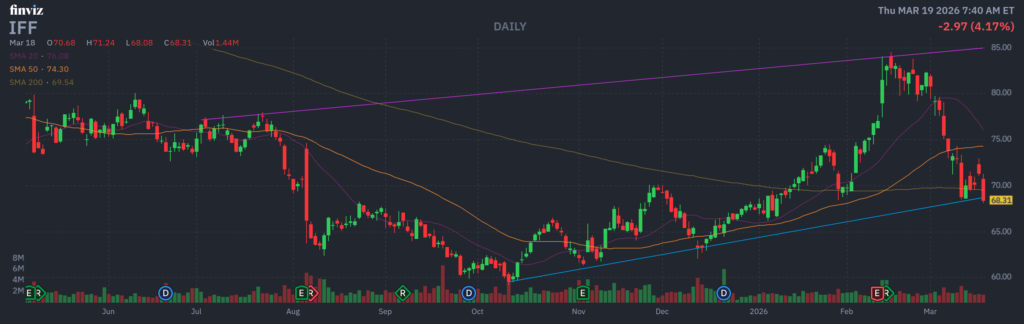
Transaction Date: 08-27-2025 Shares Bought: 156,459 shares an average price paid of $70.12 for a cost of $10,971,329
Name: Paul J. Fribourg
Position: Director
Transaction Date: 03-12-2026 Shares Bought: 14,260 shares an average price paid of $69.79 for a cost of $995,204
Company: International Flavors & Fragrances Inc. (IFF)
International Flavors & Fragrances Inc., along with its subsidiaries, manufactures and markets food, beverage, health, biosciences, smell, and related goods in the United States and abroad. It operates in four segments: taste, food ingredients, health and biosciences, and scent. The Taste category sells savory products such as soups, sauces, meat, fish, poultry, and snacks; beverages include juice drinks and dairy products such as yogurt, ice cream, cheese, and other items. The Food Ingredients segment offers natural, artificial, and plant-based specialty food ingredients. The Health & Biosciences division provides enzymes, food cultures, probiotics, and specialty food ingredients, while the Scent segment develops fragrance compounds and fragrance ingredients. International Flavors & Fragrances Inc. was founded in 1909 and is located in New York, NY.
J. Erik Fyrwald has been the Chief Executive Officer of International Flavors & Fragrances Inc. since February 6, 2024, when he joined the company’s Board of Directors. He has nearly four decades of leadership experience in the nutrition, agriculture, and chemical industries, including previous roles as CEO of Syngenta, Univar Solutions, and Nalco, as well as top leadership positions at DuPont. He is well-known for fostering innovation and long-term growth, having overseen large-scale worldwide operations and strategic reforms. He earned a Bachelor of Science in Chemical Engineering from the University of Delaware and finished the Advanced Management Program at Harvard Business School.
Paul J. Fribourg was appointed as a director of International Flavors & Fragrances Inc., joining the company in July 2025 and taking up the director post concurrently. He has more than four decades of global leadership experience in agriculture, food, and investment, and has been Chairman and CEO of Continental Grain Company since 1997. In addition to his executive leadership, he has served on multiple boards of big international corporations, providing strategic and operational insight. He received a Bachelor of Arts from Amherst College and finished the Advanced Management Program at Harvard Business School.
Insomniac Hedge Fund Guy Opinion: IFF is a classic “ingredients behind the scenes” business. It formulates flavors, fragrances, and specialty ingredients used in food, beverages, personal care, and household products. Think Coca-Cola taste profiles, perfumes, and enzymes in packaged foods. It’s a global oligopoly alongside a few large players, with scale and customer intimacy mattering more than brand recognition.
The moat is moderate but real. Formulations are embedded in customer products and often co-developed, creating switching costs. Once a flavor or scent is locked into a product, changing it risks consumer perception and regulatory headaches. That said, pricing power is not absolute—customers (especially large CPGs) push back aggressively.
Growth has been messy. Over the last five years, revenue has been roughly flat to low-single-digit growth, with ~$11.5B in 2024 sales and minimal growth overall. Recent performance shows modest recovery, with ~6% growth in 2025 but only 1–4% expected going forward.
Recurring revenue is high in practice (repeat formulations and long-term supply relationships), but not contractual SaaS-style. Call it sticky but not subscription. Net retention is likely solid but tied to volume trends in end markets like packaged food and consumer goods.
Management, led by CEO Erik Fyrwald, is in the middle of a portfolio reset—selling non-core assets, reducing debt, and focusing on higher-margin segments like scent and biosciences. Execution risk is non-trivial.
Profitability is decent but not elite: ~17–20% EBITDA margins, below best-in-class peers, with recent volatility due to impairments and restructuring.
Name: Leonard Potter
Position: Director
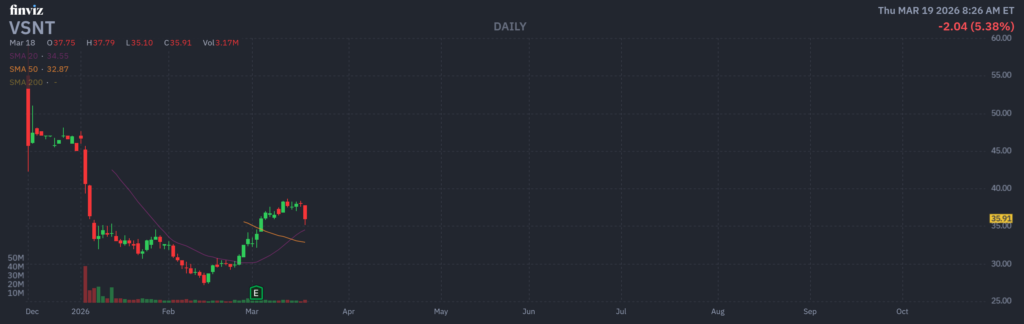
Transaction Date: 03-10-2026 Shares Bought: 13,500 shares an average price paid of $37.81 for a cost of $510,475
Company: Versant Media Group Inc. (VSNT)
Versant Media Group, Inc. operates in the media and entertainment sectors in the United States. It creates, licenses, and acquires content that is distributed across a variety of channels, including networks and digital platforms. The company provides news, sports, and entertainment content through its portfolio of brands, which includes MS NOW, CNBC, USA Network, Golf Channel, GolfNow, SportsEngine, E!, SYFY, Oxygen True Crime, Fandango, and Free TV Network. The corporation uses television networks and internet channels to serve the political news and opinion, business news and personal finance, golf and athletics participation, and sports and genre entertainment industries. The corporation was founded in 2025 and is headquartered in New York, NY.
Leonard A. Potter has been a Director of the Board of Versant Media Group Inc. from the business’s inception in 2025, effectively joining both the company and its board at that point. He is a seasoned investor and entrepreneur, best known as the founder and Chief Investment Officer of Wildcat Capital Management and a co-founder of Vida Ventures, with previous top positions at Soros Fund Management. He formerly worked as a corporate attorney, specializing in mergers, acquisitions, and governance. While particular public data about his academic history are few, he is known to have a solid educational foundation that supports his legal and investing careers.
Insomniac Hedge Fund Guy Opinion: Versant Media Group is essentially a freshly spun-off collection of legacy cable and digital media assets from Comcast—think CNBC, USA Network, SYFY, Golf Channel, plus digital properties like Fandango and Rotten Tomatoes. It’s a scaled media bundle built around news, sports, and entertainment, with roughly $6.7B in revenue as of 2025.
The problem is obvious: this is a linear TV-heavy business in structural decline. Revenue has been shrinking (~5% annually), driven by cord-cutting and weaker advertising. The company is trying to offset this with digital platforms and direct-to-consumer initiatives, but those are still relatively small pieces of the mix.
Moat? Limited. There’s some strength in live news and sports—content that still holds real-time value—but most of the portfolio lacks pricing power. Distribution leverage has flipped; cable networks used to dictate terms, now they’re fighting for relevance against streaming platforms.
Recurring revenue is decent (affiliate fees from cable distributors), but it’s declining recurring revenue, which is a very different animal than SaaS-style stickiness. Net retention is likely negative given subscriber losses across the industry.
Management, led by CEO Mark Lazarus, is focused on stabilizing the asset base and extracting cash. The playbook is clear: cut costs, harvest cash flows, and reinvest selectively into streaming and digital extensions.
Profitability is still solid on paper—~$2.4B EBITDA and strong free cash flow (~$1.4B)—but earnings declined meaningfully in 2025.
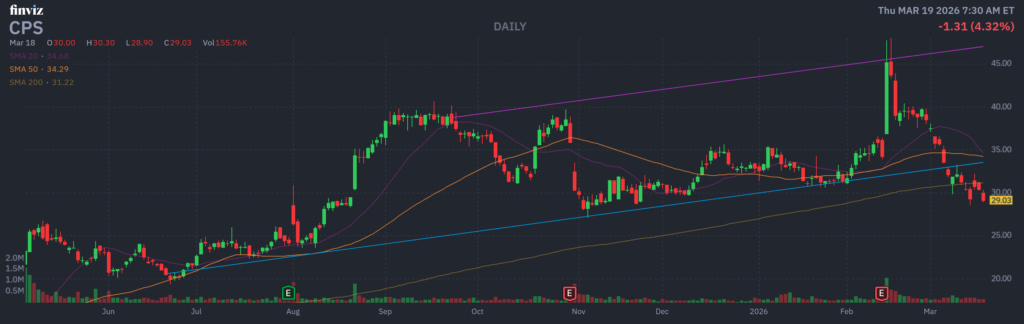
Name: David John Mastrocola
Position: Director
Transaction Date: 03-11-2026 Shares Bought: 6,885 shares an average price paid of $30.23 for a cost of $208,144
Company: Cooper-Standard Holdings Inc. (CPS)
Cooper-Standard Holdings Inc. manufactures sealing and fluid handling systems through subsidiaries in North America, Europe, Asia Pacific, and South America. Its sealing product line comprises dynamic and static seals, encapsulated glass, decorative trimmings, frameless systems, and sophisticated platforms like as Fortrex and FlushSeal. The company also manufactures gasoline and brake delivery systems, including fuel lines, brake lines, connections, and coated tubing. It also provides fluid transfer solutions such pumps, hoses, cooling systems, and thermal management tubing. Its products are largely used in passenger automobiles and light trucks for OEM and aftermarket applications. The company was created in 1960 and its headquarters are in Northville, Michigan.
David John Mastrocola has been a director of Cooper-Standard Holdings Inc. since 2010, and was later named Lead Director in 2011. He is a private investor who formerly worked at Goldman Sachs for nearly 20 years as a Partner and Managing Director, where he held senior leadership positions in corporate finance and mergers and acquisitions. Mastrocola joined Cooper-Standard’s board in 2010, where he has subsequently served as lead director. He earned a Bachelor of Science in Accounting from Boston College and an MBA from Harvard University.
Insomniac Hedge Fund Guy Opinion: Cooper-Standard is a classic auto supplier—manufacturing sealing systems, fuel and brake lines, and fluid transfer components for global OEMs. Translation: it sells essential but low-differentiation parts into a brutally competitive, cyclical industry tied directly to global vehicle production.
There’s no real moat here. This is a scale and cost business where pricing power is limited and margins are constantly under pressure from OEMs. Switching costs are low, and suppliers tend to get squeezed—especially during downturns or commodity inflation cycles.
Revenue tells the story. Over the past five years, growth has been essentially flat to slightly negative, with 2025 revenue around $2.74B (+0.4% YoY) . This isn’t a growth business—it’s tied to auto volumes, which have been volatile and structurally challenged. Recurring revenue is effectively 0%; this is almost entirely project-based OEM supply. Net retention isn’t meaningful in the SaaS sense—contracts reset and pricing is renegotiated constantly.
Management, led by CEO Jeffrey Edwards, has been focused on cost cutting, restructuring, and operational efficiency. To their credit, it’s working—at least operationally. The company delivered meaningful margin improvement and positive free cash flow in 2025 after years of losses . EBITDA margins are still low (~5% in 2025) but expected to improve toward double digits .
Profitability is the key swing factor. CPS is transitioning from a distressed, loss-making supplier to a potentially viable, cash-generating one—but it’s early, and leverage remains a risk.
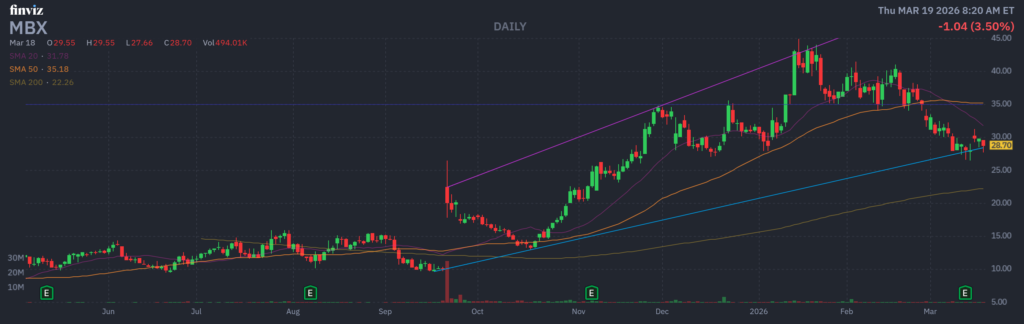
Name: P. Kent Hawryluk
Position: President & CEO
Transaction Date: 03-13-2026 Shares Bought: 18,500 shares an average price paid of $28.41 for a cost of $525,663
Company: MBX Biosciences Inc. (MBX)
MBX Biosciences, Inc., a clinical-stage biopharmaceutical business, specializes in the research and development of precision peptide therapeutics for the treatment of endocrine and metabolic disorders. Canvuparatide, a parathyroid hormone peptide prodrug, is the company’s principal product candidate and is now in Phase 3 clinical trials to treat persistent hypoparathyroidism. The business is also working on Imapextide, a long-acting glucagon-like peptide-1 receptor antagonist that is in Phase 2 clinical trials as a potential treatment for post-bariatric hypoglycemia, a chronic consequence of bariatric surgery. Furthermore, it is developing MBX 4291, a lead obesity product candidate that is undergoing new drug-enabling trials for the treatment of obesity and co-morbidities. The company was created in 2018 and is headquartered in Carmel, Indiana.
P. Kent Hawryluk has been President and Chief Executive Officer of MBX Biosciences Inc. since January 2020. He is also a co-founder of the company and joined its board of directors in April 2019, before taking on the CEO post. Prior to creating MBX, he held senior positions in various biotechnology businesses, including Avidity Biosciences, where he served as Co-Founder and Chief Business Officer from 2013 to 2019, and Marcadia Biotech, which he previously co-founded. He has vast experience founding and developing life science firms. He has a Bachelor of Arts from Princeton University, an MBA from Northwestern University’s Kellogg School of Management, and a Master of Science in Biology from Purdue University.
Insomniac Hedge Fund Guy Opinion: MBX Biosciences is a classic clinical-stage biotech—no revenue, high burn, but positioned in one of the hottest areas in pharma: endocrine and metabolic disease, especially obesity. The company is building a pipeline of “precision peptide” therapies using its proprietary PEP™ platform, targeting hormone pathways with the goal of improving dosing and tolerability.
The lead asset, canvuparatide, targets chronic hypoparathyroidism and is heading toward Phase 3. That’s the nearest-term value driver. Behind it sits a deeper pipeline, including MBX 4291 for obesity—a GLP-1/GIP-style therapy—and earlier-stage metabolic programs.
There is no real moat yet—this is still science risk. The “platform” could become one if it consistently produces differentiated peptide drugs, but today it’s more promise than proof. And importantly, MBX is entering extremely competitive markets dominated by large players in obesity and metabolic disease.
Financially, this is pre-commercial biotech 101. Revenue is effectively zero, recurring revenue doesn’t exist, and net retention is irrelevant. The company posted a ~$87M net loss in 2025 with rising R&D spend as programs advance. The flip side: a strong balance sheet, with roughly $450M+ in cash, giving runway into 2029—which reduces near-term dilution risk.
Management, led by CEO Kent Hawryluk, appears execution-focused, hitting clinical milestones and raising capital opportunistically post-IPO.

Name: Paul J. Sarvadi
Position: Chairman Of The Board & CEO
Transaction Date: 03-17-2026 Shares Bought: 201,987 shares an average price paid of $23.21 for a cost of $4,688,790
Company: Insperity Inc. (NSP)
Insperity, Inc. provides human resources and business solutions to small and medium-sized organizations, especially in the United States. It offers Insperity HR360 solution, a full-service PEO solution delivering HR technology, compliance, and strategic support for small and midsize businesses; Insperity HRCore is a streamlined HR platform for payroll, compliance, and workforce management, while Insperity HRScale is a scalable HR solution that combines Insperity knowledge with Workday technology for organizations. The company also offers performance solutions such as personnel recruiting, retirement and insurance services, contractor management, and Perks+ services. It also provides human capital management and payroll solutions, as well as integrated payroll, benefits administration, and performance management services. Insperity, Inc. was founded in 1986 and is based in Kingwood, Texas.
Paul J. Sarvadi has served as Chairman of the Board and Chief Executive Officer of Insperity Inc. since 1986, when he assumed leadership of the company he co-founded and began shaping its long-term strategy and growth. He joined Insperity in 1986 at its inception and has played a central role in building it into a leading provider of human resources and business performance solutions for small and mid-sized businesses. Prior to his current role, he served as President from 1989 to 2003 and held earlier leadership positions within the company. Sarvadi also previously served as President of the National Association of Professional Employer Organizations. He attended Rice University and the University of Houston, forming the foundation of his business career.
Insomniac Hedge Fund Guy Opinion: Insperity is a Professional Employer Organization (PEO)—essentially outsourced HR for small and mid-sized businesses. It bundles payroll, benefits, compliance, and HR services into a single offering, becoming the employer of record while clients focus on operations. It’s a scale business tied directly to employment levels and wage inflation.
The moat is moderate. Switching costs exist—once a company outsources HR, payroll, and benefits, it’s operationally sticky—but this isn’t mission-critical tech. The real edge comes from scale in benefits purchasing (especially healthcare) and regulatory complexity. The bigger Insperity gets, the better it can price and manage risk.
Growth has been decent but clearly slowing. Over the last decade, revenue compounded ~10% annually, but the last few years have dropped to low-single-digit growth (~3–4%), with 2025 revenue around $6.8B . Growth is driven by adding “worksite employees” and increasing revenue per employee, both tied to macro conditions.
Recurring revenue is effectively ~100%, since clients pay ongoing per-employee service fees. Retention tends to be solid, but not exceptional—this is still a competitive, price-sensitive market.
Management, led by founder-CEO Paul Sarvadi, has historically executed well, emphasizing disciplined growth and shareholder returns (buybacks/dividends).
The real issue is profitability. This is a low-margin business (~2–4% operating margins historically, now closer to ~2%), and margins are under pressure from rising healthcare and workers’ comp costs . Recent results show revenue holding up but earnings compressing—classic PEO downside.
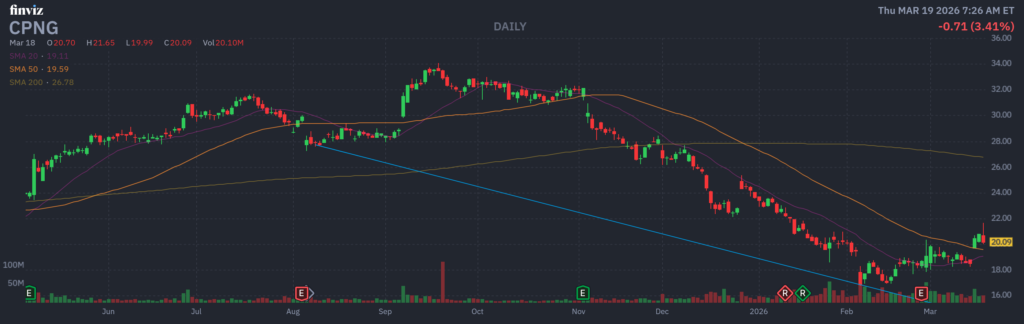
Name: Neil Mehta
Position: Director
Transaction Date: 03-11-2026 Shares Bought: 7,350,104 shares an average price paid of $18.58 for a cost of $136,562,971
Company: Coupang Inc. (CPNG)
Coupang, Inc., and its subsidiaries own and operate retail businesses in South Korea and around the world via mobile applications and internet websites. It operates in two segments: product commerce and developing offerings. The product commerce sector comprises Korean retail and marketplace offerings; Rocket Fresh, a fresh grocery offering; and advertising products. The Developing Offerings sector includes Eats, a restaurant ordering and delivery service, Play, an online video streaming service, financial activities, and Farfetch, a luxury apparel marketplace. It also operates and provides support services in the US, South Korea, Taiwan, Singapore, China, Japan, Europe, the United Kingdom, and India. Coupang, Inc. was established in 2010 and is based in Seattle, Washington.
Neil Mehta has served as a Director of Coupang Inc. since December 2010, when he joined the company’s Board of Directors and began contributing to its governance and long-term strategic oversight. He currently serves as Lead Independent Director and chairs the Compensation Committee, while also participating in the Nominating and Corporate Governance Committee. Mehta brings strong experience in technology investing and high-growth companies as the founder and managing partner of Greenoaks Capital Partners, an investment firm established in 2012 that focuses on global technology and consumer internet businesses. Earlier in his career, he held investment roles at Orient Property Group and Kayne Anderson Capital Advisors. He earned a BSc in Government from the London School of Economics and Political Science.
Insomniac Hedge Fund Guy Opinion: Coupang is essentially the “Amazon of South Korea,” but with a tighter, more vertically integrated model. The company operates a logistics-heavy e-commerce platform offering same-day and next-day delivery, supported by its proprietary fulfillment network. It’s expanding into newer areas like food delivery, fintech, and international markets (notably Taiwan), but core value still comes from its Product Commerce segment.
The moat is logistics + density. Coupang has built a hyper-efficient last-mile delivery network in Korea that’s extremely hard to replicate. High order frequency and dense urban geography allow for fast delivery at competitive costs. On top of that, its WOW membership program increases customer stickiness and spending per user, reinforcing a flywheel similar to Prime.
Revenue growth has been strong but normalizing. After earlier hyper-growth, the business is now compounding at mid-teens (~14–18%), with 2025 revenue reaching about $34.5B (+14% YoY). Recurring revenue isn’t disclosed in a clean SaaS-like way, but membership, repeat purchases, and cohort data show strong retention—older cohorts continue to spend more over time.
Management, led by founder-CEO Bom Kim, is aggressively reinvesting into growth—sometimes at the expense of near-term profitability. That’s visible in the “Developing Offerings” segment, which is growing fast but still loss-making.
Profitability is improving but uneven. Core commerce margins are expanding toward ~8–10% EBITDA, but consolidated margins remain thin (~3–5%) due to heavy reinvestment and expansion costs.
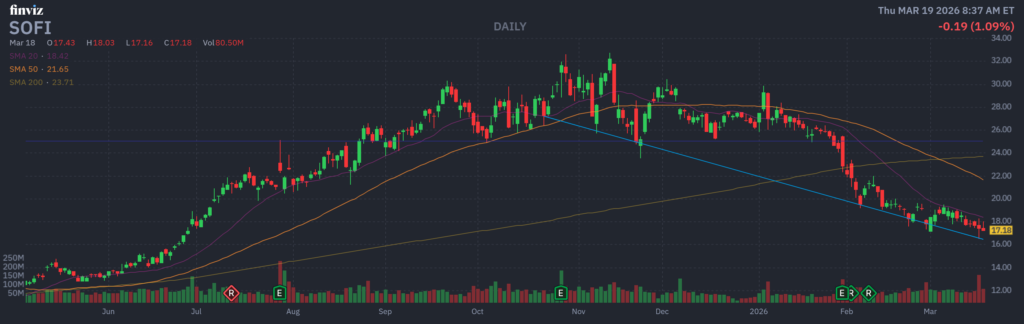
Name: Anthony Noto
Position: ChiefExecutive Officer
Transaction Date: 03-17-2026 Shares Bought: 28,900 shares an average price paid of $17.32 for a cost of $500,516
Company: SoFi Technologies Inc. (SOFI)
SoFi Technologies, Inc. provides a variety of financial services in the United States, Latin America, Canada, and Hong Kong. The corporation is divided into three business segments: lending, technology platforms, and financial services. It provides lending and financial services and products that let its members to borrow, save, spend, invest, and protect their money, as well as personal loans, student loans, house loans, and other related services. The company also manages Galileo, a technological platform that provides services to financial and non-financial institutions, as well as Technisys, a cloud-native digital and core banking platform that sells software licenses and related services such as implementation and maintenance.The company was created in 2011 and is headquartered in San Francisco, California.
Anthony Noto joined SoFi Technologies Inc. in February 2018 and was appointed Chief Executive Officer and member of the board on March 1, 2018. He was named CEO when he joined the company, following temporary leadership and taking on the duty of steering SoFi’s expansion as a major digital financial services platform. Prior to joining SoFi, Noto held prominent positions at Twitter, the National Football League, and Goldman Sachs, gaining vast experience in finance and technology. He graduated from the United States Military Academy at West Point with a Bachelor of Science in Mechanical Engineering and later earned an MBA from the University of Pennsylvania’s Wharton School.
Insomniac Hedge Fund Guy Opinion: SoFi is trying to build the “Amazon of financial services”—a one-stop digital platform for lending, banking, investing, and payments. What started as a student loan refi business is now a full-stack fintech with three engines: lending (still the cash generator), financial services (fastest growth), and a tech platform (Galileo + APIs).
The “moat” isn’t traditional—it’s ecosystem-driven. SoFi’s strategy is cross-sell and lifetime value: acquire a customer with loans, then layer on deposits, investing, credit cards, and subscriptions. Roughly 35–40% of new products are opened by existing users, showing decent early signs of platform stickiness.
Growth is the headline. Revenue has been compounding at ~25–35%+ in recent years, with 2025 still running hot—~30% expected full-year growth. Fee-based (more recurring-like) revenue is growing even faster—50%+ YoY in 2025, now a meaningful and rising share of the business.
Recurring revenue isn’t cleanly disclosed, but the mix is improving as financial services and platform fees scale. Still, this is not a pure SaaS model—credit exposure and loan cyclicality remain core risks. Net retention isn’t disclosed, but rising product-per-user and member growth (30%+ annually) suggest strong engagement.
Management, led by CEO Anthony Noto, has executed well—pivoting from growth-at-all-costs to profitability. SoFi is now consistently GAAP profitable, with ~25–30% EBITDA margins and strong operating leverage.

Name: Michael Kim
Position: EVP, Chief Digital Officer
Transaction Date: 03-12-2026 Shares Bought: 15,000 shares an average price paid of $16.50 for a cost of $247,500
Transaction Date: 02-27-2026 Shares Bought: 30,000 shares an average price paid of $14.30 for a cost of $428,955
Company: Claritev Corp (CTEV)
Claritev Corporation and its subsidiaries offer data analytics and technology-enabled end-to-end cost control, payment, and revenue integrity solutions to the healthcare business in the United States. The company provides claims intelligence solutions, such as reference-based pricing, negotiation services, surprise bill services, and Vistara; network solutions; and payment and revenue integrity solutions, which include clinical negotiation, prepayment integrity, post-payment integrity, and revenue integrity services. The company offers solutions to commercial healthcare payers, third-party administrators, employers, brokers/consultants, providers, government healthcare payers, and system integrators. The corporation was previously known as MultiPlan Corporation before changing its name to Claritev Corporation in February 2025. Claritev Corporation was created in 1980 and has its headquarters in McLean, Virginia.
Michael Kim has been Claritev Corporation’s Executive Vice President and Chief Digital Officer since February 2025, following his promotion from Senior Vice President and Chief Information Officer in October 2020. He joined the firm in December 2013 as Chief Information Officer and has since been instrumental in driving corporate technology, digital transformation, and data-driven projects. With over two decades of experience in technology leadership, including positions at The Hartford and Torus Insurance, he now supervises the company’s digital, AI, and information security operations. He has a bachelor’s degree in economics from Yale University.
Insomniac Hedge Fund Guy Opinion: Claritev is a healthcare data, analytics, and cost-containment platform that helps insurers and employers reduce medical spend. Think payment integrity, network optimization, and analytics layered on top of massive healthcare claims data. It’s not glamorous, but it sits directly in the flow of healthcare dollars—which is where the value is.
The moat is moderate. Claritev benefits from data scale, embedded relationships with payers, and multi-year contracts, but this isn’t a monopoly business. Switching costs exist, but competition in healthcare analytics and cost management is real. The upside is that once integrated into claims workflows, the product becomes operationally sticky.
Growth has been underwhelming. Revenue is roughly $965M in 2025, growing ~3–4%, with a choppy multi-year track record that includes declines earlier in the cycle. This is not a clean growth story—more of a turnaround trying to reaccelerate. That said, bookings and pipeline momentum suggest some stabilization.
The business is largely recurring, driven by contracts and subscription-like arrangements, though exact percentages aren’t clearly disclosed. Customer retention appears solid, with large clients renewing multi-year agreements, but concentration risk is meaningful.
Management, led by CEO Travis Dalton, is in “turnaround mode”—rebranding, restructuring, and pushing toward sustainable growth. Messaging is confident, but execution still needs to prove itself.
Profitability is where things get weird. Claritev posts ~60%+ EBITDA margins, but remains GAAP net loss-making, largely due to heavy debt and amortization. That gap matters.
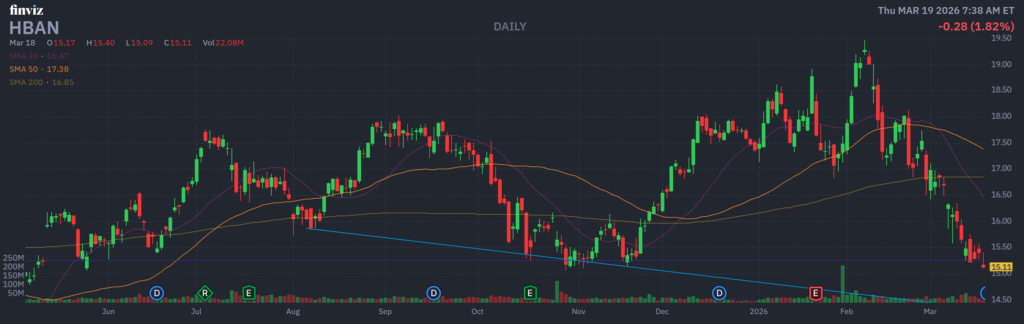
Name: Stephen D. Steinour
Position: President, CEO & Chairman
Transaction Date: 03-12-2026 Shares Bought: 32,277 shares an average price paid of $15.49 for a cost of $499,971
Company: Huntington Bancshares Inc. (HBAN)
Huntington Bancshares Incorporated serves as the bank holding company for The Huntington National Bank, which offers business, consumer, and mortgage banking services. It provides consumer and commercial customers with financial products and services such as deposits, lending, payments, mortgage banking, dealer financing, investment management, trust, brokerage, insurance, and others. The company also offers 24-Hour Grace, Asterisk-Free Checking, Money Scout, Standby Cash, Early Pay, Savings Goal Getter, and Huntington Heads Up, which are digitally enabled consumer and business financial solutions, as well as full-service retail brokerage investment services. It also provides equipment financing, asset-based lending, distribution finance, structured lending, municipal finance solutions, and Huntington ChoicePay. The corporation was founded in 1866 and is based in Columbus, Ohio.
Stephen D. Steinour has served as President, Chief Executive Officer and Chairman of Huntington Bancshares Inc. since January 14, 2009, when he was elected to lead the company during a period of financial industry challenges. He joined Huntington in 2009 from CrossHarbor Capital Partners, where he was a Managing Partner, bringing extensive banking and leadership experience. Prior to that, he spent more than 15 years at Citizens Financial Group, ultimately serving as President and CEO, along with earlier senior roles at Fleet Financial Group and Bank of New England. Under his leadership, Huntington has focused on regional expansion and customer-focused banking strategies. He holds a bachelor’s degree in economics from Gettysburg College and completed executive leadership studies at Stanford.
Insomniac Hedge Fund Guy Opinion: Huntington Bancshares is a classic U.S. regional bank—plain vanilla on the surface, but quietly executing well. The business is built around commercial and consumer lending, funded by a large deposit base, with growing fee income from payments, wealth management, and capital markets. In other words: spread income first, fee income second.
There’s no real “moat” in the traditional sense—banking is competitive—but Huntington’s advantage lies in its regional scale, disciplined underwriting, and increasingly diversified revenue mix. The bank has been pushing into fee-generating businesses, which helps offset the cyclicality of net interest income. Payments, wealth, and capital markets have all been growing mid-to-high single digits.
Revenue growth has been better than most peers recently, with ~10–11% growth in 2025, driven by loan expansion and margin stability. Over a longer period, growth is more modest—mid-single digits—typical for a regional bank. There’s no real “recurring revenue” metric here, but net interest income dominates, supplemented by fee income that’s becoming a larger piece of the mix.
Management, led by CEO Steve Steinour, has been aggressive on growth via acquisitions and balance sheet expansion. Loan growth (~14% YoY in 2025) and a pending large acquisition signal a willingness to scale, not just optimize.
Profitability is solid but not elite. Net interest margin sits around ~3.1%, and returns on equity are healthy, though efficiency ratios have ticked up recently, suggesting some cost pressure.
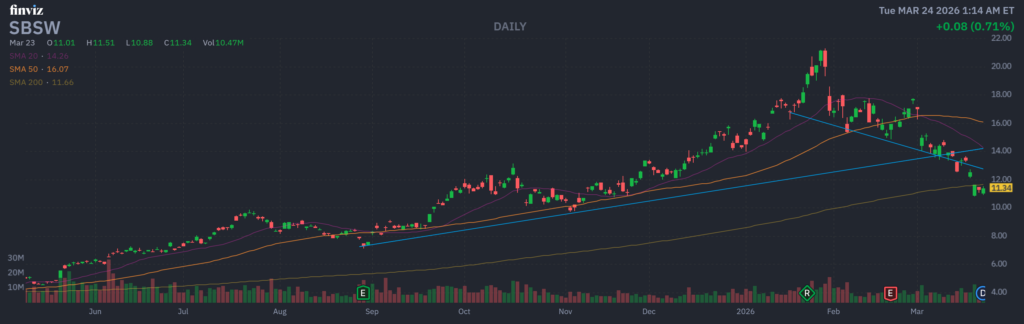
Name: Charl Keyter
Position: Chief Financial Officer
Transaction Date: 03-20-2026 Shares Bought: 148,819 shares an average price paid of $11.63 for a cost of $1,730,765
Company: Sibanye Stillwater Ltd. (SBSW)
Sibanye Stillwater Limited, along with its subsidiaries, operates as a precious metals mining firm in South Africa, the United States, Europe, and Australia. The company produces gold, platinum group metals (PGMs) such as palladium, platinum, rhodium, iridium, and ruthenium, as well as chrome, lithium, zinc, nickel, silver, cobalt, and copper. Sibanye Stillwater Limited was established in 2013 and is headquartered in Weltevreden Park, South Africa.
Charl Keyter has served as Chief Financial Officer of Sibanye Stillwater Ltd. since January 1, 2013, when he was appointed Executive Director and CFO after previously joining the company as a director in November 2012. He has played a key role in shaping the company’s financial strategy, including supporting its transformation into a globally diversified metals producer and strengthening its balance sheet through disciplined financial management. Keyter brings more than three decades of experience in the mining sector, having previously held senior finance roles at Gold Fields, where he led international finance operations. He holds a BCom in Accounting from the University of Johannesburg, an MBA from North-West University, and is a Chartered Management Accountant.
Insomniac Hedge Fund Guy Opinion: Sibanye Stillwater is not a typical “quality compounder”—it’s a leveraged bet on precious metals cycles. The company is a diversified mining group producing platinum group metals (PGMs), gold, and increasingly battery metals like lithium and nickel. Operations span South Africa and the U.S., with earnings heavily tied to commodity prices rather than volume growth.
There is no real moat here. Mining is inherently commoditized—price taker, not price maker. Sibanye’s “edge” is scale, asset diversification, and optionality across metals, but none of that protects it from collapsing palladium or platinum prices.
Revenue over the past five years has been volatile rather than consistently growing—ranging from massive pandemic-era spikes to sharp declines, with recent growth around low-single digits (~3–6%) depending on the cycle. This is not a steady grower; it’s cyclical with sharp swings tied to metal pricing.
Recurring revenue is essentially zero—this is pure commodity exposure. Net revenue retention is not a meaningful concept here; customer relationships don’t drive economics, commodity prices do.
Management has tried to reposition the company as a diversified “green metals” platform, expanding into lithium, nickel, and recycling. The strategy makes sense directionally, but execution risk is high and capital allocation has been uneven.
Profitability tells the real story. Sibanye went from ~30%+ operating margins during the 2021 boom to negative margins in recent periods, reflecting collapsing PGM prices and impairments. Losses in 2023–2024 and asset write-downs highlight just how brutal the cycle can be

Name: Bradford T. Whitmore
Position: Director and 10% Owner
Transaction Date: 03-12-2026 Shares Bought: 187,512 shares an average price paid of $6.38 for a cost of $1,196,909
Company: Ultralife Corp (ULBI)
Ultralife Corporation and its subsidiaries design, manufacture, install, and maintain power, communication, and electronics systems globally. The corporation is divided into two business segments: battery and energy products, and communications systems. The Battery & Energy Products segment includes lithium 9-volt, cylindrical, thin lithium manganese dioxide, rechargeable, and non-rechargeable batteries. The Communications Systems section manufactures communications systems and accessories for military communications systems, including radio frequency amplifiers, power supply and cables, connector assemblies, amplified speakers, and equipment mounts. This segment’s military communications systems and accessories are intended to improve and expand the functionality of communications equipment such as vehicle-mounted, manpack, and handheld transceivers. The company was established in 1990 and is based in Newark, New York.
Bradford T. Whitmore became Director of Ultralife Corporation in June 2007 and is also recognized as a director and 10% owner of the company. He has been a long-standing member of the board, providing strategic oversight and financial guidance, and later went on to serve as Chairman of the Board starting in March 2010. In addition to his role at Ultralife, Whitmore has extensive investment experience as Managing Partner of Grace Brothers LP. His significant ownership stake reflects strong alignment with shareholder interests. He holds a Bachelor of Science in Mechanical Engineering from Purdue University and an MBA from Northwestern University’s Kellogg School of Management.
Insomniac Hedge Fund Guy Opinion: Ultralife is a small-cap, somewhat messy industrial story centered on batteries and power systems. The company designs and manufactures lithium batteries and energy solutions primarily for defense, government, and industrial applications. A smaller communications systems segment rounds out the business, but it’s increasingly irrelevant.
The “moat” here is niche positioning rather than scale. Ultralife serves specialized, often mission-critical applications—military radios, medical devices, and industrial systems—where reliability matters more than price. That creates some stickiness, but this is not a dominant platform business. It’s a fragmented market with limited pricing power.
Revenue growth has actually been solid recently, helped by acquisitions and defense demand. Full-year 2025 revenue reached about $191M, up ~16% YoY, with quarterly growth often in the double digits. Over a 5-year view, growth is lumpy but trends mid-to-high single digits overall.
Recurring revenue is limited—this is largely a product-driven business. There’s some repeat ordering, but no real consumables flywheel like higher-quality industrial models. Net retention isn’t disclosed and likely not a key driver.
Management, led by CEO Michael Manna, has leaned into acquisitions (notably Electrochem) to drive growth and vertical integration. The strategy is logical but execution risk is real, especially given rising debt and integration costs.
Profitability is the issue. Despite revenue growth, margins have been under pressure, with gross margins around ~23–25% and inconsistent operating income. Non-cash impairments and higher expenses have recently pushed the company into losses.
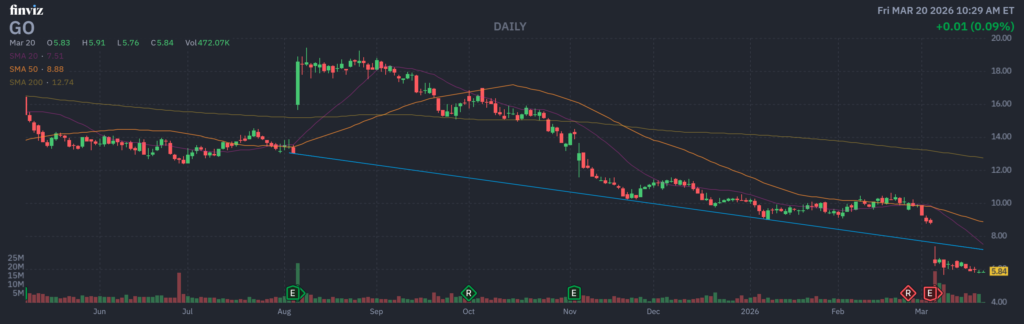
Name: Erik D. Ragatz
Position: Director
Transaction Date: 03-16-2026 Shares Bought: 116,003 shares an average price paid of $6.06 for a cost of $702,618
Transaction Date: 03-18-2026 Shares Bought: 83,997 shares an average price paid of $5.79 for a cost of $486,382
Company: Grocery Outlet Holding Corp. (GO)
Grocery Outlet Holding Corp. sells consumables and fresh products through independently operated stores in the United States. It sells perishable category products such dairy and deli, produce and floral, and meat and seafood. The company also sells non-perishable category items such groceries, general merchandise, health and beauty care, frozen foods, and beer and wine. The company has stores in California, Washington, Oregon, Pennsylvania, Tennessee, Idaho, Maryland, Nevada, North Carolina, New Jersey, Georgia, Ohio, Alabama, Delaware, Kentucky, and Virginia. The company was founded in 1946 and is based in Emeryville, California.
Erik D. Ragatz has served as a Director of Grocery Outlet Holding Corp. since October 2014, when he joined the company’s Board of Directors and later served as Chairman before becoming Lead Independent Director in 2023. He brings extensive experience in private equity and corporate governance, having spent over two decades at Hellman & Friedman, where he served as Partner and now Senior Advisor, focusing on investments in consumer, retail, and industrial sectors. Ragatz has also held board roles across multiple portfolio companies, contributing deep expertise in strategy, operations, and financial oversight. He holds a Bachelor of Arts in Economics and an MBA from Stanford University.
Insomniac Hedge Fund Guy Opinion: Grocery Outlet is a discount grocery chain built around a “treasure hunt” model—buying excess inventory, closeouts, and opportunistic deals from suppliers, then selling them at steep discounts. Stores are run by independent operators, which keeps overhead low and adds local flavor. It’s part off-price retail, part grocery—closer to TJX than Kroger in spirit.
The moat is unconventional. Grocery Outlet’s edge comes from its sourcing network and flexibility in buying distressed or surplus inventory. That said, it’s not a hard moat—competitors like Aldi, Walmart, and dollar stores can compete on price, even if they lack the “surprise deal” element. The independent operator model helps margins but introduces execution variability.
Revenue growth has been solid, with ~$4.7–4.8B expected in 2025 and high-single-digit growth (~7–10%) recently . But comps are weak (low single-digit or negative), suggesting growth is increasingly store-driven rather than organic. There is no real recurring revenue, and retention is purely traffic-based—this is retail, not SaaS.
Management is now led by CEO Jason Potter, brought in to professionalize operations and improve consistency. So far, execution has been mixed, with restructuring, leadership turnover, and strategic resets underway.
Profitability is where the story breaks. Despite ~30% gross margins, operating income has been volatile, and 2025 included a massive operating loss driven by impairments and restructuring . The company is now closing underperforming stores after expanding too aggressively.
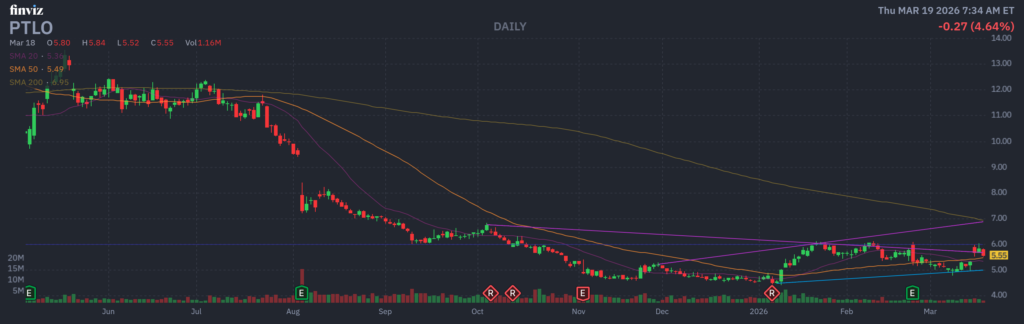
Name: Lee Eugene I Jr.
Position: Director
Transaction Date: 03-13-2026 Shares Bought: 286,000 shares an average price paid of $5.18 for a cost of $1,481,480
Company: Portillo’s Inc. (PTLO)
Portillo’s Inc. owns and operates fast casual restaurants around the United States. The company serves Chicago-style hot dogs and sausages, Italian beef sandwiches, char-grilled burgers, chopped salads, crinkle-cut and cheese fries, handcrafted chocolate cakes, and chocolate cake shakes. It also maintains a food van called The Beef Bus, as well as a ghost kitchen. In addition, the company offers delivery services via its app and website, as well as third-party delivery systems. Additionally, it sells gift cards. Portillo’s Inc. was formed in 1963 and is headquartered in Oak Brook, Illinois.
Eugene I. Lee Jr. has served as Director at Portillo’s Inc. since June 2025. He brings extensive leadership experience in the restaurant industry and corporate governance. Lee previously served as Chief Executive Officer of Darden Restaurants from 2015 to 2022 and later as Chairman of its board from 2021 to 2023, where he helped drive significant revenue growth and operational improvements. Earlier in his career, he held several senior leadership roles at RARE Hospitality International, including President and Chief Operating Officer, before joining Darden through its acquisition of the company. In addition to his role at Portillo’s, he also serves as Independent Board Chair of Advance Auto Parts. He holds an MBA from Suffolk University in Boston.
Insomniac Hedge Fund Guy Opinion: Portillo’s is a Chicago-born fast-casual restaurant chain built around a focused menu—hot dogs, Italian beef sandwiches, burgers, and shakes. It’s essentially a regional cult brand trying to scale nationally, with growth driven primarily by opening new restaurants rather than same-store sales.
The “moat” is brand affinity, not technology or switching costs. In Chicagoland, Portillo’s units generate industry-leading volumes (~$10M+ per store), but outside its core markets, performance drops materially. That’s the central debate: is this a scalable national concept or just a strong regional chain?
Revenue growth has been solid but not spectacular—roughly mid-to-high single digits over the past few years, with ~4–5% growth in 2024 and ~2–4% expected in 2025. Growth is increasingly coming from new unit openings, while same-store sales are weak to flat, with declining traffic offset by price increases.
There is no real recurring revenue model here—this is a pure restaurant business. However, loyalty programs (Portillo’s Perks) and strong repeat traffic provide some pseudo-recurring characteristics. Net revenue retention isn’t relevant in the traditional sense.
Management has been in transition, with a strategic reset underway—slowing unit growth, improving store economics, and experimenting with smaller “restaurant of the future” formats to reduce build costs and improve returns.
Profitability is where things get messy. Restaurant-level margins are decent (~20%+), but corporate overhead and expansion costs compress net margins, and recent results show declining operating income and earnings pressure.

Name:Charles Galagher Jeff
Position: Chief Financial Officer, EVP
Transaction Date: 03-17-2026 Shares Bought: 40,000 shares an average price paid of $5.07 for a cost of $202,762
Company: Arko Corp. (ARKO)
Arko Corp., through its subsidiary, operates a chain of convenience stores in the United States. It operates in four segments: retail, wholesale, fleet fueling, and GPMP. The Retail division operates retail establishments that provide fuel, merchandise, cold and hot prepared foods, beverages, cigarettes and other tobacco products, candies, salty snacks, groceries, beer, and general merchandise to retail customers. The Wholesale segment provides fuel to dealers, sub-wholesalers, bulk and spot purchasers. The Fleet Fueling sector manages proprietary and third-party cardlock systems and sells fuel with proprietary fuel cards. The GPMP segment is responsible for wholesale fuel distribution to both the retail and wholesale segments. The corporation is headquartered in Richmond, Virginia.
Charles Galagher Jeff was appointed Executive Vice President and Chief Financial Officer of ARKO Corp. on December 1, 2025, and he joined the firm in this capacity. He is a seasoned finance executive with extensive leadership experience, having previously served as EVP and CFO at Murphy USA and held senior finance and strategy roles at major retailers, including Dollar Tree, Advance Auto Parts, and Walmart, as well as consulting experience at KPMG and Ernst & Young. He earned a Bachelor of Science in Electrical Engineering from Mississippi State University, a Master of Science in Engineering, and an MBA from Northwestern University’s Kellogg School of Management.
Insomniac Hedge Fund Guy Opinion: Arko Corp is essentially a fuel distributor wrapped in a convenience store operator. The company runs and supplies gas stations across the U.S., with revenue heavily tied to fuel sales (low margin, high volume) and in-store merchandise (higher margin but more cyclical). Over time, management has been shifting the model toward wholesale fuel distribution and dealer-operated stores—less sexy, but structurally more stable.
The “moat” here is thin. This is a scale and logistics business, not a differentiated product company. Arko benefits from network density, fuel supply relationships, and its growing dealer ecosystem, but switching costs are low and competition is intense. This is not a pricing power story—it’s an execution story.
Revenue has been volatile. After rapid acquisition-driven growth earlier in the decade, the last couple of years show flat to declining sales (~$7.8–8.7B, down mid-single digits recently) as fuel prices normalize and volumes fluctuate. There is no real “recurring revenue” in the SaaS sense—fuel demand is repeat but not contractual. Stability instead comes from margins on fuel distribution and wholesale relationships.
Management, led by CEO Arie Kotler, is focused on “dealerization”—converting company-operated stores into dealer-run locations to reduce costs and improve returns. Early signs suggest margin improvement and better capital efficiency. The recent IPO of its fuel distribution arm also signals a push toward a more asset-light, fuel-focused model.
Profitability is modest. EBITDA is stable, but net income is thin and sensitive to fuel margins and consumer spending.

Name: Charles C. Townsend
Position: Director
Transaction Date: 03-11-2026 Shares Bought: 250,000 shares an average price paid of $4.55 for a cost of $1,138,706
Company: Gogo Inc. (GOGO)
Gogo Inc., through its subsidiaries, provides broadband connectivity services to the aviation industry in the United States and abroad. The company’s product portfolio comprises networks, antennas, aerial equipment, and software. The company provides in-flight systems and services, aviation partner support, engineering, design, and development services, and manufacturing operations functions. It provides voice and data communications, in-flight entertainment, and other services. Furthermore, the company’s infrastructure comprises networks, towers, cyber security software, and data centers that offer in-flight connectivity and telecommunications services. Gogo Inc. was formed in 1991 and is based in Broomfield, Colorado.
Charles C. Townsend has served on the Board of Directors since January 2010. Mr. Townsend is currently the managing general partner of Bluewater Wireless II, L.P. He formed Aloha Partners LP in 2001 and served as its managing general partner until 2008. Mr. Townsend also served as the managing general partner of Aloha Partners II from 2006 to 2014. From 1988 to 1998, Mr. Townsend was President and CEO of the Atlantic Cellular Company. Since January 2004, Mr. Townsend has also been President of Pac 3, LLC. Mr. Townsend has a Bachelor of Arts in Social Psychology from the University of Virginia and a master of business administration from Harvard Business School.
Insomniac Hedge Fund Guy Opinion: Gogo is a niche connectivity provider focused on in-flight broadband for business aviation, military, and government aircraft. Think private jets, not commercial airlines. The company sells onboard equipment and then monetizes it through ongoing connectivity subscriptions—essentially turning planes into recurring data pipes.
The moat is decent but not impenetrable. Gogo benefits from an installed base of aircraft already equipped with its systems and long certification cycles (FAA approvals, STCs), which create friction for switching. That said, it’s still a competitive market with satellite players like Viasat and Starlink creeping in. This isn’t a monopoly—it’s a positioning game.
Revenue has been volatile but is now inflecting. 2025 revenue hit ~$910M, up over 100% YoY, largely due to the Satcom Direct acquisition; on a pro-forma basis, growth was only ~1–2%, so underlying organic growth is still modest. Over a longer period, growth has been inconsistent, reflecting both restructuring and strategy shifts.
The key metric is mix: ~80% of revenue is service-based, which is recurring and higher margin. This gives the business a subscription-like profile once hardware is installed. Net retention isn’t disclosed, but ARPU stability and service growth suggest reasonable stickiness.
Management, led by CEO Chris Moore, is pushing a transformation: from a U.S.-focused air-to-ground provider to a global satellite + 5G hybrid connectivity platform. New products (Galileo LEO, 5G network) are the growth bet.
Profitability is improving but not elite. EBITDA is scaling (~$218M in 2025), but net income remains thin due to heavy investment and integration costs.
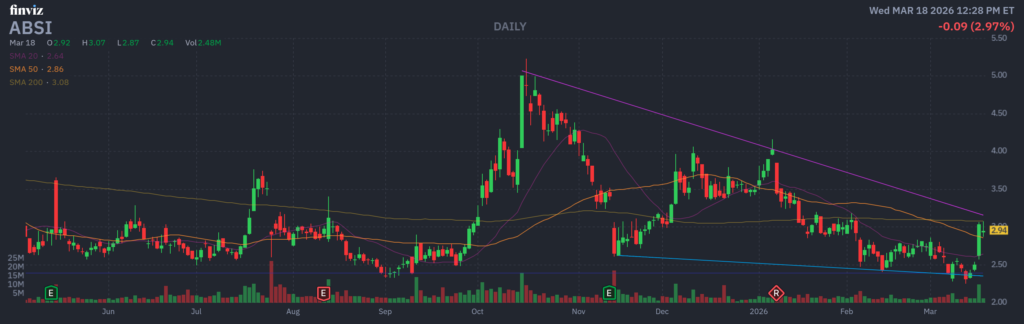
Name: Andreas Busch
Position: Chief Innovation Officer
Transaction Date: 03-12-2026 Shares Bought: 100,000 shares an average price paid of $2.29 for a cost of $229,000
Company: Absci Corp (ABSI)
Absci Corporation is a data-first, generative artificial intelligence medication creation firm based in the United States. To create distinct antibody therapies, the company uses artificial intelligence and scalable wet lab technologies. Its preclinical development programs include ABS-101 for the treatment of inflammatory bowel illness, ABS-201 for androgenic alopecia, ABS-301 for immuno-oncology, and ABS-501 for oncology. Absci Corporation has partnership agreements with PrecisionLife, Memorial Sloan Kettering Cancer Center, Twist Bioscience, Owkin, Oracle Corporation, and Advanced Micro Devices, Inc. for joint research and development. The company was created in 2011, and its headquarters is in Vancouver, Washington.
Andreas Busch has been Absci Corp’s Chief Innovation Officer since October 2022, having previously joined the firm as a member of its board of directors before taking on the executive post. In this role, he oversaw research and development, technological operations, and innovation strategy, making important contributions to the company’s AI-driven drug discovery pipeline. Before joining Absci, he held key R&D leadership positions with large pharmaceutical firms such as Bayer, Shire, and Cyclerion Therapeutics. He received his PhD in Pharmacology from Johann Wolfgang Goethe University in Frankfurt, where he also works as an Extraordinary Professor.
Insomniac Hedge Fund Guy Opinion: Absci is an early-stage, AI-driven biotech trying to reinvent drug discovery. The pitch: combine generative AI with synthetic biology to design biologic drugs faster and cheaper than traditional methods. Instead of selling products today, Absci partners with large pharma companies to co-develop drugs, earning upfront fees, milestones, and eventually royalties if anything makes it to market.
The moat is still theoretical. The platform—“Integrated Drug Creation”—sounds compelling, but it’s unproven at scale. In biotech, the real moat is clinical success, not slide decks. Until Absci produces a commercially viable drug, the edge is more promise than reality.
Financials reflect that. Revenue is tiny and volatile—roughly $2–5M annually, with negative growth recently (~-30% YoY). The reason: revenue is milestone-driven, not recurring. One quarter you get a payment, the next you don’t. Recurring revenue is effectively 0% today, though long-term royalties could change that if drugs succeed.
Net retention doesn’t really apply here—this isn’t a SaaS model. Instead, customer concentration risk is high, with a handful of pharma partners driving nearly all revenue.
Management is founder-led, with CEO Sean McClain pushing aggressively into internal drug development. That’s a pivot from platform-only to biotech risk, which increases upside—but also burn.
Profitability is nonexistent. The company is deeply loss-making, with tens of millions in annual cash burn and ongoing dilution risk, though recent capital raises extend runway into ~2027–2028.
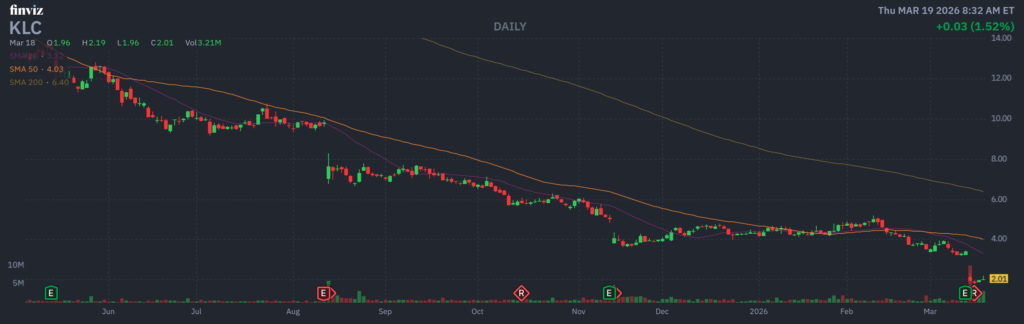
Name: John T. Wyatt
Position: Chief Executive Officer
Transaction Date: 03-17-2026 Shares Bought: 494,118 shares an average price paid of $2.02 for a cost of $998,721
Company: KinderCare Learning Companies Inc. (KLC)
Charles Galagher Jeff was appointed Executive Vice President and Chief Financial Officer of ARKO Corp. on December 1, 2025, and he joined the firm in this capacity. He is a seasoned finance executive with extensive leadership experience, having previously served as EVP and CFO at Murphy USA and held senior finance and strategy roles at major retailers, including Dollar Tree, Advance Auto Parts, and Walmart, as well as consulting experience at KPMG and Ernst & Young. He earned a Bachelor of Science in Electrical Engineering from Mississippi State University, a Master of Science in Engineering, and an MBA from Northwestern University’s Kellogg School of Management.
John T. Wyatt has been Chief Executive Officer of KinderCare Learning Companies Inc. since December 2, 2025, when he was reappointed, while also serving as Chairman of the Board, a post he has held since 2021. He became CEO of KinderCare in 2012, guiding the company through a period of significant restructuring and expansion that lasted until mid-2024. Wyatt has over 40 years of leadership experience in consumer and retail organizations, including senior positions at Gap Inc.’s Old Navy division. He has a business-focused educational background, which complements his extensive leadership experience.
Insomniac Hedge Fund Guy Opinion: KinderCare is essentially a scaled childcare operator—running early childhood education centers, employer-sponsored facilities, and before/after-school programs across the U.S. It’s a real economy business, not software: capacity, occupancy, and labor drive everything.
The “moat” is softer than it looks. There’s some advantage in scale, brand, and employer partnerships, but childcare is ultimately a local, labor-intensive service with limited pricing power. Switching costs exist for parents, but they’re not insurmountable. This is not a network-effect or high-tech lock-in story.
Revenue has grown to roughly $2.6–2.7B, with low single-digit growth (~2–4%) recently after stronger post-COVID recovery years. Growth is increasingly driven by price increases and new centers rather than same-center demand, with occupancy actually trending slightly down.
Recurring revenue is effectively high (parents pay tuition weekly), but it’s not “sticky SaaS recurring”—it’s tied to enrollment and economic conditions. Net retention isn’t disclosed, but declining occupancy suggests pressure underneath the surface.
Management, led by CEO Paul Thompson, is focused on operational discipline, new site growth, and debt reduction post-IPO. The strategy is sensible, but execution is constrained by the economics of the industry.
Profitability is the key issue. Despite ~$2.7B revenue, operating margins are thin (~4% recently) and volatile, impacted by labor inflation and the roll-off of COVID subsidies. This is a structurally high-cost business with limited operating leverage.
This blog is solely for educational purposes and the author’s own amusement. IT IS NOT INVESTMENT ADVICE. Think of the blog as part of my personal investment journal that I am willing to share with the DIY investor. We could be long, short, or have no position at all in any of the stocks mentioned and express no written or implied obligation to disclose any of that. Nothing contained here constitutes a recommendation to buy or sell any security. Investing involves risk, including the possible loss of principal, and past performance is not indicative of future results.
“The insomniac hedge fund guy” is a moniker Harvey Sax, the portfolio manager for The Insiders Fund” has used from time to time on email, blog ,and social media posts. While Mr. Sax is the portfolio manager of The Insiders Fund, these posts are not communications from, nor endorsed by, Alpha Wealth Funds, LLC or any of its managed funds. References to Alpha Wealth Funds or its affiliates are for identification only and do not imply sponsorship or approval.
All company names, logos, and trademarks belong to their respective owners. The use of company logos is solely for descriptive and illustrative purposes under fair use. Any information provided is based on publicly available data and should not be considered financial, investment, or legal advice. Readers should conduct their own research or consult with a professional before making any investment decisions. Insiders sell the stock for many reasons, but they generally buy for just one – to make money. You’ve always heard the best information is inside information. Everyone with any stock market experience pays close attention to what insiders are doing. After all, who knows a business better than the people running it? Officers, directors, and 10% owners are required to inform the public through a Form 4 Filing of any transaction, buy, sell, exercise, or any other within 48 hours of doing so.
This info is available for free from the SEC’s Web site, Edgar, although we subscribe to SECForm4 as they provide a way to manage and make sense of the vast realms of data. I’ve tried a lot of vendors. SECForm4 is one of the smaller ones, but I like supporting Frank. He is not arrogant. He’s helpful and has great prices. He also trades on his own data, so I like people that eat what they kill. The bar is different from selling because the natural state of management is to be a seller. This is because most companies provide significant amounts of management compensation packages as stock and options. Therefore, we analyze unusual patterns with selling, such as insiders selling 25 percent or more of their holdings or multiple insiders selling near 52-week lows. Another red flag is large planned sale programs that start without warning. Unfortunately, the public information disclosure requirements about these programs, referred to as Rule 10b5-1, are horrendously poor. Also, planned sales that pop up out of nowhere are basically sales and are seeking cover under this corporate welfare loophole.
I also generally ignore 10 percent shareholders as they tend to be OPM (other people’s money) and perhaps not the smart money on which we are trying to read the tea leaves. I say generally because some 10% shareholders are great investor, think Warren Buffett and others. Of course, insiders can also be wrong about their Company’s prospects. Don’t let anyone fool you into believing they never make mistakes. Do your own analysis. They can easily be wrong, and in many cases, maybe most cases, have no more idea what the future may hold than you or me. In short, you can lose money following them. We have, and we curse aloud; what were they thinking!
We like Fly on the Wall for keeping up with what events might be happening, analysts’ comments, and whatever else could be moving the stock. Dow Jones news service is an essential tool, but many services pick up their feed like they do Bloomberg. My assistant probes the 10k for a reasonable description of the business. I’ve found that to be the most accurate and succinct place to find out what a business actually does.