The light of day is coming up on this self imposed quarterly earnings blackout. 1st Quarter Earnings begins in earnest, next week. We will see then if stock are cheap enough for any insiders to jump in.

Name: Celeste Beeks Mastin
Position: President and CEO
Transaction Date: 04-07-2026 Shares Bought: 5,170 shares an average price paid of $57.08 for a cost of $295,104
Company: Fuller H B Co. (FUL)
H.B. Fuller Company, through its subsidiaries, develops, manufactures, and markets adhesives, sealants, coatings, polymers, tapes, encapsulants, additives, and other specialized chemical products. It operates in three segments: hygiene, health, and consumable adhesives; engineering adhesives; and building adhesive solutions. Construction Adhesives manufactures solutions for commercial roofing, heating, ventilation, air conditioning, and insulation applications, as well as caulks and sealants for the consumer and professional markets. The company offers its products both directly to clients and through distributors and retailers in North America, Latin America, Europe, India, the Middle East, Africa, and the Asia Pacific. The H.B. Fuller Company was established in 1887 and is headquartered in Saint Paul, Minnesota.
Celeste Beeks Mastin joined H.B. Fuller Company on March 7, 2022, as Executive Vice President and Chief Operating Officer. She was promoted to President and Chief Executive Officer on December 4, 2022, and joined the company’s Board of Directors. She has almost three decades of leadership expertise in manufacturing and distribution, including previous CEO positions at PetroChoice and Distribution International.
Insomniac Hedge Fund Guy Opinion: H.B. Fuller is a global specialty chemicals company that makes adhesives, sealants, and coatings used across packaging, hygiene products, electronics, and construction. It’s not sexy, but it’s everywhere—if something is glued, sealed, or bonded, there’s a decent chance Fuller is involved. The business spans over 20,000 products and is deeply embedded in industrial supply chains.
The moat is modest but real. Adhesives are typically a small percentage of customer costs but mission-critical for performance. That creates sticky relationships, especially in packaging, hygiene (diapers, medical), and electronics. However, this isn’t Waters-level switching cost—customers can and do dual-source. Pricing power exists, but it’s tied heavily to raw material pass-through and execution.
Revenue growth over the last five years has been low single-digit (~2–4%), with volatility driven by industrial demand and portfolio changes. Fiscal 2025 revenue was $3.47B, down ~2.7% reported, essentially flat organically. This is not a secular grower—it’s cyclical with some acquisition overlay.
Recurring revenue is harder to define here. A large portion of sales is tied to ongoing production (packaging, hygiene), so there is repeat business, but it lacks true contractual or subscription-like characteristics. Net retention isn’t disclosed and likely not a key KPI.
Management, led by CEO Celeste Mastin, is focused on margin expansion, pricing discipline, and portfolio optimization. The story right now is transformation—moving from a volume-driven chemical business to a higher-margin specialty player.
Profitability is improving. Adjusted EBITDA margins have expanded to ~18–19% in 2025, up from ~16% a year ago, driven by cost actions and pricing.
Name: William R. Shepard
Position: Director
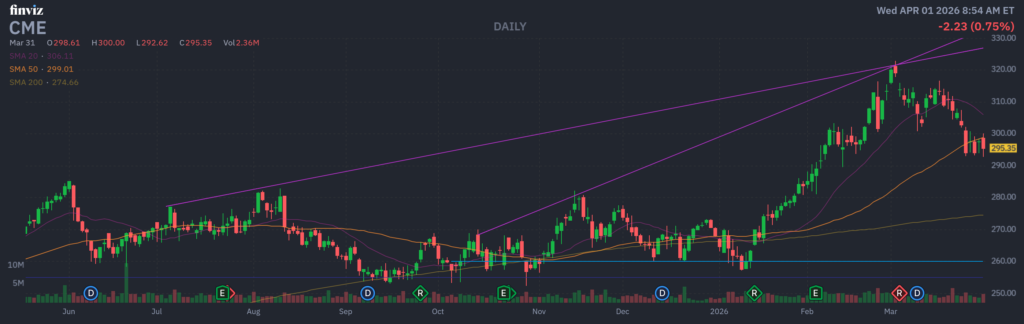
Transaction Date: 03-26-2026 Shares Bought: 1,470 shares an average price paid of $297.38 for a cost of $437,101
Company: CME Group Inc. (CME)
CME Group Inc., through its subsidiaries, operates contract markets for the trading of futures and options on futures contracts worldwide. It provides futures and options products based on interest rates, equity indices, and foreign exchange, as well as agricultural, energy, and metals commodities, fixed income, and foreign currency trading services. The company offers clearing house services, which include clearing, settling, and guaranteeing futures and options contracts, as well as cleared swaps products traded on its exchanges. In addition, the company provides a variety of market data services. The corporation was previously known as Chicago Mercantile Exchange Holdings Inc. before changing its name to CME Group Inc. in July 2007. The company was founded in 1898 and is based in Chicago, Illinois.
William R. Shepard has been a Director of CME Group Inc. since 1997, making him one of the board’s longest-tenured members. He joined the company’s Board of Directors that same year and has been an active member of its governance, having previously served as Second Vice Chairman from 2002 to 2007 and contributed to important risk and clearing committees. Aside from CME, he is the founder and president of Shepard International, Inc., a futures commission merchant, and has been a CME member for decades. His educational history is rarely disclosed in public company papers.
Insomniac Hedge Fund Guy Opinion: CME Group is the tollbooth of global financial risk. It operates the world’s largest derivatives exchange, offering futures and options across interest rates, equities, commodities, FX, and increasingly crypto. When volatility rises—rates, inflation, geopolitics—CME gets paid. Not for taking risk, but for facilitating it.
The moat is exceptional. CME owns deeply entrenched benchmark contracts (Eurodollars, U.S. Treasuries, WTI crude, S&P futures) with powerful network effects. Liquidity begets liquidity—traders go where everyone else already is. Add in clearing infrastructure and regulatory barriers, and you get a near-monopoly in key contracts. This is one of the strongest exchange moats globally.
Revenue growth has been mid-to-high single digits (~6–8%) over the past few years, with 2025 revenue at ~$6.5B (+6%). The model is highly recurring—transaction fees, clearing, and especially market data subscriptions. Market data alone is growing double digits and is effectively subscription-like. Net retention isn’t disclosed, but usage-based volume plus embedded workflows suggest very high stickiness.
Management, led by CEO Terry Duffy, is pragmatic and capital allocation-focused—returning massive cash via dividends while steadily expanding into new areas like crypto derivatives and prediction markets.
____________________________________________________________________________________________________________________
This blog is solely for educational purposes and the author’s own amusement. IT IS NOT INVESTMENT ADVICE. Think of the blog as part of my personal investment journal that I am willing to share with the DIY investor. We could be long, short, or have no position at all in any of the stocks mentioned and express no written or implied obligation to disclose any of that. Nothing contained here constitutes a recommendation to buy or sell any security. Investing involves risk, including the possible loss of principal, and past performance is not indicative of future results.
“The insomniac hedge fund guy” is a moniker Harvey Sax, the portfolio manager for The Insiders Fund” has used from time to time on email, blog ,and social media posts. While Mr. Sax is the portfolio manager of The Insiders Fund, these posts are not communications from, nor endorsed by, Alpha Wealth Funds, LLC or any of its managed funds. References to Alpha Wealth Funds or its affiliates are for identification only and do not imply sponsorship or approval.
All company names, logos, and trademarks belong to their respective owners. The use of company logos is solely for descriptive and illustrative purposes under fair use. Any information provided is based on publicly available data and should not be considered financial, investment, or legal advice. Readers should conduct their own research or consult with a professional before making any investment decisions. Insiders sell the stock for many reasons, but they generally buy for just one – to make money. You’ve always heard the best information is inside information. Everyone with any stock market experience pays close attention to what insiders are doing. After all, who knows a business better than the people running it? Officers, directors, and 10% owners are required to inform the public through a Form 4 Filing of any transaction, buy, sell, exercise, or any other within 48 hours of doing so.
This info is available for free from the SEC’s Web site, Edgar, although we subscribe to SECForm4 as they provide a way to manage and make sense of the vast realms of data. I’ve tried a lot of vendors. SECForm4 is one of the smaller ones, but I like supporting Frank. He is not arrogant. He’s helpful and has great prices. He also trades on his own data, so I like people that eat what they kill. The bar is different from selling because the natural state of management is to be a seller. This is because most companies provide significant amounts of management compensation packages as stock and options. Therefore, we analyze unusual patterns with selling, such as insiders selling 25 percent or more of their holdings or multiple insiders selling near 52-week lows. Another red flag is large planned sale programs that start without warning. Unfortunately, the public information disclosure requirements about these programs, referred to as Rule 10b5-1, are horrendously poor. Also, planned sales that pop up out of nowhere are basically sales and are seeking cover under this corporate welfare loophole.
I also generally ignore 10 percent shareholders as they tend to be OPM (other people’s money) and perhaps not the smart money on which we are trying to read the tea leaves. I say generally because some 10% shareholders are great investor, think Warren Buffett and others. Of course, insiders can also be wrong about their Company’s prospects. Don’t let anyone fool you into believing they never make mistakes. Do your own analysis. They can easily be wrong, and in many cases, maybe most cases, have no more idea what the future may hold than you or me. In short, you can lose money following them. We have, and we curse aloud; what were they thinking!
We like Fly on the Wall for keeping up with what events might be happening, analysts’ comments, and whatever else could be moving the stock. Dow Jones news service is an essential tool, but many services pick up their feed like they do Bloomberg. My assistant probes the 10k for a reasonable description of the business. I’ve found that to be the most accurate and succinct place to find out what a business actually does.