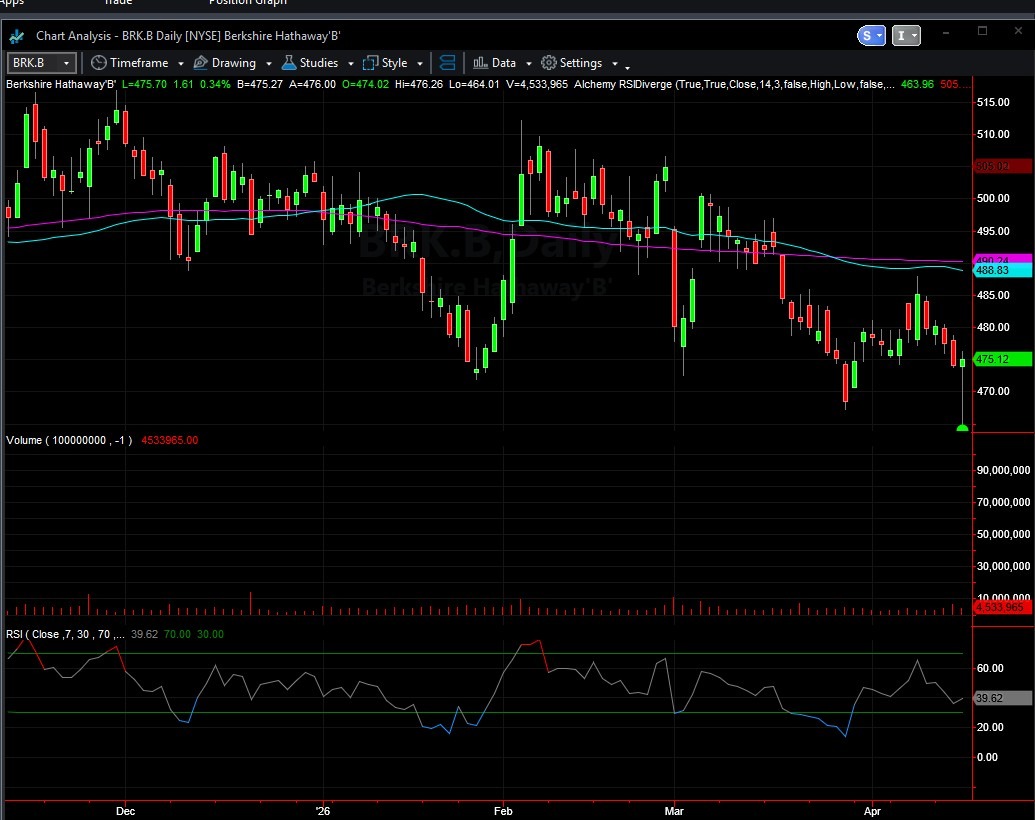
With legendary Warren Buffett stepping down, investors are despondent, reflected in BRK B’s flat performance over the last two weeks despite the overall market’s sharp 12% rise. THIS IS ABOUT TO CHANGE.
I rely on proprietary technical indicators, but the most reliable is RSI relative strength divergence,which I explain in my book, The Investment Survival Guide, and on my blog, insomniachedge.com/blog. I bought Berkshire yesterday for both the hedge fund I manage and my personal account. Last night, I discovered it flashed a bullish RSI divergence signal—by far the most important and reliable chart pattern.
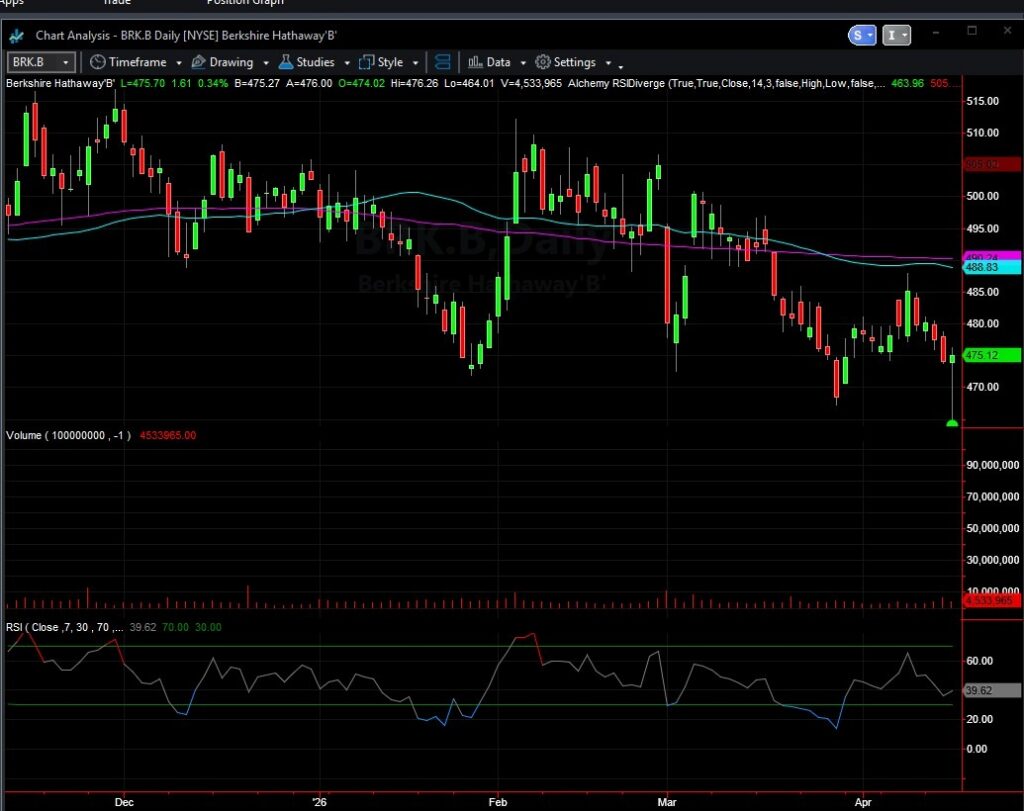
Pro tip: Comparing Berkshire’s recent horizontal closing prices with the corresponding, upward-sloping RSI valleys reveals a bullish divergence, strongly signaling an imminent price increase.
Now for the fundamentals- what we know.
Berkshire is resuming buybacks. In 2025, buybacks stopped entirely as cash exceeded $300 billion, and Buffett felt the stock wasn’t “meaningfully” undervalued. New CEO Greg Abel restarted them in March 2026. How do Berkshire’s businesses and holdings fare under the current administration and cycles?
GEICO: Largest private contributor ($45.2B, 12.2% of total). Lower gas prices mean more driving, more drivers, and a potentially better rate environment. Already a market leader.
Berkshire Hathaway Reinsurance: Contributed ~$24.5B in premiums. In April 2026, Berkshire Hathaway was named a key private-sector partner in the U.S. government’s expanded DFC reinsurance guarantees ($40B) to stabilize maritime trade in the Straits of Hormuz.
The Manufacturing Group (~20.3% of Berkshire Hathaway, or $75.4B) is a key focus due to the investment theme of the Trump administration’s economic onshoring of vital industries (semiconductors, pharmaceuticals, energy). This second-largest revenue driver includes major private industrial companies like Precision Castparts, Lubrizol, Marmon, and IMC (Iscar).
McLane Company: ~14.8% ($55.0B). Acceleration in GDP is the only obvious beneficiary. McLane is a huge wholesale distributor for grocery stores and restaurants (like Walmart and 7-Eleven), generating massive revenue despite very thin margins.
Berkshire Hathaway Energy (BHE): ($27.9B). A massive utility and energy holding company (including PacifiCorp, MidAmerican Energy, and NV Energy). Poised to greatly benefit from the AI infrastructure energy demand.
BNSF Railway: ~6.4% ($23.8B). A key beneficiary of U.S. reindustrialization and the booming domestic oil industry. As a major North American freight rail network, 2025 revenue was flat due to a focus on “precision railroading” and efficiency over volume.
Service and Retailing Groups: ~5.4% ($20.1B). No obvious direct beneficiary other than general GDP growth. Includes private brands like NetJets, Dairy Queen, See’s Candies, and FlightSafety International.
Berkshire Hathaway’s intrinsic value proposition is currently being significantly underestimated by the market. Despite a recent market rally, the valuation of Berkshire Hathaway’s Class A and Class B shares does not appear to fully reflect the considerable appreciation within its massive stock portfolio, which was valued at approximately $320 billion as of early 2026. This disconnect between market price and underlying asset value suggests a notable undervaluation.
The primary factor contributing to this perceived market apathy is likely Berkshire’s colossal cash position. The company holds an estimated $371 billion in cash and short-term U.S. Treasury Bills. This extraordinary sum is roughly triple the cash reserves held by technology behemoths like Alphabet or Amazon. The consensus worry is that this massive cash pile, while offering unparalleled financial stability, acts as a “drag” on overall performance and returns, given the low yield on cash equivalents compared to operating businesses or equity investments.
To put the magnitude of this cash hoard into perspective: $371 billion alone exceeds the total market capitalization of roughly 90% of the companies listed in the S&P 500 index. More critically, this enormous sum provides the company with an unprecedented, immediately deployable war chest. It is more than enough capital to fund what would be a historic and value-accretive stock buyback program, a move that would immediately signal to the market that management views the stock as deeply undervalued and could significantly reduce the outstanding share count, boosting earnings per share.
This fundamental undervaluation, combined with the technical indicator of a bullish RSI divergence mentioned elsewhere, strongly suggests that Berkshire Hathaway is presenting a major buy signal. The divergence indicates that while the stock price has been declining or consolidating, the underlying momentum (as measured by the Relative Strength Index) has been improving, often a precursor to a significant price rally. The combination of strong underlying fundamentals (the value of the operating businesses, the stock portfolio, and the cash) and a compelling technical signal paints a decidedly bullish picture for the company’s future stock performance.