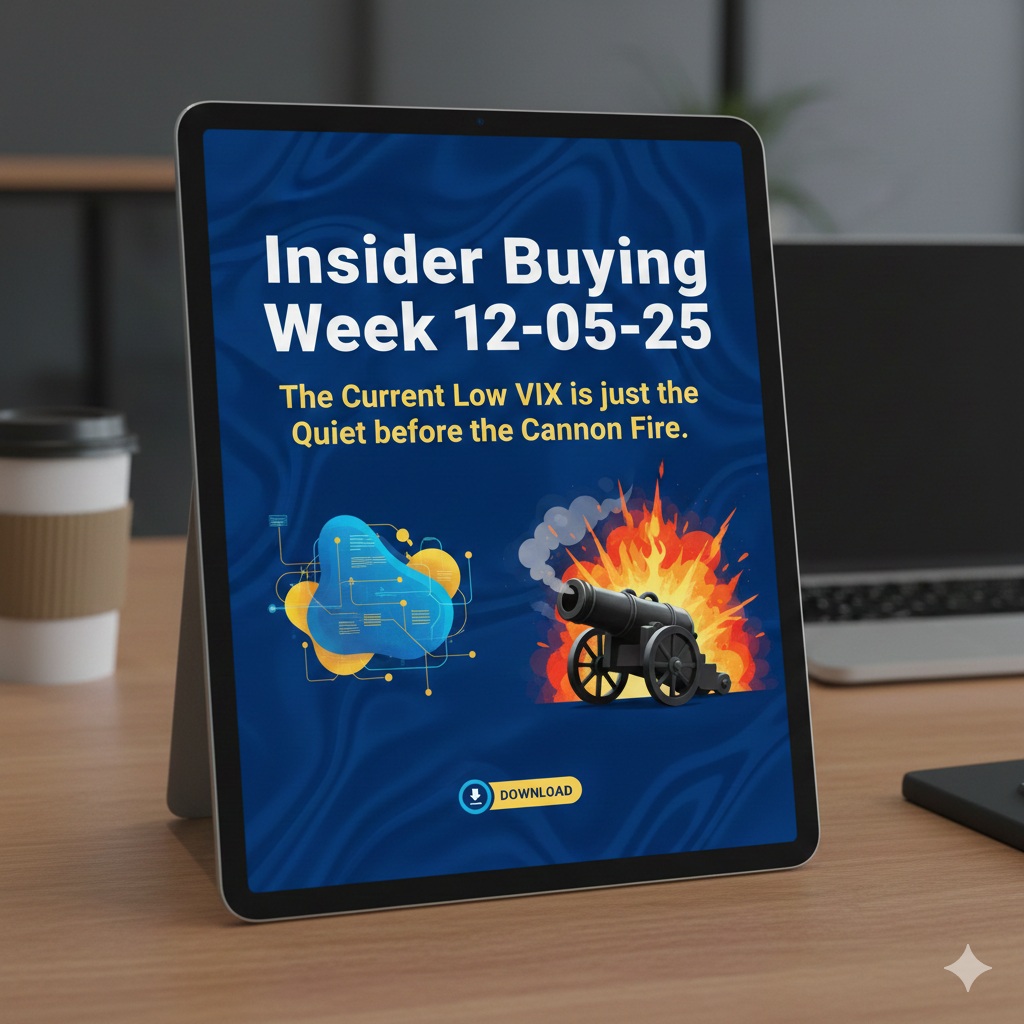
The market sustained its upward trend, advancing by 0.44%. The Nasdaq Composite demonstrated stronger performance, rising by 0.91%. The previous volatility spike in November appears distant, as the VIX has reached historic lows. While portfolio insurance may seem cost-effective in this environment, it is important to consider the current context. Insurance never looks cheap when you need it and when it is cheap, you rarely need it. Thus the goldilocks moment we are in.
Insider purchases, which often serve as confidence indicators, are unavailable during the blackout period, which occurs at the end of each quarter before required filings are made. During this time, most quarterly filers restrict their officers and directors from trading company shares, except through legislative loopholes like 10b5-1 corporate exemptions.
The low volatility environment is a tightly coiled spring. It doesn’t unwind gently; it explodes. The change will come when one of the established narratives—which the VIX is currently pricing in as gospel—is violently invalidated.
Here are the three primary forces that will change this market dynamic and bring true, broad-based volatility back to the indices:
1. The Fed’s Pivot Failure (The Macro Shock)
The market is currently priced for perfection: inflation is cooling, the economy avoids recession (the ‘soft landing’), and the Fed will cut rates soon. This is a fragile house of cards built on expectations.
- The Trigger: An unexpected return of persistent inflation (e.g., oil spikes, wages accelerate again) that forces the Fed to reverse course, maintain higher rates for longer, or, worse, hike again.
- The Impact: As per basic interest-rate risk (and you should know this), if rates go up, the value of fixed-income instruments goes down. But more broadly, higher rates for longer crush growth valuations, particularly the high-flying tech stocks that are currently supporting the index.
- The Market Reaction: The narrative of the soft landing collapses. The market will instantly price in a hard landing, and the VIX will spike violently, reflecting the sudden realization that the cost of capital is not coming down to save the day.
2. The Structural Failure (The Concentration Crack)
The biggest lie the VIX tells is that the market is healthy. It’s not. It’s dependent on the performance of a handful of mega-cap tech stocks. If these giants falter, the entire index structure cracks.
- The Trigger: A significant, synchronized failure among the top 5-7 market capitalization companies. This could be due to unexpected regulatory action (anti-trust), a major earnings miss driven by a slowdown in cloud spending, or a sudden technological displacement.
- The Impact: When these titans drop, the index cannot be saved by smaller stocks. Index-tracking funds and ETFs are forced to sell, creating a powerful feedback loop.
- The Market Reaction: This is the quickest way to see a 10-15% correction in the S&P 500. The low-volatility illusion vanishes the second the market realizes its foundation is built on seven stocks that suddenly look vulnerable.
3. The Earnings Recession Wake-Up (The Fundamental Reset)
Right now, the market is forward-looking, anticipating strong growth recovery. But what if the “soft landing” is just a delayed, messy downturn?
- The Trigger: Corporate earnings reports that definitively show margin compression and demand destruction persisting far longer than expected. We need to see guidance slashed across multiple sectors simultaneously, not just isolated incidents.
- The Impact: This is the catalyst that forces the street to downgrade their outlooks en masse. An analyst with clout (the “axe”) changing their sector opinion can severely impact price, especially when the opinion confirms a hidden fear.
- The Market Reaction: This forces a fundamental revaluation of the market. The high support levels that everyone thought were solid suddenly become the new resistance levels, as the relationship between supply and demand is fundamentally altered. You’ll see major technical breakdowns as traders realize the underlying business is not sound.
Insomniac Hedgehog Guy says:
You cannot predict the when, but you must prepare for the what.
- Stop Trading the Index: If you are long volatility, you are betting on one of these three macro shocks. That’s a low-probability, high-payoff bet.
- Focus on Stock-Specific Defense: Identify the stocks you own where a 20% earnings miss would fundamentally change the bull thesis. These are your weakest links.
- Hedge the Concentration Risk: If you believe the structural failure is the most likely catalyst, you need defensive positions or hedges against the largest components of the index.
The change is coming. The current low VIX is just the quiet before the cannon fire. Be ready to trade the chaos, not be consumed by it.
Name: Paul M. Todd
Position: Chief Financial Officer
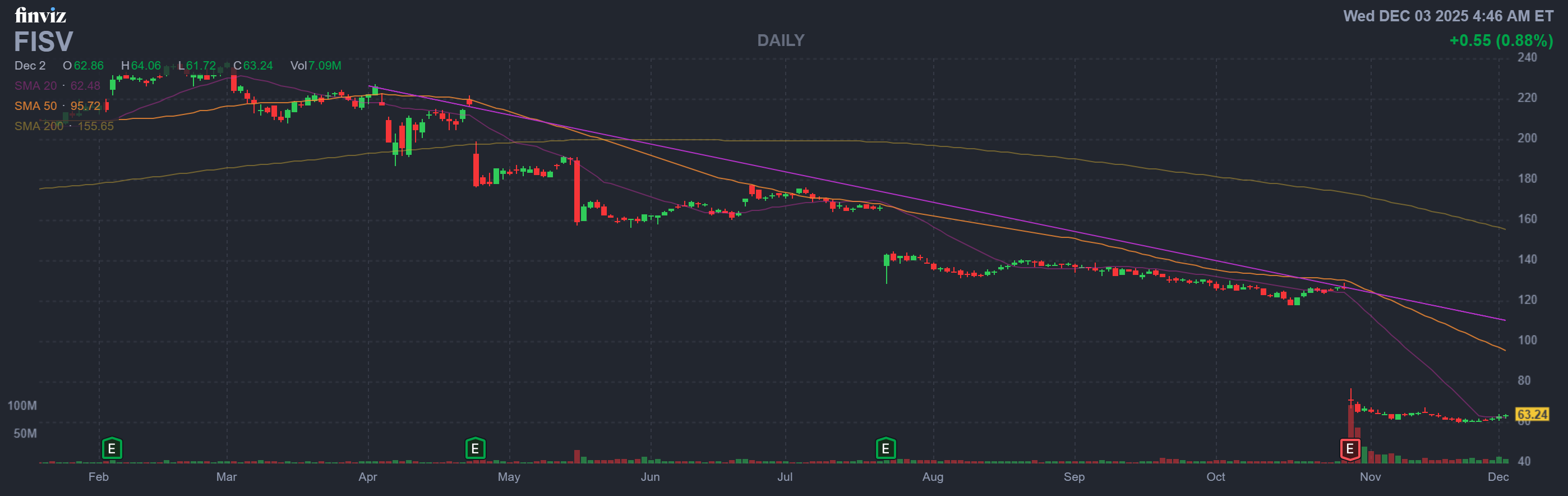
Transaction Date: 12-01-2025 Shares Bought: 17,000 shares an Average Price Paid of $62.41 for Cost: $1,060,970
Company: Fiserv Inc. (FISV)
Fiserv, Inc. is a prominent global provider of payments and financial technology solutions that is publicly traded on the New York Stock Exchange and a member of the S&P 500 Index. Retailers, banks, credit unions, financial institutions, corporations, and government agencies are among the company’s global clients. Fiserv offers cutting-edge solutions in digital banking, account processing, card issuance, network services, payments, e-commerce, and merchant acquisition, such as the Clover cloud-based point-of-sale and business management platform. Its products and services are important to clients’ operations, and they are offered by regional teams throughout North America, Europe, the Middle East, Africa, Latin America, and the Asia Pacific.
Paul M. Todd has been appointed Fiserv’s Chief Financial Officer, starting October 31, 2025. Before joining Fiserv, he was CFO of Global Payments from 2019 to 2022, and CFO of TSYS for around five years. Between both positions, he worked as a partner at TTV Capital, where he focused on early-stage fintech investments. He has a bachelor’s degree from the University of Memphis and an MBA from Vanderbilt University.
Insomniac Hedge Fund Guy Opinion:
Fiserv remains a heavyweight in the payments-infrastructure world — deep tentacles into banks, retailers, and the rails of commerce. Its recurring processing-based revenue and historically strong cash flow generation gave it the air of a blue-chip fintech stalwart. But the 2025 reset — poor Q3, brutal guidance cut, and a board shake-up — just reminded the street how fragile even dominant platforms can be when growth slows and execution slips.
The recent insider buying — by execs and board members — smells like a classic “buy-the-dip” play: they’re likely signaling they think the worst is priced in, and that the new management’s “One Fiserv” turnaround will eventually restore margins and growth. Still, my back-of-the-envelope DCF suggests only modest upside from current levels, and that hinges heavily on no further slide in volume or macro disruption.
This is now not a high-growth fintech rocket — it’s a deeply discounted cash flow generator with structural baggage. For a value-oriented investor willing to endure some volatility and execution risk, Fiserv might be an opportunistic hold. For anything expecting re-acceleration or “growth-style” returns — you’re chasing ghosts.
Name: Donal L. Mulligan
Position: Director
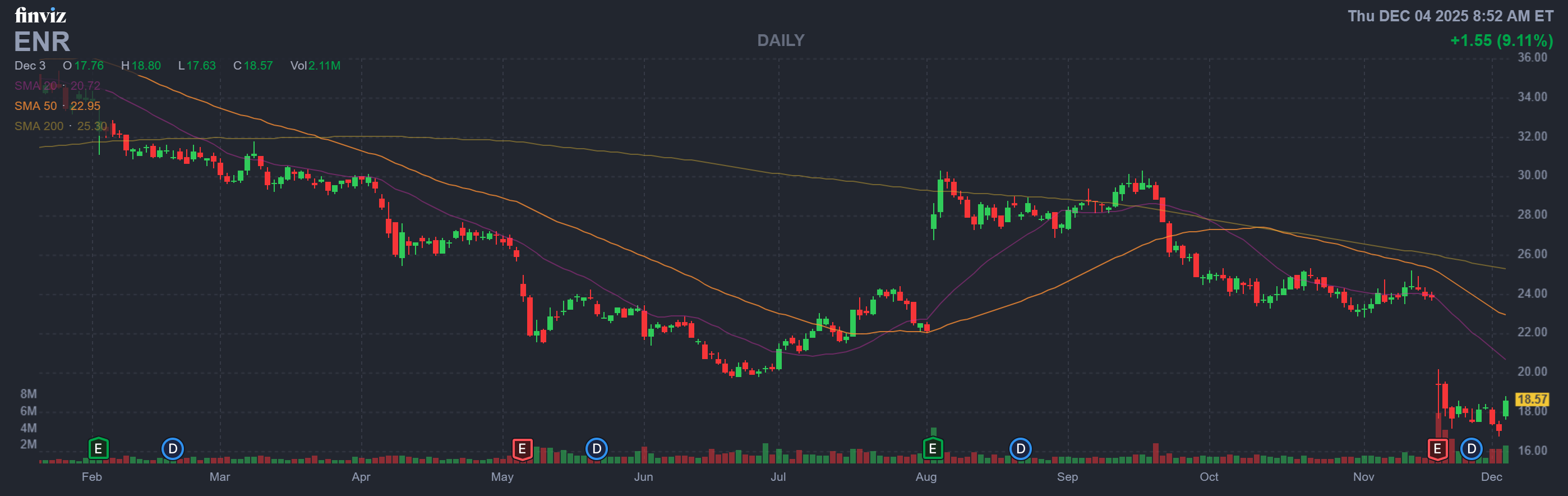
Transaction Date: 12-02-2025 Shares Bought: 15,000 shares an Average Price Paid of $17.40 for Cost: $261,000
Name: Mark Stephen LaVigne
Position: President and CEO
Transaction Date: 12-02-2025 Shares Bought: 10,000 shares an Average Price Paid of $17.11 for Cost: $171,100
Company: Energizer Holdings Inc. (ENR)
Energizer Holdings, Inc., founded in 2015 and headquartered in Saint Louis, Missouri, manufactures, sells, and distributes a wide range of household and specialty batteries, as well as lighting products globally. Its offerings include lithium, alkaline, carbon zinc, nickel metal hydride, zinc air, and silver oxide batteries under the Energizer, Eveready, and Rayovac brands. The company also provides primary, rechargeable, specialty, and hearing aid batteries, along with handheld lights, headlights, lanterns, area lights, and flashlights under brands such as Hard Case, Dolphin, and WeatherReady. In addition, Energizer licenses its Energizer, Rayovac, and Eveready brands to manufacturers of consumer products like solar batteries, car batteries, portable power devices, generators, power tools, household light bulbs, and other lighting solutions.
Donal L. Mulligan has served on the Board of Directors of Energizer Holdings Inc. since 2021. He brings extensive financial expertise and leadership experience, having previously held the roles of Executive Vice President and Chief Financial Officer at General Mills, where he worked from 2001 until his retirement. Prior to General Mills, Mulligan held senior financial and operational positions at Pillsbury, PepsiCo, and YUM! Brands. He is a member of Energizer’s Audit Committee and the Finance and Oversight Committee, contributing deep experience in global expansion, capital structure, and risk management. Mulligan also serves on the boards of Tennant Company and Herbalife Nutrition Limited. He holds a bachelor’s degree in accounting from the University of Notre Dame and an MBA from the University of Michigan’s Ross School of Business.
Mark is the President and CEO of Energizer Holdings, a role he has held since January 2021. He has been with the company since 2010, serving in multiple senior leadership positions, including President and Chief Operating Officer from 2015 to 2021, Vice President, General Counsel, and Corporate Secretary, and Vice President, Assistant General Counsel, and Corporate Secretary. Before joining Energizer, he was a partner at Bryan Cave Leighton Paisner from 2007 to 2010, after starting there in 1998, focusing on business and transactional counseling as well as mergers and acquisitions. He holds a bachelor’s degree from the University of Notre Dame and a law degree from St. Louis University.
Insomniac Hedge Fund Guy Opinion: Energizer is no sexy tech-story — it’s a stodgy, commodity-style consumer-goods name selling batteries and auto-care kits. But that very mundanity creates a quasi-“turnaround value trap”: margins are thin, growth is glacial, and demand is fickle. All that said, the stock today trades like a dying brand, while insiders are quietly buying, and the business still generates real cash. If management pulls off cost-savings and the APS acquisition begins to pay off — you get a cash-flow stallion trading at trough valuations. My rough DCF pegs value at US$26–32/share; if macro and demand don’t crater, that’s a serious margin of safety relative to current ~US$18–19.
Name: Douglas I. Ostrover
Position: Co-Chief Executive Officer
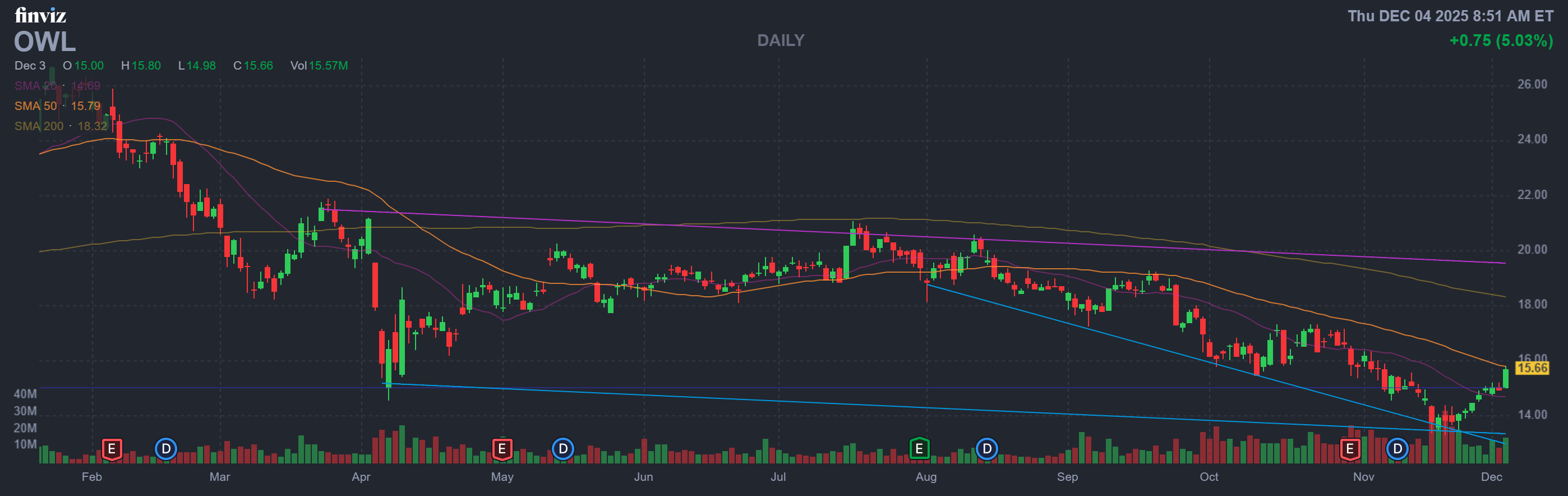
Transaction Date: 12-01-2025 Shares Bought: 158,000 shares an Average Price Paid of $15.06 for Cost: $2,379,469
Name: Marc S. Lipschultz
Position: Co-Chief Executive Officer
Transaction Date: 12-01-2025 Shares Bought: 158,000 shares an Average Price Paid of $15.06 for Cost: $2,379,469
Name: Craig Packer
Position: Co-President
Transaction Date: 12-01-2025 Shares Bought: 125,000 shares an Average Price Paid of $15.06 for Cost: $1,882,492
Name: Alan Kirshenbaum
Position: Chief Financial Officer
Transaction Date: 12-01-2025 Shares Bought: 33,670 shares an Average Price Paid of $14.87 for Cost: $500,808
Company: Blue Owl Capital Inc. (OWL)
Blue Owl is a worldwide alternative asset manager founded on Permanent money that deploys private money across Credit, GP Strategic Capital, and Real Assets platforms for institutional and private wealth customers. The firm was formed in 2021 by the merger of Owl Rock and Dyal Capital, and it has continued to expand its capabilities through strategic acquisitions, broadening offerings across real estate finance, credit solutions, and equity investments, backed by a team of experienced investment professionals and a global workforce.
Douglas I. Ostrover became Co Chief Executive Officer and Chairman of the Board of Blue Owl Capital Inc in May 2021, the same time the company went public. He is a co founder of Owl Rock Capital Partners, the firm that later became the foundation of Blue Owl’s Credit platform. Prior to that, Ostrover played a key role in establishing GSO Capital Partners, which became the alternative lending arm of Blackstone Group. Earlier in his career, he held a senior leadership role in leveraged finance at Credit Suisse First Boston and advanced to serve as the global head of its Leveraged Finance Group until his departure in 2005. He holds a Bachelor’s degree in Economics from the University of Pennsylvania and an MBA from the New York University Stern School of Business.
Marc S. Lipschultz was appointed Co Chief Executive Officer of Blue Owl Capital Inc on May 12, 2023. He continues to serve on the firm’s board of directors and acts as Co Chief Investment Officer for its credit advisers. Prior to Blue Owl, Lipschultz co founded Owl Rock Capital Partners and spent more than 20 years at KKR & Co., where he served on the Management Committee and as Global Head of Energy and Infrastructure. He holds an A.B. with honors and distinction, Phi Beta Kappa, from Stanford University and an MBA with high distinction as a Baker Scholar from Harvard Business School.
Craig W. Packer has served as Co President of Blue Owl Capital Inc. since the company’s founding and public listing in May 2021. He is also a member of the firm’s board of directors, overseeing the Credit platform as Co Chief Investment Officer and acting as CEO of Blue Owl’s BDCs. Packer co founded the predecessor firm, Owl Rock Capital Partners. He holds a B.S. from the University of Virginia and an MBA from Harvard Business School.
Alan Kirshenbaum has been the Chief Financial Officer of Blue Owl Capital Inc. since the company’s founding in May 2021 and also serves as Co-Chair of its Operating Committee. He brings extensive experience in financial leadership within the investment industry, including prior CFO roles at Sixth Street Specialty Lending and TPG Special Situations Partners, along with early experience in public accounting. Kirshenbaum’s expertise spans treasury, operations management, and financial planning for investment platforms. He holds a Bachelor of Science from Rutgers University and an MBA from New York University’s Stern School of Business.
Insomniac Hedge Fund Guy Opinion: Blue Owl is a beast of scale in private markets, with a durable fee stream and diversified platform that many managers don’t have. The recent insider buying — right after a messy fund-merger reversal and price drop — reeks of confidence and opportunistic value play. That said, GAAP profitability is shaky, cost pressure is real, and the business depends heavily on continued asset-raising and favorable credit cycles. If you believe alternative-asset allocation keeps accelerating and private credit stays healthy, OWL could deliver solid upside. But it’s not a “safe” value play — think of it as a leveraged bet on the alternative-asset wave. For a value-minded investor, the current valuation offers a modest margin of safety against a bullish long-term base case.
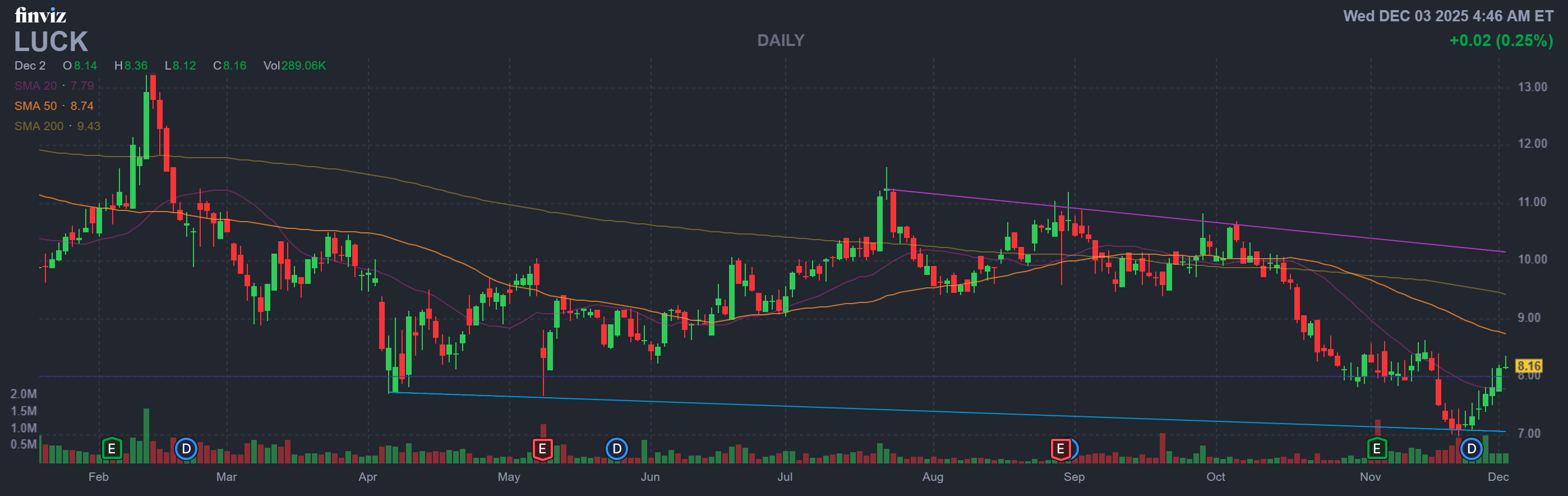
Name: Richard Meynard Born
Position: Director
Transaction Date: 11-28-2025 Shares Bought: 60,000 shares an Average Price Paid of $8.09 for Cost: $485,472
Company: Lucky Strike Entertainment Corp. (LUCK)
Lucky Strike Entertainment Corporation is a leading operator of location-based entertainment venues, with over 360 locations in North America. The company offers a range of recreational activities, including bowling, amusement parks, water parks, and family entertainment centers. Its portfolio comprises both classic bowling centers and luxury entertainment concepts with lounge seating, arcades, expanded food and beverage options, and exceptional customer service for individuals and groups. Lucky Strike also organizes and runs professional and amateur bowling competitions, as well as other broadcasting operations.
Richard Meynard Born joined Lucky Strike Entertainment as a director on June 23, 2025. He has over 35 years of expertise in hospitality-focused real estate development and management, most notably as a co-founder of BD Hotels, which manages a vast portfolio of hotels and buildings in important countries. In his new role at Lucky Strike, he serves as a member of the Nominating and Corporate Governance Committee, which helps shape the company’s governance and strategic oversight. Mr. Born graduated from the New York University School of Medicine.
Insomniac Hedge Fund Guy Opinion: Lucky Strike Entertainment is a high-stakes roll on scale and leverage. Their pivot from pure bowling alleys to broad entertainment venues gives hint of ambition — but at heart it’s a cyclical leisure play, heavily dependent on consumers’ willingness to spend. The current valuation leaves precious little margin of safety: they trade at a price that assumes disciplined debt servicing, stable same-store demand, and smooth execution of re-branding/expansion. I’m skeptical. If macro conditions sag — or if incremental costs (interest, capex, labor) bite — LUCK’s cash flow could crater, and equity could get crushed. Management’s recent insider buy and buyback are interesting, but size is small — likely a “we think it’s cheap” nod, not conviction in a flawless turnaround. As a speculative leisure-brick speculation, it’s a “maybe for gamblers,” but not something a value-oriented, risk-aware veteran should pony up major capital for. Buyer beware — treat LUCK as a high-volatility punt, not a durable compounder.
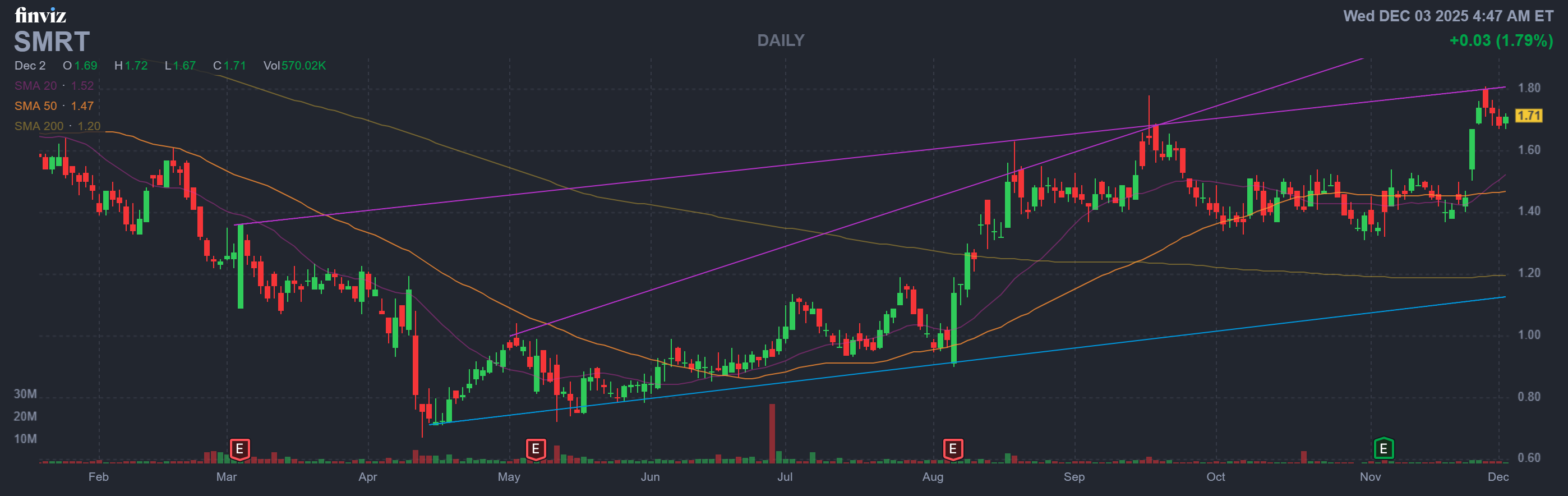
Name: Martell Frank
Position: Chief Executive Officer
Transaction Date: 12-01-2025 Shares Bought: 47,278 shares an Average Price Paid of $1.69 for Cost: $79,934
Company: SmartRent Inc. (SMRT)
SmartRent, Inc. is an enterprise real estate technology firm that offers software and smart building solutions to rental property owners, operators, property managers, homebuilders, developers, and inhabitants in the United States and throughout the world. Its cloud-based platform and smart devices are intended to improve visibility, security, and control across real estate assets while providing inhabitants with a unified, all-in-one smart home experience. SmartRent’s offerings include smart apartments and houses, building and unit access control, community and resident Wi-Fi, asset protection and monitoring, parking management, and self-guided tour capabilities. The company also offers professional services, including installation, training, and continuing support. SmartRent was founded in 2017, and its headquarters are in Scottsdale, Arizona.
Frank Martell is the President & CEO of SmartRent. He was appointed to that position on June 16, 2025. Before becoming CEO, he joined SmartRent’s Board of Directors in June 2024 and sat on both the Audit Committee and the Nominating and Corporate Governance Committee. He has over 30 years of leadership experience in real estate services, data analytics, and technology-driven enterprises. His previous responsibilities include CEO of loanDepot, Inc., and executive leadership at CoreLogic, Inc., where he held top positions such as CFO, COO, and later CEO. Martell has a Bachelor of Science in Accounting from Villanova University’s School of Business, which informs his financial and strategic leadership style.
Insomniac Hedge Fund Guy Opinion:
SmartRent sits at a dangerous but potentially lucrative inflection. The shift from hardware-heavy sales toward a recurring-revenue, SaaS-first model — paired with cost cuts — has steadied the ship and somewhat de-risks the earnings profile. Their 870,000-unit base, retention above 99.9%, and net revenue retention over 100% give real credence to the claim: once hardware fades, a sticky, cash-generating SaaS subscription stream could form a durable competitive moat.
That said — the company is not there yet. Losses remain, revenue has contracted, and hardware remains a crutch. Execution must be clean. The rumour of insider buying might reflect confidence, but I need verified filings before giving that weight. If they hit cash-flow neutrality and prove SaaS can scale while maintaining margins, SmartRent could double from here. But until then, it’s a high-risk, high-reward swing — only for players comfortable with volatility and uncertainty.
This blog is solely for educational purposes and the author’s own amusement. IT IS NOT INVESTMENT ADVICE. Think of the blog as part of my personal investment journal that I am willing to share with the DIY investor. There are also many parts that I am not willing to share if I think it could influence trading action or be detrimental to the Fund’s partners. We could be long, short, or have no position at all in any of the stocks mentioned and express no written or implied obligation to disclose any of that. Nothing contained here constitutes a recommendation to buy or sell any security. Investing involves risk, including the possible loss of principal, and past performance is not indicative of future results.
“The insomniac hedge fund guy” is a moniker Harvey Sax, the portfolio manager for The Insiders Fund” has used from time to time on email, blog ,and social media posts. While Mr. Sax is the portfolio manager of The Insiders Fund, these posts are not communications from, nor endorsed by, Alpha Wealth Funds, LLC or any of its managed funds. References to Alpha Wealth Funds or its affiliates are for identification only and do not imply sponsorship or approval.
The Insiders Fund and its blogs and posts are not affiliated with, endorsed by, or sponsored by any of the companies mentioned herein. All company names, logos, and trademarks belong to their respective owners. The use of company logos is solely for descriptive and illustrative purposes under fair use. Any information provided is based on publicly available data and should not be considered financial, investment, or legal advice. Readers should conduct their own research or consult with a professional before making any investment decisions. Insiders sell the stock for many reasons, but they generally buy for just one – to make money. You’ve always heard the best information is inside information. Everyone with any stock market experience pays close attention to what insiders are doing. After all, who knows a business better than the people running it? Officers, directors, and 10% owners are required to inform the public through a Form 4 Filing of any transaction, buy, sell, exercise, or any other within 48 hours of doing so.
This info is available for free from the SEC’s Web site, Edgar, although we subscribe to SECForm4 as they provide a way to manage and make sense of the vast realms of data. I’ve tried a lot of vendors. SECForm4 is one of the smaller ones, but I like supporting Frank. He is not arrogant. He’s helpful and has great prices. He also trades on his own data, so I like people that eat what they kill. The bar is different from selling because the natural state of management is to be a seller. This is because most companies provide significant amounts of management compensation packages as stock and options. Therefore, we analyze unusual patterns with selling, such as insiders selling 25 percent or more of their holdings or multiple insiders selling near 52-week lows. Another red flag is large planned sale programs that start without warning. Unfortunately, the public information disclosure requirements about these programs, referred to as Rule 10b5-1, are horrendously poor. Also, planned sales that pop up out of nowhere are basically sales and are seeking cover under this corporate welfare loophole.
I also generally ignore 10 percent shareholders as they tend to be OPM (other people’s money) and perhaps not the smart money on which we are trying to read the tea leaves. I say generally because some 10% shareholders are great investor, think Warren Buffett and others. Of course, insiders can also be wrong about their Company’s prospects. Don’t let anyone fool you into believing they never make mistakes. Do your own analysis. They can easily be wrong, and in many cases, maybe most cases, have no more idea what the future may hold than you or me. In short, you can lose money following them. We have, and we curse aloud; what were they thinking!
We like Fly on the Wall for keeping up with what events might be happening, analysts’ comments, and whatever else could be moving the stock. Dow Jones news service is an essential tool, but many services pick up their feed like they do Bloomberg. She probes the 10k for a reasonable description of the business. I’ve found that to be the most accurate and succinct place to find out what a business actually does. When I have time, over the weekend, I’ll add some preliminary analysis to the Opinion at the end. It is largely done now by my AI. Sometimes I won’t update this for a couple of weeks or more. A good way to use this blog is as I do, it’s a reference point and filing cabinet for various stocks with notable insider buying. It’s one of many tools I use.