Insiders continue to sit on the sidelines as this market remains in a state of flux. Whether this inactivity is due to the traditional quarterly earnings blackout or something more nefarious remains a matter of speculation. Last week, the S&P 500 fell 0.47% and the Nasdaq Composite dropped 0.71%, while the equal-weighted index diverged with a healthy 1.14% gain.
It is easy to make a bearish case for staying out of the market. The primary engine of growth—the AI infrastructure buildout—is beginning to sputter, and credit spreads on the massive data center debt binge are widening. Bubble comparisons are growing louder by the day. Meanwhile, rising oil prices and diesel costs are reaching a breaking point for long-haul trucking; these transportation expenses will inevitably impact the price of nearly everything we consume.
Furthermore, the conflict with Iran confirms my long-held conviction that cheap hydrocarbon supplies from the Middle East are not dependable. Political consensus is scarce, as neither the MAGA Republican base nor Democrats appear to approve of the current trajectory. It is likely that after the midterms, Congress will have the votes to shut off funding for the war. However, by that time, we may have already reengaged in major hostilities to force Iran to the bargaining table. While I am hopeful that strategy will succeed, hope is not a sound investment strategy. We must consider the alternative: if those efforts fail, widespread damage to oil and gas infrastructure in the region could keep the price of oil and its byproducts elevated for much longer than anticipated.
Next week’s conversation will center on the Federal Reserve and their upcoming meeting. Polymarket data indicates a 93% to 94% probability that the FOMC will hold interest rates steady during their October 28–29 gathering. We will likely hear the same familiar rhetoric regarding the long, variable lags of monetary policy and the inflationary—yet supposedly transitory—impact of rising energy prices. Chairman Walsh remains one of the few figures who has successfully navigated the political pressure from Trump; he is positioned to maintain his tenure and appears determined to raise rates to solidify his inflation-fighting credentials, regardless of the political fallout.
The Federal Reserve combats inflation by squeezing consumers through higher rates. It is a bitter pill, but the logic remains that short-term pain prevents greater instability later—a theory always accompanied by that classic refrain about the uncertain lag of monetary policy.
When you factor in midterm uncertainties and the potential for a budget freeze, I have to ask: why would insiders buy into this market right now? In truth, there is no compelling evidence to support it. While the broader market—represented by the equal-weighted RSP index—saw a decent gain last week, suggesting a potential rotation, the insider buying data simply doesn’t back that narrative yet. If Warren Buffett were weighing in today, he might caution against underestimating the resilience of the American economy. However, my take is that the younger generation, having never experienced a true bear market, is driving the current activity with a vengeance. For now, it seems there are still plenty of gamblers left in the casino.
Important marketing announcement: If you want to quickly gain insight into how analysts are reacting to the deluge of upcoming quarterly earnings webcasts, there is no better tool than Veru’s 365 Attaboy strategy. This method is exceptionally effective for evaluating analyst sentiment during this critical period. For a limited time, Attaboy is available at no additional cost with your subscription to The Insomniac Hedge Fund Guy. I encourage you to explore this opportunity, as similar market intelligence if available at all is typically offered by premium services at a significant cost.
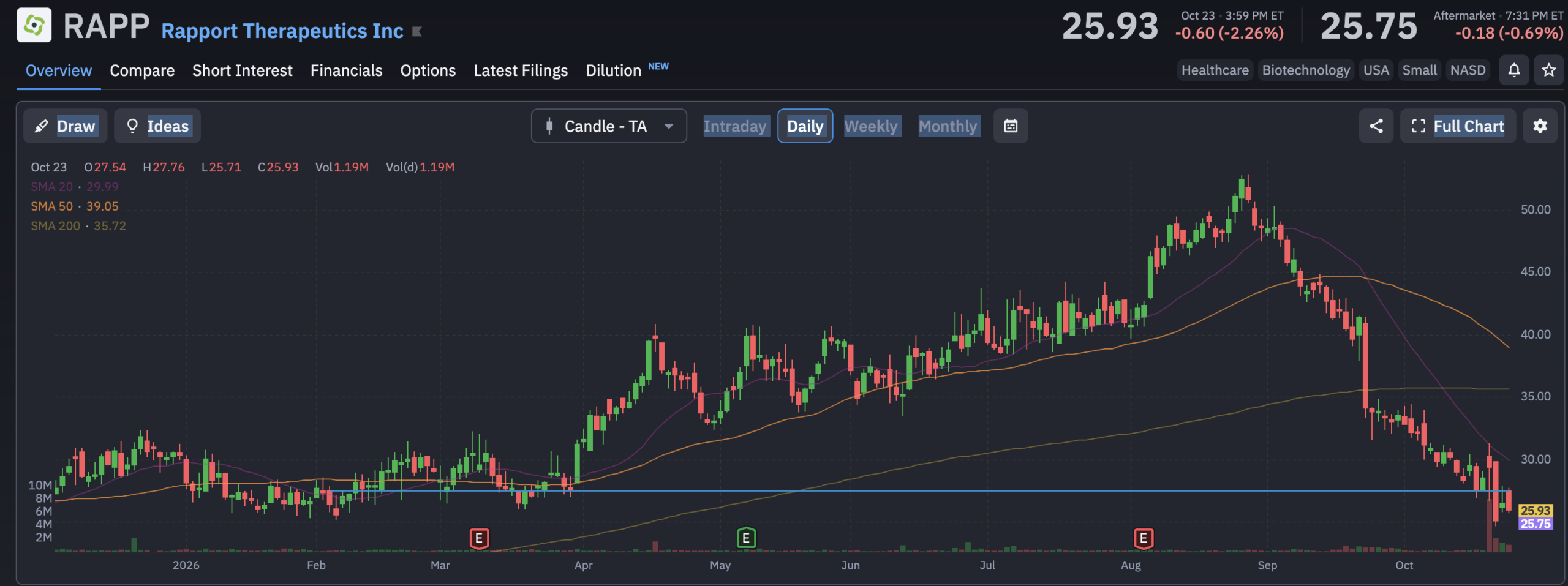
Name: Robert C. Pohlad
Position: Director
Transaction Date: 10-22-2026 Shares Bought: 35,714 shares an average price paid of $27.28 for Cost: $974,278
Robert C. Pohlad is a prominent business executive and investor serving on the Board of Directors of Rapport Therapeutics, a clinical-stage biopharmaceutical company focused on central nervous system disorders.
Beyond Rapport, Pohlad is best known as the President of Pohlad Holdings, where he oversees diverse family-owned enterprises spanning commercial real estate, investments, and the Minnesota Twins Major League Baseball team. He also serves on the board of PepsiCo, having previously led PepsiAmericas as Chairman and CEO. In his governance role at Rapport Therapeutics, he contributes extensive corporate leadership and capital allocation experience.
Name: John Maraganore
Position: Director
Transaction Date: 10-22-2026 Shares Bought: 9411 shares an average price paid of $26.45 for Cost: $$248,891
John Maraganore is a prominent biotechnology leader and executive who serves on the Board of Directors of Rapport Therapeutics.
He is best known as the founding CEO of Alnylam Pharmaceuticals, where he led the company for nearly two decades from its inception to pioneering the commercialization of RNA interference (RNAi) therapeutics. Currently, Maraganore operates as an active biotech advisor, venture partner, and board member across several innovative life sciences companies, helping guide early-stage drug developers through clinical and strategic milestones. At Rapport, his extensive industry expertise and governance experience support the company’s advancement of precision neuroscience medicines.
Company: Rapport Therapeutics
Rapport Therapeutics is a clinical-stage biopharmaceutical company, meaning it has no approved drugs on the market yet and burns cash funding trials in hopes of eventually selling something. Its lead candidate is RAP-219, a precision-targeted therapy going after a receptor subtype implicated in neurological and psychiatric disease. The pipeline currently spans two big indications: focal onset seizures (epilepsy) and, as of this month, bipolar mania. This is a binary, catalyst-driven story, not a steady-eddy cash generator.
Insomniac Hedge Fund Guy Opinion:
This is a high-conviction, high-risk speculative biotech play, not a core holding. Perfect 10 score: +2.0 (constructive), driven by Strong Buy analyst sentiment, a bullish catalyst dimension, and a sector tailwind, offset by bearish cash flow. The Phase 2 bipolar data was a genuine win, the cash runway is a real strength, and the mechanism story has legs. But negative cash flow, zero revenue, and a binary Phase 3 readout ahead mean this trades on hope and data, not fundamentals. The case leans constructive-to-bullish on the evidence, but it’s a lottery ticket with good odds, not a sure thing, and that decision is one to make with a financial advisor, not off a stock report.
This is educational, not advice.
_______________________________________________________________________________________________________________________________
This blog is solely for educational purposes and the author’s own amusement. IT IS NOT INVESTMENT ADVICE. Think of the blog as part of my personal investment journal that I am willing to share with the DIY investor. We could be long, short, or have no position at all in any of the stocks mentioned and express no written or implied obligation to disclose any of that. Nothing contained here constitutes a recommendation to buy or sell any security. Investing involves risk, including the possible loss of principal, and past performance is not indicative of future results.
“The insomniac hedge fund guy” is a moniker Harvey Sax, the portfolio manager for The Insiders Fund” has used from time to time on email, blog ,and social media posts. While Mr. Sax is the portfolio manager of The Insiders Fund, these posts are not communications from, nor endorsed by, Alpha Wealth Funds, LLC or any of its managed funds. References to Alpha Wealth Funds or its affiliates are for identification only and do not imply sponsorship or approval.
All company names, logos, and trademarks belong to their respective owners. The use of company logos is solely for descriptive and illustrative purposes under fair use. Any information provided is based on publicly available data and should not be considered financial, investment, or legal advice. Readers should conduct their own research or consult with a professional before making any investment decisions. Insiders sell the stock for many reasons, but they generally buy for just one – to make money. You’ve always heard the best information is inside information. Everyone with any stock market experience pays close attention to what insiders are doing. After all, who knows a business better than the people running it? Officers, directors, and 10% owners are required to inform the public through a Form 4 Filing of any transaction, buy, sell, exercise, or any other within 48 hours of doing so.
This info is available for free from the SEC’s Web site, Edgar, although we subscribe to SECForm4 as they provide a way to manage and make sense of the vast realms of data. I’ve tried a lot of vendors. SECForm4 is one of the smaller ones, but I like supporting Frank. He is not arrogant. He’s helpful and has great prices. He also trades on his own data, so I like people that eat what they kill. The bar is different from selling because the natural state of management is to be a seller. This is because most companies provide significant amounts of management compensation packages as stock and options. Therefore, we analyze unusual patterns with selling, such as insiders selling 25 percent or more of their holdings or multiple insiders selling near 52-week lows. Another red flag is large planned sale programs that start without warning. Unfortunately, the public information disclosure requirements about these programs, referred to as Rule 10b5-1, are horrendously poor. Also, planned sales that pop up out of nowhere are basically sales and are seeking cover under this corporate welfare loophole.
I also generally ignore 10 percent shareholders as they tend to be OPM (other people’s money) and perhaps not the smart money on which we are trying to read the tea leaves. I say generally because some 10% shareholders are great investor, think Warren Buffett and others. Of course, insiders can also be wrong about their Company’s prospects. Don’t let anyone fool you into believing they never make mistakes. Do your own analysis. They can easily be wrong, and in many cases, maybe most cases, have no more idea what the future may hold than you or me. In short, you can lose money following them. We have, and we curse aloud; what were they thinking!
We like Fly on the Wall for keeping up with what events might be happening, analysts’ comments, and whatever else could be moving the stock. Dow Jones news service is an essential tool, but many services pick up their feed like they do Bloomberg. My assistant probes the 10k for a reasonable description of the business. I’ve found that to be the most accurate and succinct place to find out what a business actually does.
For more, please visit out website at https://insomniachedge.com/