I’ve lived to see many a market but none like this jumps to mind. Bull or bear, this is one that doesn’t look behind. Tomorrow will just be higher.
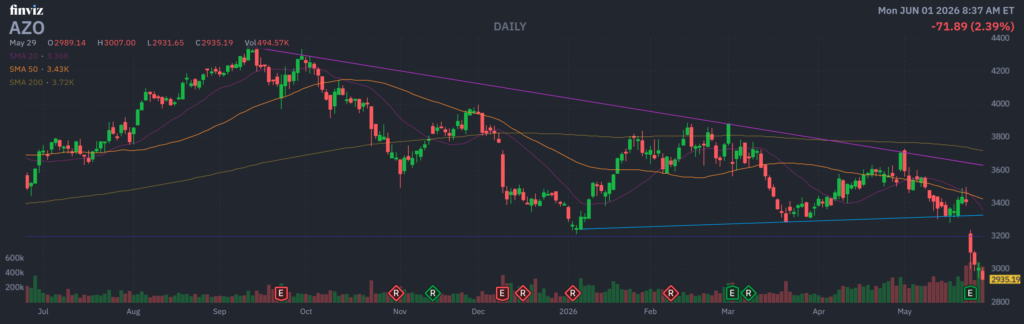
Name: Brian Hannasch
Position: Director
Transaction Date: 05-29-2026 Shares Bought: 165 shares an average price paid of $2,987.00 for Cost: $492,855
Company: Autozone Inc. (AZO)
AutoZone, Inc. is a retailer and distributor of automobile replacement parts and accessories in the United States, Mexico, and Brazil. The company sells new and remanufactured automotive hard parts, maintenance items, accessories, and non-automotive products for automobiles, SUVs, vans, and light trucks. It also sells air conditioner compressors, batteries, and accessories, bearings, belts, and hoses, calipers, chassis, clutches, CV axles, engines, fuel pumps, fuses, ignition and lighting supplies, mufflers, radiators, starters and alternators, thermostats, and water pumps, as well as tire repairs. AutoZone, Inc. was formed in 1979 and is based in Memphis, Tennessee.
Brian Hannasch has been a Director of AutoZone, Inc. since December 2023, when he was elected to the company’s Board of Directors. Hannasch is the former President and CEO of Alimentation Couche-Tard, where he served more than two decades after joining the firm in 2001, leading its growth into one of the world’s leading convenience store operators. He has vast experience in retail operations, merchandising, supply chain management, and international expansion strategies. Hannasch holds a bachelor’s degree in finance from Iowa State University.
Insomniac Hedge Fund Guy Opinion: AutoZone is one of the best operators in automotive aftermarket retail. The company sells replacement parts, accessories, and maintenance products through thousands of stores across the U.S., Mexico, and Brazil. Its core customers are both do-it-yourself consumers and professional repair shops.
The moat comes from scale, distribution, and availability. When a repair shop needs a part, it often needs it immediately. AutoZone’s extensive store network, inventory management, and rapid delivery capabilities make it difficult for smaller competitors to match its service levels. The aging vehicle fleet in the U.S. also provides a favorable long-term tailwind, as older cars require more maintenance and replacement parts.
Over the last five years, revenue has grown at a healthy mid-single-digit rate, driven by steady demand and market share gains. Unlike software companies, AutoZone has little recurring revenue in the traditional sense, but demand is highly repeatable because vehicles continuously require maintenance and repairs. Customer retention among professional repair shops remains strong due to convenience and reliability.
Management has historically been disciplined, focusing on operational efficiency, inventory productivity, and aggressive share repurchases. The company is well known for its ability to convert earnings into free cash flow and return substantial capital to shareholders.
Profitability remains a major strength. AutoZone consistently generates industry-leading returns on capital and strong operating margins. Earnings per share have grown faster than revenue for years, helped by both operating leverage and a shrinking share count.
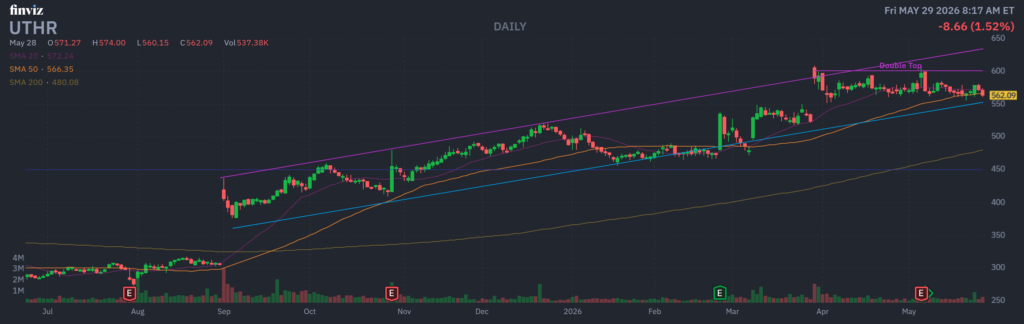
Name: Martine A. Rothblatt
Position: Chairperson & CEO
Transaction Date: 05-26-2026 Shares Bought: 1,500 shares an average price paid of $575.96 for Cost: $863,947
Company: United Therapeutics Corp (UTHR)
United Therapeutics Corporation is a biotechnology business that focuses on researching and commercializing treatments for chronic and life-threatening disorders, primarily pulmonary arterial hypertension (PAH). Tyvaso, Remodulin, Orenitram, Adcirca, and Unituxin are some of its most important products. The company is also developing novel regenerative medicine and xenotransplantation programs, such as gene-edited organs and organ manufacturing technology. United Therapeutics develops drug delivery technology in collaboration with MannKind Corporation and DEKA Research & Development Corp. The company was founded in 1996 and has its headquarters in Silver Spring, Maryland.
Martine A. Rothblatt has been Chairman and CEO of United Therapeutics Corp. since the company’s inception in 1996. Under her guidance, United Therapeutics has developed to become a major biotechnology business specializing on pulmonary hypertension medicines as well as organ manufacturing and transplantation technologies. Prior to creating United Therapeutics, Rothblatt developed Sirius Satellite Radio and worked extensively in satellite communications, biotechnology innovation, and healthcare advocacy. She holds a bachelor’s degree in communication studies from the University of California, Los Angeles, a J.D. from the UCLA School of Law, and an MBA from Pepperdine University.
Insomniac Hedge Fund Guy Opinion: United Therapeutics is one of the more unusual biotech success stories in the market. The company focuses primarily on treatments for pulmonary arterial hypertension (PAH), a rare but serious lung disease. Unlike most biotech firms chasing speculative pipelines, UTHR already generates substantial cash flow from a portfolio of approved therapies including Remodulin, Tyvaso, and Orenitram. Tyvaso, especially, has become the core growth engine as adoption expands into broader pulmonary disease indications.
The moat comes from specialization in rare disease markets, deep physician relationships, and complex drug-delivery systems that are not easy to replicate. The company also benefits from high barriers to entry due to regulatory expertise and limited competition in PAH therapies. Revenue growth over the past five years has been strong, largely driven by Tyvaso’s rapid expansion.
Recurring revenue is effectively very high because patients often remain on therapies for long periods, creating a durable treatment base. Net retention trends appear strong as existing patients stay on therapy while new indications bring incremental demand. Unlike many biotech companies, UTHR operates with real scale and impressive profitability. Gross margins are extremely high, and the business consistently generates significant free cash flow with minimal balance-sheet stress.
Management, led by founder Martine Rothblatt, is unconventional but highly ambitious. Beyond PAH drugs, the company is investing heavily in organ manufacturing and xenotransplantation technologies, which could become transformational long-term opportunities if successful.
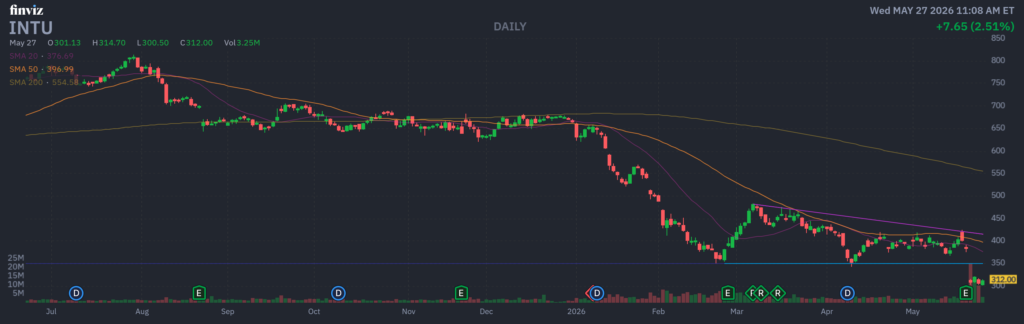
Name: Vasant M. Prabhu
Position: Director
Transaction Date: 05-22-2026 Shares Bought: 1,750 shares an average price paid of $309.52 for Cost: $541,665
Company: Intuit Inc. (INTU)
Intuit Inc. offers financial management, tax preparation, payment, marketing, and personal finance solutions to individuals, small businesses, and accountants. Its operations are divided into four segments: Global Business Solutions, Consumer, Credit Karma, and ProTax. QuickBooks, TurboTax, Mailchimp, Credit Karma, and ProConnect are among the company’s core products, which provide payroll, payment processing, tax filing, lending, marketing automation, and credit monitoring services. Intuit sells its goods through direct sales, mobile platforms, and partner channels. The company was founded in 1983, and its headquarters are in Mountain View, California.
Vasant M. Prabhu has been a Director of Intuit Inc. since January 2024, when he was appointed to the company’s Board of Directors. Prabhu formerly served as Vice Chairman and Chief Financial Officer of Visa Inc., where he oversaw the company’s global expansion, public market expansion, and digital payments strategy for nearly two decades. Prior to joining Visa, he held top finance and strategic leadership positions at NBCUniversal, Starwood Hotels & Resorts, and Safeway Inc. Prabhu holds a bachelor’s degree in commerce from St. Xavier’s College in Kolkata, India, and an MBA from the University of Chicago Booth School of Business.
Insomniac Hedge Fund Guy Opinion: Intuit is one of the best software franchises in small business and consumer finance. The company owns TurboTax, QuickBooks, Credit Karma, and Mailchimp, creating an ecosystem that touches tax filing, accounting, payroll, payments, and consumer credit. QuickBooks remains the crown jewel, deeply embedded in small business workflows across the U.S.
The moat is significant. Small businesses rarely switch accounting systems because migration is painful, employee retraining is costly, and financial data continuity matters. That creates strong customer retention and pricing power. Intuit has also built a network effect around accountants and bookkeepers who standardize on QuickBooks, reinforcing its dominance.
Over the last five years, revenue has compounded at roughly 12–14% annually, helped by acquisitions and continued cloud adoption. The business is heavily recurring, with subscription and services revenue accounting for roughly 80%+ of total revenue. QuickBooks Online and payroll products continue to grow faster than the broader company, while retention remains exceptionally strong. Net revenue retention is not fully disclosed but is believed to remain well above 100% in the online ecosystem due to cross-selling and price increases.
Management, led by CEO Sasan Goodarzi, has executed well on transitioning Intuit from desktop software into a cloud-based financial platform. The company has also aggressively integrated AI features across its ecosystem to automate bookkeeping, invoicing, and tax preparation.
Profitability remains elite. Intuit consistently generates operating margins above 25%, massive free cash flow, and strong EPS growth.
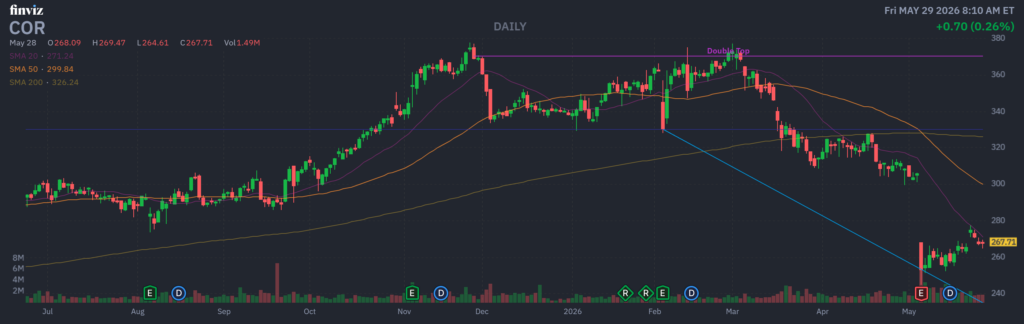
Name: Dermot Mark Durcan
Position: Director
Transaction Date: 05-28-2026 Shares Bought: 4,000 shares an average price paid of $266.26 for Cost: $1,065,040
Company: Cencora Inc. (COR)
Cencora, Inc. is a global pharmaceutical procurement and distribution corporation that serves healthcare professionals, pharmacies, hospitals, and manufacturers. Its U.S. Healthcare Solutions division sells generic and specialty pharmaceuticals, vaccines, blood products, over-the-counter medications, and animal health products. The company also offers consultancy, packaging, supply chain management, clinical trial support, data analytics, commercialization, and pharmacy management services. Cencora, Inc. is a leading player in pharmaceutical distribution and healthcare supply chain services globally. AmerisourceBergen Corporation was renamed Cencora in August 2023. The corporation was founded in 1871, and its headquarters are in Conshohocken, Pennsylvania.
Dermot Mark Durcan has been a Director of Cencora Inc. since March 2023, when he joined the company’s Board of Directors following the rebranding of AmerisourceBergen as Cencora. Durcan is the former CEO of Micron Technology, where he worked for nearly three decades after entering the firm in 1984, holding various high positions such as President and Chief Operating Officer before becoming CEO in 2012. He has vast experience in worldwide operations, technological production, and corporate strategy. Durcan holds a bachelor’s degree in accounting from the University of Wisconsin-Madison and is a CPA.
Insomniac Hedge Fund Guy Opinion: Cencora is one of the three dominant pharmaceutical distributors in the U.S., alongside McKesson and Cardinal Health. The company moves prescription drugs from manufacturers to pharmacies, hospitals, and healthcare providers. Distribution is a brutally low-margin business, but scale is everything, and Cencora has plenty of it.
The moat comes from logistics infrastructure, purchasing power, and deep relationships across the healthcare supply chain. It is extremely difficult for a new entrant to replicate the company’s nationwide distribution network and regulatory compliance systems. The business also benefits from steady demand because pharmaceutical consumption tends to remain resilient even during economic slowdowns.
Over the past five years, revenue growth has generally been in the high-single-digit range, driven largely by higher drug volumes and specialty pharmaceuticals. The company’s specialty drug platform is particularly important because specialty medicines are growing much faster than traditional prescriptions. Recurring revenue is effectively very high since customers rely on ongoing distribution agreements and long-term relationships. Net retention metrics are not formally disclosed, but customer stickiness appears strong given the operational complexity involved.
Management has executed well, focusing on operational efficiency, specialty pharma expansion, and disciplined capital allocation. Profitability margins remain thin—as is normal for distributors—but earnings growth and cash flow generation have been consistently strong due to scale advantages and buybacks.
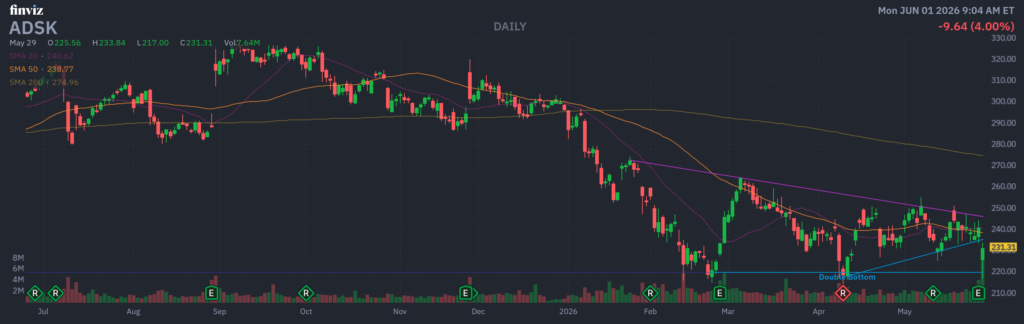
Name: Stacy J. Smith
Position: Director
Transaction Date: 05-29-2026 Shares Bought: 3,435 shares an average price paid of $231.17 for Cost: $794,054
Company: Autodesk Inc. (ADSK)
Autodesk, Inc. provides 3D design, engineering, and entertainment technology solutions globally. Its offerings include AutoCAD, Revit, Fusion, Inventor, Civil 3D, Autodesk Build, BIM Collaborate Pro, Maya, 3ds Max, and other cloud-based tools for architecture, engineering, construction, manufacturing, and media and entertainment. The company also provides collaboration, project management, data management, and digital asset lifecycle solutions to assist customers increase productivity and streamline operations. It sells its products and services via a network of resellers and distributors. Autodesk, Inc. was established in 1982 and is based in San Francisco, California.toimmune indications.The company was established in 2011 and is based in Brisbane, California.
Stacy J. Smith has been a Director at Autodesk, Inc. since November 2011, when he was named to the company’s Board of Directors. He is now the Chair of the Autodesk Board and the Executive Chairman of Kioxia Corporation. Smith worked for Intel Corporation for nearly 30 years, holding many high leadership positions such as Chief Financial Officer, Chief Information Officer, and Executive Vice President, directing manufacturing, operations, and sales. He retired in 2018. He holds an MBA in finance from the University of Texas in Austin.
Insomniac Hedge Fund Guy Opinion: Autodesk is one of the best software businesses most investors already know but still underestimate. The company dominates computer-aided design (CAD) software through products like AutoCAD, Revit, and Fusion, which are deeply embedded across architecture, engineering, construction, and manufacturing workflows. If you design buildings, factories, or infrastructure, there’s a good chance Autodesk touches the process somewhere.
The moat is enormous. Engineers and architects are trained on Autodesk products, firms build workflows around them, and switching costs are high. Network effects exist through industry standardization, while the company’s cloud ecosystem keeps customers increasingly locked in.
Subscription revenue represents roughly 94%+ of total revenue, making Autodesk one of the most recurring-revenue-heavy software companies in the market. Net revenue retention remains strong at approximately 100–110%, showing customers continue expanding usage after initial adoption.
CEO Andrew Anagnost has successfully transformed Autodesk from a perpetual-license software vendor into a subscription-based platform company. That transition created a far more predictable and profitable business model.
Profitability continues improving. Fiscal 2025 non-GAAP operating margins reached roughly 37%, while free cash flow remains exceptionally strong. Autodesk combines double-digit growth with elite software economics.
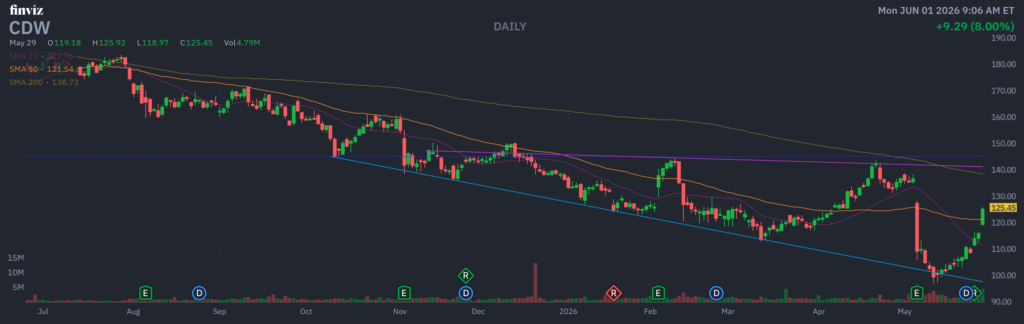
Name: David W. Nelms
Position: Director
Transaction Date: 05-27-2026 Shares Bought: 18,000 shares an average price paid of $111.43 for Cost: $2,005,740
Company: CDW Corp. (CDW)
CDW Corporation offers information technology (IT) solutions in the United States, United Kingdom, and Canada. It operates in three segments: commercial, government, and education. The company provides standalone hardware and software products and services, as well as integrated IT solutions that include on-premise and cloud capabilities for hybrid infrastructure, digital experience, and security. It also offers hardware items like as notebooks/mobile devices, tablets, network communications, collaborative hardware, data storage, and servers. The company was previously known as CDW Computer Centers, Inc., but changed its name to CDW Corporation in June 2003. CDW Corporation was founded in 1984 and is headquartered in Vernon Hills, Illinois.
David W. Nelms has been a Director at CDW Corp. since January 2014, when he joined the company’s Board of Directors. He has also held various board leadership positions, including Lead Independent Director and Non-Executive Chair. Nelms is the retiring Chairman and CEO of Discover Financial Services, where he oversaw the company’s tremendous development and expansion after entering as President and Chief Operating Officer in 1998. He has substantial experience with financial services, payments, corporate strategy, and governance. Nelms holds a bachelor’s degree in mechanical engineering from the University of Florida and an MBA from Harvard Business School.
Insomniac Hedge Fund Guy Opinion: CDW is basically the grown-up version of an IT reseller. The company helps businesses, governments, schools, and healthcare organizations buy, deploy, and manage technology infrastructure. That includes hardware, software, cloud services, cybersecurity, and IT consulting. It isn’t glamorous, but it sits in the middle of enterprise IT spending.
The moat comes from relationships, scale, and procurement complexity. Large organizations increasingly want a one-stop shop to manage thousands of vendors, licenses, devices, and service contracts. CDW has built deep customer relationships over decades and acts as a trusted technology advisor rather than just a box mover.
Revenue has grown at roughly a 5–6% annual rate over the last five years, reaching over $22 billion in annual sales. Software and services have been growing faster than hardware, helping improve the mix of the business.
Management has generally executed well, focusing on higher-margin services, acquisitions, and shareholder returns through buybacks. The company has proven it can navigate changing technology cycles without blowing up margins.
Profitability is solid rather than spectacular. Operating margins are typically in the high single digits, but the business generates strong cash flow and attractive returns on capital because it doesn’t require massive investment to grow.

Name: Richard A. Wurster
Position: President & CEO
Transaction Date: 05-28-2026 Shares Bought: 21,959 shares an average price paid of $84.23 for Cost: $1,849,512
Company: Schwab Charles Corp (SCHW)
Schwab Charles Corporation is a savings and loan holding firm that offers wealth management, brokerage, banking, custody, and financial advice services in the United States and abroad. The company works in two segments: Investor Services and Advisor Services. It offers brokerage accounts, trading platforms, mutual funds, exchange-traded funds, managed portfolios, retirement services, and banking products like checking accounts, mortgages, and loan solutions. Charles Schwab also offers trust custody, advisor support, and equity compensation plan services. The corporation was founded in 1971 and has its headquarters in Westlake, Texas.
Richard A. Wurster has been President and Chief Executive Officer of The Charles Schwab Corporation since January 2025. He joined Schwab in 2016 through the company’s acquisition of optionsXpress and has since held various top leadership positions, including President of Charles Schwab & Co. and Managing Director of the firm’s retail and institutional operations. Wurster was President and CEO of TD Ameritrade from 2008 to 2016, prior to joining Schwab. He received a bachelor’s degree in economics from the University of Illinois at Urbana-Champaign and an MBA from Northwestern University’s Kellogg School of Management.
Insomniac Hedge Fund Guy Opinion: Charles Schwab is one of the dominant retail brokerage and wealth management platforms in the U.S. The company makes money through asset management fees, net interest income on client cash balances, trading, banking products, and advisory services. Schwab’s scale is enormous, with trillions in client assets and a customer base ranging from retail investors to RIAs using its custody platform.
The moat comes from trust, scale, and customer inertia. Once investors consolidate accounts, retirement assets, banking, and advisory relationships onto Schwab’s platform, switching becomes inconvenient. The TD Ameritrade acquisition further strengthened Schwab’s market position and expanded its client ecosystem.
Over the past five years, revenue growth has been strong, driven by higher interest rates, asset growth, and acquisition synergies. A large portion of revenue is effectively recurring because it is tied to client assets and cash balances that remain on the platform year after year. Net asset retention is historically very strong due to steady inflows and high customer loyalty.
Management, led by CEO Rick Wurster following the long leadership era of Charles R. Schwab, has generally executed well through volatile markets. The company navigated the 2023 regional banking panic better than many feared, although concerns around deposit flight and unrealized bond losses pressured the stock temporarily.
Profitability remains strong despite higher funding costs over the last two years. Schwab continues to generate substantial free cash flow and benefits from operating leverage as client assets grow.

Name: John M. Hinshaw
Position: Director
Transaction Date: 05-26-2026 Shares Bought: 13,304 shares an average price paid of $75.17 for Cost: $1,000,035
Company: Sysco Corp (SYY)
Sysco Corporation, through its subsidiaries, markets and distributes a variety of food and related items to the foodservice or take-away industry in the United States, Canada, the United Kingdom, France, and across the world. It operates in four segments: U.S. Foodservice Operations, International Foodservice Operations, SYGMA, and Other. The company sells frozen food, including meat, seafood, fully prepared entrées, fruits, vegetables, and desserts; canned and dry food goods; fresh meat and seafood products; dairy products; beverages; imported specialties; and fresh produce items. It caters to restaurants, hospitals, nursing homes, schools and colleges, hotels and motels, industrial caterers, and other foodservice establishments. Sysco Corporation was established in 1969 and is based in Houston, Texas.
John M. Hinshaw has served as a Director of Sysco Corp. since February 2024, when he was appointed to the company’s Board of Directors. Hinshaw is the former Group Chief Operating Officer of HSBC Holdings plc and previously served as Chief Customer Officer at Hewlett Packard Enterprise, as well as Chief Information Officer at Boeing and Verizon Wireless. He brings extensive experience in technology, cybersecurity, digital transformation, and global operations leadership across multiple industries. Hinshaw earned a bachelor’s degree in computer science from the University of South Alabama and later completed executive education programs focused on leadership and management.
Insomniac Hedge Fund Guy Opinion: Sysco is the dominant food-service distributor in North America. The company supplies restaurants, hospitals, schools, hotels, and cafeterias with everything from meat and produce to kitchen supplies. It’s essentially the logistical backbone of the restaurant industry, operating at enormous scale with a distribution network that smaller competitors struggle to replicate.
The moat is scale and distribution density. Food distribution is a low-margin business where efficiency matters more than branding. Sysco’s nationwide warehouse and trucking infrastructure allows it to deliver frequently, maintain purchasing leverage with suppliers, and spread fixed costs across massive volume. Independent restaurants especially rely on Sysco because they lack the procurement power of large chains.
Over the last five years, revenue growth has averaged in the mid-single digits, though results were temporarily distorted by the pandemic shutdown period. Growth today is driven by pricing, market share gains, and continued expansion in specialty and international markets. A large portion of revenue is recurring in nature because customers order continuously, although it’s not “subscription recurring revenue” in the software sense. Customer retention is strong because switching distributors can disrupt kitchen operations and inventory management.
Management has focused heavily on operational efficiency, private-label expansion, and digital ordering capabilities. Execution has improved after the difficult pandemic years, and margins have gradually recovered.
Profitability remains steady rather than spectacular. Operating margins are thin—as expected in distribution—but Sysco generates strong and reliable cash flow due to scale and consistent customer demand. The company also returns significant capital through dividends and buybacks.
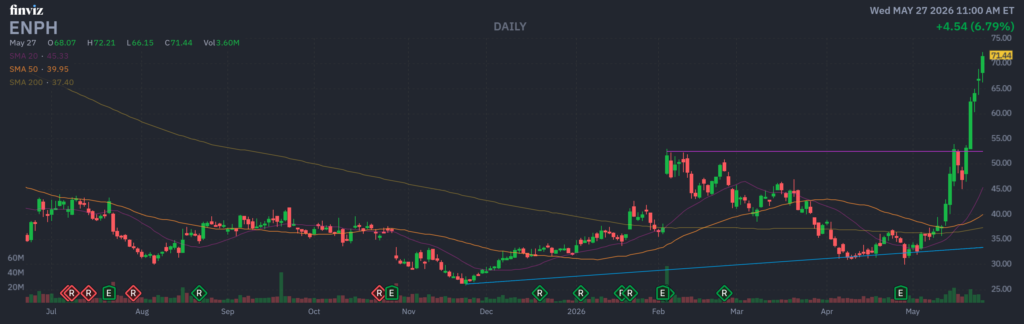
Name: Badrinarayanan Kothandaraman
Position: President & CEO
Transaction Date: 05-26-2026 Shares Bought: 5,000 shares an average price paid of $67.50 for Cost: $337,482
Company: Enphase Energy Inc. (ENPH)
Enphase Energy, Inc. creates and markets residential energy solutions for the solar sector, including microinverters, battery storage systems, energy management software, EV charging solutions, and monitoring services. Its technology provides energy conversion, monitoring, and control at the solar panel level for residential clients all over the world. The company was established in 2006 and is based in Fremont, California.
Badrinarayanan Kothandaraman is the President and CEO of Enphase Energy Inc., a position he has held since September 2017. He also serves on the company’s Board of Directors. He joined Enphase in April 2016 as Chief Operating Officer, having previously held key executive positions at Cypress Semiconductor. He has received his BTech degree from IIT Madras and his M.S. degree in materials science from U.C. Berkeley. He also received his degree in Executive MBA, Business Administration and Management, General, from the Stanford University Graduate School of Business.
Insomniac Hedge Fund Guy Opinion: Enphase Energy is one of the better-known names in residential solar technology. The company makes microinverters, battery storage systems, and energy management software that help homeowners generate, store, and monitor solar power. Unlike traditional string inverter systems, Enphase’s microinverter architecture operates panel-by-panel, improving efficiency and reliability.
The moat is technology, installer relationships, and ecosystem integration. Once homeowners adopt the Enphase platform—including batteries, monitoring software, and EV charging—the switching costs rise materially. The company also benefits from a strong installer network and premium brand positioning in residential solar.
The problem is growth has slowed dramatically after the post-pandemic solar boom. Revenue exploded between 2020 and 2023, but demand weakened due to higher interest rates, declining European demand, and California’s NEM 3.0 policy changes. Over the last five years, revenue growth is still impressive overall, but recent quarters have been volatile and well below prior peak expectations.
Recurring revenue is relatively limited compared to software businesses, though service, monitoring, and software-attached products are growing. The business still depends heavily on hardware sales cycles and residential solar demand. Net retention metrics are not meaningfully disclosed.
Management, led by CEO Badri Kothandaraman, has generally executed well operationally and maintained strong gross margins despite industry turbulence. Enphase remains far more profitable than many solar peers and has historically generated excellent free cash flow.
Profitability, however, has compressed from peak levels as volumes slowed and inventory corrections hit the industry.
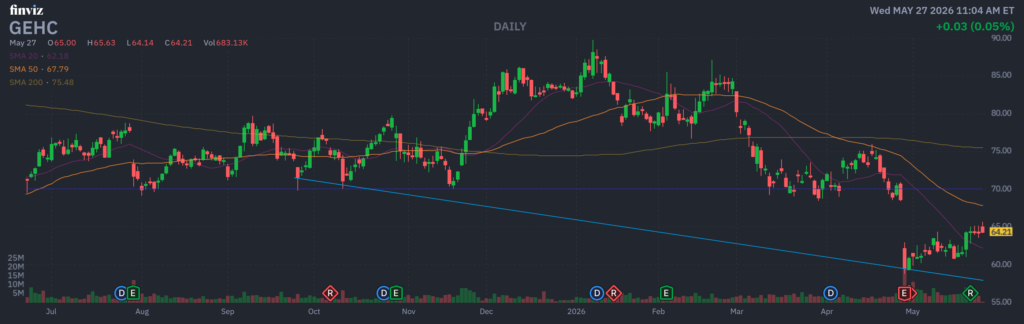
Name: Kevin Lobo
Position: Director
Transaction Date: 05-22-2026 Shares Bought: 10,000 shares an average price paid of $64.18 for Cost: $641,800
Company: GE HealthCare Technologies Inc. (GEHC)
GE HealthCare Technologies Inc. creates technologies, medications, and solutions for providers worldwide. It works in four segments: Imaging, Advanced Visualization Solutions, Patient Care Solutions, and Pharmaceutical Diagnostics, providing CT, MRI, ultrasound, X-ray, patient monitoring, anesthetic, cardiology, and molecular imaging solutions. The company also provides contrast media medicines and radiopharmaceuticals for diagnostic scans and nuclear medicine treatments. The company has a strategic partnership with DeepHealth. GE HealthCare Technologies Inc. was previously known as GE Healthcare Holding LLC before changing its name to GE HealthCare Technologies Inc. in December 2022. The corporation was established in 2022 and is based in Chicago, Illinois.
Kevin Lobo has been a Director of GE HealthCare Technologies Inc. since April 2024, when he was appointed to the company’s Board of Directors. Lobo is the Chairman and CEO of Stryker Corporation, a position he has held since 2012, after joining Stryker in 2011 as Group President of Orthopaedics. He has considerable leadership expertise in global medical technology, healthcare innovation, and operational strategy, having previously held executive positions at Johnson & Johnson and Novartis. Lobo holds a bachelor’s degree in commerce from McGill University and an MBA from the University of Toronto.
Insomniac Hedge Fund Guy Opinion: GE HealthCare is one of the largest medical imaging and diagnostics companies in the world. The business sells MRI, CT, ultrasound, PET imaging systems, patient monitoring equipment, and pharmaceutical diagnostics used by hospitals and healthcare systems globally. It became a standalone company after being spun out from General Electric, giving investors a cleaner way to own the healthcare franchise without the old GE complexity.
The moat comes from scale, installed equipment, and long customer relationships. Hospitals do not frequently replace imaging vendors because switching is expensive, disruptive, and requires retraining staff. Once a GEHC machine is installed, the company generates recurring revenue from software, maintenance, upgrades, and service contracts. Roughly 40%+ of revenue is recurring, which helps stabilize results despite slower hospital spending cycles.
Over the past five years, revenue growth has generally been in the low-to-mid single digits, though imaging demand and AI-enabled diagnostics are improving the long-term outlook. The company has also benefited from strong demand for precision care and diagnostic pharmaceuticals. Net retention is not formally disclosed, but customer retention is historically strong given the mission-critical nature of the equipment.
Management under CEO Peter Arduini has focused on margin expansion, operational discipline, and AI integration across imaging workflows.
Profitability has improved meaningfully since the spin-off. Margins are not as high as pure software or life-science tool companies, but cash flow generation is solid and improving steadily.
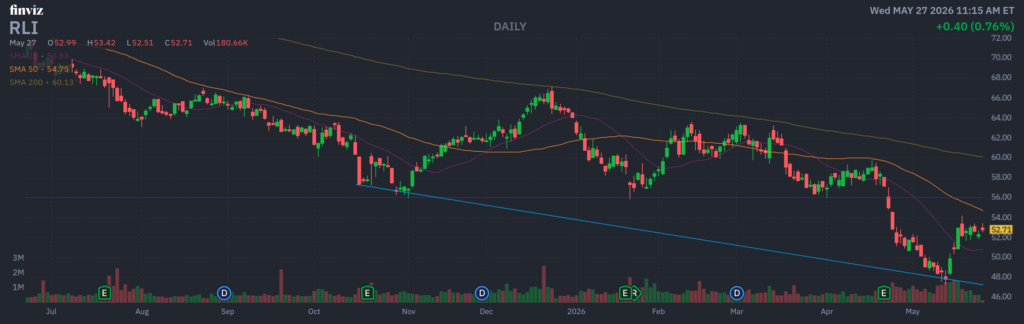
Name: Craig W. Kliethermes
Position: Chief Executive Officer
Transaction Date: 05-21-2026 Shares Bought: 5,000 shares an average price paid of $52.00 for Cost: $260,000
Company: Rli Corp (RLI)
RLI Corp. is an insurance holding company that offers specialized property, liability, and surety insurance products in the United States. The company is divided into three segments: casualty, property, and surety. It provides commercial excess liability, transportation insurance, workers’ compensation, directors’ and officers’ liability coverage, professional liability, commercial property insurance, marine insurance, and surety bonds for corporations and contractors. RLI also offers reinsurance and sells its products via brokers, agents, carrier partners, and branch offices. The corporation, founded in 1965, is headquartered in Peoria, Illinois.
Craig W. Kliethermes has been President and Chief Executive Officer of RLI Corp. since January 2022. He joined the company in 1986 and has held several leadership positions over the last three decades, including Executive Vice President, Chief Underwriting Officer, and President of RLI Insurance Company, before being promoted to CEO. Under his leadership, RLI has maintained its concentration on the specialist property, casualty, and surety insurance sectors, with an emphasis on underwriting discipline and profitability. Kliethermes holds a bachelor’s degree in finance from Illinois State University.
Insomniac Hedge Fund Guy Opinion: RLI Corp is a specialty property & casualty insurer that focuses on niche commercial and personal insurance markets where underwriting expertise matters more than scale. The company writes excess liability, transportation, marine, surety, and specialty property coverage rather than competing head-to-head in commoditized auto or homeowners insurance.
The moat is underwriting discipline. RLI has spent decades building expertise in narrow insurance niches where pricing risk correctly matters more than being the cheapest provider. Unlike many insurers chasing premium growth, RLI is willing to walk away from underpriced business, which has helped it maintain one of the best underwriting track records in the industry. Its combined ratio has consistently outperformed peers over long periods.
Over the last five years, revenue growth has generally run in the high-single-digit to low-double-digit range, helped by strong premium pricing and favorable insurance market conditions. Recurring revenue is effectively very high because insurance renewals create an ongoing stream of premiums, although exact retention metrics are not disclosed in SaaS-style terms. Customer retention and broker relationships appear strong across its specialty lines.
Management has historically been conservative and shareholder-oriented, prioritizing underwriting profitability over aggressive expansion. That culture matters in insurance because bad underwriting decisions often do not show up until years later.
Profitability is where RLI stands out. Many insurers struggle to consistently generate underwriting profits, but RLI regularly produces combined ratios below 100 while also benefiting from investment income on its float. Rising interest rates have further improved earnings power by increasing yields on invested assets.
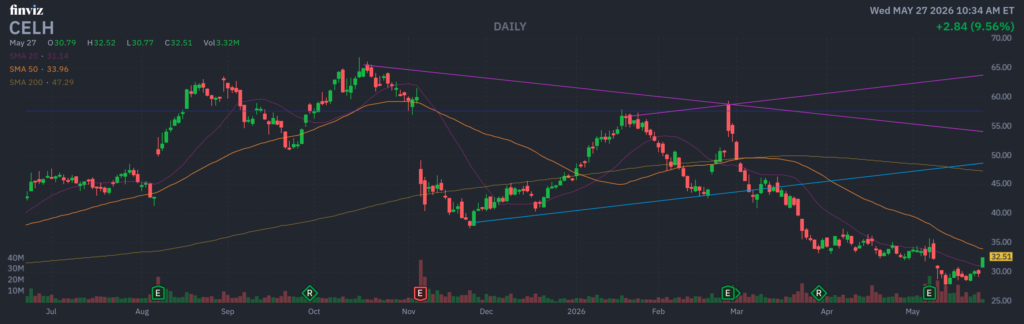
Name: Hal Kravitz
Position: Director
Transaction Date: 05-22-2026 Shares Bought: 8,400 shares an average price paid of $29.73 for Cost: $249,732
Name: John Fieldly
Position: Chief Executive Officer
Transaction Date: 05-22-2026 Shares Bought: 8,475 shares an average price paid of $29.36 for Cost: $248,826
Name: Eric Hanson
Position: President & COO
Transaction Date: 05-21-2026 Shares Bought: 7,500 shares an average price paid of $29.04 for Cost: $217,800
Company: Celsius Holdings Inc. (CELH)
Celsius Holdings, Inc. develops, processes, produces, markets, sells, and distributes functional energy drinks in the United States, North America, Europe, Asia Pacific, and around the world. The company provides CELSIUS ESSENTIALS, a functional energy drink formulated with aminos, and CELSIUS Hydration, a line of zero-sugar hydration powders featuring electrolytes in various fruit-forward flavors, as well as ready-to-drink energy beverages, on-the-go powder and hydration sticks, and nutrition and wellness products under the CELSIUS, Alani Nu, and Rockstar brand names. The company was previously known as Vector Ventures, Inc. before changing its name to Celsius Holdings, Inc. in January 2007. Celsius Holdings, Inc. was created in 2004 and is based in Boca Raton, Florida.
Hal Kravitz has been a Director of Celsius Holdings Inc. since December 2023, when he was named to the company’s Board of Directors. Kravitz is the founder and Managing Partner of Kravitz Capital Management, with decades of experience in investment management, consumer brands, and business strategy. Before joining the Celsius board, he was an early investor in the firm and has contributed significantly to its long-term success and expansion in the functional beverage market. Kravitz holds a bachelor’s degree in finance and business administration from the University of Florida.
John Fieldly has been the Chief Executive Officer of Celsius Holdings Inc. In April 2018, He joined the company in 2012 as Chief Financial Officer, eventually becoming President and Chief Operating Officer before being appointed to CEO. Celsius grew into one of the fastest-growing energy drink and functional beverage companies under his leadership, expanding its retail distribution and strategic relationship network dramatically. Before joining Celsius, Fieldly worked in finance and accounting for several public and private enterprises. He has a bachelor’s degree in accounting and finance from Florida Atlantic University and is a Certified Public Accountant.
Eric Hanson has been President and Chief Operating Officer of Celsius Holdings Inc. since January 2024. He first joined the company in 2023 as Chief Marketing Officer, following more than two decades at PepsiCo, where he held many top leadership positions in energy drinks, sports beverages, and brand development. Since becoming President and COO, Hanson has supervised worldwide operations, commercial execution, and growth strategies as Celsius continues to extend its presence in the energy beverage market. He holds a bachelor’s degree in business administration and marketing from the University of Colorado Boulder.
Insomniac Hedge Fund Guy Opinion: Celsius Holdings is one of the more disruptive stories in beverages over the last five years. The company markets itself as a “better-for-you” energy drink brand, targeting fitness-conscious consumers with zero-sugar formulas and lifestyle branding that sits somewhere between traditional energy drinks and wellness products.
The moat is brand momentum plus distribution. Celsius went from niche fitness shelves to mainstream retail at an unusually fast pace, helped significantly by its distribution partnership with PepsiCo. That relationship massively expanded shelf space, convenience store penetration, and international reach.
Revenue growth has been explosive, with the business compounding at well above 50% annually over the past five years. The problem is that hypergrowth is now slowing as the company laps massive gains from prior years. Unlike software businesses, Celsius does not have recurring revenue or meaningful net retention metrics. This is still fundamentally a consumer packaged goods company where brand relevance matters every quarter.
Management deserves credit for scaling the business without completely destroying margins. Gross margins remain healthy for a beverage company, and profitability has improved materially versus just a few years ago. The balance sheet is also relatively clean, giving the company flexibility for marketing and expansion.
The real debate is valuation versus durability. Bulls think Celsius becomes the next global energy drink giant. Bears think growth normalizes sharply once category momentum cools.
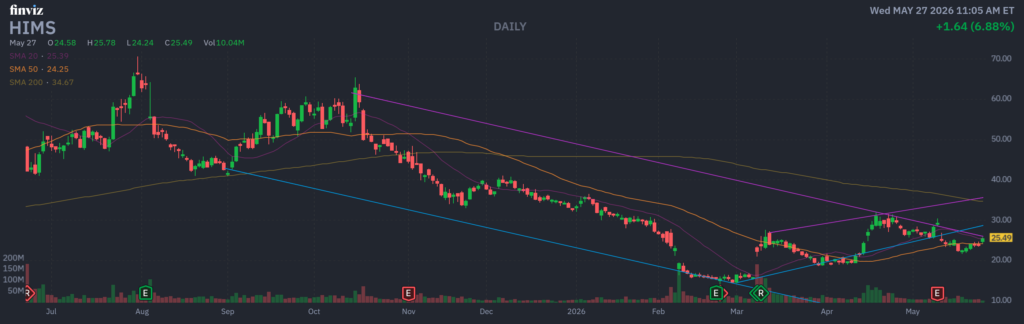
Name: David B. Wells
Position: Director
Transaction Date: 05-26-2026 Shares Bought: 48,400 shares an average price paid of $24.23 for Cost: $1,172,974
Company: Hims & Hers Health Inc. (HIMS)
Hims & Hers Health, Inc. is a consumer-focused health and wellness platform that links people to licensed healthcare practitioners in the United States, the United Kingdom, Canada, Germany, the Republic of Ireland, France, Spain, and other countries. Customers can purchase a variety of handpicked prescription and non-prescription health and wellness products and services directly through the company’s websites and mobile app. It also offers personalized health and wellness products, over-the-counter drug and device products, cosmetics, and supplements under the Hims & Hers brand name, with a focus on general wellness, skincare, sexual health and wellness, and hair care, as well as laboratory testing services to measure a set of biomarkers. Hims & Hers Health, Inc. is headquartered in San Francisco, California.
David B. Wells has been a Director of Hims & Hers Health Inc. since February 2021, when the firm went public following a business combination with a special purpose acquisition company. Wells is Netflix’s former Chief Financial Officer, having spent more than a decade guiding the company’s global expansion and financial success before retiring in 2020. He also previously worked for Deloitte in audit and advisory services. David earned a B.S. in Commerce and English from the University of Virginia and an M.B.A./M.P.P. Magna Cum Laude from the University of Chicago.
Insomniac Hedge Fund Guy Opinion: Hims & Hers is basically a modern direct-to-consumer healthcare platform wrapped in a consumer-brand play. The company started with telehealth prescriptions for hair loss, ED, and skincare, but has expanded into mental health, weight loss, and primary care-style subscriptions. The core idea is convenience: online consultations, recurring prescriptions, and home delivery without the friction of traditional healthcare systems.
The moat is mostly brand, customer acquisition scale, and subscription behavior. There’s very little hard technological differentiation, but Hims has become one of the few recognizable consumer brands in telehealth. The company benefits from aggressive marketing, strong digital engagement, and a growing subscriber base that creates recurring revenue visibility. Roughly 95%+ of revenue is recurring subscription-based, which is the biggest attraction here.
Revenue growth over the last five years has been explosive, consistently above 50% annually during expansion phases. Growth accelerated again with demand tied to GLP-1 weight-loss offerings and broader healthcare subscriptions. Net revenue retention appears healthy as customers adopt multiple services across mental health, dermatology, and wellness categories.
Management, led by co-founder and CEO Andrew Dudum, has executed aggressively and understands consumer internet economics better than most healthcare executives. The company has shown discipline improving margins while still growing rapidly, which matters because many telehealth businesses burned cash endlessly after the pandemic boom.
Profitability is finally improving. Hims moved from heavy losses toward positive EBITDA and meaningful cash generation faster than skeptics expected. That’s the bull case.
Name: John Chidsey
Position: President and CEO
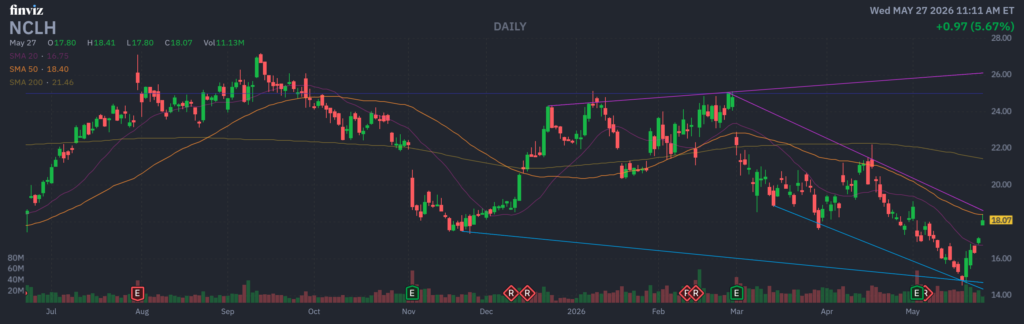
Transaction Date: 05-22-2026 Shares Bought: 153,000 shares an average price paid of $16.37 for Cost: $2,504,610
Company: Norwegian Cruise Line Holdings Ltd. (NCLH)
Norwegian Cruise Line Holdings Ltd. and its subsidiaries operate cruise ships in North America, Europe, Asia-Pacific, and across the world. It offers itineraries to Europe, Asia, Australia, New Zealand, South America, Africa, Canada, Bermuda, the Caribbean, and Alaska, as well as an inter-island tour in Hawaii. The company also offers features, amenities, and activities such as various accommodations, dining venues, bars and lounges, spas, casino and retail shopping areas, and entertainment options; shore excursions at each port of call; and air transportation and hotel packages for stays prior to or following a voyage. It offers its products and services under the Norwegian Cruise Line, Oceania Cruises, and Regent Seven Seas Cruises brands. The company was created in 1966 and is headquartered in Miami, Florida.
John Chidsey has been President and Chief Executive Officer of Norwegian Cruise Line Holdings Ltd. since February 2023. He joined the company in 2023 after a lengthy managerial career in the consumer and restaurant industries, most recently as CEO of Subway from 2019 to 2022 and previously as Chairman and CEO of Burger King Holdings from 2006 to 2010. Chidsey has vast expertise overseeing huge global consumer brands, operational turnarounds, and international expansion efforts. He holds a bachelor’s degree in mechanical engineering from Davidson College and an MBA from Emory University’s Goizueta Business School.
Insomniac Hedge Fund Guy Opinion: Norwegian Cruise Line Holdings is the smallest of the three major publicly traded cruise operators, sitting behind Carnival Corporation & plc and Royal Caribbean Group in scale. The company operates the Norwegian, Oceania, and Regent brands, targeting customers across mass-market, premium, and luxury cruising. The post-COVID recovery story is still the core investment debate here.
The moat is decent but not overwhelming. Cruise lines benefit from brand recognition, customer loyalty programs, and limited global berth supply, but this is still a capital-intensive business with high fixed costs and heavy debt loads. Norwegian’s edge is its stronger exposure to premium travelers, which generally supports better onboard spending and pricing compared to pure mass-market operators.
Revenue growth over the last five years has been distorted by the pandemic collapse and rebound. Sales have now recovered above pre-2020 levels, driven by higher ticket pricing, onboard spending, and strong booking demand. Recurring revenue isn’t really part of the story here—this is not a software-style business—though repeat customers and future cruise deposits provide some visibility into demand trends. Net retention metrics are not disclosed in a meaningful way.
Management under CEO Harry Sommer has focused on repairing the balance sheet, improving occupancy, and increasing pricing discipline after the pandemic nearly crippled the industry.
Profitability has rebounded sharply from the massive COVID-era losses, but leverage remains the key risk. Interest expense is materially higher than before 2020, limiting how quickly earnings can normalize.
Name: Jeffrey C. Royal
Position: Director
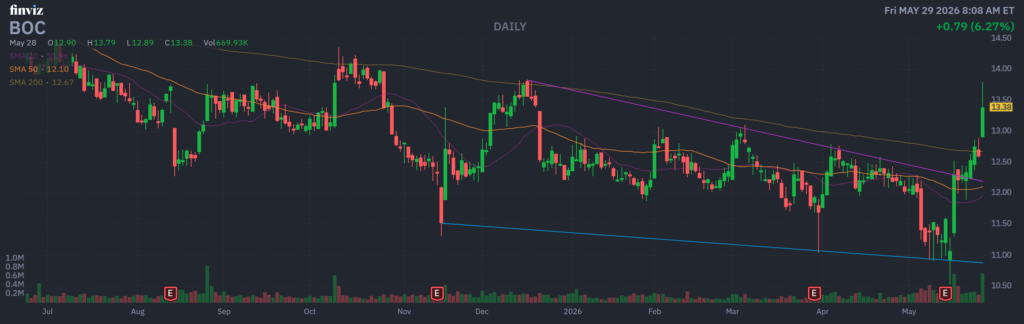
Transaction Date: 05-22-2026 Shares Bought: 41,046 shares an average price paid of $12.69 for Cost: $520,983
Company: Boston Omaha Corp (BOC)
Boston Omaha Corporation, along with its subsidiaries, operates outdoor billboard advertising businesses throughout the southeast United States. The company works in four segments: General Indemnity Group, LLC (GIG), Link Media Holdings, LLC (LMH), Boston Omaha Broadband, LLC (BOB), and Boston Omaha Asset Management, LLC (BOAM). It also operates in the surety insurance and related brokerage, broadband, and asset management sectors. Boston Omaha Corporation was created in 2017 and is based in Omaha, Nebraska.
Jeffrey C. Royal has been a Director at Boston Omaha Corp. since January 2019, when he was elected to the company’s Board of Directors. Royal is a long-time banking professional and business leader who has been President of Dundee Bank since 2006 and was appointed CEO of Old Market Capital Corporation in September 2024. He has substantial experience in banking, lending, corporate governance, and financial management from leading positions at several financial institutions and public company boards. Royal received his bachelor’s and master’s degrees in business administration from Creighton University.
Insomniac Hedge Fund Guy Opinion: Boston Omaha is basically a mini-Berkshire Hathaway playbook applied to tiny and overlooked businesses. The company owns billboard advertising assets, surety insurance operations, broadband infrastructure, and minority stakes in other businesses. It’s run by co-CEOs Alex Rozek and Adam Peterson, who have spent years allocating capital into fragmented industries where disciplined operators can slowly compound value.
The moat today is limited, but the strategy is interesting. Billboard advertising provides stable local cash flows with high replacement costs and regulatory barriers. Broadband infrastructure could become more valuable over time, especially in underserved markets. The insurance business gives them float, though still at a much smaller scale than the Berkshire comparison enthusiasts like to make.
Revenue growth over the last five years has been strong but uneven, driven mostly by acquisitions and expansion rather than pure organic growth. The recurring revenue profile is decent because billboard leases, broadband subscriptions, and insurance renewals generate ongoing cash flow, though not enough yet to classify the company as a true recurring-revenue machine. Net retention metrics are not meaningfully disclosed.
Profitability is where the debate starts. Boston Omaha has often prioritized reinvestment and acquisitions over near-term earnings, so reported profitability has been inconsistent. Bulls view this as intelligent long-term capital allocation; bears see a collection of small businesses trading at a premium valuation.
Name: Olimpio Matarazzo Neto
Position: Director
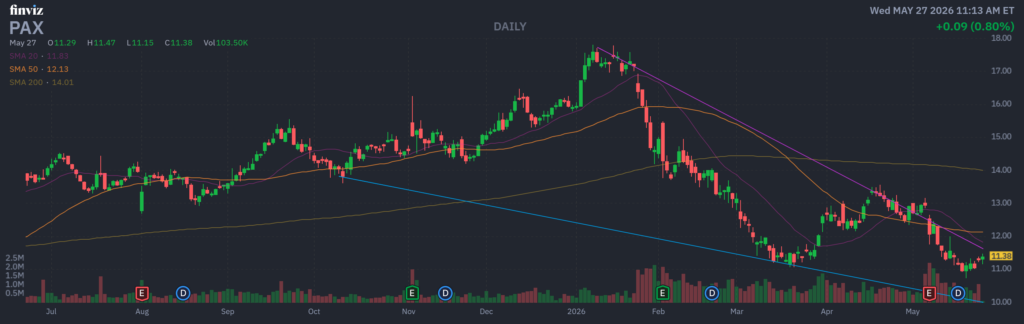
Transaction Date: 05-15-2026 Shares Bought: 45,000 shares an average price paid of $11.18 for Cost: $502,950
Company: Patria Investments Ltd. (PAX)
Patria Investments Limited is a private market investing firm. It invests in private equity, secondary direct and indirect, and venture capital, with an emphasis on middle market, buyout, and growth capital investments. It aims to be sector-agnostic, focusing on agriculture, power and energy, healthcare, logistics and transportation, food and beverage, agricultural goods, packaged foods and meats, education services, outsourced business services, and digital and technology services. Patria Investments Limited is a subsidiary of Patria Holdings Limited. Patria Investments Limited was created in 1994 and is based in Grand Cayman, Cayman Islands. It has further offices throughout South America, North America, Europe, and Asia.
Olimpio Matarazzo Neto has been a Director of Patria Investments Ltd. since January 2021, when the firm went public on NASDAQ. Matarazzo Neto is one of Patria Investments’ founding partners and has helped the firm grow into a top alternative asset manager in Latin America. Throughout his tenure at Patria, he has concentrated on private equity investments, strategic growth, and corporate governance in a variety of regional sectors. He holds a degree in business administration from Fundação Getulio Vargas in São Paulo, Brazil.
Insomniac Hedge Fund Guy Opinion: Patria Investments is a Latin America-focused alternative asset manager specializing in private equity, infrastructure, credit, real estate, and public equities. The company benefits from being one of the few scaled managers with deep regional expertise across Brazil and broader Latin America. Institutional investors looking for exposure to emerging-market infrastructure and private assets often end up talking to Patria.
The moat is mainly relationship-driven. Patria has decades-long connections with governments, family-owned businesses, pension funds, and institutional investors in Latin America. That local knowledge is difficult for large global firms to replicate. The company also benefits from long-duration infrastructure and private equity funds that create sticky assets under management and recurring fee income.
Over the last five years, revenue growth has been strong, supported by acquisitions and rising fee-paying assets under management. A large portion of revenue is recurring management fees, while performance fees create periodic upside but also add volatility. Fee-related earnings have become increasingly important as management tries to build a steadier earnings profile. Net retention metrics are not disclosed in the same way SaaS companies report them, but fundraising relationships appear durable.
Management has generally executed well, expanding beyond Brazil into a broader Latin American alternatives platform. The strategy is ambitious but logical given institutional demand for private-market exposure in emerging economies.
Profitability can fluctuate depending on realization activity and performance fees, which is normal for alternative asset managers. Still, the underlying fee-related earnings trend has been improving.
Name: Clay Howard Geyer
Position: Chief Operating Officer
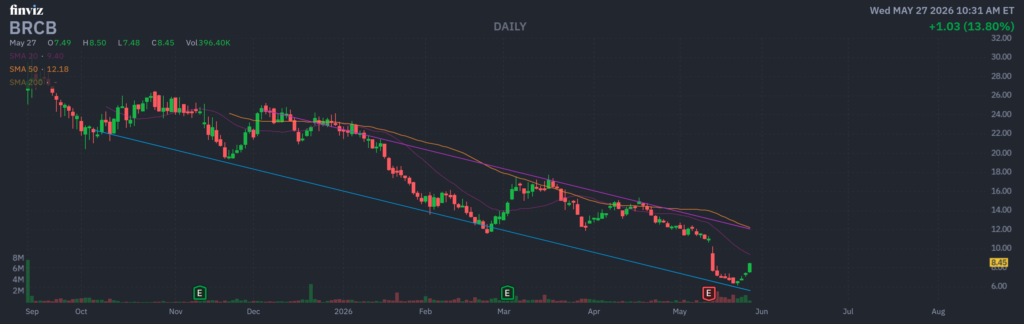
Transaction Date: 05-21-2026 Shares Bought: 46,005 shares an average price paid of $6.52 for Cost: $299,816
Company: Black Rock Coffee Bar Inc. (BRCB)
Black Rock Coffee Bar, Inc. owns and runs a rapidly expanding chain of drive-thru coffee shops across the United States, with a focus on providing exceptional beverages and prompt customer service. The company serves a wide range of espresso-based coffee drinks, teas, smoothies, energy drinks, and flavored specialty drinks, as well as breakfast sandwiches, bagels, and other sweet and savory food options. Black Rock Coffee Bar prioritizes a community-driven culture and an exciting customer experience to foster brand loyalty and return visits. The company’s expansion continues with additional store openings across numerous states. Black Rock Coffee Bar was created in 2008 and is based in Scottsdale, Arizona.
Clay Howard Geyer has been the Chief Operating Officer of Black Rock Coffee Bar Inc. since January 2025. He joined the firm in 2016 and has previously held many operational leadership positions, including overseeing the company’s rapid retail expansion, field operations, and drive-thru coffee platform growth in multiple US areas. Geyer formerly worked in restaurant and retail operations management, specializing in developing multi-unit consumer enterprises. He received a bachelor’s degree in business administration from Oregon State University.
Insomniac Hedge Fund Guy Opinion: Black Rock Coffee Bar is a fast-growing drive-thru coffee chain trying to carve out a niche between local coffee shops and giant national brands. The company focuses on speed, convenience, energy drinks, and a younger customer demographic. Unlike premium café concepts built around in-store experience, Black Rock leans heavily into high-volume drive-thru traffic and customizable beverages.
The bull case is simple: unit expansion. Black Rock still has a relatively small footprint compared to giants like Starbucks or Dutch Bros, which gives it a long runway if management executes well. Revenue growth over the last five years has been extremely strong, largely driven by new store openings rather than mature-store economics alone. Same-store sales have been more volatile as the company scales into new regions.
The moat is limited right now. Coffee is an intensely competitive business with low switching costs, so brand loyalty and operational execution matter more than proprietary advantages. Black Rock’s differentiation comes from store-level culture, drive-thru efficiency, and beverage customization rather than technology or exclusivity. Recurring revenue effectively comes from repeat customer behavior, not contracts or subscriptions.
Management is focused aggressively on expansion, which means investors are betting on future scale rather than current profitability. Margins remain modest compared to mature restaurant chains because the company is still investing heavily in growth and new locations.
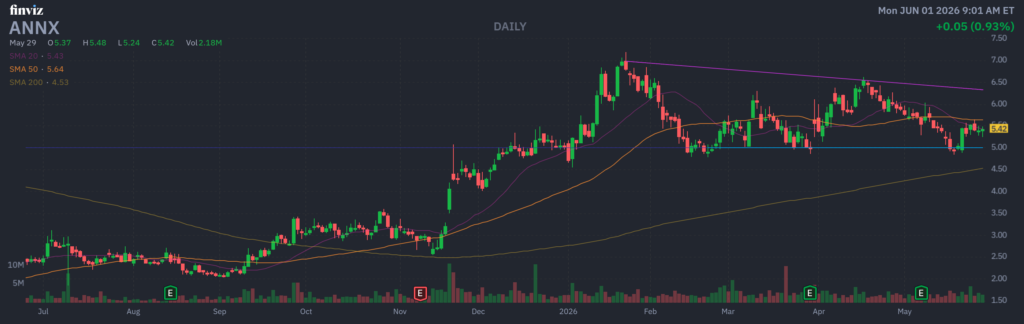
Name: Muneer A. Satter
Position: Director
Transaction Date: 05-28-2026 Shares Bought: 613,497 shares an average price paid of $5.41 for Cost: $3,319,019
Company: Annexon Inc. (ANNX)
Annexon, Inc., a clinical-stage biopharmaceutical firm, researches and develops drugs to treat inflammatory illnesses. Tanruprubart, an investigational full-length monoclonal antibody, is currently in Phase 3 clinical trials for the treatment of patients with guillain-barré syndrome, has completed Phase II clinical trials for Huntington’s disease, and is in Phase 2a clinical trials for amyotrophic lateral sclerosis. It is also developing ANX007, an antigen-binding fragment in Phase 3 studies for the treatment of geographic atrophy, and ANX1502, a new oral small molecule inhibitor in Phase 1 trials for autoimmune indications.The company was established in 2011 and is based in Brisbane, California.
Muneer A. Satter has been a Director at Annexon Inc. since December 2014, when he joined the company’s Board of Directors. Satter is the Founder and Managing Partner of Satter Medical Technology Partners, as well as the Chairperson of Satter Investment Management. He has vast experience in private equity, healthcare investing, and corporate governance. Before starting his investment firms, he worked for Goldman Sachs for 24 years, where he was Global Head of the Mezzanine Group and held various top leadership positions in investment banking and asset management. Satter holds a Bachelor of Arts in Economics from Northwestern University, a Juris Doctor from Harvard Law School, and an MBA from Harvard Business School.
Insomniac Hedge Fund Guy Opinion: Annexon is a clinical-stage biotech focused on diseases driven by the classical complement pathway, an area attracting significant investor interest after the success of several immune-focused drug companies. Its lead programs target Guillain-Barré Syndrome (GBS), geographic atrophy, and other neuroinflammatory diseases. The entire investment case revolves around clinical trial execution and eventual regulatory approval.
Unlike mature biotech companies, Annexon has essentially no commercial revenue today and remains pre-product. That means metrics like recurring revenue, recurring revenue growth, and net retention are largely irrelevant at this stage because the company is still funding operations through investor capital rather than product sales.
The potential moat is scientific rather than commercial. Annexon’s C1q-targeting platform is differentiated and could become valuable if clinical data continue to hold up. The problem is that biotech moats do not exist until products reach the market and physicians actually adopt them.
Management, led by CEO Douglas Love, has pushed key programs into late-stage development and is advancing regulatory discussions for its lead GBS asset. Recent trial updates have been encouraging, which explains why investors remain engaged despite heavy losses.
Profitability is nowhere in sight. The company lost over $100 million in the first half of 2025 as R&D spending accelerated, and cash burn remains substantial. While Annexon had roughly $227 million in cash and investments mid-2025, additional financing is likely before commercialization.
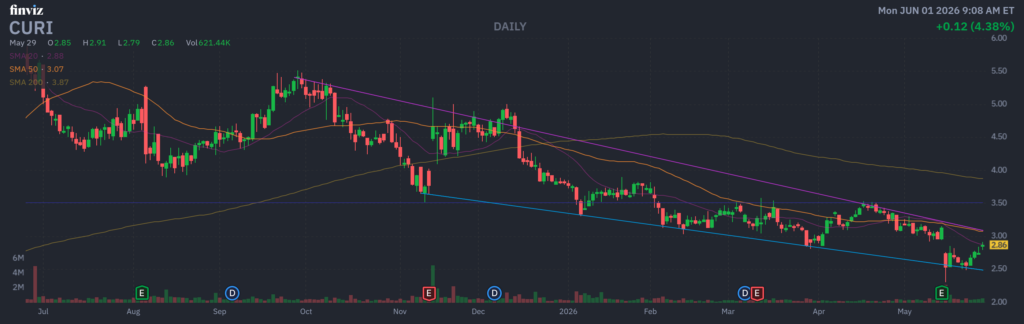
Name: Clinton Larry Stinchcomb
Position: President and CEO
Transaction Date: 05-27-2026 Shares Bought: 94,256 shares an average price paid of $2.74 for Cost: $258,638
Transaction Date: 05-26-2026 Shares Bought: 30,000 shares an average price paid of $2.67 for Cost: $80,040
Company: CuriosityStream Inc. (CURI)
CuriosityStream Inc., a media and entertainment corporation, distributes factual content via various channels. The company provides video and audio programming services in various categories of factual entertainment, including science, history, society, nature, lifestyle, and technology, through direct subscription video on-demand platforms accessible by internet-connected devices or indirectly through distribution partners who deliver CuriosityStream content via the distributor’s platform or system, as well as through bundled content licenses for SVoD and linear offerings. It provides streaming content for a variety of screens and devices, including televisions, set-top boxes, laptops, streaming media players, game consoles, and mobile devices. CuriosityStream Inc. is headquartered in Silver Spring, Maryland.
Clinton Larry Stinchcomb has been President and CEO of CuriosityStream Inc. since August 2020, after the company’s founder, John Hendricks. He joined CuriosityStream in 2018 as Chief Distribution Officer and later rose to the position of Executive Vice President of Distribution and Strategy, where he oversaw the company’s global expansion and streaming partnerships. Prior to joining CuriosityStream, Stinchcomb held various leadership positions at Discovery Communications, including General Manager of Discovery Channel and EVP of Digital. He holds a bachelor’s degree in economics from the University of Virginia.
Insomniac Hedge Fund Guy Opinion: CuriosityStream started as a niche documentary streaming platform, but the story today is increasingly about content licensing and AI. The company owns a large library of factual video content covering science, history, technology, and nature. Originally, investors viewed it as a small Netflix-for-documentaries business. Now, management is monetizing that content through licensing deals, including AI model training partnerships.
The moat is the content library itself. CuriosityStream has spent years building and organizing factual footage that can be licensed multiple times. Unlike scripted entertainment, educational and real-world video datasets may have growing value in AI training environments. That has become the company’s fastest-growing revenue stream.
Revenue growth has been volatile, but 2025 marked a major turnaround. Full-year revenue reached roughly $72 million, up about 40% year-over-year after several difficult years. Licensing revenue, driven largely by AI partnerships, grew dramatically and became a meaningful contributor to results.
Management, led by CEO Clint Stinchcomb, deserves credit for pivoting the business away from pure streaming subscriptions toward higher-margin licensing opportunities. The company has also improved operating cash flow and moved much closer to sustainable profitability.
Profitability remains the key debate. CuriosityStream is still not consistently producing strong GAAP earnings, but cash flow, EBITDA, and gross margins have improved materially.
This blog is solely for educational purposes and the author’s own amusement. IT IS NOT INVESTMENT ADVICE. Think of the blog as part of my personal investment journal that I am willing to share with the DIY investor. We could be long, short, or have no position at all in any of the stocks mentioned and express no written or implied obligation to disclose any of that. Nothing contained here constitutes a recommendation to buy or sell any security. Investing involves risk, including the possible loss of principal, and past performance is not indicative of future results.
“The insomniac hedge fund guy” is a moniker Harvey Sax, the portfolio manager for The Insiders Fund” has used from time to time on email, blog ,and social media posts. While Mr. Sax is the portfolio manager of The Insiders Fund, these posts are not communications from, nor endorsed by, Alpha Wealth Funds, LLC or any of its managed funds. References to Alpha Wealth Funds or its affiliates are for identification only and do not imply sponsorship or approval.
All company names, logos, and trademarks belong to their respective owners. The use of company logos is solely for descriptive and illustrative purposes under fair use. Any information provided is based on publicly available data and should not be considered financial, investment, or legal advice. Readers should conduct their own research or consult with a professional before making any investment decisions. Insiders sell the stock for many reasons, but they generally buy for just one – to make money. You’ve always heard the best information is inside information. Everyone with any stock market experience pays close attention to what insiders are doing. After all, who knows a business better than the people running it? Officers, directors, and 10% owners are required to inform the public through a Form 4 Filing of any transaction, buy, sell, exercise, or any other within 48 hours of doing so.
This info is available for free from the SEC’s Web site, Edgar, although we subscribe to SECForm4 as they provide a way to manage and make sense of the vast realms of data. I’ve tried a lot of vendors. SECForm4 is one of the smaller ones, but I like supporting Frank. He is not arrogant. He’s helpful and has great prices. He also trades on his own data, so I like people that eat what they kill. The bar is different from selling because the natural state of management is to be a seller. This is because most companies provide significant amounts of management compensation packages as stock and options. Therefore, we analyze unusual patterns with selling, such as insiders selling 25 percent or more of their holdings or multiple insiders selling near 52-week lows. Another red flag is large planned sale programs that start without warning. Unfortunately, the public information disclosure requirements about these programs, referred to as Rule 10b5-1, are horrendously poor. Also, planned sales that pop up out of nowhere are basically sales and are seeking cover under this corporate welfare loophole.
I also generally ignore 10 percent shareholders as they tend to be OPM (other people’s money) and perhaps not the smart money on which we are trying to read the tea leaves. I say generally because some 10% shareholders are great investor, think Warren Buffett and others. Of course, insiders can also be wrong about their Company’s prospects. Don’t let anyone fool you into believing they never make mistakes. Do your own analysis. They can easily be wrong, and in many cases, maybe most cases, have no more idea what the future may hold than you or me. In short, you can lose money following them. We have, and we curse aloud; what were they thinking!
We like Fly on the Wall for keeping up with what events might be happening, analysts’ comments, and whatever else could be moving the stock. Dow Jones news service is an essential tool, but many services pick up their feed like they do Bloomberg. My assistant probes the 10k for a reasonable description of the business. I’ve found that to be the most accurate and succinct place to find out what a business actually does.