So far the year is shaping up completely predictable. Last year’s winners or this year’s laggards. The AI trade has moved from the Capex spenders to the Capex beneficiaries. Let’s call it bytes to kilowatts. Notable insiders, not just any insiders but the ones that we identify as notable purchases moderately outperformed popular indices last week. There is a lot of pain but it’s masked by the notable outperformance of the S&P 500 minus the MAG 7. RSP over S&P.
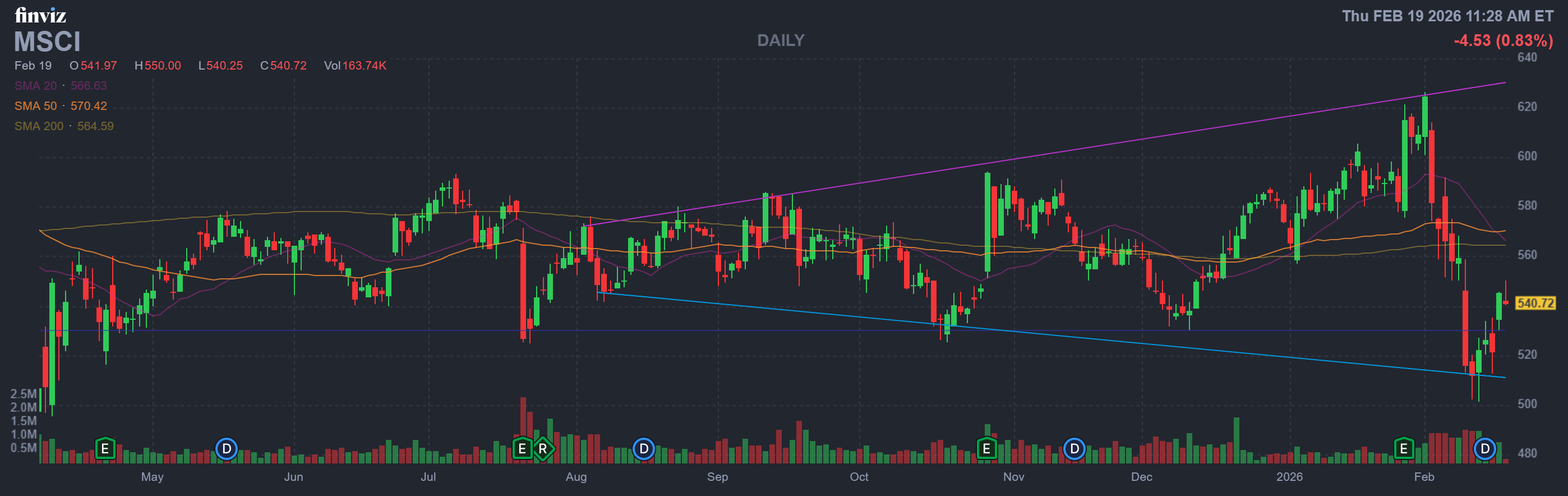
Name: Robert G. Ashe
Position: Director
Transaction Date: 02-18-2026 Shares Bought: 3,681 shares an Average Price Paid of $543.21 for Cost: $1,999,556
Name: Henry A. Fernandez
Position: Chairman and CEO
Transaction Date: 02-13-2026 Shares Bought: 6,800 shares an Average Price Paid of $523.56 for Cost: $3,560,239
Company: MSCI Inc. (MSCI)
MSCI Inc. is a prominent provider of vital decision support tools and solutions for the worldwide investing community, providing mission-critical services to help investors negotiate the complexity of an ever-changing financial landscape. The company provides customers with significant knowledge of the global investment process, as well as expertise in research, data, and technology, enabling them to assess key risk and return drivers and build more successful portfolios. The organization has a thorough understanding of client needs, challenges, and objectives, enabling proactive responses to industry developments. The company is committed to an integrated approach, service quality, and new research, and it ensures that its solutions are accessible through adaptable, cutting-edge technology. The company was incorporated in 1998 and is based in New York, New York.
Robert G. Ashe has served as a Director of MSCI Inc. since December 2, 2013, when he was elected to the company’s Board of Directors and began providing governance oversight as an independent director and member of committees such as Audit and Governance. In April 2018 he was also designated Lead Independent Director, giving him additional board leadership responsibilities. Before joining MSCI’s board, Ashe retired from IBM in 2012 after serving in senior management roles following a long executive career at Cognos, where he held positions including CEO. He holds an Honours Bachelor of Commerce with a major in Accounting from the University of Ottawa and he is also a Certified Public Accountant in Canada.
Henry A. Fernandez has been Chairman and CEO of MSCI Inc. since 1996. Before leading MSCI’s transformation into a fully independent, publicly traded company in 2007, he worked at Morgan Stanley as a managing director, where he was responsible for emerging markets product strategy, equity derivative sales and trading, mergers and acquisitions, global corporate finance, and mortgage finance for US financial institutions. He worked with Morgan Stanley from 1983 to 1991 and again from 1994 to 2007. He earned a Bachelor of Arts in Economics from Georgetown University, an MBA from Stanford University’s Graduate School of Business, and a doctoral studies in economics from Princeton University.
Insomniac Hedge Fund Guy Opinion: MSCI is not a stock. It’s a financial toll road with pricing power masquerading as a ticker symbol. The moat is real — network effects, switching costs, and global brand credibility create a durable competitive fortress. With 95%+ recurring revenue and operating margins north of 50%, this is a capital-light compounding machine that makes most SaaS CEOs jealous.
The risk isn’t the business. The risk is the multiple. MSCI trades like a long-duration asset — exquisitely sensitive to rates and ETF flows. When passive flows surge, MSCI prints money. When markets wobble and ETF flows slow, the stock compresses violently despite stable fundamentals. That’s the paradox of premium franchises.
My DCF suggests fair value in the mid-$400s under reasonable assumptions. If you’re paying materially above that, you’re underwriting flawless execution, sustained ETF dominance, and stable rate regimes. That can work — but you’re not buying cigar butts here. You’re paying for excellence.
Insider buying isn’t driving the story, and short interest is muted. This isn’t a battleground stock — it’s an institutional core holding.
Bottom line: MSCI is a world-class business at a world-class valuation. If you want sleep-at-night quality with compounding characteristics, it belongs on the radar. Just don’t confuse a great company with a great entry point.
Not financial advice. Do your own work.
Name: John W. Stanton
Position: Director
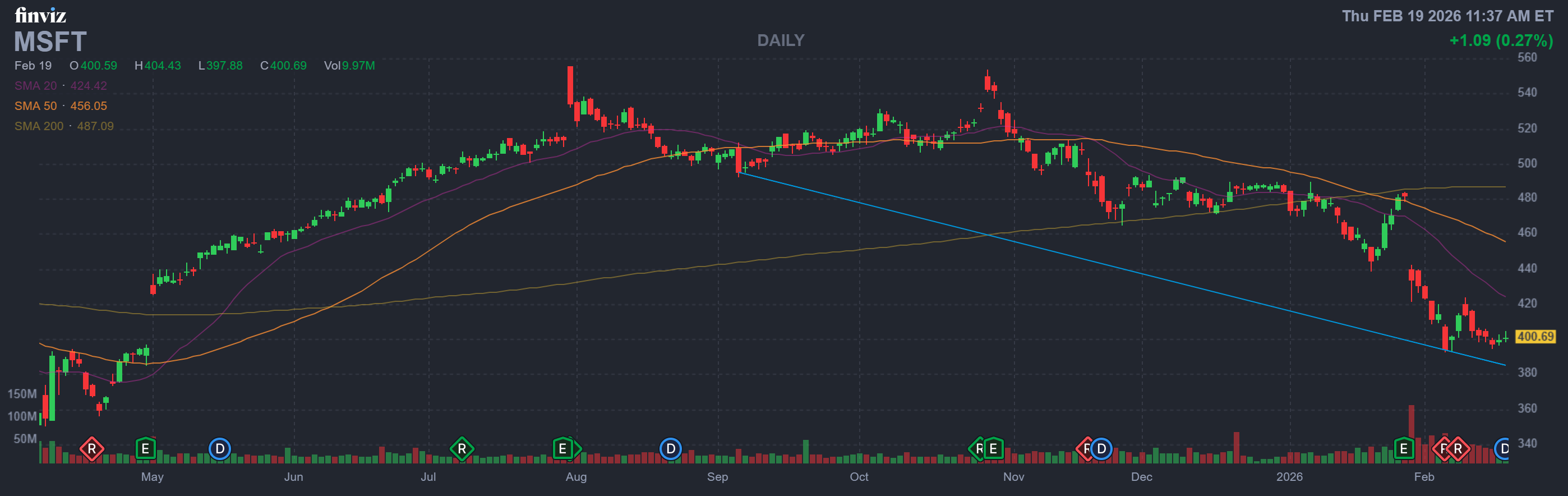
Transaction Date: 02-18-2026 Shares Bought: 5,000 shares an Average Price Paid of $397.35 for Cost:$1,986,750
Company: Microsoft Corp (MSFT)
Microsoft Corporation creates and maintains software, services, devices, and solutions worldwide. The Productivity and Business Processes segment provides Microsoft 365 commercial, enterprise mobility + security, windows commercial, power BI, exchange, sharepoint, Microsoft teams, security and compliance, and copilot; Microsoft 365 commercial products, such as Windows commercial on-premises and office licensed services; Microsoft 365 consumer products and cloud services, including Microsoft 365 consumer subscriptions, office licensed on-premises, and other consumer services. The company was founded in 1975 and is based in Redmond, Washington.
John W. Stanton joined Microsoft Corp. as an independent Director on the company’s board of directors in July 2014, bringing decades of leadership experience from the wireless and communications industry to the role. Before his board appointment, Stanton founded and chaired Trilogy Partnerships and held executive leadership positions such as chairman and CEO of Western Wireless and VoiceStream Wireless, as well as COO and vice chairman of McCaw Cellular. At Microsoft, he has served as a member of key committees, including compensation and audit, helping guide corporate strategy and governance. Stanton earned a bachelor’s degree in political science from Whitman College and an MBA from Harvard Business School.
Insomniac Hedge Fund Guy Opinion: Microsoft is one of the steadiest large-cap compounders you’ll find — fortress margins, high recurring revenue, and entrenched enterprise footprints. But let’s not pretend it’s a cheap call option on AI: the market has priced in durable growth, and the stock’s dependency on capex-heavy AI scaling injects execution risk. Insider purchases by directors signal undervaluation to those closest to the business, but broad insider selling reminds us these executives aren’t all-in. Short interest is muted, so bearish conviction isn’t deep — but neither is speculative froth. For fundamental investors, MSFT offers a rare blend of cash-cow economics and future optionality — not a bargain basement buy but a core holding with premium valuation deserved by quality, not by hype. It’s not financial advice — just one seasoned market mind cutting through the noise.
Name: Lucy Clarke
Position: President of Risk & Broking
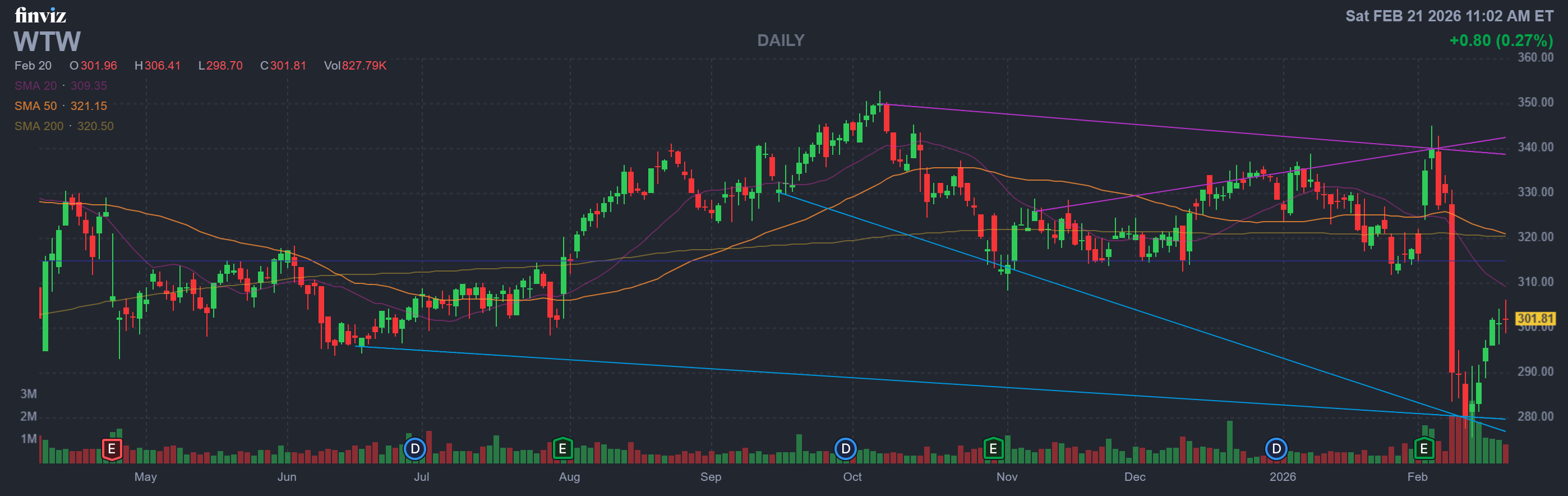
Transaction Date: 02-13-2026 Shares Bought: 3,500 shares an Average Price Paid of $284.84 for Cost: $996,929
Company: Willis Towers Watson PLC (WTW)
Willis Towers Watson Public Limited Company is a global advising, broking, and solutions provider. The company provides strategy and design consultancy, plan management services and support, and integrated solutions such as investment discretionary management, pension administration, core actuarial, and communication and change management aid. It also offers consulting, data, software, and products to help clients with overall rewards and talent concerns. The company also provides software and technology, risk and capital management, goods and pricing, financial and regulatory reporting, financial and capital modeling, mergers and acquisitions, outsourcing, and business management services. The company was founded in 1828 and is headquartered in London, United Kingdom.
Lucy Clarke is the President of Risk & Broking at Willis Towers Watson PLC, having joined the company in 2024 and been appointed to her current role effective July 2024, when she took responsibility for leading the global Risk & Broking segment’s operational and strategic growth within WTW. Before joining WTW, Clarke brought over 25 years of industry experience from senior leadership roles at Marsh and the JLT Group, helping shape specialty and global placement businesses. She holds a Bachelor of Arts in English and Economics from Vanderbilt University.
Insomniac Hedge Fund Guy Opinion:
Willis Towers Watson is not sexy — and that’s precisely why it works. This is a scale-driven, renewal-heavy brokerage machine sitting on a durable revenue base that behaves more like a bond with growth than a growth stock with volatility. The moat is real but not impenetrable; the real differentiator is operating efficiency, and that’s where WTW still trails Marsh and Aon.
The market is currently valuing WTW as a steady compounder rather than a turnaround story. With mid-single-digit revenue growth and incremental margin expansion potential, the upside comes from execution, not reinvention. Insider buying has been modest, but the lack of heavy short interest tells you institutions aren’t lining up for a collapse.
At an estimated intrinsic value near $290 per share using conservative DCF assumptions, the stock looks fairly valued unless margins materially close the gap with peers. If management squeezes out 200–300 basis points of margin improvement, you’ve got upside optionality. If not, you’re collecting steady compounding.
This is a professional’s stock — not a moonshot, not a landmine. Just disciplined capital allocation in a cyclical but resilient industry.
Not financial advice. Do your own work.
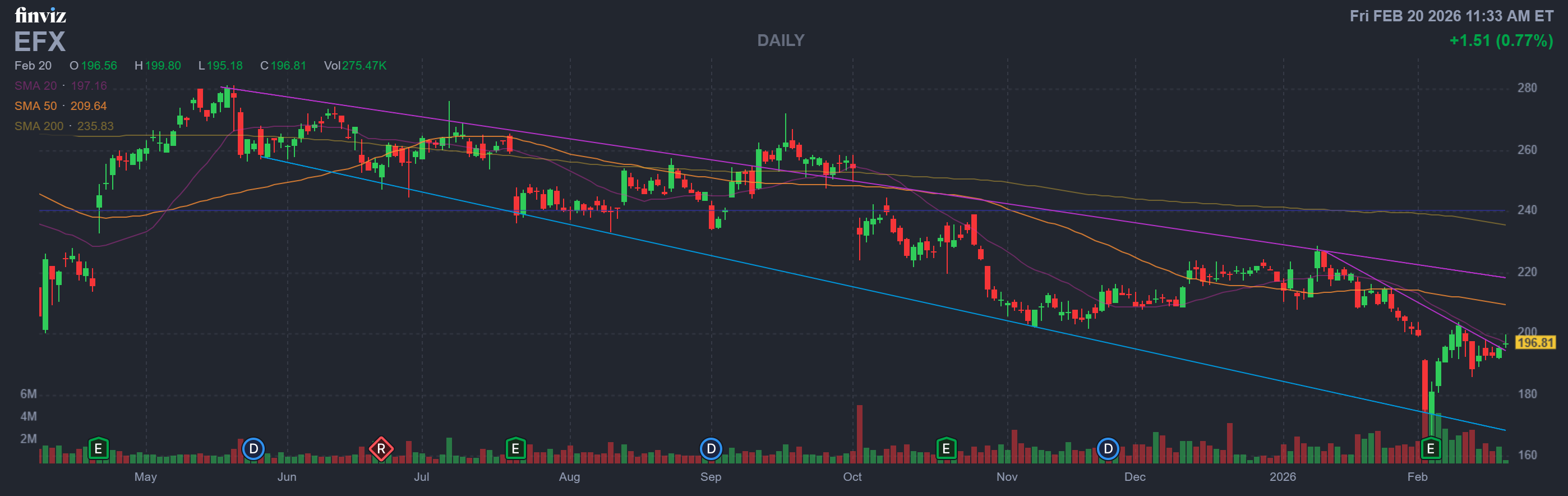
Name: Cecilia Mao
Position: EVP, Chief Product Officer
Transaction Date: 02-18-2026 Shares Bought: 2,400 shares an average price paid of $193.72 for Cost: $464,928
Company: Equifax Inc. (EFX)
Equifax Inc. is a data, analytics, and technology corporation. The Workforce Solutions segment provides services that allow customers to verify their income and employment, as well as services that help employers comply with and automate certain payroll-related and human resource management processes throughout the duration of the employment relationship. The U.S. Information Solutions segment offers consumer and commercial information services, such as credit information and scoring, as well as credit monitoring products. The International section provides information services to consumers and businesses, including credit and financial information, as well as recovery management. The corporation was founded in 1899 and is based in Atlanta, Georgia.
Cecilia Mao is Equifax Inc.’s Executive Vice President and Chief Product Officer, a position she has held since February 2024. She joined the company in May 2020 as Chief Product Officer, leading global product strategy and innovation across key offerings, including fraud, identity, digital, and analytics products. Prior to joining Equifax, she worked in senior product leadership at Oracle Data Cloud and previously at FICO and Verisk Analytics. According to various professional biographies, she finished the Oracle Accelerated Professional Insights program at IESE Business School in 2019. She has a bachelor’s degree in physics from the University of California, Berkeley.
Insomniac Hedge Fund Guy Opinion: Equifax is a classic tollbooth franchise hiding inside a boring credit bureau wrapper. The moat is real — proprietary data, regulatory complexity, and embedded integrations make displacement nearly impossible. Post-breach, management quietly rebuilt the foundation, migrating to the cloud and positioning the company for margin expansion. Workforce Solutions remains the crown jewel, providing recurring, high-margin income verification services that are less cyclical than mortgage origination.
The market’s hesitation centers on housing weakness and macro sensitivity. That’s fair. Mortgage volume drives meaningful incremental profit. But insiders buying during softness suggests confidence that operating leverage will return as cloud investments normalize and housing stabilizes.
At current valuation levels, the stock appears fairly priced under conservative DCF assumptions. It’s not a screaming bargain, but it’s also not priced for structural decline. This is a compounder, not a rocket ship. The upside lies in margin expansion and steady recurring revenue growth, not multiple expansion mania.
Short interest is low because this is not a fragile story. It’s an oligopoly data utility with durable economics. The question isn’t whether Equifax survives — it’s whether you’re willing to own a slow, steady compounder at a reasonable but not cheap price.
Not financial advice. Just one battle-tested market operator’s take.
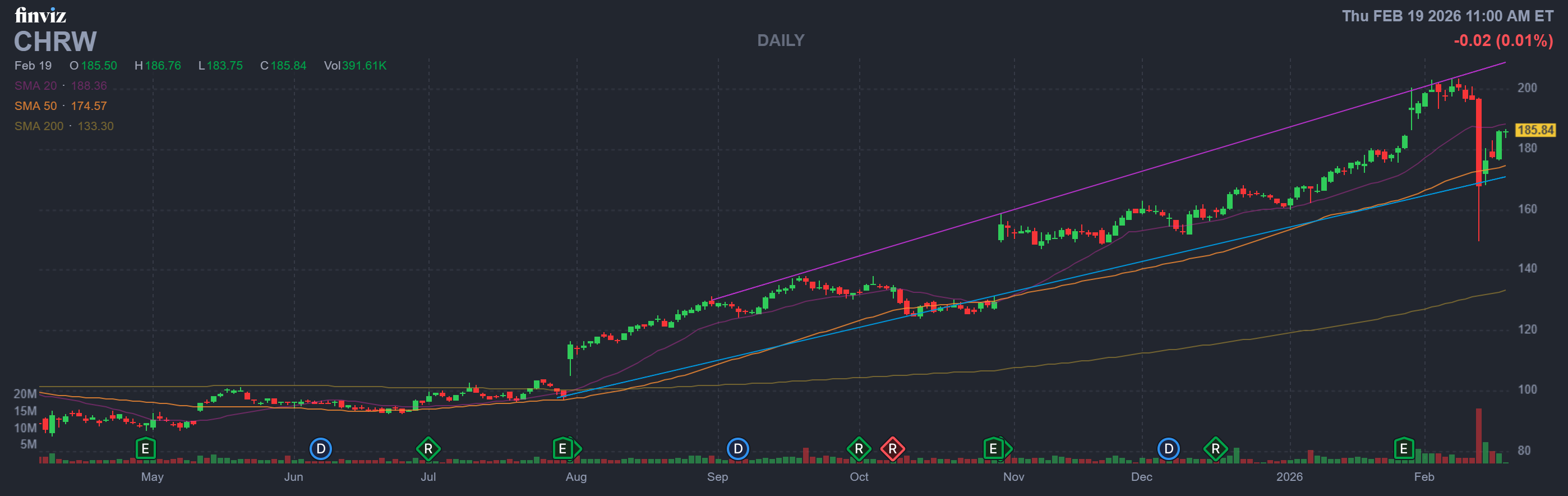
Name: David P. Bozeman
Position: President & CEO
Transaction Date: 02-12-2026 Shares Bought: 1,223 shares an average price paid of $163.34 for Cost: $199,771
Company: C. H. Robinson Worldwide Inc. (CHRW)
C.H. Robinson Worldwide, Inc. and its subsidiaries provide freight transportation, logistics, and supply chain services in the United States and globally. It operates in two segments: North American Surface Transportation and Global Forwarding. The company provides transportation and logistical services. In addition, the company buys, sells, and/or markets fresh fruits, vegetables, and other value-added perishables under the Robinson Fresh brand. Additionally, the organization provides transportation management and other surface transportation services. It distributes fresh produce to grocery stores, restaurants, and produce wholesalers. C.H. Robinson Worldwide, Inc. was formed in 1905 and is based in Eden Prairie, Minnesota.
David P. Bozeman has been President and CEO of C.H. Robinson since June 2023, and he also serves on the company’s Board of Directors. He is an accomplished executive with over 30 years of experience working with industry-leading enterprises and well-known brands in supply chains, middle-mile transportation, manufacturing, digital, and customer service. He previously served as Vice President, Ford Customer Service Division and Vice President, Enthusiast Vehicles at Ford Blue. He formerly worked for Harley-Davidson, Inc. for sixteen years. He also sat on the Board of Directors for Weyerhaeuser 7. He received an MS in Engineering Management from the Milwaukee School of Engineering and a BS in Manufacturing Design from Bradley University.
Insomniac Hedge Fund Guy Opinion: CHRW is a rugged cyclical with enviable scale and AI-driven leverage — a logistics machine in a soft market. The buyback and margin expansion show operational discipline, but revenue softness and elevated valuation compress the margin of safety. At current prices, you’re pricing in near-perfect execution in a sector that hates predictability. Solid credits, but not a cheap or obvious deep value play.
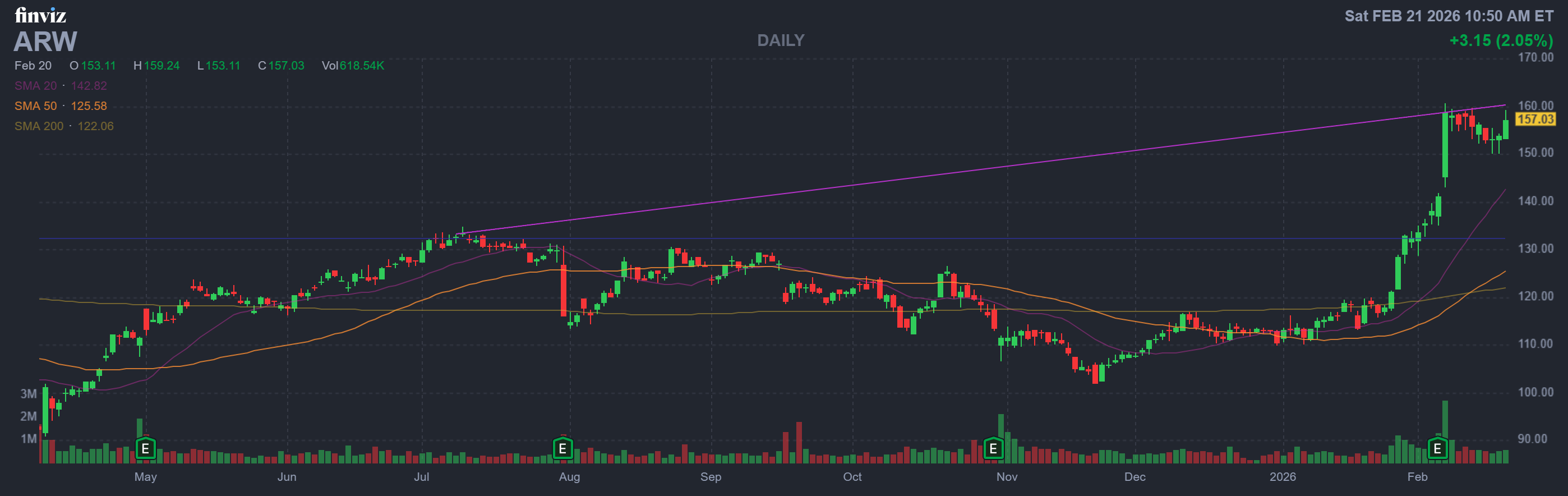
Name: William F. Austen
Position: Interim President and CEO
Transaction Date: 02-19-2026 Shares Bought: 3,960 shares an Average Price Paid of $151.87 for Cost: $601,408
Company: Arrow Electronics Inc. (ARW)
Arrow Electronics, Inc. finds and develops technology for manufacturers, service providers, and enterprise computer solution users in the Americas, Europe, the Middle East, Africa, and Asia Pacific. The Global Components division sells and distributes electronic components, such as semiconductors and related services, as well as interconnect, passive, and electromechanical items, such as capacitors and memory devices, among other things. The Global Enterprise Computing Solutions division provides computing solutions such as data center, cloud, security, and analytics, as well as engineering and integration support and authorized hardware and software training. The company’s clients include original equipment manufacturers, value-added resellers, managed service providers, contract manufacturers, and other commercial entities. Arrow Electronics, Inc. was formed in 1935 and is headquartered in Centennial, Colorado.
William F. Austen is the Interim President and Chief Executive Officer of Arrow Electronics Inc., having been appointed to that role effective September 16, 2025, after the company’s Board of Directors announced a leadership transition and began a search for a permanent CEO. He joined Arrow Electronics as a Director on May 15, 2020, bringing governance experience from his extensive executive career. Prior to his current interim leadership role, Austen served as president, CEO and Director of Bemis Company, Inc., and held leadership and board positions in several industrial firms, giving him broad operational and strategic expertise relevant to Arrow’s global technology distribution business. He earned his Doctor of Science, Honorary, Global Business degree from State University of New York Maritime College and Master’s Engineering Administration degree from The George Washington University.
Insomniac Hedge Fund Guy Opinion: Arrow is a grinder. No glamour. No AI fairy dust. Just trucks, warehouses, inventory turns, and capital discipline. The market hates distribution at the bottom of the cycle and loves it at the top — which tells you exactly when to pay attention. At a reasonable multiple of normalized earnings and strong buyback support, ARW offers a classic cyclical value setup. But don’t kid yourself — this is not a compounder. It’s a timing play wrapped in operational excellence. If you’re buying here, you’re betting on the semiconductor inventory cycle turning, not on structural reinvention. Not investment advice. Just one battle-hardened market operator’s take.
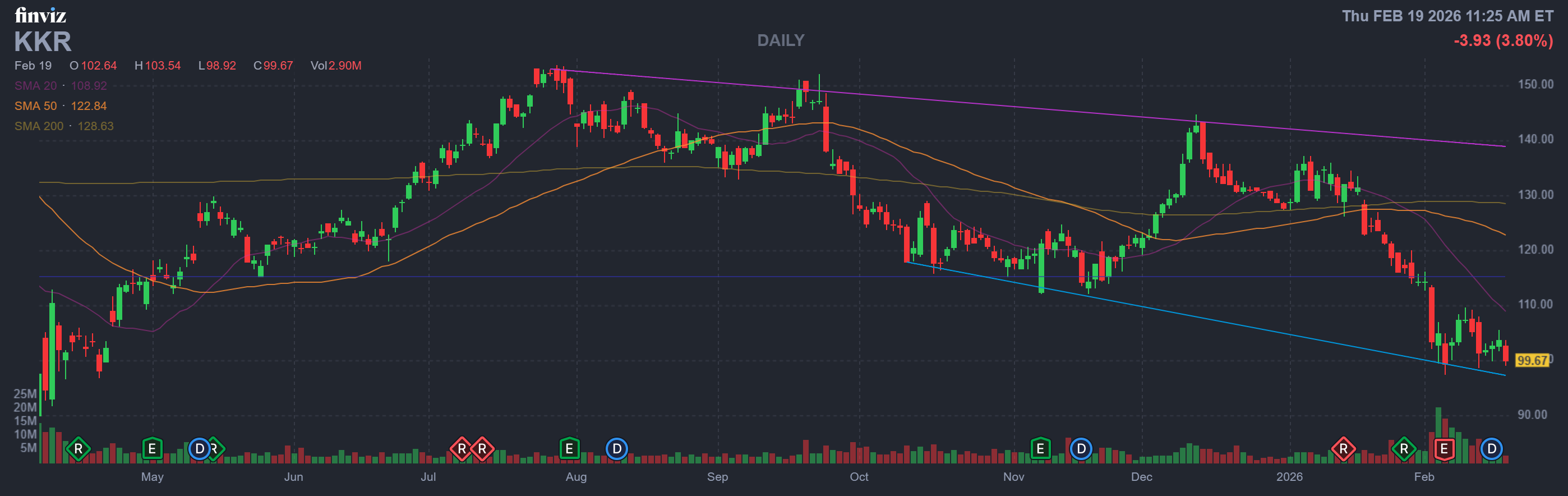
Name: Matt Cohler
Position: Director
Transaction Date: 02-17-2026 Shares Bought: 43,872 shares an average price paid of $102.90 for Cost: $4,514,429
Name: Scott C. Nuttall
Position: Co-Chief Executive Officer
Transaction Date: 02-17-2026 Shares Bought: 125,000 shares an average price paid of $102.66 for Cost: $12,833,087
Name: Joseph Y. Bae
Position: Co-Chief Executive Officer
Transaction Date: 02-17-2026 Shares Bought: 125,000 shares an average price paid of $102.19 for Cost: $12,773,530
Company: KKR & Co. Inc. (KKR)
KKR & Co. Inc. is a private equity and real estate investment corporation focused on direct and fund-of-fund investments. It focuses on acquisitions, leveraged buyouts, management buyouts, credit special situations, growth equity, mature, mezzanine, distressed, turnaround, lower middle market, and medium market investments. The firm considers investments in all industries, with a particular emphasis on software, fintech, data and information, security, semiconductors, consumer electronics, the internet of things, information services, information technology infrastructure, financial technology, network and cyber security architecture, engineering and operations, content, technology and hardware, and so on. The company was founded on May 1, 1976, and is headquartered in New York, with regional offices in North America, Europe, Australia, the Middle East, and Asia Pacific.
Matt Cohler has been a Director of KKR & Co. Inc. since December 31, 2021, when he was appointed as an independent member of the board. Cohler is a seasoned venture capitalist and partner at Benchmark Capital, and his board role at KKR reflects his experience in technology and finance governance. Before joining the KKR board, he held senior roles at major tech firms, including Facebook and LinkedIn, and served on numerous public company boards. He holds a Bachelor of Arts degree from Yale University.
Scott C. Nuttall became Co-Chief Executive Officer of KKR & Co. Inc. in October 2021 and has been a central figure in the firm’s leadership and long-term strategy. He joined KKR in 1996, building his career across the firm’s capital markets, strategic development, and public markets businesses. Prior to becoming Co-CEO, Nuttall served as Co-President and Co-Chief Operating Officer from July 2017 to October 2021, helping guide KKR through significant growth and organizational evolution. He has also been a director of the company since July 2017, contributing to board-level governance and oversight. Nuttall holds a Bachelor of Science degree from the University of Pennsylvania.
Joseph Y. Bae has been a Co-Chief Executive Officer of KKR & Co. Inc. since 2021, sharing the top leadership role as part of a planned succession with Scott Nuttall. He joined KKR in 1996, rising through various senior leadership roles, including Co-President and Co-Chief Operating Officer from July 2017 until his Co-CEO appointment, and has been a member of the company’s Board of Directors since July 2017. Bae is known for driving KKR’s expansion in Asia and leading growth across the firm’s private markets businesses. He holds a Bachelor of Arts degree in economics from Harvard University.
Insomniac Hedge Fund Guy Opinion: KKR’s positioning as an alternatives juggernaut is undeniable, but the valuation still prices in near-perfect fundraising and fee momentum continuing indefinitely. Its moat is real — scale and persistent capital flows — yet not wide enough to ignore cyclical risk or execution drag (FiberCop and other headline struggles). The stock’s recent volatility reflects this tension: great long-term optionality if discipline holds, but no margin for error if markets tighten and deal pricing deteriorates. This is an opportunity for the patient and analytical, not the headline hunter — decent intrinsic buffers but not a screaming value discount.
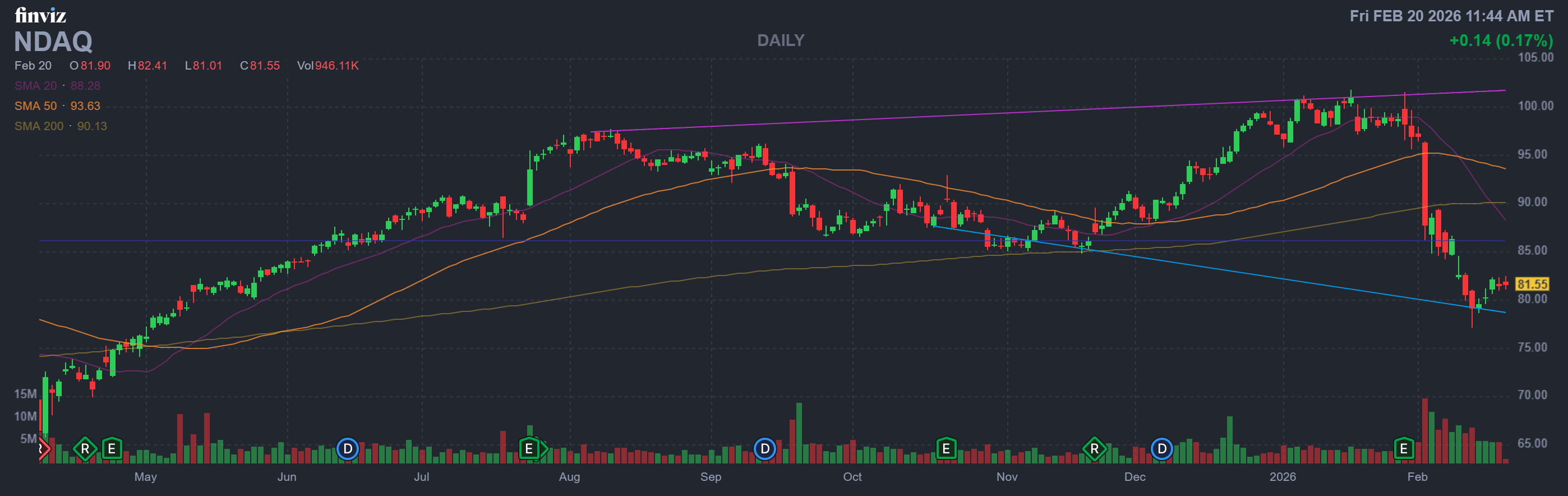
Name: Johan Torgeby
Position: Director
Transaction Date: 02-17-2026 Shares Bought: 12,000 shares an average price paid of $79.86 for Cost: $958,320
Company: Nasdaq Inc. (NDAQ)
Nasdaq, Inc. is a technology business that serves financial markets and other industries in the United States and abroad. It operates in three segments: Capital Access Platforms, Financial Technology, and Market Services. The company distributes historical and real-time market data; creates and licenses Nasdaq-branded indices and financial products; offers investor relations intelligence, governance solutions, and sustainability solutions to public and private companies and organizations, as well as insights and workflow solutions; and runs listing platforms. The corporation was previously known as The NASDAQ OMX Group, Inc., but changed its name to Nasdaq, Inc. in September 2015. Nasdaq, Inc. was founded in 1971 and is based in New York, NY.
Johan Torgeby has served as a Director of Nasdaq Inc. (NDAQ) since July 2022, when he was appointed to the company’s Board of Directors and joined the Finance Committee. He joined Nasdaq at the time of his board appointment and has contributed deep expertise in global banking, capital markets, and financial services. In addition to his role at Nasdaq, he is widely recognized for his leadership in the European financial sector. Mr. Torgeby holds a bachelor’s degree in economics from Lund University in Sweden, which underpins his strong foundation in finance and business strategy.
Insomniac Hedge Fund Guy Opinion:
Nasdaq is no longer just an exchange — it’s morphing into a financial infrastructure software company with exchange DNA. The strategic shift toward high-margin recurring SaaS revenue is the right move in a world where transaction volumes are volatile but compliance and market surveillance spending is not. The Adenza acquisition adds scale and sticky enterprise software revenue, but it also adds leverage and integration risk that the market hasn’t fully digested.
Relative to CME and ICE, Nasdaq’s margins are thinner, but its mix shift could narrow that gap over time. The valuation implies steady execution and moderate growth — not heroic outcomes, but certainly not a distressed asset either. This is a steady compounder if management delivers on integration and deleveraging. It’s not going to 5x from here — but it doesn’t need to.
If insiders step up meaningfully during integration volatility, that’s the tell. Until then, this is a disciplined infrastructure play trading near fair value. Attractive on pullbacks. Not financial advice — just one insomniac who’s seen enough market cycles to know the tollbooth usually wins.
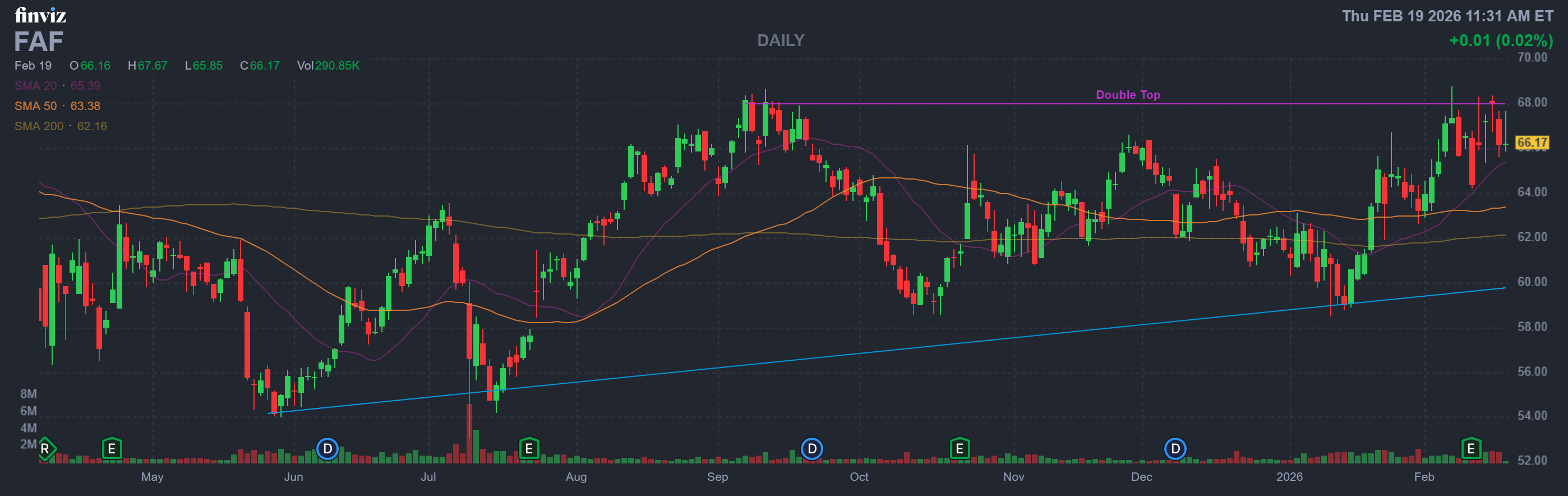
Name: Parker S. Kennedy
Position: Director
Transaction Date: 02-13-2026 Shares Bought: 59,841 shares an Average Price Paid of $67.68 for Cost: $4,050,101
Company: First American Financial Corp (FAF)
First American Financial Corporation, through its subsidiaries, offers financial services. It operates in two segments: Title Insurance and Services, and Home Warranty. The Title Insurance and Services segment issues residential and commercial title insurance policies and provides related products and services on a global scale. It also allows for tax-deferred real estate trades, as well as the maintenance, management, and access to title plant data and records. This sector distributes its products through a network of direct operations and agents in numerous states and the District of Columbia, as well as Canada, the United Kingdom, Australia, New Zealand, South Korea, and other countries. First American Financial Corporation was founded in 1889 and is headquartered in Santa Ana, Calif.
Parker S. Kennedy is the Lead Independent Director and Chairman Emeritus of First American Financial Corporation. He joined the firm in 1977 and was elected to the board in 1987. Over the course of his long career, he held several executive positions, including Chairman and CEO of The First American Corporation from 2003 until the company’s separation in 2010, and Executive Chairman of First American Financial before becoming lead independent director. Throughout his career at First American, Kennedy held high management positions such as president, national sales director, and other leadership roles. He received his bachelor’s degree from the University of Southern California and his Juris Doctorate from Hastings College of the Law.
Insomniac Hedge Fund Guy Opinion: FAF isn’t a sexy SaaS with sticky net retention — it’s a real estate cycler with a franchise built on trust, data, and distribution. Recent results show revenue and earnings inflecting higher, and management’s capital return moves are bullish signals. But its top line is tethered to housing activity and refinancing waves that are notoriously fickle. The current price tags in some cyclical strength; a conservative DCF shows valuation generally fair, not cheap, offering limited downside cushion if transaction volumes disappoint. This isn’t a moat-brand in the tech sense — it’s a deep value cyclical play that rewards macro timing and execution discipline, not buy-and-hold zealotry. Not investment advice — just one sharp market maverick’s take.
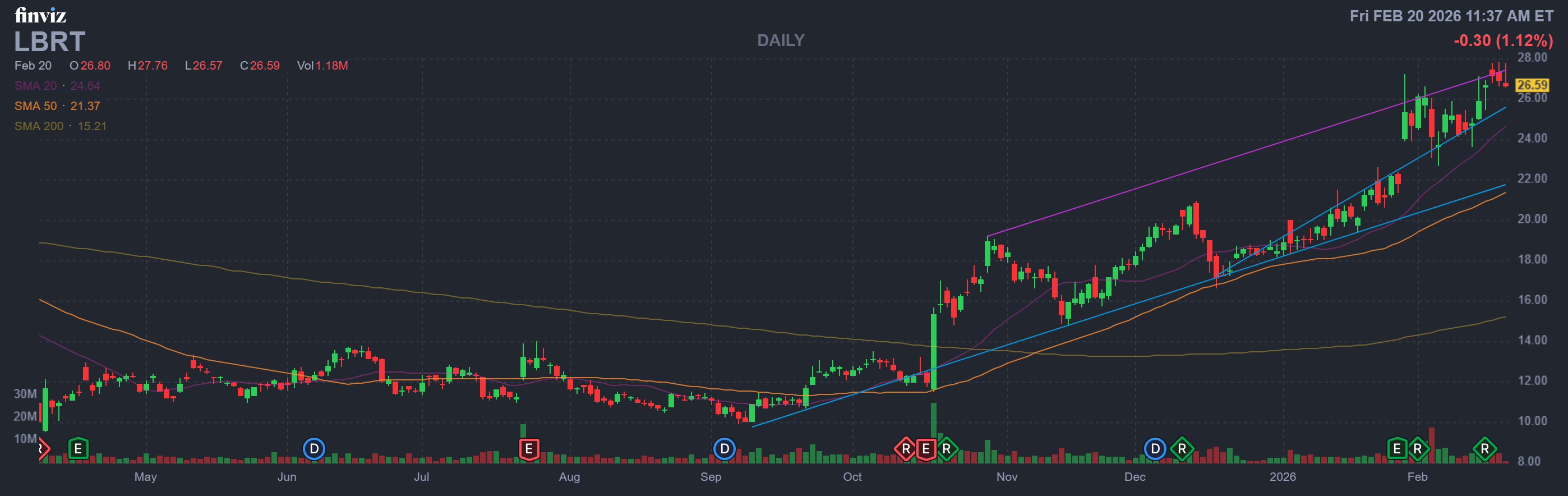
Name: Arjun N. Murti
Position: Director
Transaction Date: 02-17-2026 Shares Bought: 9,696 shares an average price paid of $25.79 for Cost: $250,000
Company: Liberty Energy Inc. (LBRT)
Liberty Energy Inc., a provider of integrated energy services and technology, offers hydraulic fracturing services and related technologies to North American onshore oil, gas, and enhanced geothermal exploration and production firms. It provides wireline services, proppant delivery solutions, field gas processing and treatment, compressed natural gas distribution, data analytics, and related commodities such as sand mine operations and technology, proppant handling equipment, and logistics software. The company was previously known as Liberty Oilfield Services Inc., but it changed its name to Liberty Energy Inc. in April 2022. Liberty Energy Inc. was founded in 2011 and is based in Denver, Colorado.
Arjun N. Murti is an energy industry expert who was appointed as Liberty Energy Inc.’s independent Class I director on January 22, 2025, to fill a newly established board seat with an initial term expiring at the company’s 2026 annual meeting of stockholders. Before joining Liberty Energy’s board, he worked as an equities research analyst, counselor, and board member in the global energy industry, including top positions at Veriten LLC and Warburg Pincus, as well as a long stint at Goldman Sachs. Murti’s extensive background in finance and energy strategy complements his governance responsibilities at Liberty. He earned a Bachelor of Science and a Bachelor of Arts in Finance from the University of Denver.
Insomniac Hedge Fund Guy Opinion:
Liberty Energy is a torque instrument on U.S. shale, not a forever compounder. The company has executed exceptionally well in a brutal industry, improving its balance sheet, generating real free cash flow, and returning capital to shareholders — a rarity in oilfield services. Founder-led management gives it credibility, and its electric frac initiatives position it competitively in a consolidating market.
However, this remains a deeply cyclical business with limited structural moat. Margins are a function of frac pricing power, which in turn depends on oil prices and producer capital discipline. The current valuation suggests the market assumes a moderation of activity rather than a collapse, which is reasonable but leaves limited room for macro error.
Insider buying during softness likely reflects management’s belief that normalized cash flow exceeds what the market implies. The DCF suggests fair value in the low-to-mid $20s under conservative assumptions, meaning upside exists if oil remains stable and service capacity stays tight.
This is not a sleep-well-at-night stock. It’s a cycle bet with a dividend. If you understand where we are in the energy cycle and respect the volatility, Liberty can generate strong returns. If oil rolls over, so will LBRT. Know what you own. This isn’t financial advice — it’s one market veteran’s read on the tape.
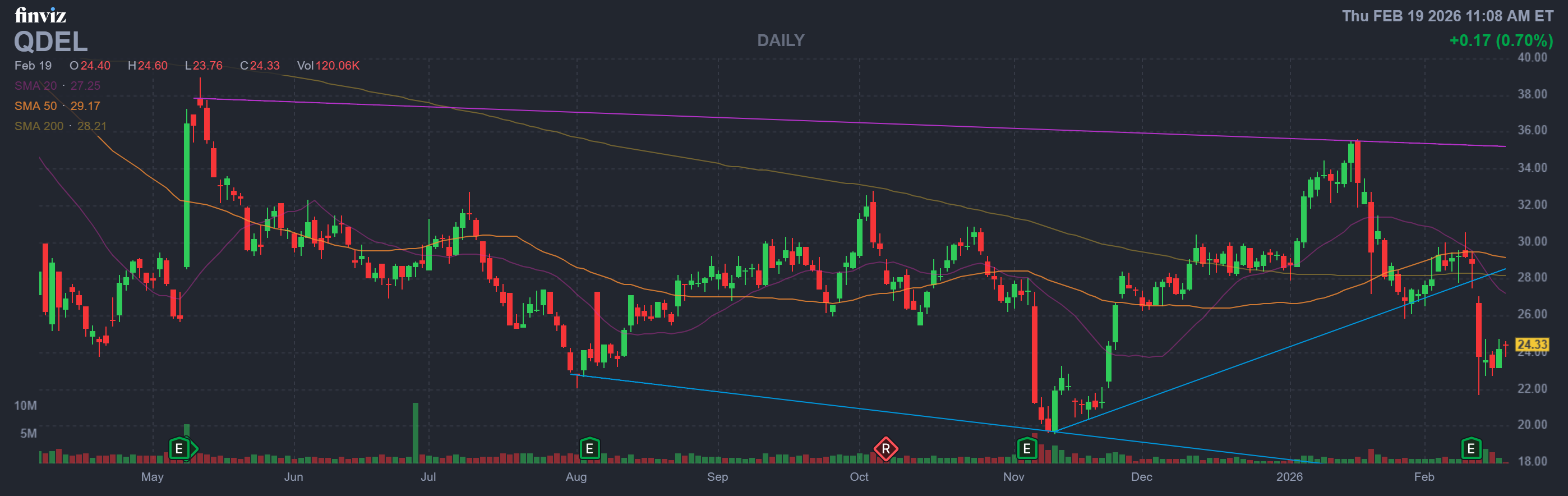
Name: Matthew Strobeck
Position: Director
Transaction Date: 02-13-2026 Shares Bought: 10,000 shares an average price paid of $23.96 for Cost: $239,586
Company: QuidelOrtho Corp. (QDEL)
QuidelOrtho Corporation offers diagnostic testing solutions. The company operates in four business units: Labs, Transfusion Medicine, Point of Care, and Molecular Diagnostics. The Labs business unit offers clinical chemistry laboratory instruments and tests that measure target compounds in bodily fluids for the evaluation of health testing products used to detect and monitor illness progression across a wide range of treatment fields, as well as specialty diagnostic solutions. The company’s products are sold directly to end consumers via a direct sales staff. Its operations span North America, Europe, the Middle East, Africa, China, and other regions. The company was established in 1979 and is based in San Diego, California.
Matthew Strobeck has been an independent director of QuidelOrtho Corp since 2018, joining the board following the merger of Quidel and Ortho Clinical Diagnostics and bringing his expertise in healthcare and life sciences investing and governance. In his role as a director, he has served on key board committees such as the Audit and Science & Technology Committees, assisting in the oversight of the company’s strategic, scientific, and financial elements. Matthew Strobeck earned a B.S. from St. Lawrence University, dual S.M. degrees from the Harvard University/MIT Health Sciences & Technology Program and the MIT Sloan School of Management, and a Ph.D. from the University of Cincinnati.
Insomniac Hedge Fund Guy Opinion: QuidelOrtho is a classic post-pandemic cleanup story — the kind that separates disciplined investors from narrative chasers. The merger created a diagnostics platform with legitimate recurring revenue through reagent pull-through and a defensible installed base. However, the COVID windfall masked underlying operational inefficiencies and left the balance sheet heavier than ideal.
The market has punished QDEL for collapsing pandemic revenues and margin compression, and rightfully so. This is not Abbott. It does not have global scale advantages nor Roche-level pricing power. But it does have something interesting: operational leverage. If management successfully extracts integration synergies and stabilizes organic growth in the mid-single digits, operating margins can meaningfully recover.
Recent insider buying suggests internal confidence that the worst is priced in. Elevated short interest reflects skepticism around execution and debt risk. Both sides have valid arguments.
At current normalized assumptions, intrinsic value sits modestly above depressed trading levels, but the margin of safety is not enormous. This is a turnaround with asymmetric upside if execution improves — and dead money if it doesn’t.
The stock is no longer priced like a growth darling. It’s priced like a company on probation. The question is whether management earns its parole.
Not financial advice. Just one insomniac who’s seen a few cycles.
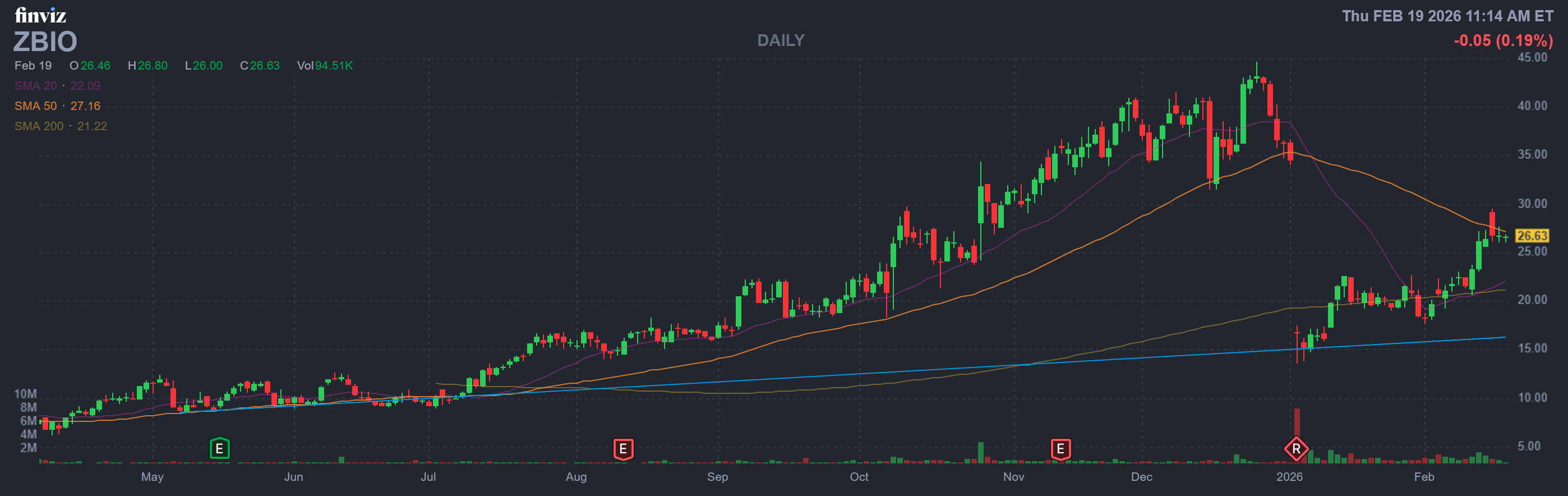
Name: Hongbo Lu
Position: Director
Transaction Date: 02-11-2026 Shares Bought: 25,985 shares an average price paid of $22.50 for a cost of $584,663
Company: Zenas BioPharma Inc. (ZBIO)
Zenas BioPharma, Inc., a clinical-stage biopharmaceutical firm, develops and commercializes breakthrough immunology-based treatments. Obexelimab, a bifunctional monoclonal antibody designed to bind CD19 and FcγRIIb, is the company’s flagship product candidate. It is used to treat immunoglobulin G4-related illness, multiple sclerosis, and systemic lupus erythematosus, among other indications. The business also produces ZB002, an anti-TNFα monoclonal antibody; ZB004, a cytotoxic T-lymphocyte-associated antigen 4-immunoglobulin fusion; and ZB001, an anti-IGF-1R monoclonal antibody. Zenas BioPharma (Cayman) Limited was the company’s previous name until August 2023, when it changed to Zenas BioPharma, Inc. The company was established in 2019 and is based in Waltham, Massachusetts.
Hongbo Lu has served as an independent Director on the board of Zenas BioPharma Inc. since November 2022, where she provides strategic oversight as part of the company’s governance team. Prior to joining Zenas BioPharma, she worked in healthcare investment and life sciences for many years. She is a Class I director of Zenas BioPharma, where she serves on board committees and contributes to the company’s clinical-stage immunology strategy. She received her Ph.D. in bioengineering from the University of Washington, an MBA from the Haas School of Business at the University of California, Berkeley, and an undergraduate degree with honors from Tsinghua University.
Insomniac Hedge Fund Guy Opinion: Zenas BioPharma is not an investment. It’s a wager on biology. The company’s entire valuation rests on obexelimab’s ability to prove it can deliver meaningful efficacy in autoimmune disease while avoiding the safety baggage of traditional B-cell depletion. If that thesis works, the upside is substantial given the size of the addressable market. If it fails, the equity resets toward cash value — and possibly below if dilution looms.
There is no recurring revenue cushion, no diversification, and no operational leverage yet. This is a probability-adjusted math problem disguised as a stock. The market will violently reprice shares around data releases, financing events, or insider activity. Elevated short interest could amplify volatility in either direction.
Management credibility and capital discipline matter more here than PowerPoint slides. If insiders are meaningfully accumulating shares into weakness, that deserves attention. If they are not, neither should you.
ZBIO is appropriate only for investors who understand binary risk and position size accordingly. The opportunity is asymmetric — but so is the downside. This is not financial advice. It’s one market veteran’s sober assessment: respect the science, respect the dilution risk, and never bet more than you’re willing to lose.
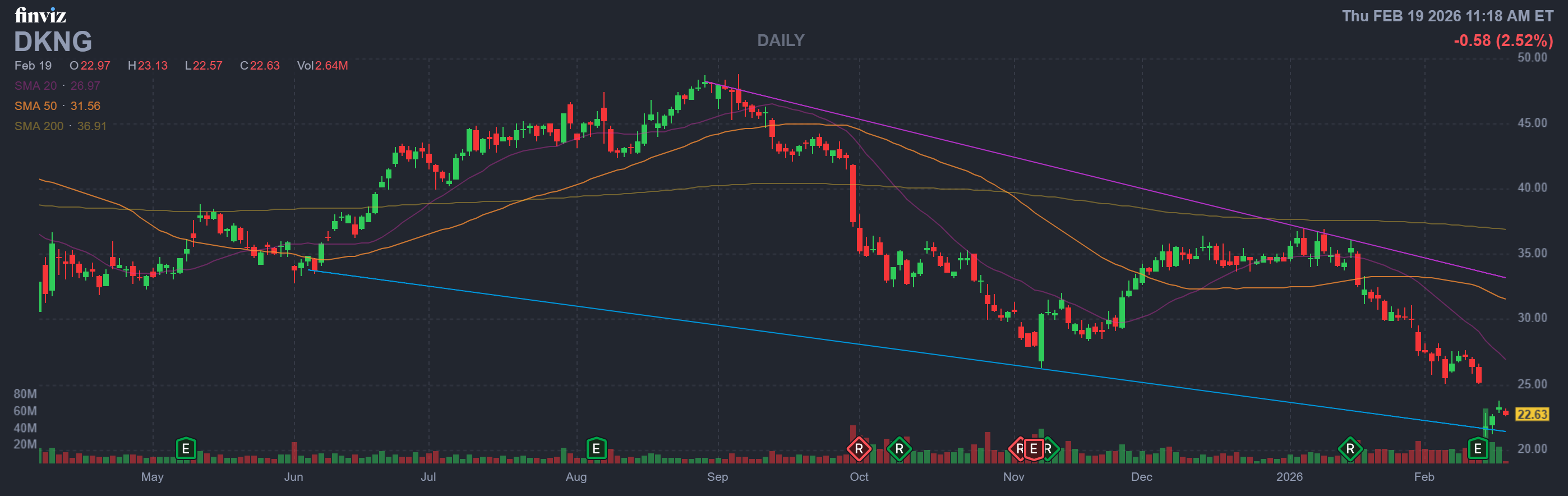
Name: Harry Sloan
Position: Director
Transaction Date: 02-17-2026 Shares Bought: 100,000 shares an average price paid of $21.85 for a cost of $2,185,000
Company: DraftKings Inc. (DKNG)
DraftKings Inc. is a digital sports entertainment and gambling company that operates both in the United States and worldwide. The company provides online and retail sports betting, daily fantasy sports, digital lottery couriers, prediction markets, and other services, in addition to retail sportsbooks. It also offers iGaming, or internet casino items like blackjack, roulette, baccarat, and slot machines. Additionally, the company designs and develops sports betting and casino gaming software for online and retail sportsbooks, as well as iGaming operators. DraftKings Inc. was created in 2011 and is based in Boston, Massachusetts.
Harry Sloan is a director of DraftKings Inc., having joined the board in April 2020. He is a seasoned media investor, entrepreneur, and former studio executive, with experience as chairman and chief executive officer of Metro Goldwyn Mayer and as the founder of SBS Broadcasting. Sloan began his career as an entertainment lawyer and later established the firm Sloan, Kuppin & Ament. He holds a Bachelor of Arts from UCLA and a Juris Doctor degree from Loyola Law School.
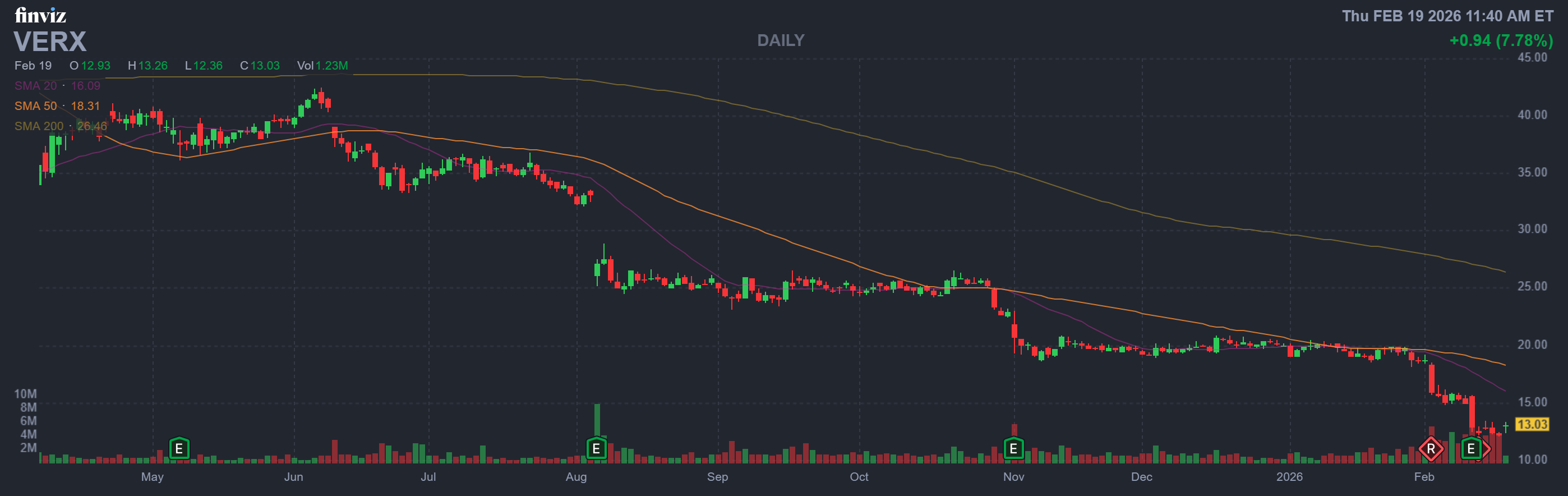
Insomniac Hedge Fund Guy Opinion: DraftKings is no longer a reckless land-grab story — it’s a margin expansion story pretending to be one. The company successfully built scale in a brutal regulatory patchwork and is now harvesting operational leverage in mature states. That shift matters.
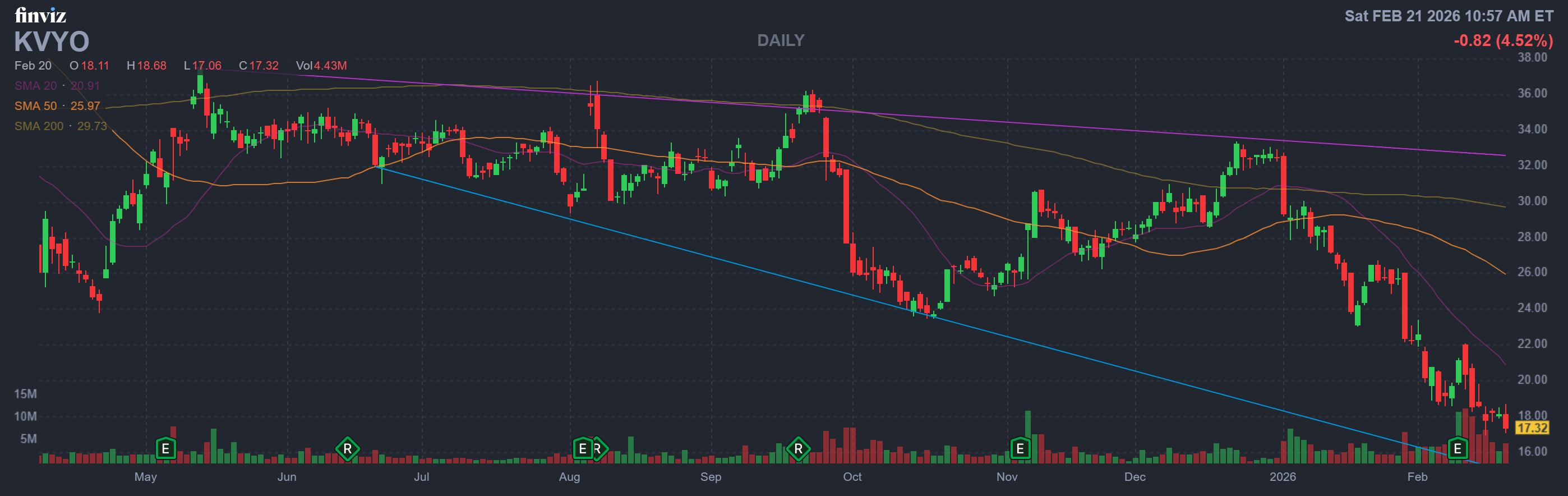
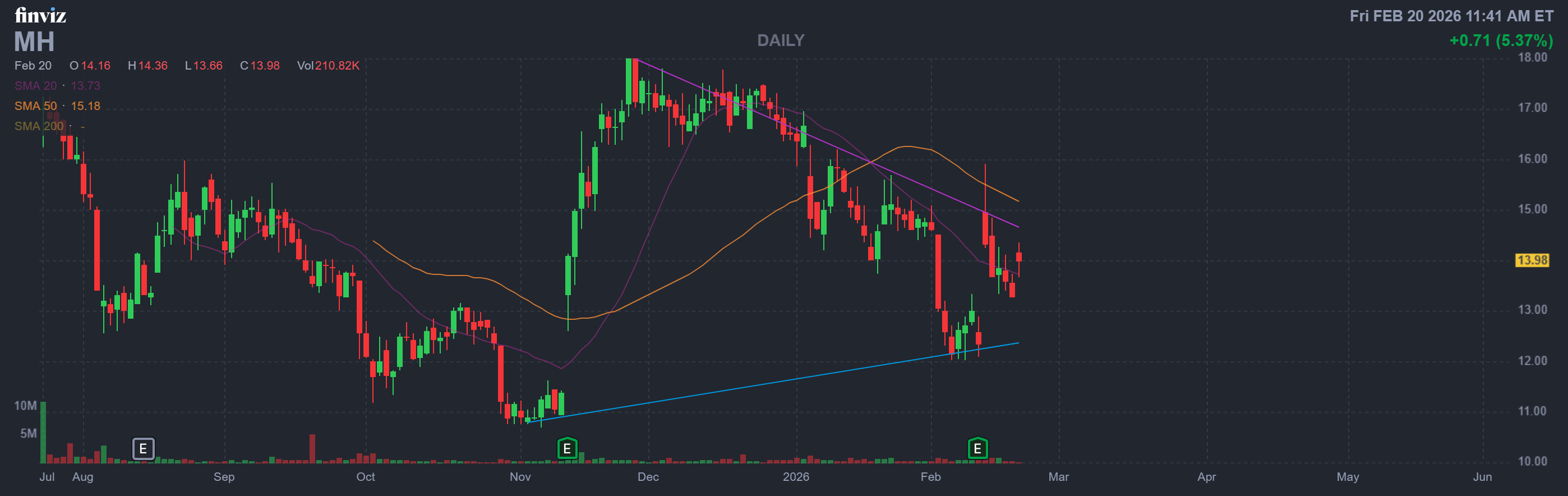
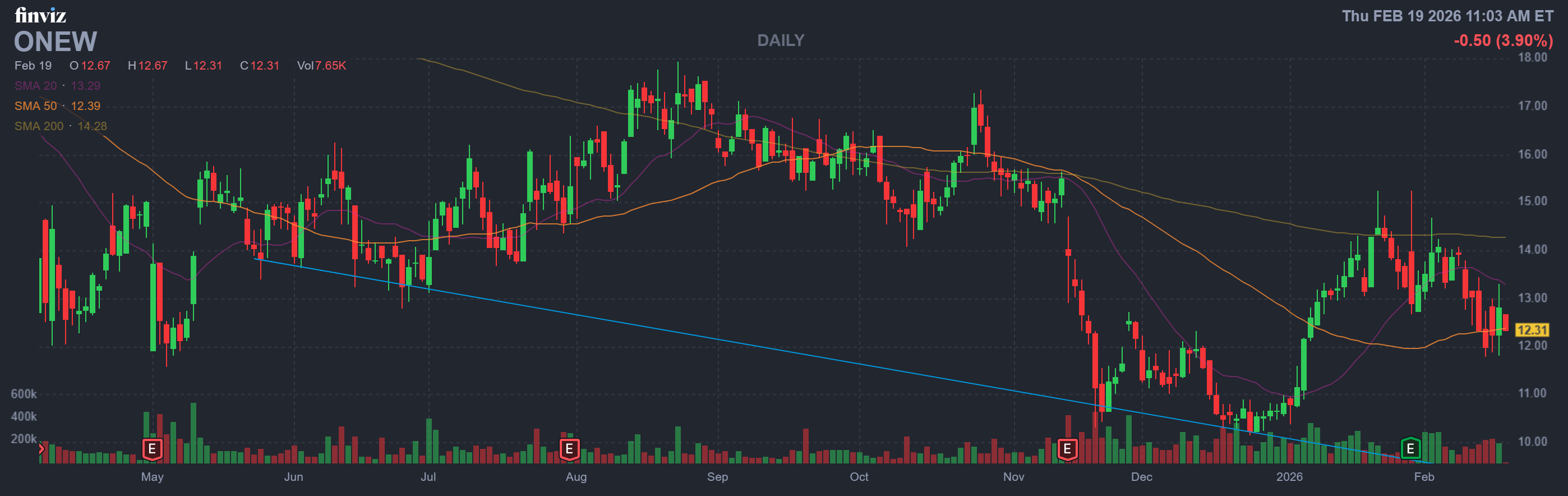
Name: Philip Austin Jr. Singleton
Position: Executive Chairman
Transaction Date: 02-11-2026 Shares Bought: 24,353 shares an average price paid of $12.63 for Cost: $307,501
Company: OneWater Marine Inc. (ONEW)
OneWater Marine Inc. is a recreational marine retailer in the United States. The company sells new and pre-owned recreational boats and yachts, as well as related nautical products, including parts and equipment. It also offers boat repair and maintenance services, as well as ancillary services including indoor and outdoor storage and marina services. In addition, the company offers boat financing, insurance, and extended service contracts for customers through third-party lenders and insurance providers. Furthermore, it rents out boats and personal watercraft. The company was founded in 2014 and is based in Buford, Georgia.
P. Austin Singleton has been the Executive Chairman of the Board of OneWater Marine Inc. since August 2025, overseeing the company’s strategic direction, stakeholder engagement, and shareholder value generation. Mr. Singleton previously held the positions of Chief Executive Officer and Director from April 2019 to August 2025, Chief Executive Officer of OneWater Marine from its establishment in 2014, and CEO of Singleton Marine, which merged with Legendary Marine to form OneWater Marine in 2006. He also served on OneWater Marine’s Board of Managers from its formation in 2006 until its initial public offering (IPO). He graduated from Auburn University with a degree in business and finance.
Insomniac Hedge Fund Guy Opinion: OneWater is not a compounder — it’s a cyclical operator mispriced during sentiment extremes. The post-COVID boat supercycle inflated revenues and margins beyond sustainable levels, and the market is now punishing the stock as if boating demand is permanently impaired. That’s emotional pricing, not analytical pricing. The company’s acquisition-driven scale, growing marina and service mix, and insider alignment create a business that should generate normalized free cash flow even in mid-cycle conditions. However, this is not a structural moat story; it’s a balance-sheet-and-discipline story. If management navigates inventory normalization and protects margins, today’s valuation implies recession-level permanence. Elevated short interest suggests skepticism is crowded. Insider buying signals confidence that the downturn is cyclical, not existential. My DCF suggests fair value materially above depressed trading levels assuming modest growth and conservative margins. This is a “buy fear, sell normalization” setup — but only for investors who understand cyclicals and can tolerate volatility. If the economy rolls hard, it will not be spared. If demand stabilizes, the risk-reward skews asymmetric. Not financial advice — just one market insomniac who knows cycles don’t last forever.
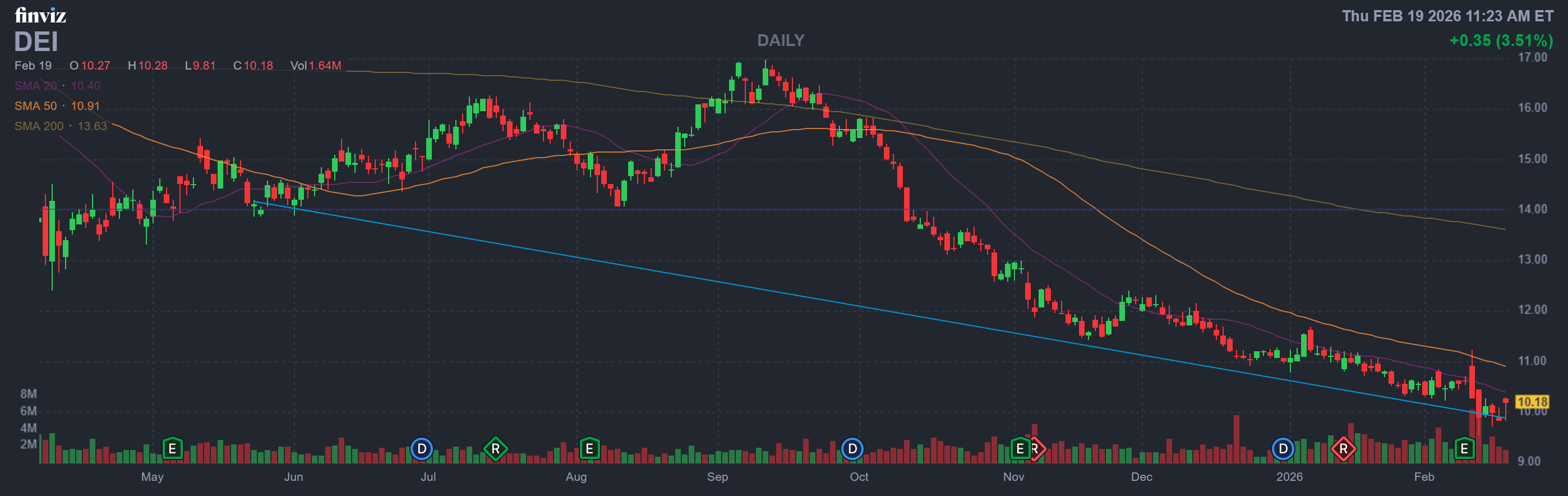
Name: Jordan L. Kaplan
Position: Chairman and CEO
Transaction Date: 02-13-2026 Shares Bought: 98,000 shares an average price paid of $10.18 for Cost: $997,640
Company: Douglas Emmett Inc. (DEI)
Douglas Emmett, Inc. is a fully integrated, self-administered, and self-managed real estate investment trust, as well as one of the leading owners and operators of high-quality office and multifamily facilities in the best coastal submarkets of Los Angeles and Honolulu. Douglas Emmett focuses on owning and acquiring a sizable portion of top-tier commercial complexes and premier multifamily communities in areas with severe supply limitations, high-end executive housing, and critical lifestyle amenities. Douglas Emmett was created in 1971 and completed its initial public offering in 2006.
Jordan L. Kaplan has been the Chairman at Douglas Emmett, Inc. since 2025 and has served as the Chief Executive Officer and a member of the Board since their inception. He joined the company’s predecessor operating companies in 1986, later co-founding its immediate predecessor in 1991, and served as Chief Financial Officer from 1991 to 2006 before helping lead the firm through its evolution into DEI. Kaplan has been CEO and a member of the Board since the company’s inception as a REIT, and he was named Chairman of the Board in 2025. He holds a bachelor’s degree from the University of California, Santa Barbara, and an MBA from the University of California, Los Angeles.
Insomniac Hedge Fund Guy Opinion: DEI is a value play, not a growth story — rent rolls are recurring but hamstrung by macro headwinds. If you’re banking on an office market renaissance or accretive redevelopments, there’s optionality here. But with high leverage and weak profitability, it’s a risk-on trade that requires conviction in coastal real estate rebound. Current pricing discounts fundamentals, but the margin for error is thin — and short sellers are betting you’ll regret being long before the recovery. Not advice, just how the tower math reads.
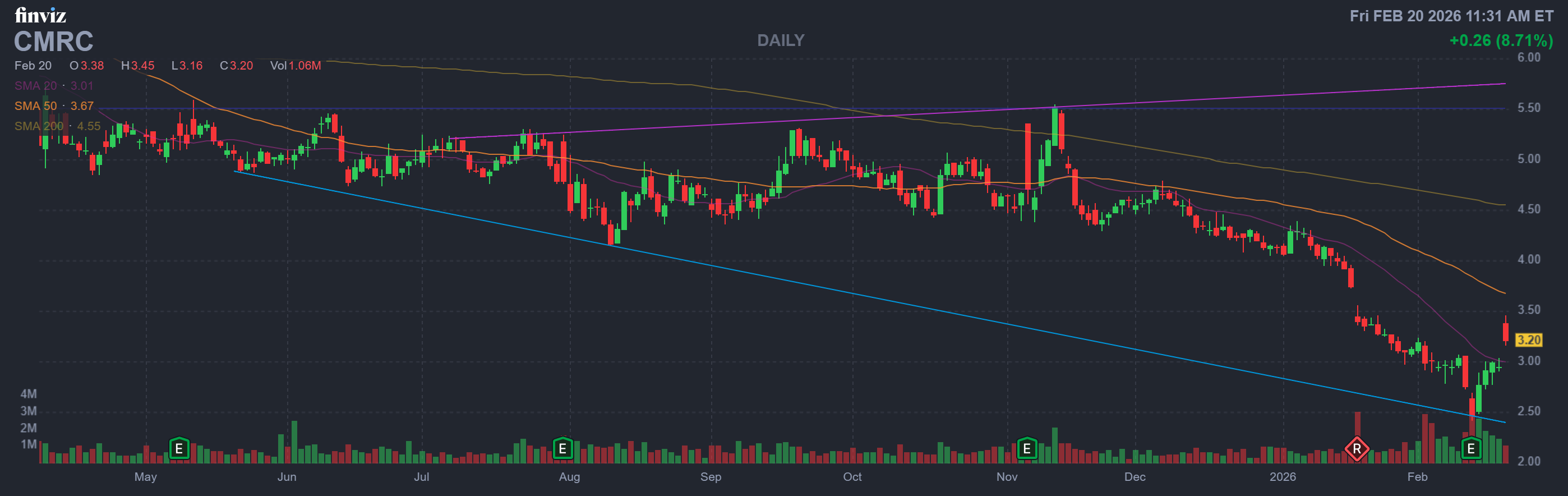
Name: Ellen F. Siminoff
Position: Executive Chair
Transaction Date: 02-17-2026 Shares Bought: 100,000 shares an average price paid of $2.94 for Cost: $294,080
Company: Commerce.com Inc. (CMRC)
Commerce.com, Inc. provides a software-as-a-service e-commerce platform to brands and retailers in the United States, North and South America, Europe, the Middle East, Africa, and the Asia Pacific. The company offers a platform for starting and growing an e-commerce business, which includes store design, catalog management, hosting, checkout, order management, reporting, and pre-integration with third-party services like payments, shipping, and accounting. It serves stores of all sizes, product categories, and purchasing kinds, including business-to-consumer and business-to-business. Commerce.com, Inc. was previously known as BigCommerce Holdings, Inc., but changed its name to Commerce.com, Inc. in July 2025. The company was founded in 2009 and is based in Austin, Texas.
Ellen F. Siminoff was appointed Executive Chair of Commerce.com Inc. on October 1, 2024, a position designed to strengthen strategic leadership and governance. She joined the company’s Board of Directors in February 2020 and has since taken an active part in long-term planning and executive oversight. Siminoff formerly held senior leadership and board positions in the technology and media sectors, bringing decades of experience to her new job. She earned her BA in economics from Princeton University and an MBA from the Stanford Graduate School of Business.
Insomniac Hedge Fund Guy Opinion: Commerce One wasn’t a company. It was a liquidity event masquerading as a revolution. The business model depended less on durable economics and more on capital market enthusiasm. Revenues grew fast, but growth without profitability is just acceleration toward a cliff if unit economics don’t work. There was no recurring revenue engine, no durable moat, and no margin structure to justify the absurd valuation.
At its peak, the stock traded at a valuation that required flawless execution, dominant market share, and sustained 30%+ long-term growth. What it delivered instead was dilution, cash burn, and eventually bankruptcy.
The lesson isn’t that B2B commerce was a bad idea — it wasn’t. The lesson is that price matters. Valuation discipline matters. Insider behavior matters.
Shorting it early would’ve required titanium nerves. Buying it required blind faith.
Commerce One is a permanent reminder that narrative is not cash flow, TAM is not profit, and a rising stock is not validation of intrinsic value.
The market will always produce a new Commerce One. Your job isn’t to mock it — it’s to recognize it before it recognizes you.
Not financial advice. Just one market veteran’s scar tissue talking.