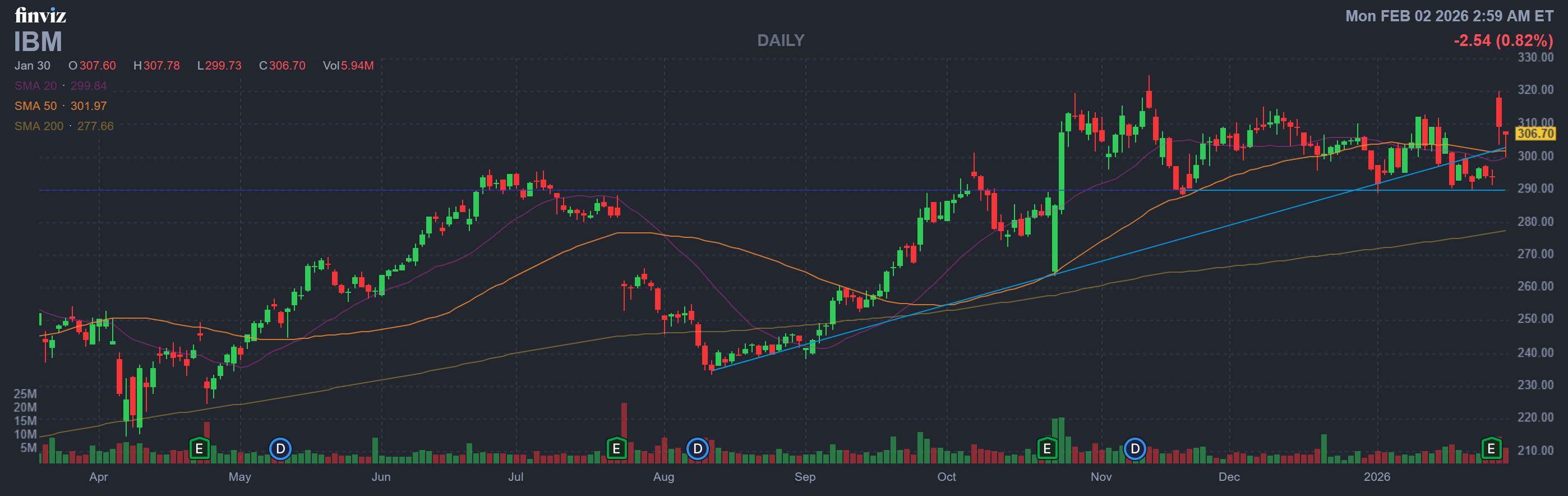
Name: David N. Farr
Position: Director
Transaction Date: 01-30-2026 Shares Bought: 1000 shares an average price paid of $304.00 for a cost of $304,000
Company: International Business Machines Corp. (IBM)
International Business Machines Corporation and its subsidiaries provide integrated solutions and services throughout the Americas, Europe, the Middle East, Africa, and Asia Pacific. It operates in four segments: software, consulting, infrastructure, and finance. The software segment provides hybrid cloud and AI solutions that enable clients to achieve digital and AI transformations across their apps, data, and environments. Its consulting division integrates talents for strategy, experience, technology, and operations across domains and industries. The Infrastructure division offers both on-premises and cloud-based server and storage solutions, as well as lifecycle services for hybrid cloud infrastructure deployment. International Business Machines Corporation, founded in 1911, is headquartered in Armonk, New York.
David N. Farr has been an independent director on the board of International Business Machines Corporation since January 1, 2012. Before joining IBM’s board, Farr had a long career at Emerson Electric Co., which he joined in 1981, rising through various leadership roles to become Chairman and Chief Executive Officer until his retirement in 2021. In addition to his board service at IBM, Farr brings decades of global executive experience from leading a major industrial enterprise. He holds a B.A. in Chemistry from Wake Forest University and an MBA from Vanderbilt University.
Insomniac Hedge Fund Guy Opinion: IBM’s transformation from Big Blue legacy to hybrid cloud/AI player is real, backed by software growth and strategic buys. But let’s be honest: it’s not a high-octane growth stock like Snowflake or AWS. The moat is durable enterprise relationships, not explosive market share. Recent insider buys are confidence plays, not screaming buy signals. The stock’s current valuation doesn’t leave a huge margin of safety against execution missteps, though the recurring revenue shift and emerging AI book lend downside protection. In a market that loves clear growth paths, IBM trades like a hybrid value/growth story—solid, but without the squash-the-competition mojo of pure cloud leaders. Not financial advice—just street-smart analysis.
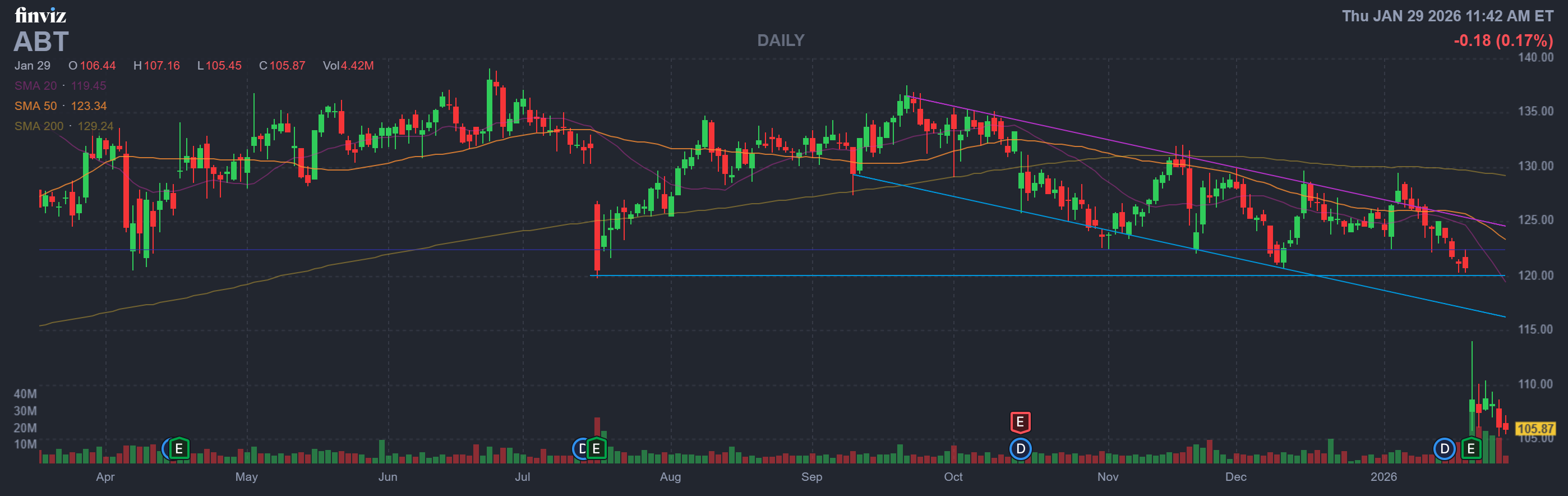
Name: Robert B. Ford
Position: Chairman and CEO
Transaction Date: 01-23-2026 Shares Bought: 18,800 shares an average price paid of $107.13 for Cost: $2,013,967
Company: Abbott Laboratories (ABT)
Abbott Laboratories and its subsidiaries discover, develop, manufacture, and sell health-care products around the world. It operates in four business segments: established pharmaceutical products, diagnostic products, nutritional products, and medical devices. The company provides generic pharmaceuticals for the treatment of pancreatic exocrine insufficiency, irritable bowel syndrome or biliary spasm, intrahepatic cholestasis or depressive symptoms, gynecological disorder, hormone replacement therapy, dyslipidemia, hypertension, hypothyroidism, hypertriglyceridemia, Ménière’s disease and vestibular vertigo, pain, fever, inflammation, and migraine, as well as anti-infective clarithromycin, influenza vaccine, and products. In addition, the company offers nutritious items for children and adults, as well as infant formula. Abbott Laboratories was founded in 1888 and is headquartered in Abbott Park, Illinois.
Robert B. Ford is Abbott’s Chairman of the Board and CEO. He became chairman in December 2021, after being appointed president and CEO in March 2020. He previously held the positions of president and chief operating officer and executive vice president of medical devices at Abbott, where he oversaw the diabetes care, cardiovascular, and neuromodulation divisions. Mr. Ford holds a bachelor’s degree from Boston College and a master’s degree in business administration from UC Berkeley’s Haas School of Business.
Insomniac Hedge Fund Guy Opinion: Abbott is a quality healthcare heavyweight with diversified revenue and a steady cash engine, but don’t confuse consistency with explosive optionality. The stock’s recent sell-off reflects near-term execution headwinds (nutrition slump, testing normalization), not a broken business. Management’s insider purchase is a bullish signal — smart operators rarely buy into broken franchises — and the Exact Sciences deal strategically shifts the growth needle into high-margin diagnostics. Yet the valuation already prices a decent long-term trajectory, so you’re not getting a screaming discount here. This is a deep compounder, not a fast-money growth flier — decent ballast for a portfolio, but don’t lean on it for outsized returns. Not investment advice — just a seasoned perspective.
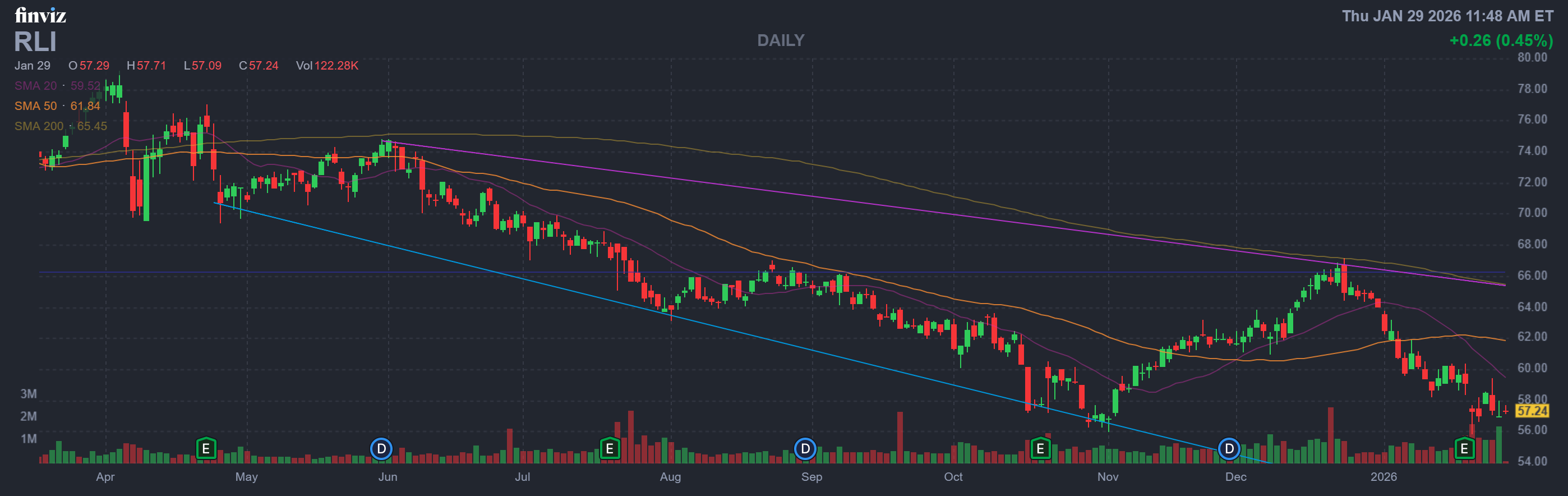
Name: Jennifer L. Klobnak
Position: Chief Operating Officer
Transaction Date: 01-23-2026 Shares Bought: 2,000 shares an average price paid of $57.99 for Cost: $115,980
Name: Craig W. Klietherme
Position: Chief Executive Officer
Transaction Date: 01-23-2026 Shares Bought: 5,000 shares an average price paid of $57.45 for Cost: $287,250
Company: RLI Corp. (RLI)
RLI Corp. is a specialist insurance firm in the United States that underwrites property, casualty, and surety products. It frequently targets specialized or underdeveloped markets through a network of agents and brokers. RLI, known for its personalized coverage and deep underwriting knowledge, services both commercial and personal insurance clients across the United States, emphasizing strong relationship-driven service. The organization has established a reputation for prudent risk management and steady performance in specialty lines. RLI was established in 1965 in Peoria, Illinois.
Jennifer L. Klobnak has been the Chief Operating Officer of RLI Corp., since January 2022, where she oversees operational strategy and execution throughout the company’s specialty insurance businesses. At RLI, she promotes process excellence, cross-divisional collaboration, and innovation to support long-term growth in specialty property, casualty, and surety markets. Klobnak has held advanced leadership positions within the firm since her arrival in 2000, providing extensive experience in operations, risk services, and enterprise risk management to her present post. Her extensive stay demonstrates her dedication to improving organizational performance and customer service. Jennifer L. Klobnak earned a Bachelor of Science in Accounting from Bradley University.
Craig W. Kliethermes has been the president and CEO of RLI Corp., since January 2022. He is responsible for the strategic direction and operational execution of RLI’s main insurance operations, ensuring disciplined underwriting and enterprise performance. Kliethermes joined RLI in 2006 and has held several leadership positions, including President and Chief Operating Officer of RLI and its subsidiaries, where he oversaw significant operational and risk management projects. His extensive industry knowledge enables continued growth and service excellence in specialty property, casualty, and surety markets. Craig W. Kliethermes has a Bachelor of Science in Mathematics from Maryville University in St. Louis and professional actuarial certifications.
Insomniac Hedge Fund Guy Opinion: RLI isn’t sexy — it’s discipline incarnate. A niche P&C insurer with decades of underwriting profitability and a dividend streak that would make an aristocrat blush. Yet the market’s love of growth and scale has RLI trading like a comp-grade slow grower, not a precision risk-selector. Insider buys signal conviction that near-term earnings slumps are temporary and underwriting trends will normalize — but you’re not buying a rocket ship. RLI’s valuation implies a modest margin of safety only if combined ratios stay tight and insurance pricing holds. As a hedge fund maverick, I respect the discipline and balance sheet, but sector cyclicality and limited blockbuster growth cap the upside. Not a screaming buy, but worth a seat at the table if you believe specialty insurance outperforms commoditized carriers. Not financial advice — just one veteran market mind’s cut.
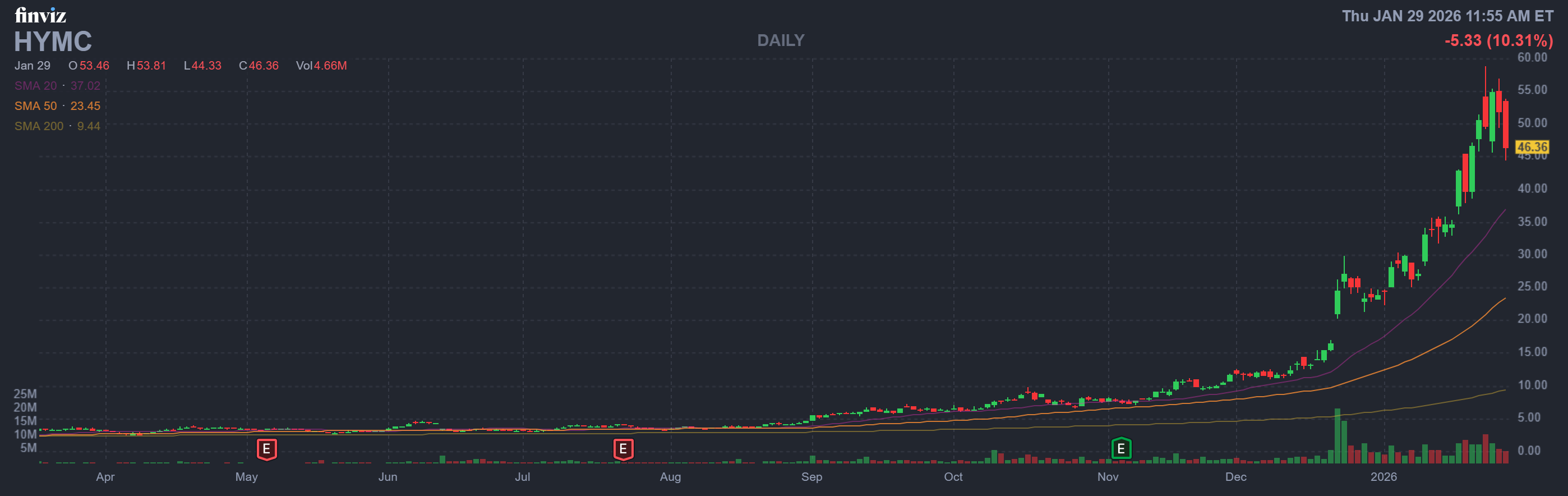
Name: Eric Sprott
Position: Owner
Transaction Date: 01-26-2026 Shares Bought: 100,000 shares an average price paid of $49.96 for Cost: $4,996,000
Company: Hycroft Mining Holding Corp. (HYMC)
Hycroft Mining Holding Corp. is a gold and silver exploration and development business established in the United States. Its primary focus is on expanding the Hycroft Mine, one of the world’s largest precious metals resources, located in northern Nevada’s Tier-1 mining jurisdiction. The company’s current strategy focuses on technical research, exploration drilling, and converting the asset to eventual commercial operations while maximizing high-grade gold and silver potential throughout its vast land holdings. Hycroft is publicly traded on the NASDAQ under the symbol HYMC and employs a team to drive research and development initiatives at the site. Hycroft Mining Holding Corp. was founded through its company combination and incorporation in 2017 and took on the name Hycroft Mining Holding Corporation on May 29, 2020.
Eric Sprott has been an owner of Hycroft Mining Holding Corp., since March 2022, when he made a significant equity investment that established him as one of the company’s largest shareholders. He became associated with Hycroft at that time as a strategic investor, supporting the company during a critical phase of its development, and has since increased his ownership through additional share purchases disclosed in regulatory filings. Sprott is not involved in day-to-day operations but is recognized for his long-standing influence as a prominent resource-sector investor. He holds a Bachelor of Commerce degree from Carleton University.
Insomniac Hedge Fund Guy Opinion: HYMC is the poster child for speculative mining leverage: a structurally weak earnings story anchored to macro metal prices rather than recurring business performance. Its capital structure reset and deep institutional buy-ins (especially from Eric Sprott) have fueled narrative plays and momentum trading, but this is not a traditional investment on fundamentals. The valuation today feels priced for perfection: a smooth transition to commercial production and exploration catalysts that justify its risk profile. Without meaningful revenue or profitability, the cash flow models don’t support the current valuation at reasonable discount rates — but the crowd trades this like a levered gold ETF. That’s fine if you understand you’re playing option-like asymmetry tied to metal prices and drilling results, not cash flow stability. Investors chasing this need conviction in drilling success, permitting timelines, and metals markets — because without them, HYMC remains a development gamble.
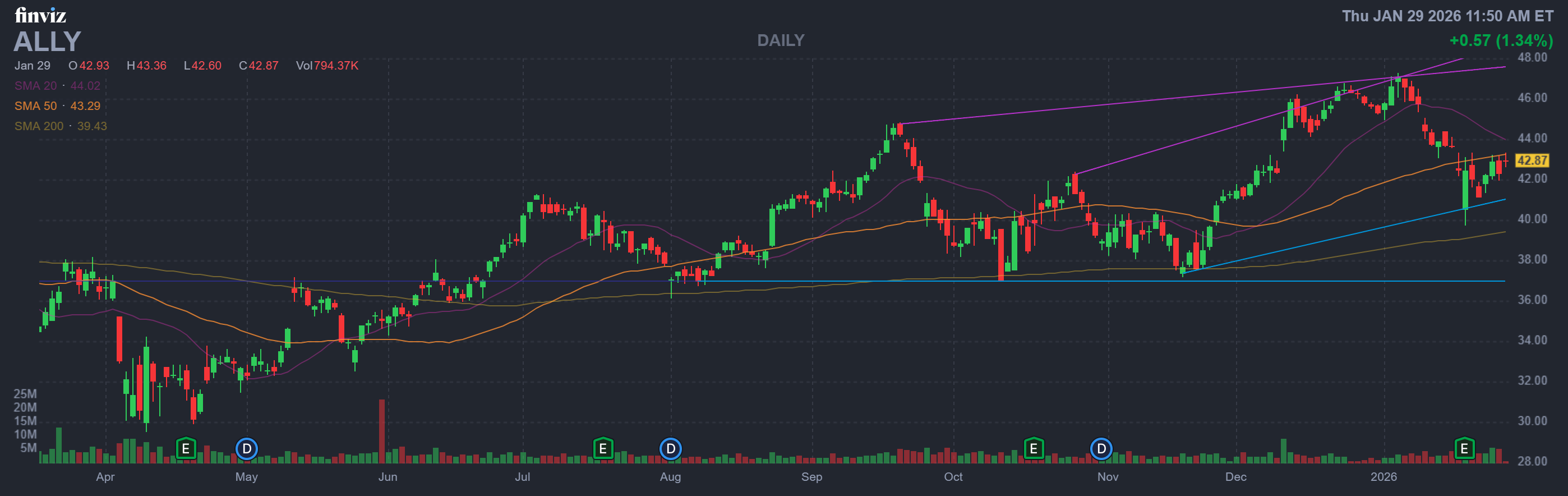
Name: Russell E. Hutchinson
Position: Chief Financial Officer
Transaction Date: 01-27-2026 Shares Bought: 11,566 shares an average price paid of $43.17 for Cost: $499,307
Name: Michael George Rhodes
Position: Chief Executive Officer
Transaction Date: 01-23-2026 Shares Bought: 23,800 shares an average price paid of $41.68 for Cost: $991,867
Company: Ally Financial Inc. (ALLY)
Ally Financial Inc., a digital financial services firm, offers a variety of digital financial products and services in the United States, Canada, and Bermuda. The company operates in four segments: Automotive Finance Operations, Insurance Operations, Corporate Finance Operations, and Corporate and Other. The company also offers consumer finance and insurance products through the car dealer channel, as well as commercial insurance directly to dealers. Furthermore, the company offers commercial banking products and services, as well as stock brokerage and investment advisory services. The company was previously known as GMAC Inc. before changing its name to Ally Financial Inc. in May 2010. Ally Financial Inc. was formed in 1919 and is headquartered in Detroit, Michigan.
Russ Hutchinson has been the Chief Financial Officer of Ally Financial since July 2023. In this job, he is in charge of Ally’s finance, accounting, capital markets, treasury, investor relations, supply chain, and modeling and analytics divisions. Hutchinson formerly worked at Goldman Sachs Group Inc. as chief operating officer for global mergers and acquisitions, following a stint as chief strategy officer, where he supervised mergers and acquisitions, strategy, and innovation. Hutchinson began his career as an associate consultant at the Boston Consulting Group’s Toronto office. He earned a Bachelor of Science in Engineering Physics from Queen’s University in Canada and an MBA from the University of Chicago Booth School of Business.
Michael George Rhodes joined Ally Financial Inc. in April 2024, assuming the role of Chief Executive Officer on April 29, 2024, and was subsequently appointed to the company’s board of directors. He has more than 25 years of expertise in retail and consumer banking, having previously served as CEO and President of Discover Financial Services, as well as key leadership positions at TD Bank, Bank of America, and MBNA America Bank. His leadership experience has included driving digital transformation, developing technological strategies, and implementing operational innovations at large financial organizations. He earned a Bachelor of Science in Engineering from Duke University and later completed a Master of Business Administration from the Wharton School of the University of Pennsylvania, building a strong academic foundation for executive leadership.
Insomniac Hedge Fund Guy Opinion: Ally is a structurally solid digital bank with real franchise value in auto finance and deposits — but not a high-growth tech juggernaut. Its valuation assumes cyclical credit stabilization and execution on efficiency gains. Insider buys hint at confidence in this transition, but heavy reliance on cyclical lending and regulatory overhead keeps intrinsic value closer to conservative cash flows than peak multiples. Risk-aware investors should respect margins and credit cycles before overpaying.
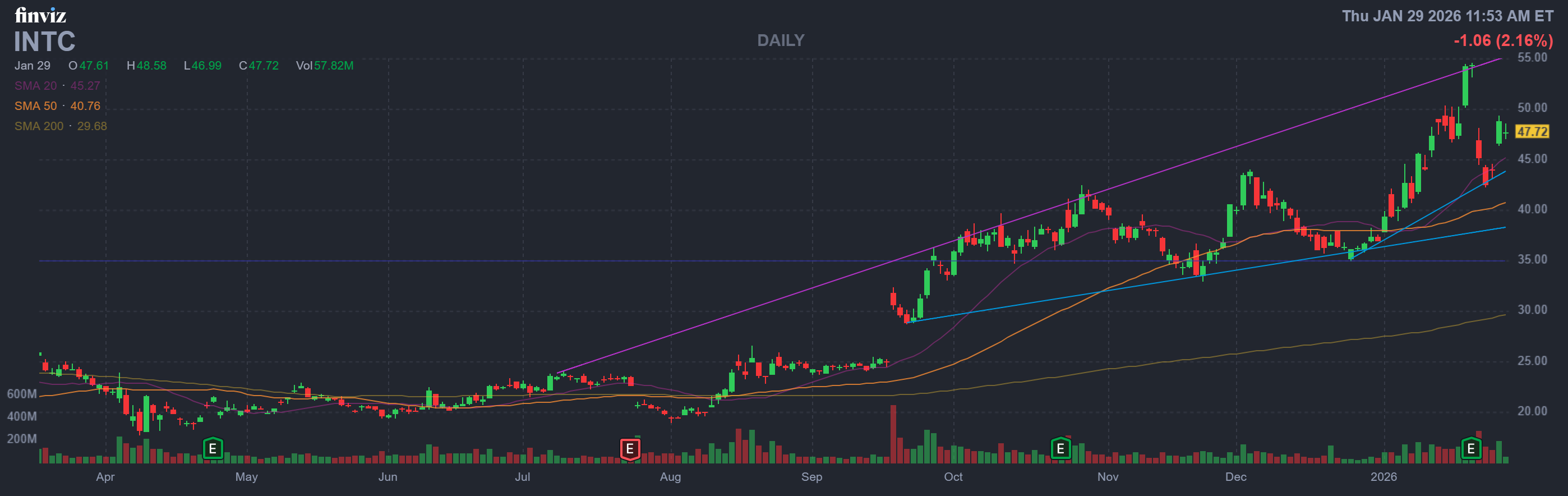
Name: David Zinsner
Position: Chairman
Transaction Date: 01-26-2026 Shares Bought: 5,882 shares an average price paid of $42.50 for Cost: $249,985
Company: Intel Corp. (INTC)
Intel Corporation designs, develops, manufactures, markets, sells, and provides computers and related end products and services in the United States, Ireland, Israel, and worldwide. The company provides client computing group products, including client and commercial CPUs, discrete client GPUs, edge computing, and connectivity; data center and AI products, such as server CPUs, discrete GPUs, and networking; and semiconductors, including wafer fabrication, substrates, and other related products and services. It also offers driving assistance and self-driving technologies, as well as the development and manufacture of multi-beam mask writing instruments. The company’s products are sold through sales organizations, distributors, resellers, retailers, and OEM partners. Intel Corporation was established in 1968 and is based in Santa Clara, California.
David Zinsner has been the executive vice president and chief financial officer of Intel Corporation since January 2022. He oversees Intel’s global finance operation, which includes finance, accounting and reporting, tax, treasury, internal audit, and investor relations. Zinsner formerly worked as president and chief operating officer at Affirmed Networks. He was also the senior vice president and chief financial officer of Analog Devices and Intersil Corp. He earned a master’s degree in business administration, finance, and accounting from Vanderbilt University and a bachelor’s degree in industrial management from Carnegie Mellon University.
Insomniac Hedge Fund Guy Opinion: Intel’s legacy scale and new capital injections make it intriguing, but the moat’s eroded, the strategic pivot is execution-dependent, and valuation leaves scant cushion. This isn’t a clean, recurring-revenue story — it’s a turnaround that could reward patience but has punished timing. Valuation feels fair-to-expensive relative to risk; only massive manufacturing execution and AI traction justify heavy positioning. Not financial advice — but don’t bet the farm on flawless execution.
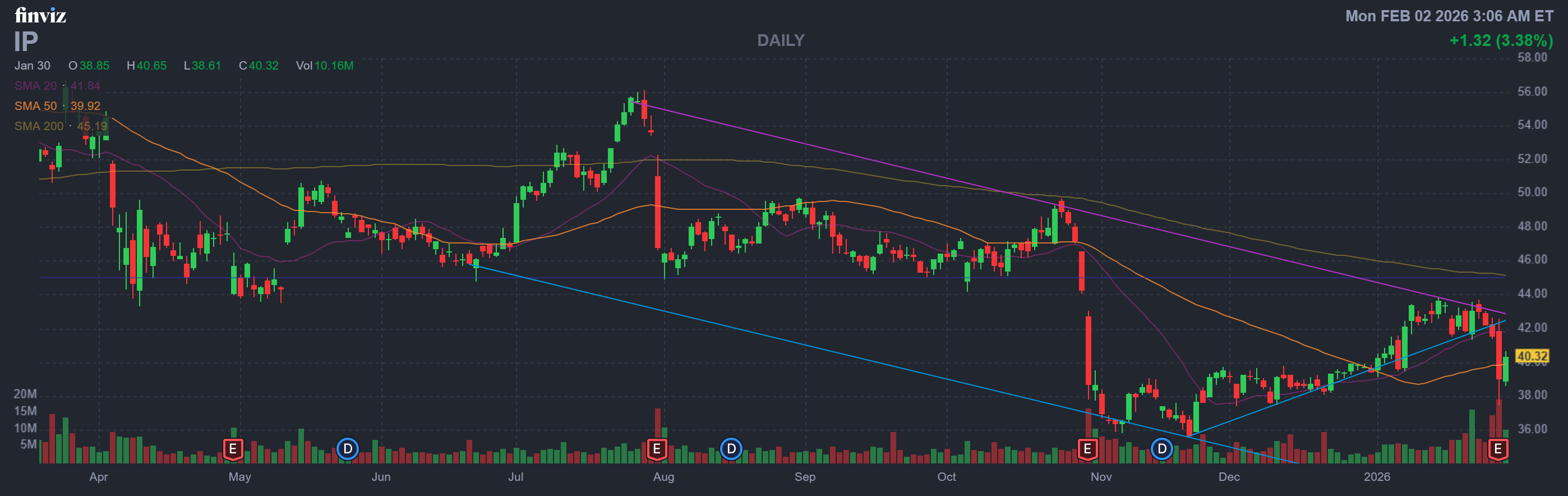
Name: Andrew K. Silvernail
Position: Chief Executive Officer
Transaction Date: 01-30-2026 Shares Bought: 50,000 shares an average price paid of $39.98 for a cost of $1,998,965
Company: International Paper Co. (IP)
International Paper Company manufactures and sells renewable fiber-based packaging and pulp products throughout North America, Latin America, Europe, and North Africa. It operates in two segments: industrial packaging and global cellulose fibers. The company sells linerboard, medium, whitetop, recycled linerboard, recycled medium, and saturating kraft, as well as pulp for a variety of applications, including diapers, towel and tissue products, feminine care, incontinence, and other personal care products, as well as specialty pulps for use in textiles, construction materials, paints, coatings, and other industries. The company offers its products directly to consumers and converters, as well as through agents, resellers, and distributors. The company was founded in 1898 and is based in Memphis, Tennessee.
Andrew K. Silvernail joined International Paper as Chief Executive Officer on May 1, 2024. He became chairman of the International Paper Board of Directors on October 1, 2024. Silvernail has two decades of experience leading global companies in the manufacturing and technology sectors. He joins IP from KKR & Co., Inc., an international investment firm, where he served as an executive advisor. Silvernail served as the chairman and CEO of Madison Industries, one of the world’s largest privately held companies. Silvernail earned a bachelor’s degree in government from Dartmouth College and an MBA from Harvard Business School.
Insomniac Hedge Fund Guy Opinion: International Paper is a real industrial giant with structural scale benefits but painfully exposed to cyclical demand and execution risk. The recent strategic pivot — splitting businesses and lean ops — suggests management knows the pressure points. The insider buy and heavy institutional holdings counterbalance some bearish noise, but shorts are telling you the market sees risk before reward. A DCF tilt into undervaluation exists, but the story isn’t smooth: margins, integration drags, and macro softness are real. This isn’t a growth moat — it’s an operational moat with rust. The valuation looks discounted relative to intrinsic assumptions, yet only tactical value investors with patience for cyclical disruption should consider nibbling. Not financial advice — just hard data and candid logic.
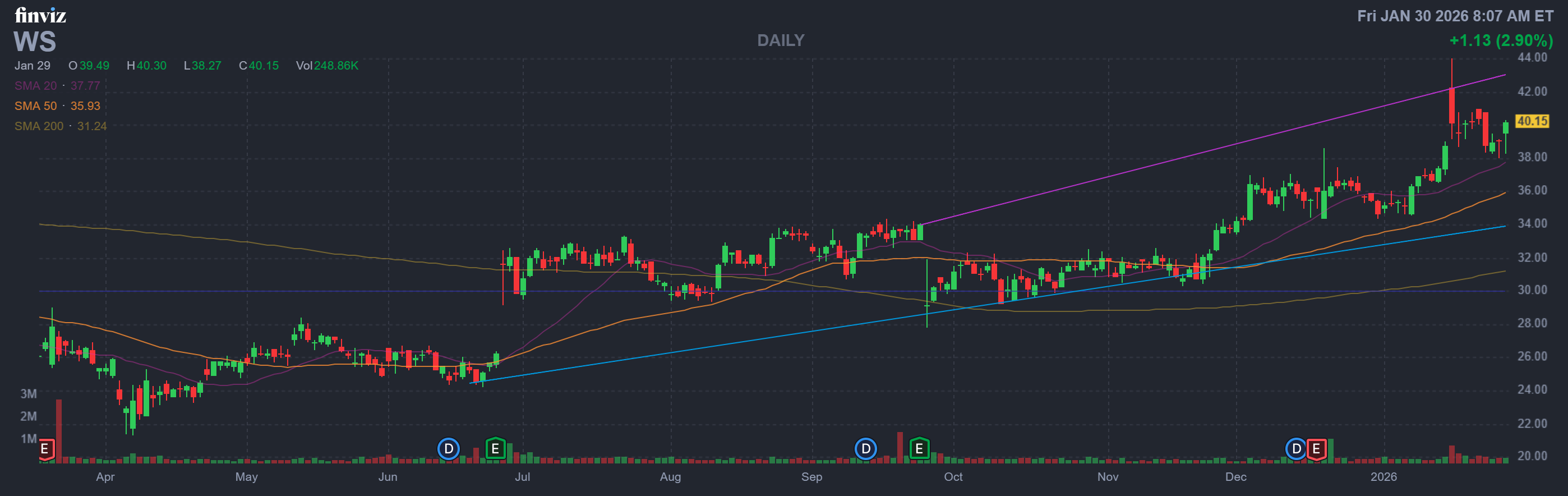
Name: Scott J. Kelly
Position: Director
Transaction Date: 01-27-2026 Shares Bought: 7000 shares an average price paid of $39.11 for a cost of $273,769
Company: Worthington Steel Inc. (WS)
Worthington Steel, Inc. is a publicly listed American steel processing firm that specializes in carbon flat-rolled steel processing, electrical steel laminations, and custom welded solutions for industries such as automotive, construction, energy, and agriculture. It purchases steel from mills and customizes it to specified dimensions and surface properties, adding value with services like pickling, galvanizing, and precision cutting. The company is known for its people-first ethic and commitment to sustainable innovation, and it has operations throughout North America and abroad. Worthington Steel was formed on June 3, 1955, by John H. McConnell and is situated in Columbus, Ohio.
John Paulson joined International Tower Hill Mines Ltd., in 2013, as a director. He then became Chairman, offering strategic oversight and long-term guidance as the company expanded its gold exploration and development operations in Alaska. Paulson’s investment-focused leadership has had a significant impact on THM’s business strategy and governance. He is well-known for his methodical, value-oriented approach to investing in commodities and natural resources. John Paulson received a bachelor’s degree from New York University and an MBA from Harvard Business School.
Insomniac Hedge Fund Guy Opinion: This is a cyclical industrial story masquerading as transformation. Worthington Steel’s pivot into electrical steel and EM expansion gives a glimmer of a moat, but the business is still fundamentally tied to steel pricing and OEM demand cycles. Recent revenue beats and deal chatter are fine catalysts, but you’re paying a mid-teens P/E for a company with thin margins and limited recurring revenue — not exactly a fortress valuation. Insider buying is a small positive, but shorts aren’t hiding. A conservative DCF pegs value near current levels with modest upside, not a blow-out bargain. WS is a turnaround/industrial cyclical play, not a compounding compounder. Only step in if you believe electrification and consolidation will materially lift margins long term — otherwise, markets may misprice risk more than reward. Not financial advice, just brutal markets logic.
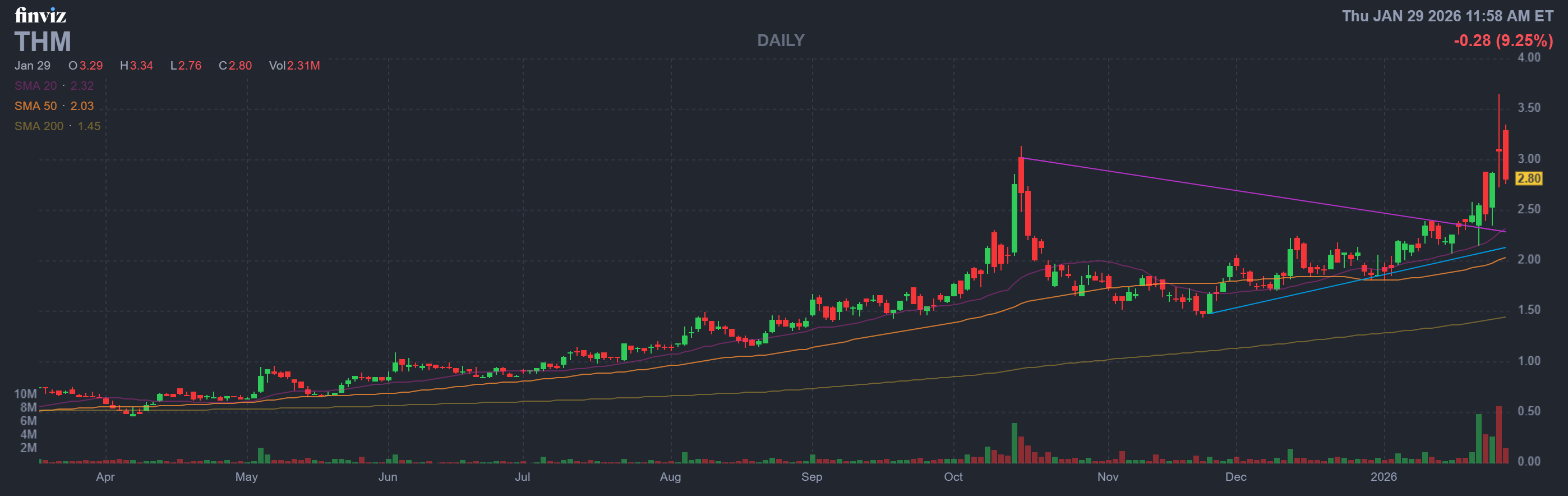
Name: John Paulson
Position: 10% Owner
Transaction Date: 01-27-2026 Shares Bought: 18,018,018 shares an average price paid of $2.22 for Cost: $40,000,000
Company: International Tower Hill Mines Ltd. (THM)
International Tower Hill Mines Ltd., a development-stage firm, acquires, explores, and develops mineral resources. The company’s activities are focused on advancing large-scale, long-term mining assets through technical research, environmental assessments, and strategic planning. Its primary focus is on the Livengood Gold Project in Alaska, a major undeveloped gold resource with long-term development potential. The company’s goal is to produce long-term value through focused exploration and project advancement. The company was previously known as Tower Hill Mines Ltd. before changing its name to International Tower Hill Mines Ltd. in March 1991. International Tower Hill Mines Ltd. was established in 1978 and is based in Vancouver, Canada.
John Paulson joined International Tower Hill Mines Ltd., in 2013, as a director. He then became Chairman, offering strategic oversight and long-term guidance as the company expanded its gold exploration and development operations in Alaska. Paulson’s investment-focused leadership has had a significant impact on THM’s business strategy and governance. He is well-known for his methodical, value-oriented approach to investing in commodities and natural resources. John Paulson received a bachelor’s degree from New York University and an MBA from Harvard Business School.
Insomniac Hedge Fund Guy Opinion: John Paulson (Paulson & Co.) is the controlling shareholder of THM. He owns ~35–40% of the company, depending on dilution from recent financings. This is not a passive ETF nibble. This is a high-conviction, write-the-check, influence-the-outcome position The details that matter:1. Paulson is a gold bull, not a tourist Paulson famously made billions shorting subprime in 2007–08. After that, he pivoted hard into gold as a hedge against monetary debasement. Let’s be blunt: No Paulson → no THM (or at least a very different, much weaker company
This isn’t retail-driven dilution chaos. It’s sponsored development capital. Why this matters (and where people get it wrong) The bullish interpretationPaulson is playing the long game. Livengood is a huge, low-grade, long-life gold asset. If gold prices stay structurally higher, the economics improve dramatically Optionality on gold = massive torque if the cycle turns. This is not a trade, it’s a macro bet wrapped in a miner
“The insomniac hedge fund guy” is a moniker Harvey Sax, the portfolio manager for The Insiders Fund” has used from time to time on email, blog ,and social media posts. While Mr. Sax is the portfolio manager of The Insiders Fund, these posts are not communications from, nor endorsed by, Alpha Wealth Funds, LLC or any of its managed funds. References to Alpha Wealth Funds or its affiliates are for identification only and do not imply sponsorship or approval.
The Insiders Fund and its blogs and posts are not affiliated with, endorsed by, or sponsored by any of the companies mentioned herein. All company names, logos, and trademarks belong to their respective owners. The use of company logos is solely for descriptive and illustrative purposes under fair use. Any information provided is based on publicly available data and should not be considered financial, investment, or legal advice. Readers should conduct their own research or consult with a professional before making any investment decisions. Insiders sell the stock for many reasons, but they generally buy for just one – to make money. You’ve always heard the best information is inside information. Everyone with any stock market experience pays close attention to what insiders are doing. After all, who knows a business better than the people running it? Officers, directors, and 10% owners are required to inform the public through a Form 4 Filing of any transaction, buy, sell, exercise, or any other within 48 hours of doing so.
This info is available for free from the SEC’s Web site, Edgar, although we subscribe to SECForm4 as they provide a way to manage and make sense of the vast realms of data. I’ve tried a lot of vendors. SECForm4 is one of the smaller ones, but I like supporting Frank. He is not arrogant. He’s helpful and has great prices. He also trades on his own data, so I like people that eat what they kill. The bar is different from selling because the natural state of management is to be a seller. This is because most companies provide significant amounts of management compensation packages as stock and options. Therefore, we analyze unusual patterns with selling, such as insiders selling 25 percent or more of their holdings or multiple insiders selling near 52-week lows. Another red flag is large planned sale programs that start without warning. Unfortunately, the public information disclosure requirements about these programs, referred to as Rule 10b5-1, are horrendously poor. Also, planned sales that pop up out of nowhere are basically sales and are seeking cover under this corporate welfare loophole.
I also generally ignore 10 percent shareholders as they tend to be OPM (other people’s money) and perhaps not the smart money on which we are trying to read the tea leaves. I say generally because some 10% shareholders are great investor, think Warren Buffett and others. Of course, insiders can also be wrong about their Company’s prospects. Don’t let anyone fool you into believing they never make mistakes. Do your own analysis. They can easily be wrong, and in many cases, maybe most cases, have no more idea what the future may hold than you or me. In short, you can lose money following them. We have, and we curse aloud; what were they thinking!
We like Fly on the Wall for keeping up with what events might be happening, analysts’ comments, and whatever else could be moving the stock. Dow Jones news service is an essential tool, but many services pick up their feed like they do Bloomberg. She probes the 10k for a reasonable description of the business. I’ve found that to be the most accurate and succinct place to find out what a business actually does. When I have time, over the weekend, I’ll add some preliminary analysis to the Opinion at the end. It is largely done now by my AI. Sometimes I won’t update this for a couple of weeks or more. A good way to use this blog is as I do, it’s a reference point and filing cabinet for various stocks with notable insider buying. It’s one of many tools I use.