Insider Buying Week 01-02-26

Whatever I write up here stands the chance of being obsolete by the weekend with Limelightin lovin Trump.  But when the headlines die down and you drift back to the business logic, it’s insiders that carry the water more often than not. So when the hell and furry settle, you’ll ask yourself what did Trump say that was full of sound and fury, signifying nothing, ? Go back and look at the insider trades

You can be an insider, too– by clicking here
Finviz Chart

Name: John Rakolta Jr. 
Position: Director
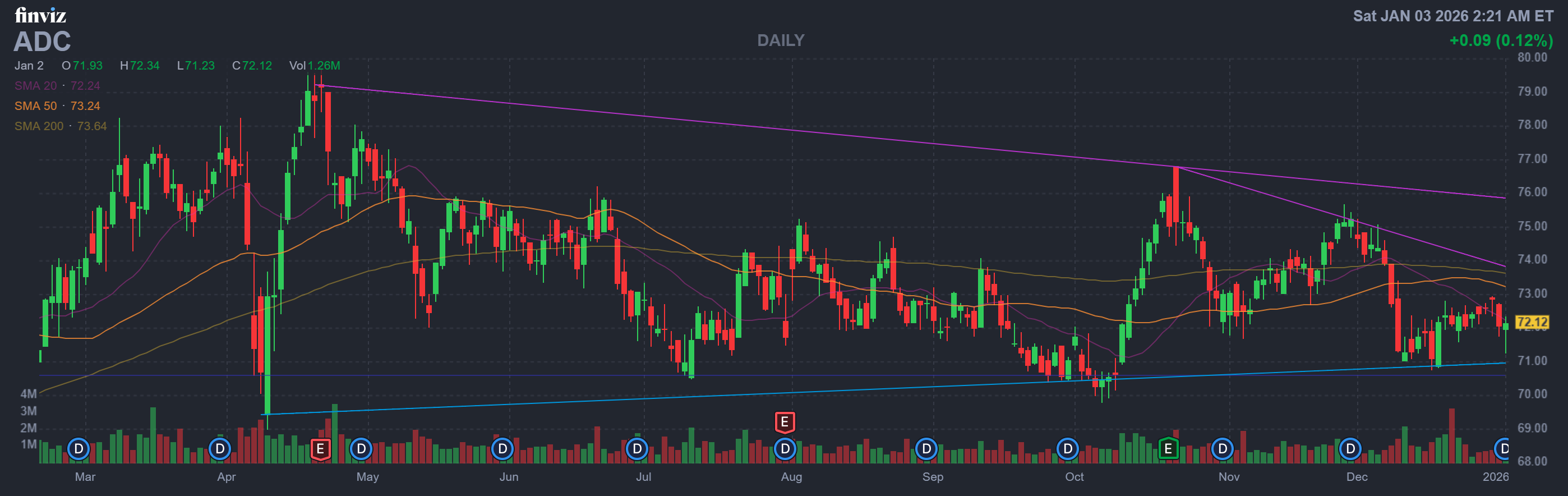
Transaction Date: 12-24-2025  Shares Bought: 15,000 shares an Average Price Paid of $72.18 for Cost: $1,082,700

Company: Agree Realty Corp. (ADC)

Agree Realty Corporation is a publicly traded real estate investment trust focused on rethinking retail by acquiring and developing net-leased buildings for industry-leading, omni-channel retail tenants. The company’s approach is built on long-term, fee-simple ownership of retail real estate and collaboration with omni-channel and necessity-based merchants to enable robust property performance. Agree Realty, based in Royal Oak, Michigan, is listed on the New York Stock Exchange. Agree Realty Corporation was founded in 1971.

John Rakolta Jr. joined Agree Realty Corp.’s Board of Directors in August 2011 and served until September 2019, when he was confirmed as the United States Ambassador to the United Arab Emirates; he was reappointed to the board effective February 22, 2021. Rakolta, a seasoned corporate executive, is the Chairman of Walbridge Construction and adds considerable leadership and governance experience to the Agree Realty board, providing strategic oversight for the net-lease retail REIT. Before his corporate and diplomatic positions, he had a lengthy career in engineering and business. John Jr. Rakolta received a Bachelor of Science in Civil Engineering from Marquette University in 1970 and later pursued executive education at Harvard Business School.

Insomniac Hedge Fund Guy Opinion: Agree Realty’s core business — long-dated net leases to investment-grade tenants — is about as close to a cash-cow as a REIT can get without being a bond fund. The recurring rent streams and near-100% occupancy erect a moat of predictability, and management’s willingness to buy stock alongside you is a genuine positive. That said, the market prices ADC like it’s a slower, steadier Realty Income with a growth overlay — leading to a rich multiple (P/E north of 40). Meanwhile, short interest creeping near 9–10% shows some pros aren’t convinced this rally has legs without strong AFFO acceleration or durable retail sector strength. DCF work pegs fair value in the high-60s/low-70s if you assume conservative REIT growth and an 8% discount — a tight margin of safety at current prices. ADC is a high-quality dividend engine with growth skew, but at today’s premium valuation, you’re paying extra for predictability rather than optionality — and that’s a trade every investor must consciously make. It’s not bad — just not a screaming discount. Investors should do their own due diligence. This is my take, not financial advice.

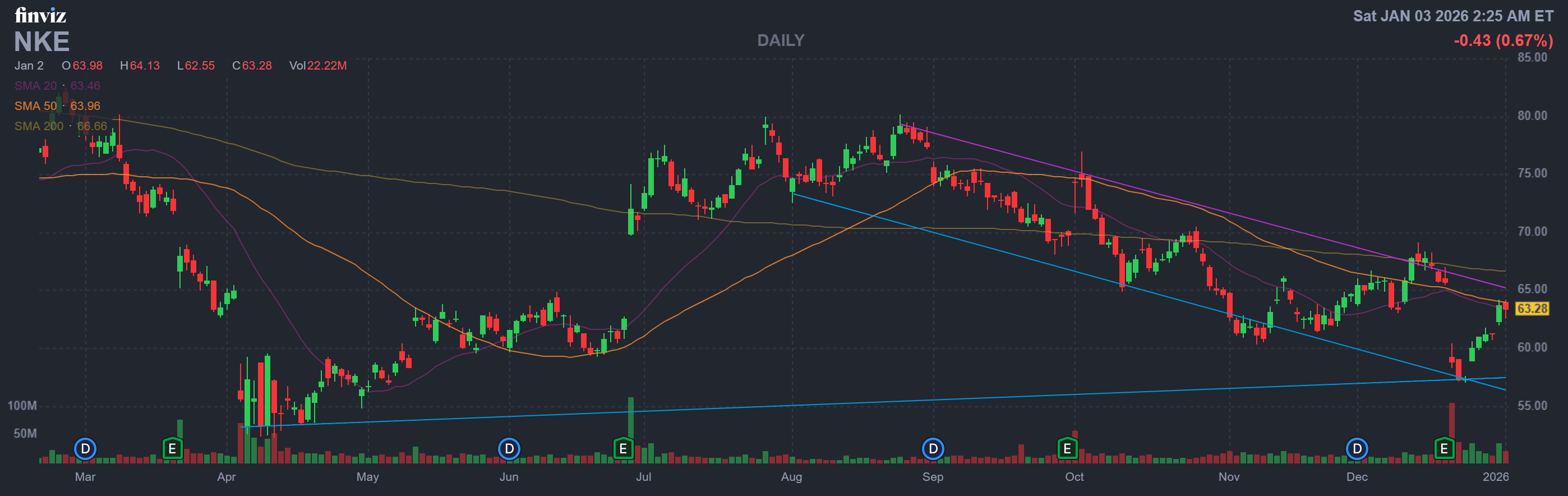
Finviz Chart

Name: Elliott Hill 
Position: President & CEO
Transaction Date: 12-29-2025  Shares Bought: 16,388 shares an Average Price Paid of $61.10 for Cost: $1,001,307

Company: NIKE Inc. (NKE)

NIKE, Inc. and its subsidiaries create, develop, market, and sell athletic and casual footwear, clothes, equipment, accessories, and services to men, women, and children across the world. The company’s operations include North America, Europe, the Middle East, Africa, Greater China, Asia Pacific, and Latin America. It sells products under the names Nike, Jordan, Jumpman, Converse, Chuck Taylor, All-Star, One Star, Star Chevron, and Jack Purcell. NIKE also offers performance equipment and accessories, branded apparel, and digital consumer experiences, including fitness applications and sport-specific content. The corporation was previously known as Blue Ribbon Sports, Inc., before changing its name to NIKE, Inc., in May 1971. Nike, Inc. was founded in 1964 and is based in Beaverton, Oregon.

Elliott Hill has been Nike, Inc.’s president and CEO since October 2024. He is an inspiring leader with a strong entrepreneurial drive, a profound understanding of the consumer and Nike culture, and a tremendous passion for Nike’s brand portfolio. Before retiring in 2020, he was Nike and Jordan Brand’s President of Consumer and Marketplace, where he oversaw all commercial and marketing operations, including the company’s profit and loss statement across four geographies. He began his work as an assistant athletic trainer with the Dallas Cowboys before joining Nike. He graduated with a bachelor’s degree in kinesiology from Texas Christian University and a master’s degree in sports management from Ohio University.

Insomniac Hedge Fund Guy Opinion: Nike still has one of the most powerful brand moats in consumer goods — but brand alone doesn’t guarantee sustained growth. Structural headwinds (tariffs, China, discounting) have pressured margins and top-line momentum, and the absence of true recurring revenue metrics or retention data typical of SaaS leaves Nike reliant on lifestyle cycles and trend relevance. Insider buys by Hill and board members are intriguing as signals of confidence, not gospel. The recent stock weakness reflects real operational challenges, and a conservative DCF implies limited valuation cushion. This is not a “buy and forget” situation — execution matters for Nike’s turnaround, and until margins stabilize and growth re-accelerates, the odds favor valuation multiple compression over expansion. Not financial advice — just one sharp market mind’s take. For my  lunchroom change, I’d rather own Deckers, with their innovative brand recyclizing, Uggs, Hokkas,Teva, Hey Joe, and others.  Its always been a trendy businessnd only aims to get more so.

Finviz Chart

Name: John R. Rutherford
Position: Director
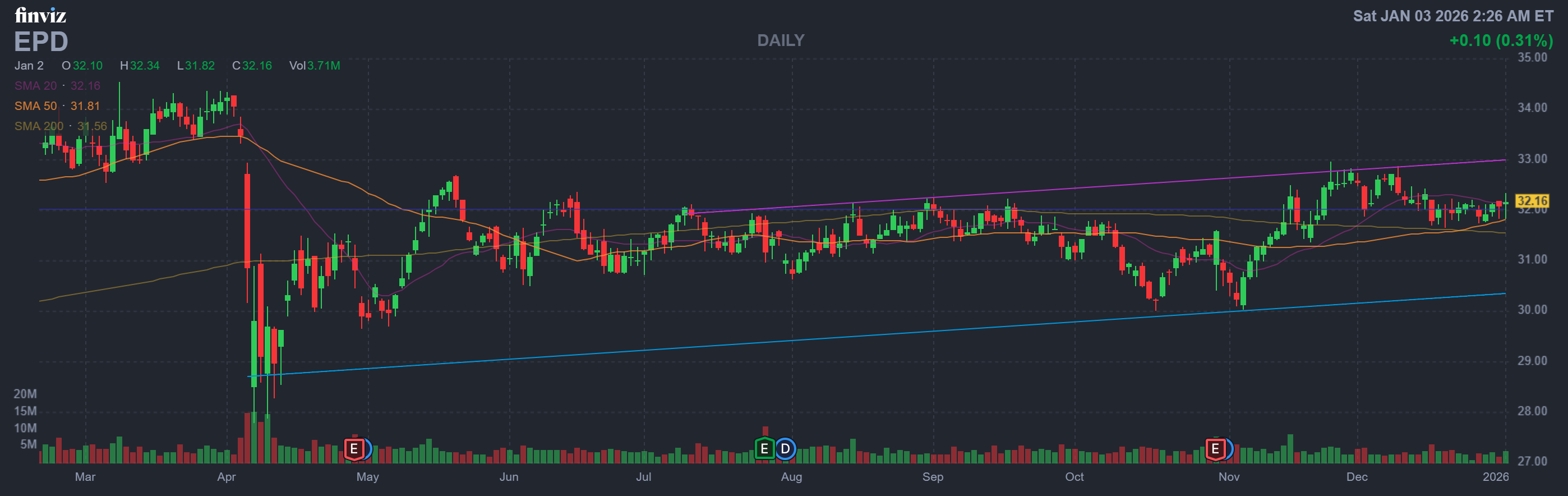
Transaction Date: 12-29-2025  Shares Bought: 15,000 shares an Average Price Paid of $32.09 for Cost: $481,334

Company: Enterprise Products Partners L.P. (EPD)

Enterprise Products Partners L.P. offers midstream energy services to producers and consumers of natural gas, natural gas liquids, crude oil, petrochemicals, and refined products. The company operates in four segments: NGL Pipelines & Services, Crude Oil Pipelines & Services, Natural Gas Pipelines & Services, and Petrochemical & Refined Products Services. It operates natural gas processing plants, large pipeline networks, fractionation facilities, storage caverns, maritime terminals, and transportation assets. Enterprise also participates in related marketing operations and refined product transportation. Enterprise Products Partners L.P. was founded in 1968 and is based in Houston, Texas. 

John R. Rutherford has served as an independent director of Enterprise Products Partners L.P. since December 31, 2018, when he joined the company’s board. He brings substantial experience in energy and finance. Before joining the EPD board, he held top positions in the oil sector, including executive vice president at Plains All American Pipeline and senior roles in investment banking. As a member of Enterprise’s General Partner Board of Directors, he contributes to governance and strategic oversight. He received his undergraduate degree from the University of Texas in Austin and an MBA from the University of Pennsylvania’s Wharton School.

Insomniac Hedge Fund Guy Opinion: EPD isn’t a rocket-ship growth story — it’s a cash-generating, wide-moat cash machine with predictable distributions and structural advantages. The partnership’s disciplined DCF growth and strong coverage ratios underscore resilience even in softer commodity environments. Recent insider buying hints management’s belief that the market is underpricing stable cash flows and yield in a low-growth sector. For income-oriented, valuation-aware market mavericks, EPD offers compelling risk-adjusted returns if you’re comfortable with energy midstream cyclicality and capex normalization risk. The valuation discount stores real optionality — but don’t expect explosive growth. This is stability with yield, not moonshots. Not investment advice — just a hardened market vet’s take. None of the pipeline companies act right to  me. They say they are largely insulated to the price of the underlying commodity with take or pay contracts yet they seem more sensitive to the costs of oil and gas than they should be.

Finviz Chart

Name: Thomas Burt
Position: Director
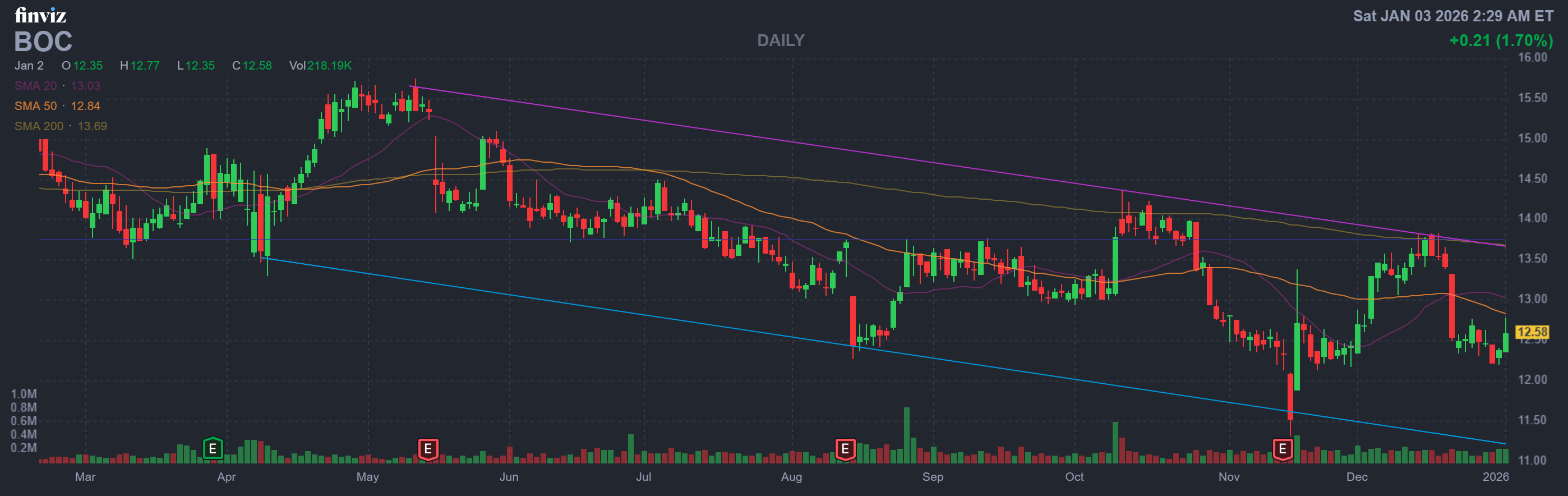
Transaction Date: 12-11-2025  Shares Bought: 14,738 shares an Average Price Paid of $13.62 for Cost: $200,792

Name: Frank H. Kenan II 
Position: Director
Transaction Date: 12-11-2025  Shares Bought: 79,887 shares an Average Price Paid of $12.75 for Cost: $1,018,792

Company: Boston Omaha Corp. (BOC)

Boston Omaha Corporation is a diverse holding company with subsidiaries in a variety of business fields. Its core activities involve outdoor billboard advertising in the southeastern United States, which is mostly carried out through Link Media Holdings, LLC. Through General Indemnity Group, LLC, the company also provides surety insurance and related brokerage services. Boston Omaha Corporation also has interests in internet services through Boston Omaha Internet, LLC, as well as investment and asset management through Boston Omaha Asset Management. Boston Omaha Corp. was founded in 2017 and is based in Omaha, Nebraska. 

Thomas Burt joined Boston Omaha Corporation as an independent director in September 2024, marking his first formal role with the company at that time. In this capacity, he serves on key oversight committees, including the Compensation Committee and the Nominating and Corporate Governance Committee, contributing his extensive executive experience to Boston Omaha’s strategic governance. Before his directorship, Burt built a long career in business leadership and operations, notably as president and CEO of Election Systems & Software, a role he has held since joining that firm in 2008. His background in senior management and services leadership underpins his value to BOC’s board. Thomas Burt holds a Bachelor of Science in Business Administration from Nebraska Wesleyan University.

Frank H. Kenan II. has been on Boston Omaha Corp’s Board of Directors since June 2017. He is the co-founder and principal of KD Capital Management, LLC, which he has been since August 2014. Mr. Kenan formerly worked as an investment analyst for Boulderado Group, LLC, a development associate at Edens & Avant, and an analyst at Vivum Group. He also serves on the Board of Directors at Flagler Systems, Inc. He also serves as a board adviser for UNC’s Kenan-Flagler Business School and Family Enterprise Center. Mr. Kenan has a B.S. from the College of Charleston and a Master of Business Administration from the University of North Carolina at Chapel Hill.

Insomniac Hedge Fund Guy Opinion: Boston Omaha is not your typical growth juggernaut — it’s a diversified industrial compounder with real recurring businesses glossed by a history of losses and valuation skepticism. The moat is asset-anchored rather than tech-powered, and profitability lags seasoned peers. Insider buys signal confidence; short interest shows doubt. Current pricing likely discounts execution risk and capital intensity. If you’re buying, you’re banking on disciplined broadband scaling and insurance margin improvement — not overnight fireworks. Not financial advice — just the sharp side of market reality.


If you are a QUALIFIED INVESTOR and are interested in learning how you can be part of the Insiders Fund, schedule some time with me here.

This blog is solely for educational purposes and the author’s own amusement. IT IS NOT INVESTMENT ADVICE.  Think of the blog as part of my personal investment journal that I am willing to share with the DIY investor. There are also many parts that I am not willing to share if I think it could influence trading action or be detrimental to the Fund’s partners. We could be long, short, or have no position at all in any of the stocks mentioned and express no written or implied obligation to disclose any of that.  Nothing contained here constitutes a recommendation to buy or sell any security. Investing involves risk, including the possible loss of principal, and past performance is not indicative of future results.

“The insomniac hedge fund guy” is a moniker Harvey Sax, the portfolio manager for The Insiders Fund” has used from time to time on email, blog ,and social media posts. While Mr. Sax is the portfolio manager of The Insiders Fund, these posts are not communications from, nor endorsed by, Alpha Wealth Funds, LLC or any of its managed funds. References to Alpha Wealth Funds or its affiliates are for identification only and do not imply sponsorship or approval.

The Insiders Fund and its blogs and posts are not affiliated with, endorsed by, or sponsored by any of the companies mentioned herein. All company names, logos, and trademarks belong to their respective owners. The use of company logos is solely for descriptive and illustrative purposes under fair use.  Any information provided is based on publicly available data and should not be considered financial, investment, or legal advice. Readers should conduct their own research or consult with a professional before making any investment decisions. Insiders sell the stock for many reasons, but they generally buy for just one – to make money. You’ve always heard the best information is inside information.  Everyone with any stock market experience pays close attention to what insiders are doing.  After all, who knows a business better than the people running it?  Officers, directors, and 10% owners are required to inform the public through a Form 4 Filing of any transaction, buy, sell, exercise, or any other within 48 hours of doing so.

This info is available for free from the SEC’s Web site, Edgar, although we subscribe to SECForm4  as they provide a way to manage and make sense of the vast realms of data. I’ve tried a lot of vendors. SECForm4 is one of the smaller ones, but I like supporting Frank. He is not arrogant. He’s helpful and has great prices. He also trades on his own data, so I like people that eat what they kill. The bar is different from selling because the natural state of management is to be a seller. This is because most companies provide significant amounts of management compensation packages as stock and options. Therefore, we analyze unusual patterns with selling, such as insiders selling 25 percent or more of their holdings or multiple insiders selling near 52-week lows. Another red flag is large planned sale programs that start without warning. Unfortunately, the public information disclosure requirements about these programs, referred to as Rule 10b5-1, are horrendously poor. Also, planned sales that pop up out of nowhere are basically sales and are seeking cover under this corporate welfare loophole.

I also generally ignore 10 percent shareholders as they tend to be OPM (other people’s money) and perhaps not the smart money on which we are trying to read the tea leaves. I say generally because some 10% shareholders are great investor, think Warren  Buffett and others.  Of course, insiders can also be wrong about their Company’s prospects. Don’t let anyone fool you into believing they never make mistakes.  Do your own analysis. They can easily be wrong, and in many cases, maybe most cases, have no more idea what the future may hold than you or me. In short, you can lose money following them.  We have, and we curse aloud; what were they thinking!

We like Fly on the Wall for keeping up with what events might be happening, analysts’ comments, and whatever else could be moving the stock.  Dow Jones news service is an essential tool, but many services pick up their feed like they do Bloomberg. She probes the 10k for a reasonable description of the business. I’ve found that to be the most accurate and succinct place to find out what a business actually does. When I have time, over the weekend, I’ll add some preliminary analysis to the Opinion at the end. It is largely done now by my AI. Sometimes I won’t update this for a couple of weeks or more.  A good way to use this blog is as I do, it’s a reference point and filing cabinet for various stocks with notable insider buying. It’s one of many tools I use. 

The Insiders Fund is for qualified investors and by Prospectus only. Nothing herein should be construed otherwise.  THE INSIDERS FUND prefers to invest in companies at or near prices that management has been willing to invest significant amounts of their own money in, but we have no requirement to do so. We also invest in many companies in anticipation of future insider buying or with the expectation that there is none at all.

You can be an insider, too– by clicking here
Prosperous Trading,