Name: Teyin M. Liu
Position: Director
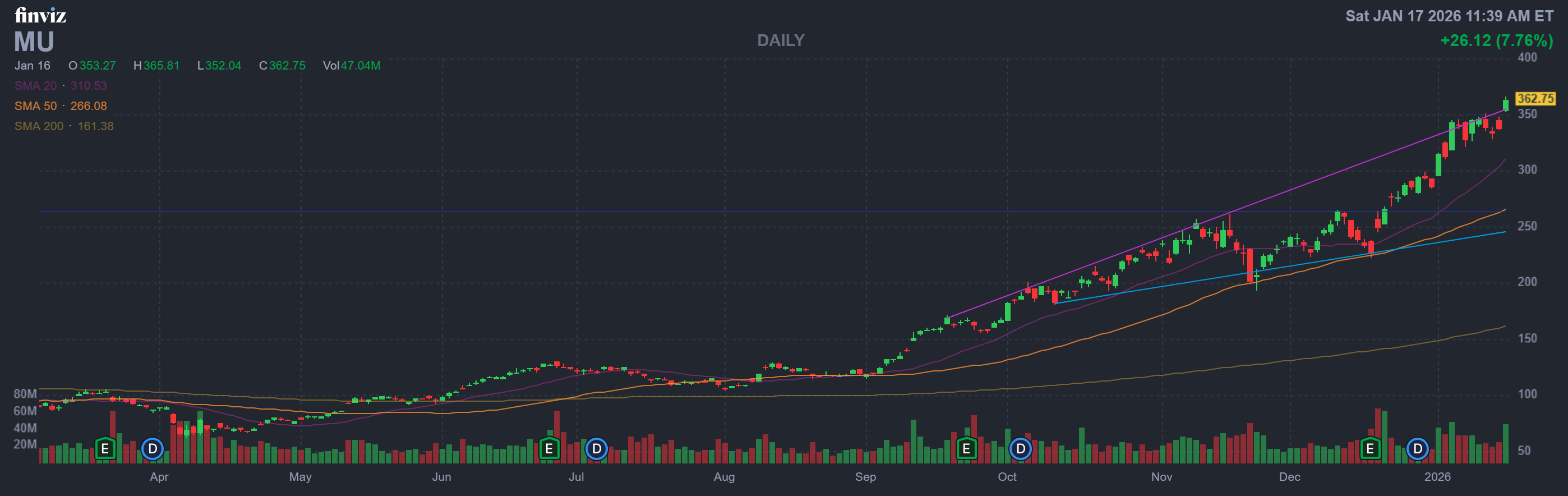
Transaction Date: 01-13-2026 Shares Bought: 23,200 shares an average price paid of $337.14 for a cost of $7,821,723
Company: Micron Technology Inc. (MU)
Micron Technology Inc. is a global provider of memory and storage solutions that operates in the United States, Asia, and other foreign markets. The corporation is divided into four segments: Cloud Memory, Core Data Center, Mobile and Client, and Automotive and Embedded Business Units. Micron provides a diverse portfolio of memory products, including DRAM components and modules, LPDDR, graphics and high-bandwidth memory, CXL-based solutions, and breakthrough NAND and DRAM technologies. Its storage offerings include data center, client, automotive, and industrial solid-state drives, as well as NAND, NOR flash, and memory cards. Micron serves the data center, PC, mobile, automotive, industrial, networking, and consumer embedded sectors. Micron Technology Inc. was founded in 1978 and is headquartered in Boise, Idaho.
Teyin M. Liu has been a director of Micron Technology, Inc. since March 5, 2025, when the company extended its board and appointed him an independent director. Before joining the Micron board, Liu had a lengthy managerial career in the semiconductor sector, most notably serving as executive chairman of Taiwan Semiconductor Manufacturing Company until his retirement in June 2024. At Micron, he serves as an independent director on the governance and finance committees. Teyin M. Liu holds advanced engineering degrees, including a bachelor’s in electrical engineering from National Taiwan University and master’s and doctoral degrees in electrical engineering and computer science from the University of California.
Insomniac Hedge Fund Guy Opinion: Micron’s transformation from commodity cyclical dud to a linchpin of the AI memory ecosystem is one of the most under-appreciated structural shifts of this cycle. The company now commands pricing power in DRAM & HBM markets that were historically brutal on margins — and that’s why its financials have ripped higher. But let’s be blunt: memory is still memory — cyclical, capex-hungry, and easily oversupplied if capex catches up. Yes, insiders buying at strength is bullish psychology, but MU’s valuation embeds peak AI demand forever more than it does realistic downturns. The best risk-adjusted view here isn’t a blow-out long — it’s selective exposure with tight risk controls. Micron is a supercycle beneficiary, but a cyclical believer’s nightmare if AI demand plateaus or competition heats up. Not advice — a sharp, pragmatic take.
Name: Michael George Rhodes
Position: Chief Executive Officer
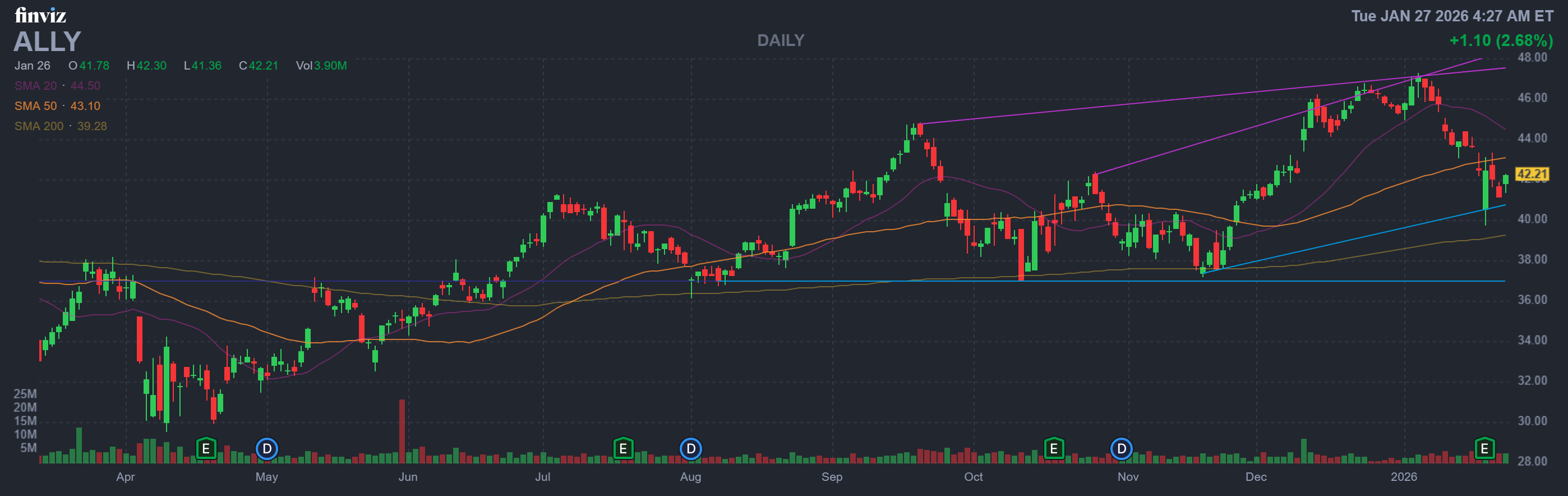
Transaction Date: 01-23-2026 Shares Bought: 23,800 shares an average price paid of $41.68 for Cost: $991,867
Company: Ally Financial Inc. (ALLY)
Ally Financial Inc., a digital financial services firm, offers a variety of digital financial products and services in the United States, Canada, and Bermuda. The company operates in four segments: Automotive Finance Operations, Insurance Operations, Corporate Finance Operations, and Corporate and Other. The company also offers consumer finance and insurance products through the car dealer channel, as well as commercial insurance directly to dealers. Furthermore, the company offers commercial banking products and services, as well as stock brokerage and investment advisory services. The company was previously known as GMAC Inc. before changing its name to Ally Financial Inc. in May 2010. Ally Financial Inc. was formed in 1919 and is headquartered in Detroit, Michigan.
Michael George Rhodes joined Ally Financial Inc. in April 2024, assuming the role of Chief Executive Officer on April 29, 2024, and was subsequently appointed to the company’s board of directors. He has more than 25 years of expertise in retail and consumer banking, having previously served as CEO and President of Discover Financial Services, as well as key leadership positions at TD Bank, Bank of America, and MBNA America Bank. His leadership experience has included driving digital transformation, developing technological strategies, and implementing operational innovations at large financial organizations. He earned a Bachelor of Science in Engineering from Duke University and later completed a Master of Business Administration from the Wharton School of the University of Pennsylvania, building a strong academic foundation for executive leadership.
Insomniac Hedge Fund Guy Opinion: Ally is a classic digital-bank turnaround story with legitimate structural advantages in low-cost deposits and one of America’s biggest auto finance platforms. But let’s be real: its moat isn’t unassailable — fintech rivals and legacy banks with branch networks still crowd its turf on both pricing and customer acquisition. Recent insider buying by CEO Rhodes underscores management’s belief that the risk/reward is tilted toward a rebound, not a breakdown. Yet conservative DCF work still points to valuation pricing in a pretty rosy credit and yield curve backdrop, leaving slim margin for error. Cyclicality in auto loans, balance sheet repositioning losses, and regulatory drag keep this more value-recovery trade than a breakout growth story. Financials peers often sport stronger scale or differentiated tech plays, meaning Ally’s future performance boils down to credit stabilization and digital execution. In 250 words or less: solid business, narrow moat, decent insider signal — but valuation and execution risk can bite hard in a slower economy. Not financial advice — just the sharp edge of market reality.
Name: Eric Sprott
Position: 10% Owner
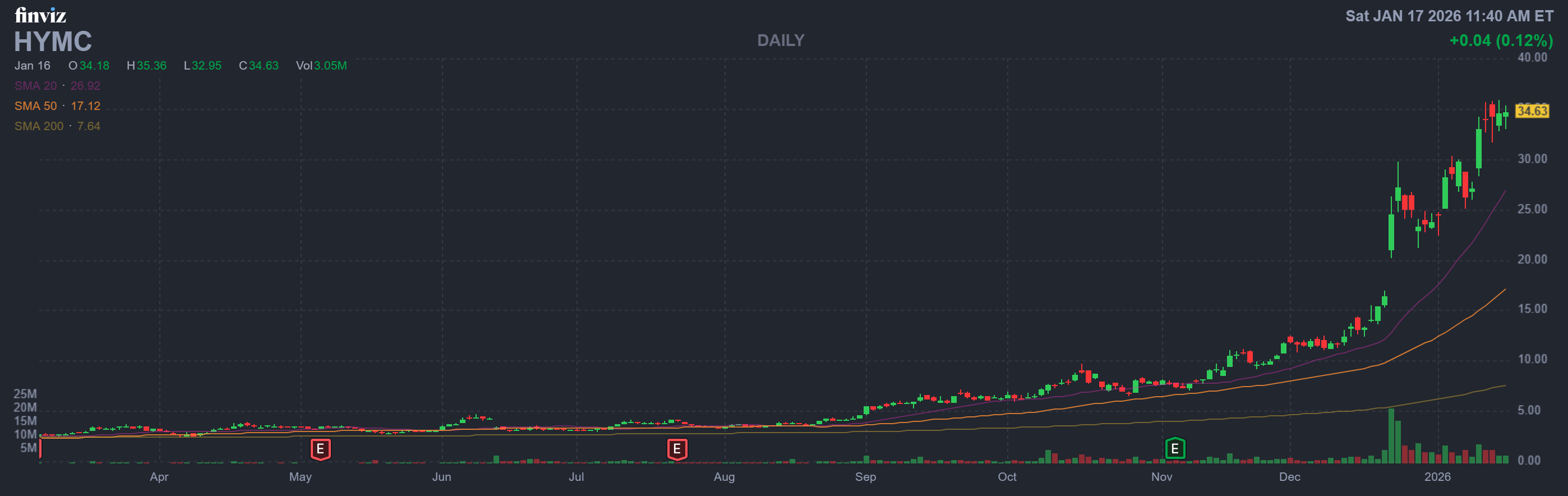
Transaction Date: 01-14-2026 Shares Bought: 200,000 shares an average price paid of $33.21 for Cost: $6,642,000
Company: Hycroft Mining Holding Corp. (HYMC)
Hycroft Mining Holding Corp. is a gold and silver exploration and development business established in the United States. Its primary focus is on expanding the Hycroft Mine, one of the world’s largest precious metals resources located in northern Nevada’s Tier-1 mining jurisdiction. The company’s current strategy focuses on technical research, exploration drilling, and converting the asset to eventual commercial operations while maximizing high-grade gold and silver potential throughout its vast land holdings. Hycroft is publicly traded on the NASDAQ under the symbol HYMC and employs a team to drive research and development initiatives at the site. Hycroft Mining Holding Corp. was founded through its company combination and incorporation in 2017 and took on the name Hycroft Mining Holding Corporation on May 29, 2020.
Eric Sprott has been an owner of Hycroft Mining Holding Corp. (HYMC) since March 2022, when he made a significant equity investment that established him as one of the company’s largest shareholders. He became associated with Hycroft at that time as a strategic investor, supporting the company during a critical phase of its development, and has since increased his ownership through additional share purchases disclosed in regulatory filings. Sprott is not involved in day-to-day operations but is recognized for his long-standing influence as a prominent resource-sector investor. He holds a Bachelor of Commerce degree from Carleton University.
Insomniac Hedge Fund Guy Opinion: Hycroft is a story stock, not a revenue-backed producer. The narrative revolves around scale, grade discovery, and balance-sheet repair, not recurring economics. Executive moves to eliminate debt and high-profile insider buys — especially from a large precious-metals focused investor — signal confidence, but this remains a pre-production play with execution risk baked into the price. The absence of revenue or a moat beyond geology makes any valuation speculative; discounting future metal production at realistic costs often yields values materially below current market pricing unless management delivers on sulfide mill commissioning and resource conversion. For deep value oriented players, the stock has optionality, but the margin of safety is thin absent clear timelines to production and cash flow. This is a speculative resource development story first and foremost.
Name: Ryan Cohen
Position: President, CEO and Chairman
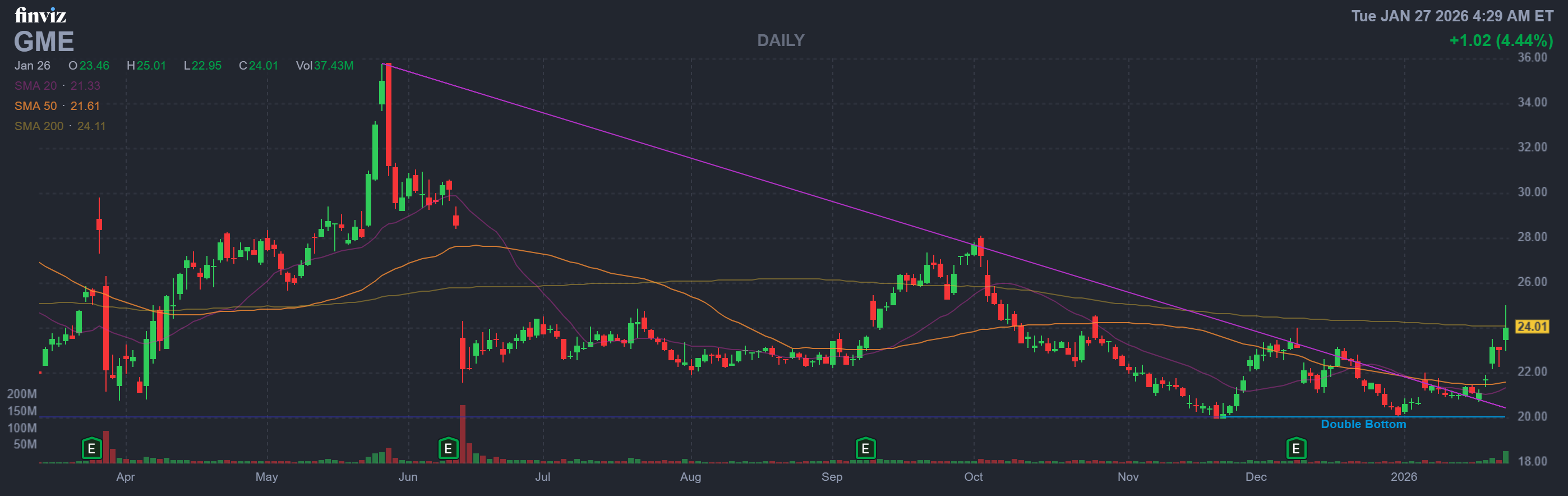
Transaction Date: 01-20-2026 Shares Bought: 1,000,000 shares an average price paid of $21.36 for Cost: $21,359,200
Company: GameStop Corp. (GME)
GameStop Corp., a specialty retailer, sells games and entertainment through physical stores and e-commerce platforms in the United States, Canada, Australia, and Europe. The company sells new and used gaming platforms, as well as accessories including controllers and gaming headsets, new and used gaming software, in-game digital currency, digital downloadable content, and full-game downloads. It sells collectibles such as clothes, toys, trading cards, gadgets, and other retail products to pop culture and technology fans. GameStop Corp., formerly GSC Holdings Corp., was formed in 1996 and is located in Grapevine, Texas.
Ryan Cohen became president, chief executive officer, and chairman of GameStop Corp. on September 28, 2023. He first joined the company in January 2021 when he was appointed to GameStop’s Board of Directors following a significant investment in the business. In June 2021, he was elevated to Chairman of the Board, where he played a key role in shaping the company’s strategic direction before assuming his current executive roles. Mr. Cohen is a self-made entrepreneur and did not pursue a formal college education, having entered business directly after high school.
Insomniac Hedge Fund Guy Opinion: GameStop’s legacy video-game retail business is in structural decline, with a multi-year revenue slide and few durable competitive advantages. Its brand and loyal base matter, but only modestly in the face of digital sandstorms from platform owners and e-commerce giants. The company’s recent profitability improvements stem largely from cost reductions, liquidity leverage, and non-core income (crypto/interest), not sustainable growth in core operations. Strong insider buying by Ryan Cohen and marquee investors like Michael Burry underscores an optionality bet: cash + collectibles + e-commerce might coalesce into a repositioned enterprise. However, short interest remains elevated, reflecting persistent skepticism about long-term fundamentals. DCF valuation under conservative assumptions suggests current share prices are priced for hero execution, not base case reality. Strengths include a massive cash cushion and virtually zero debt, but weaknesses like shrinking physical sales and thin recurring revenue undercut long-term growth. Opportunities in collectibles and digital expansion exist but are small relative to the core’s contraction, while technological threats and competitive pressure from digital platforms are existential. Without a clear recurring revenue engine or network effect, GameStop currently trades as a high-beta turnaround story with significant execution risk. It’s not a classic value play; it’s a optionality play with cash, brand, and hope priced in — and that’s a price multiple many traders are betting on, not fundamental earnings growth. (Not financial advice.)
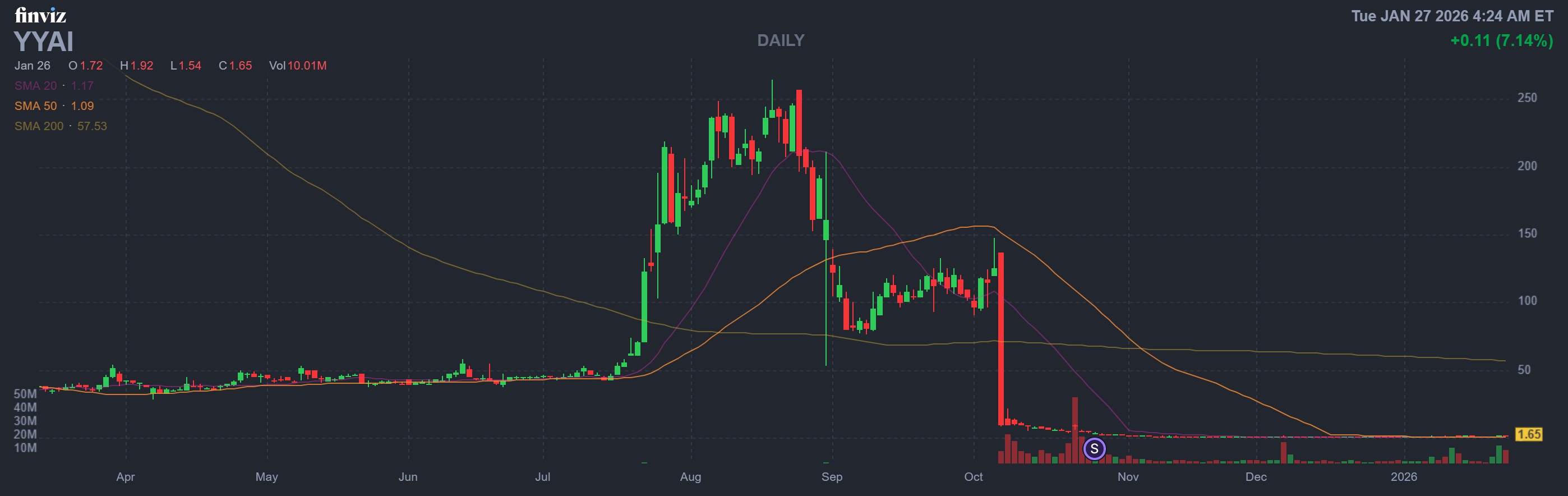
Name: Hongyu Zhou
Position: Director
Transaction Date: 01-21-2026 Shares Bought: 4,215,000 shares an average price paid of $1.37 for Cost: $5,774,550
Company: Airwa Inc. (YYAI)
AiRWA Inc. and its subsidiaries operate artificial intelligence software that provides online matchmaking and dating services throughout Hong Kong, the United States, and the United Kingdom. The company had previously been known as Connexa Sports Technologies Inc., although it changed its name to AiRWA Inc. in October 2025. AiRWA Inc. was founded in 2021 and has its headquarters in Smyrna, Delaware.
Hongyu Zhou has served as a Director of AiRWA Inc. since 2024, when he was appointed as a non independent director as part of the company’s leadership restructuring and corporate development initiatives. Since joining the board, he has remained actively involved in the company’s strategic direction and investment activities, including participation in multiple insider share acquisitions disclosed in early 2026, reflecting continued confidence in the company’s growth. Prior to joining AiRWA, he founded and managed Yuanyu Enterprise Management Co., Ltd. in 2021, where he led business operations and strategic planning. He holds a bachelor’s degree, providing a solid academic foundation for his leadership and governance roles.
Insomniac Hedge Fund Guy Opinion: Airwa’s story is all ambition, little execution. Sure, the revenue run-rate and gross margins look sporty for a penny microcap, and insider buys signal belief — but that’s the easy part. The real challenge is turning a licensing/IP + blockchain pivot into a recurring, sticky revenue engine. Today, there’s no moat, no durable net retention metric, and a business that feels more hope than traction. The stock’s valuation crater and dilution history tell you exactly how the market views execution risk: extreme. If the AiRWA Exchange somehow works within regulatory guardrails, this could surprise — but betting on that outcome is closer to venture than public equity. As a value play, there’s no margin of safety; as a speculative ticket, there’s plenty of volatility. Not financial advice — just one sharp voice saying this one’s risk-heavy, not execution-guaranteed.
__________________________________________________________________________________________________
This blog is solely for educational purposes and the author’s own amusement. IT IS NOT INVESTMENT ADVICE. Think of the blog as part of my personal investment journal that I am willing to share with the DIY investor. There are also many parts that I am not willing to share if I think it could influence trading action or be detrimental to the Fund’s partners. We could be long, short, or have no position at all in any of the stocks mentioned and express no written or implied obligation to disclose any of that. Nothing contained here constitutes a recommendation to buy or sell any security. Investing involves risk, including the possible loss of principal, and past performance is not indicative of future results.
“The insomniac hedge fund guy” is a moniker Harvey Sax, the portfolio manager for The Insiders Fund” has used from time to time on email, blog ,and social media posts. While Mr. Sax is the portfolio manager of The Insiders Fund, these posts are not communications from, nor endorsed by, Alpha Wealth Funds, LLC or any of its managed funds. References to Alpha Wealth Funds or its affiliates are for identification only and do not imply sponsorship or approval.
The Insiders Fund and its blogs and posts are not affiliated with, endorsed by, or sponsored by any of the companies mentioned herein. All company names, logos, and trademarks belong to their respective owners. The use of company logos is solely for descriptive and illustrative purposes under fair use. Any information provided is based on publicly available data and should not be considered financial, investment, or legal advice. Readers should conduct their own research or consult with a professional before making any investment decisions. Insiders sell the stock for many reasons, but they generally buy for just one – to make money. You’ve always heard the best information is inside information. Everyone with any stock market experience pays close attention to what insiders are doing. After all, who knows a business better than the people running it? Officers, directors, and 10% owners are required to inform the public through a Form 4 Filing of any transaction, buy, sell, exercise, or any other within 48 hours of doing so.
This info is available for free from the SEC’s Web site, Edgar, although we subscribe to SECForm4 as they provide a way to manage and make sense of the vast realms of data. I’ve tried a lot of vendors. SECForm4 is one of the smaller ones, but I like supporting Frank. He is not arrogant. He’s helpful and has great prices. He also trades on his own data, so I like people that eat what they kill. The bar is different from selling because the natural state of management is to be a seller. This is because most companies provide significant amounts of management compensation packages as stock and options. Therefore, we analyze unusual patterns with selling, such as insiders selling 25 percent or more of their holdings or multiple insiders selling near 52-week lows. Another red flag is large planned sale programs that start without warning. Unfortunately, the public information disclosure requirements about these programs, referred to as Rule 10b5-1, are horrendously poor. Also, planned sales that pop up out of nowhere are basically sales and are seeking cover under this corporate welfare loophole.
I also generally ignore 10 percent shareholders as they tend to be OPM (other people’s money) and perhaps not the smart money on which we are trying to read the tea leaves. I say generally because some 10% shareholders are great investor, think Warren Buffett and others. Of course, insiders can also be wrong about their Company’s prospects. Don’t let anyone fool you into believing they never make mistakes. Do your own analysis. They can easily be wrong, and in many cases, maybe most cases, have no more idea what the future may hold than you or me. In short, you can lose money following them. We have, and we curse aloud; what were they thinking!
We like Fly on the Wall for keeping up with what events might be happening, analysts’ comments, and whatever else could be moving the stock. Dow Jones news service is an essential tool, but many services pick up their feed like they do Bloomberg. She probes the 10k for a reasonable description of the business. I’ve found that to be the most accurate and succinct place to find out what a business actually does. When I have time, over the weekend, I’ll add some preliminary analysis to the Opinion at the end. It is largely done now by my AI. Sometimes I won’t update this for a couple of weeks or more. A good way to use this blog is as I do, it’s a reference point and filing cabinet for various stocks with notable insider buying. It’s one of many tools I use.